IKT453U Economics Of Natural Resources And Environment 2024-2025 Vize Soruları
20 soru · Vize · 2024-2025
IKT453U Economics Of Natural Resources And Environment dersinin 2024-2025 vize sınavı 20 sorudan oluşur; ders AÖF İktisat (İngilizce) bölümünde okutulur. Sorular aşağıda sırasıyla yer alır. Doğru cevaplar ve sonucun, testi çözdüğünde görünür.
Önizleme · 20 soru. Cevaplamak ve sonucunu görmek için sınavı başlat.
Sorular
20 soru
Soru 1
Soru 2
Soru 3
Soru 4
Soru 5
Soru 6
Soru 7
Soru 8
Soru 9
Soru 10
Soru 11
Soru 12
Soru 13
Soru 14
Soru 15
Soru 16
Soru 17
Soru 18
Soru 19
Soru 20
Sınav modunda süre tutulur, doğru cevaplar ve sonucun sınav bitince görünür.
Dersin üniteleri
IKT453U Economics Of Natural Resources And Environment ders sayfası: bütün sınavlar ve üniteler
Soruların metni (otomatik okuma)
Görsellerden otomatik okunmuştur; hata içerebilir. Sorular, görsellerdeki hâliyle geçerlidir.
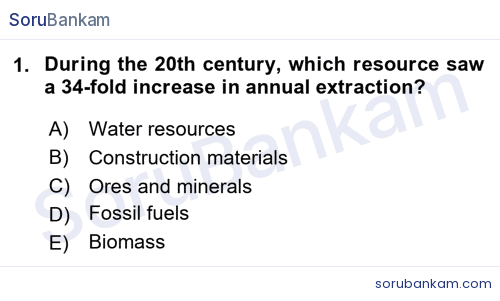
During the 20th century, which resource saw a 34-fold increase in annual extraction? A) Water resources B) Construction materials C) Ores and minerals D) Fossil fuels E) Biomass
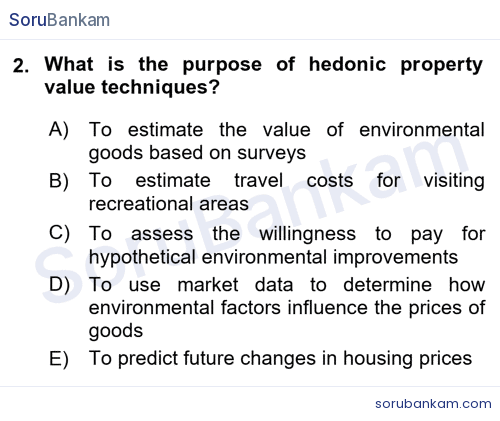
What is the purpose of hedonic property value techniques? A) To estimate the value of environmental goods based on surveys B) To estimate travel costs for visiting recreational areas C) To assess the willingness to pay for hypothetical environmental improvements D) To use market data to determine how environmental factors influence the prices of goods E) To predict future changes in housing prices
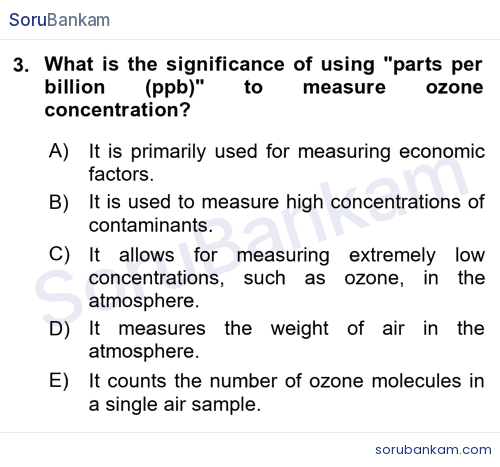
What is the significance of using "parts per billion (ppb)" measure • ozone concentration? .nt. A) It is primarily used for measuring economic factors. B) It is used to measure high concentrations of contaminants." C) It allows" for measuring" extremely low concentrations, such as ozone, in the atmosphere. D) It measures the weight of air in the atmosphere. E) It-counts the number of ozone molecules in • a single air sample.
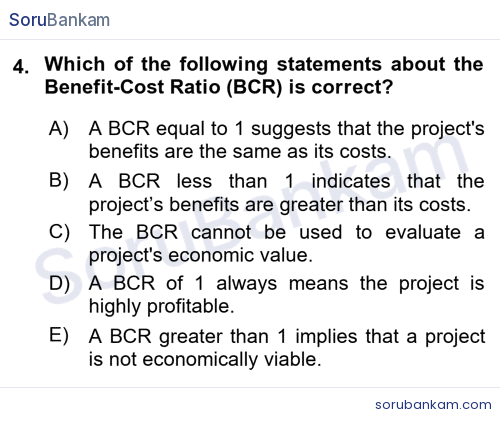
Which of the following statements about the Benefit-Cost Ratio (BCR) is correct? A) A BCR equal to 1 suggests that the project's benefits are the same as its costs. B) A BCR less than 1 indicates that. the project's benefits are greater than its costs. C) The BCR carnot be used to evaluate a projects economic value. D) A BCR of 1 always means the project is highly profitable. E) A BCR greater than 1 implies that a project is not economically viable.
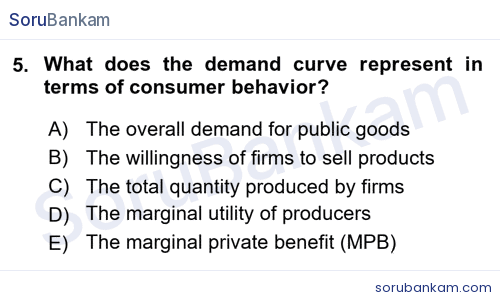
What does the demand curve represent in terms of consumer behavior? A) The overall demand for public goods B) The willingness of firms to sell products C) The total quantity produced by firms D) The marginal utility of producers E) The marginal private benefit (MPB)
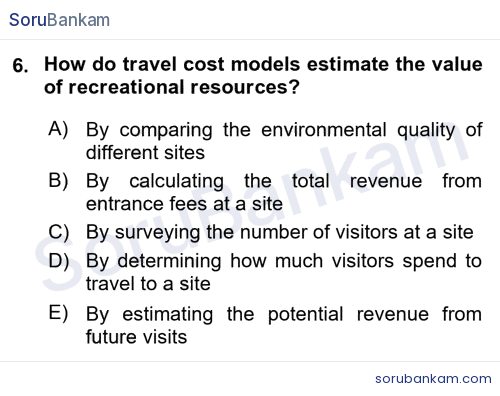
How do travel cost models estimate the value of recreational resources? A) By comparing the environméntal quality of different sites B) By calculating the total revenue from entrance fees at a site C) By surveying the number of visitors at a site D) By defermining how much visitors spend to travel to a site E) By estimating the potential revenue from future visits
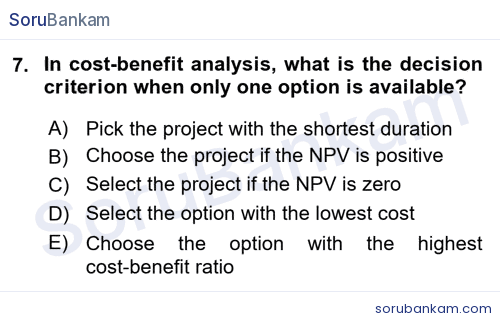
in cost-benefit analysis, what is the decision criterion when only one option is available? A) Pick the project with the shortest duration B) Choose the project if the NPV is positive C) Select the project if the NPV is zero D) Select the option with the lowest cost E) Choose the option with the highest cost-benefit ratio
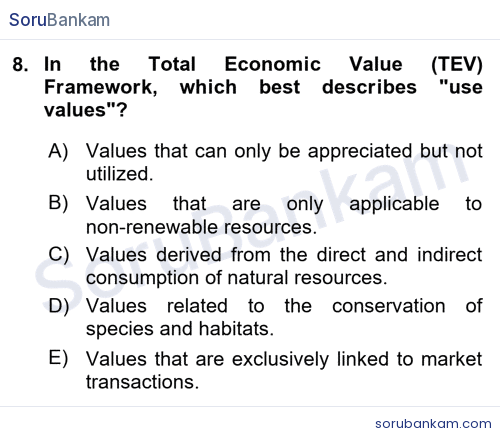
8. In the Total Economic Value (TEV) Framework, which best describes "use values"? A) Values that can only be appreciated but not utilized. B) Values i that are only applicable to non-renewable resources. C) Values derived from the direct and indirect consumption of natural resources. Values related to the conservation of species and habitats. Values that are exclusively finked to market transactions.
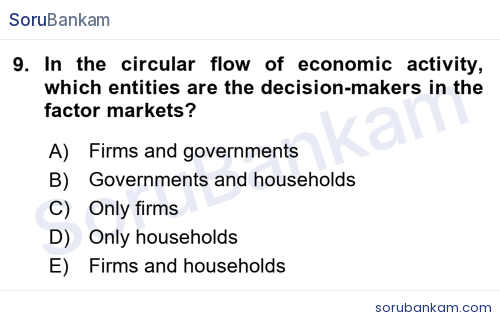
In the circular flow of economic activity, which entities are the decision-makers In the factor markets? A) Firms and govemments B) S Governments and households C) Only firms D) Only households E) Firms and households
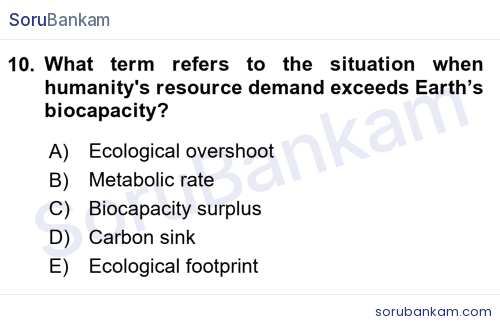
What term refers to the situation when humanity's resource demand exceeds Earth's biocapacity? A) Ecological overshoot B) Metabolic rate C) Biocapacity surplus D) Carbon sink E) Ecological footprint
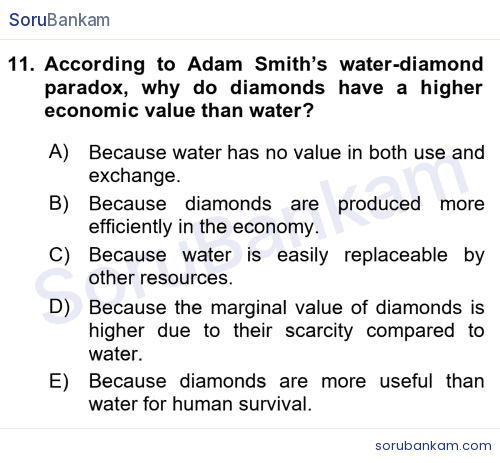
11. According to Adam Smith's water-diamond paradox, why do dlamonds have 9 higher economic value than water? auri A) Because water has no value in both use and exchange. Because diamonds are produced. more efficiently in the èconomy. C) Because "water is easily replaceable by other resources. D) Because the marginal value of diamonds is higher due to , their scarcity compared to water. E) Because diamonds are more useful than p• water for human survival.
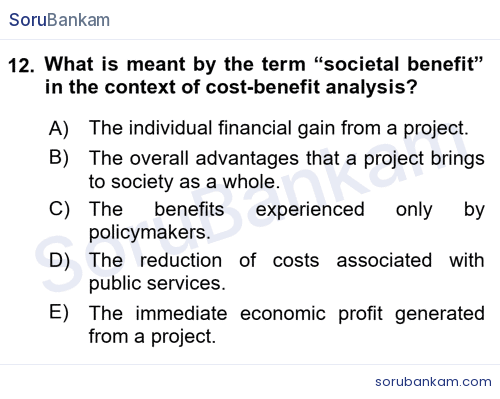
12. What is meant by the term "societal benefit" in the context of cost-benefit analysis? A) The individual financial gain from a project. B) The overall advantages that a project brings to society as a whole. C) The benefits experienced only by policymakers. D) The reduction of costs associated with public services. The immediate economic profit generated from a project.
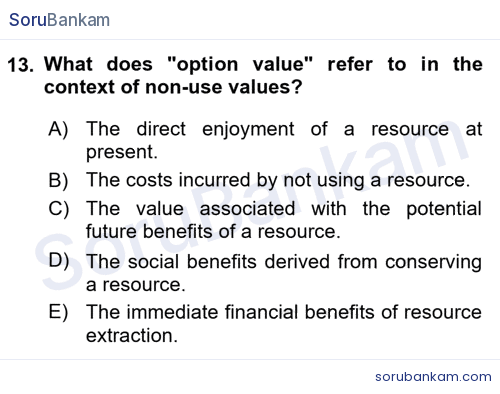
What does "option value" refer to in the context of non-use values? A) The direct enjoyment of a resource at present. B) The costs incurred by not using a resource, " C) The value associated with the potential future benefits of a resource. D) The social benefits derived from conserving a resource. E) The immediate financial benefits of resource extraction.
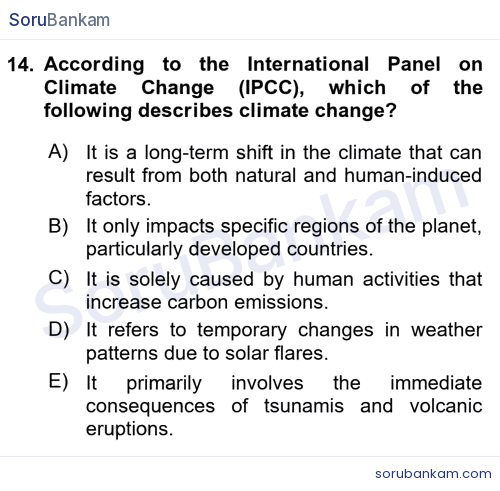
According to the International Panel on Climate Change (IPCC), which of the following describes climate change? A) Itriś à long-term shift in' the climate that can y. • result from both natural and human-induced factors. B) It only impacts specific regions of the planet, particularly developed countries. C) It is solely caused by human activities that increase carbon emissions. D) It refers to temporary changes: In weather patterns due to solar flares. E) It primarily involves the immediate consequences of tsunamis and volcanic eruptions.
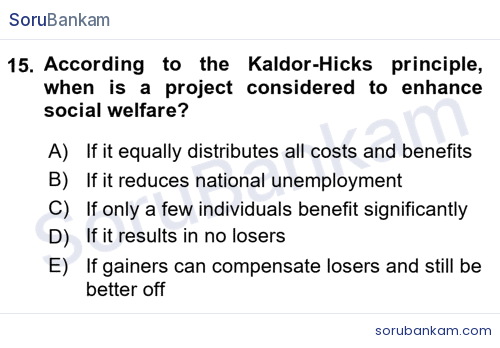
According to the Kaldor-Hicks principle, when is a project considered to enhance social welfare? A) If it equally distributes all costs and benefits B) If it reduces national unemployment C) If only a few individuals benefit significantly D) If it results in no losers E) If gainers can compensate losers and still be better off
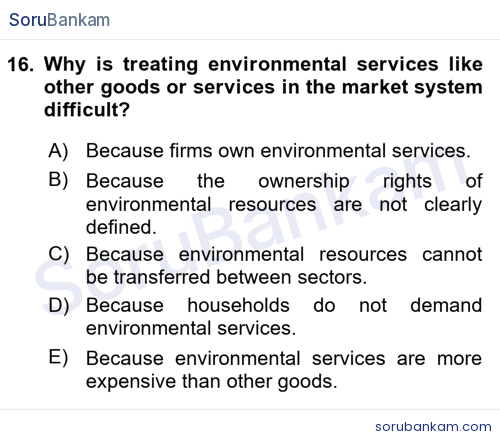
Why is treating environmental services like other goods or services in the market system difficult? A) Because firms own environmental services. B) Because the ownership rights of environmental resources are not clearly defined. C) Because environmental resources cannot be transferred between sectors. D) Because households do not demand environmental services. E) Because environmental services are more expensive than other goods.
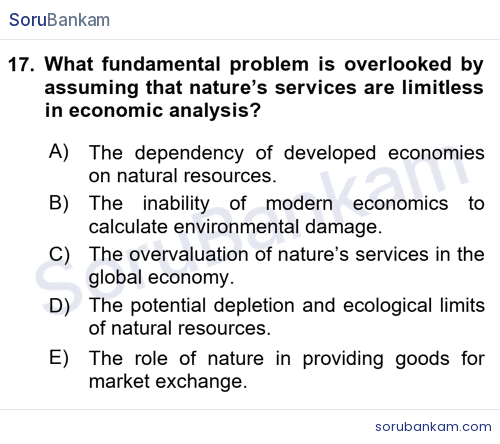
What fundamental problem is overlooked by assuming that nature's services are limitless in economic analysis? A) The dependency of developed economies on natural resources. B) The inability of modern economics to calculate environmental damage. C) The overvaluation of nature's services in the global economy. D) The potential depletion and ecological limits of natural resources. E) The role of nature in providing goods for market exchange.
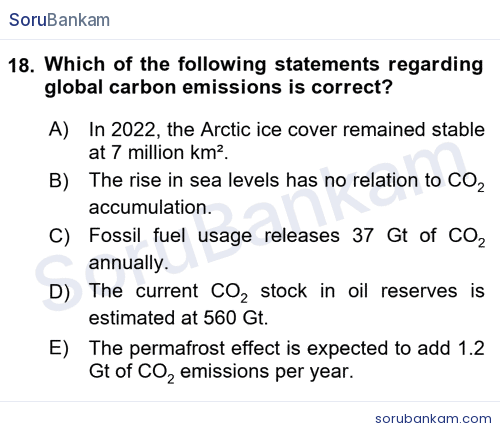
Which of the following statements regarding global carbon emissions is correct? A) In 2022, the Arctic ice cover remained stable at 7 million km?. B) The rise in sea levels has no relation to COs accumulation. C) Fossil fuel usage releases 37 Gt of COz annually. D) The current CO, stock in oil reserves: is estimated at 560 Gt. E) The permafrost effect is expected to add 1.2 Gt of CO, emissions, der year.
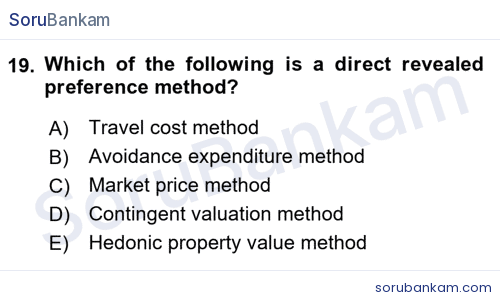
Which of the following is a direct revealed preference method? A) Travel cost method B) Avoidance expenditure method C) Market price method D) Contingent valuation method E) Hedonic property value method
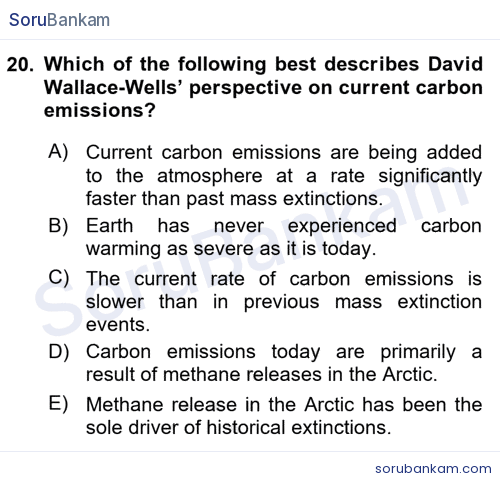
Which of the following best describes David Wallace-Wells' perspective on current carbon emissions? A) Current carbon emissions are being added to the atmosphere at a rate significanty faster than past mass extinctions. 1• B) Earth has hever experienced carbon warming as severe as it is today. C) The current rate of carbon emissions is slower than in previous mass extinction events. D) Carbon emissions today are primarily a result of methane releases in the Arctic. E) Methane release in the Arctic has been the sole driver of historical extinctions.