IKT326U Econometrics 2 2023-2024 Yaz Okulu Soruları
20 soru · Yaz okulu · 2023-2024
IKT326U Econometrics 2 dersinin 2023-2024 yaz okulu sınavı 20 sorudan oluşur; ders AÖF İktisat (İngilizce) bölümünde okutulur. Sorular aşağıda sırasıyla yer alır. Doğru cevaplar ve sonucun, testi çözdüğünde görünür.
Önizleme · 20 soru. Cevaplamak ve sonucunu görmek için sınavı başlat.
Sorular
20 soru
Soru 1
Soru 2
Soru 3
Soru 4
Soru 5
Soru 6
Soru 7
Soru 8
Soru 9
Soru 10
Soru 11
Soru 12
Soru 13
Soru 14
Soru 15
Soru 16
Soru 17
Soru 18
Soru 19
Soru 20


Sınav modunda süre tutulur, doğru cevaplar ve sonucun sınav bitince görünür.
Dersin üniteleri
IKT326U Econometrics 2 ders sayfası: bütün sınavlar ve üniteler
Soruların metni (otomatik okuma)
Görsellerden otomatik okunmuştur; hata içerebilir. Sorular, görsellerdeki hâliyle geçerlidir.
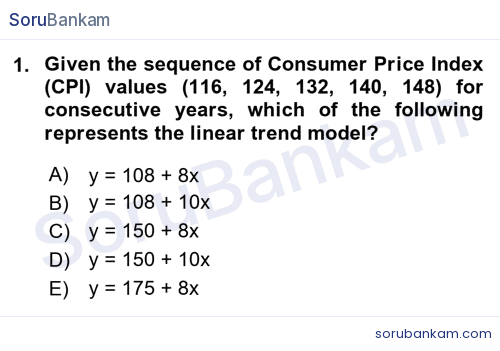
Given the sequence of Consumer Price Index (CPI) values (116, 124, 132, 140, 148) for consecutive years, which of the following represents the linear trend model? A) y = 108 + 8x B) y= 108 + 10x C) y = 150 + 8x D) y = 150 + 10x E) y = 175 + 8x
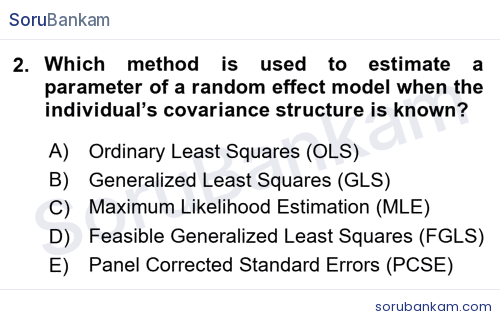
Which method is used to estimate parameter of a random effect model when the individual's covariance structure is known? A) Ordinary Least Squares (OLS) B) Generalized Least Squares (GLS) C) Maximum Likelihood Estimation (MLE) D) Feasible Generalized Least Squares (FGLS) E) Panel Corrected Standard Errors (PCSE)
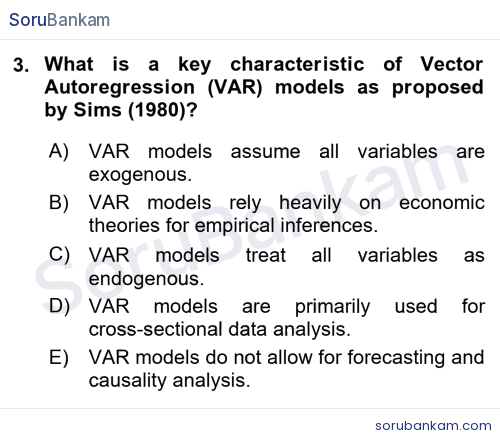
3. What is a key characteristic of Vector Autoregression (VAR) models as proposed by Sims (1980)? A) VAR models assurie" variables are exogenous. VAR models rely heavily on, economic theories for expincal interences. C) VAR ›models treat •all variables as endogenous. D) VAR models are primarily ysed for cross-sectiona, data analysis. E) VAR models do not allow for forecasting and causality analysis.
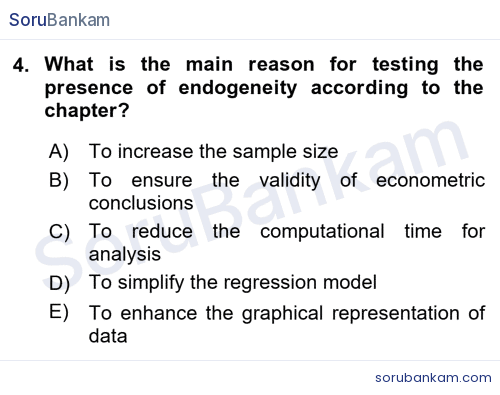
What is the main reason for testing the presence of endogenelty according to the chapter? A) To increase the sample size B) To ensure the validity of econometric conclusions C) To reduce the computational time for analysis D) To simplify the regression model E) To enhance the graphical representation of data
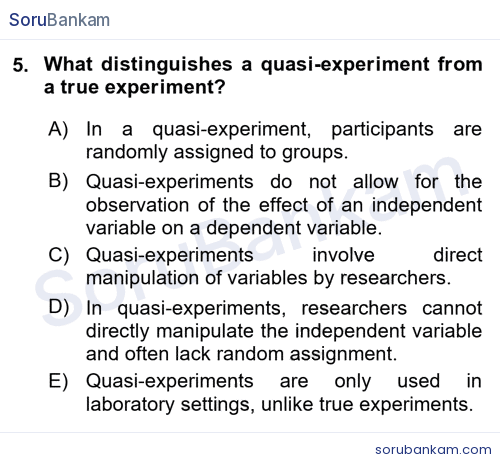
What distinguishes a quasi experiment from a true experiment? A) In a quasi-experiment, participants are randomly assigned to groups. B) Quasi-experiments do not allow for the observation of the effect of an independent variable on a dependent variable. C) Quasi-experiments Involve direct manipulation of variables by researchers. D) In quasi-experiments, researchers cannot directly manipulate the independent variable and often lack random aşsignment. E) Quasi-experiments» are only used in laboratory settings, unlike true experiments.
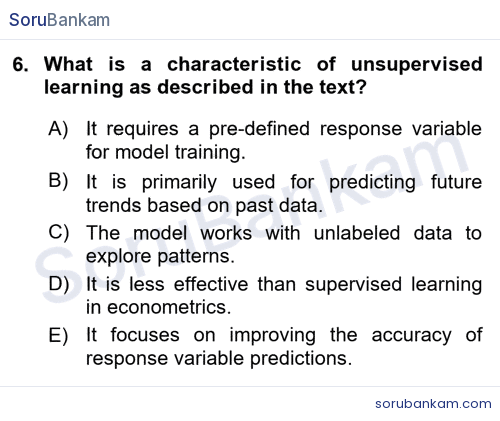
What is a characteristic of unsupervised learning as described in the text? A) It requires a pre-detined response variable for model training. B) y B) It is primarly used for predicting future trends based on past data. C) The model works with unlabeled data to explore batters. D) # is less effective than supervised learning in econometrics. E) It focuses on improving the accuracy of response variable predictions.
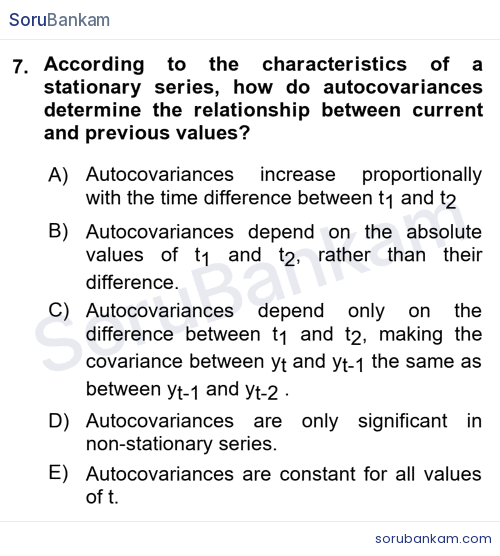
According to the characteristics of a stationary series, how do autocovariances determine the relationship between current and previous values? A) Autocovariances increase proportionally with the time difference between t1 and t2 B) Autocovariances depend on the absolute values of t1 and tz, rather than their difference. C) Autocovariances depend only on the difference between t1 and t2. making the covariance between yt and yt-1 the same as between yt-1 and yt-2• D) Autocovariances are only significant in non-stationary series. E) Autocovariances are constant for all values of t.
What is a prominent example of an unforeseen situation involving responsibility that has become a concern with the use of black-box models? A) Accidents involving autonomous vehicles B) Online fraud C) Data breaches D) Intellectual property theft E) Cyber-attacks
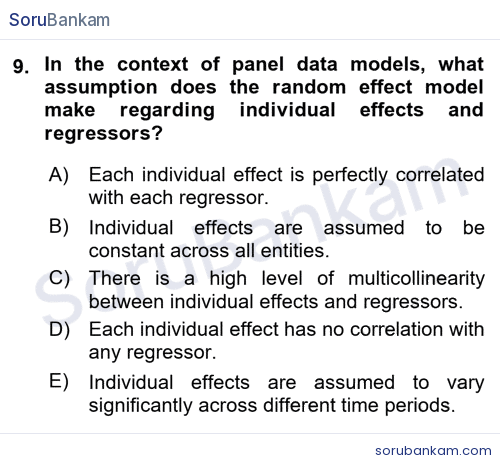
In the context of panel data models, what assumption does the random effect model make regarding individual effects and regressors? A) Each individual effect is perfectly correlated with each regressor. B) Individual effects are assumed to be constant across all entities. C) There is a high level of multicollinearity between individual effects and regressors. D) Each individual effect has no correlation with any regressor. E) Individual effects are assumed to vary. significantly across different time periods.
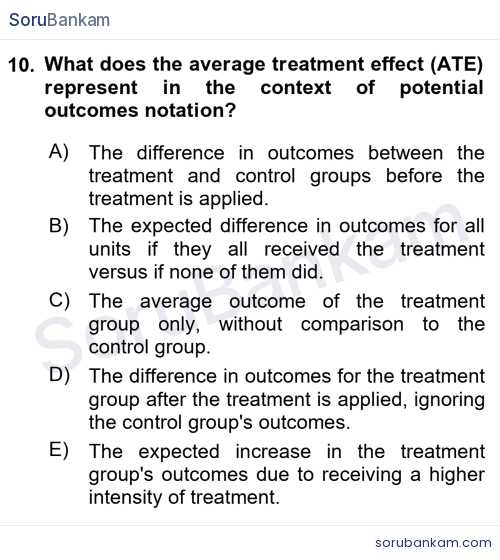
What does the average treatment effect (ATE) represent In the context of potential outcomes notation? A) The difference in outcomes between the treatment and control groups before the treatment is applied. B) The expected difference in outcomes for all units if they all received the treatment versus if none of them did. C) The average outcome of the treatment group only, without comparison to the control group. D) The difference in outcomes for the treatment group after the treatment is applied, ignoring the control group's outcomes. E) The expected increase in the treatment group's outcomes due to receiving a higher intensity of treatment.
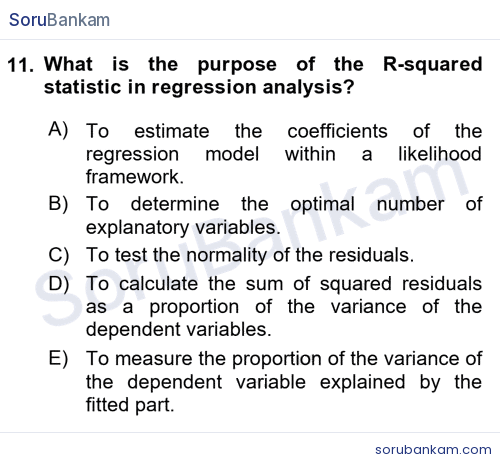
What is the purpose of the R-squared statistic in regression analysis? A) To estimate the coefficients of the regression model within a likelihood framework. B) To determine the optimal number of explanatory variables. C) To test the normality of the residuals. D) To calculate the sum of squared residuals as a proportion of the variance of the dependent variables. E) To measure the proportion of the variance of the dependent varable explained by the fitted part.
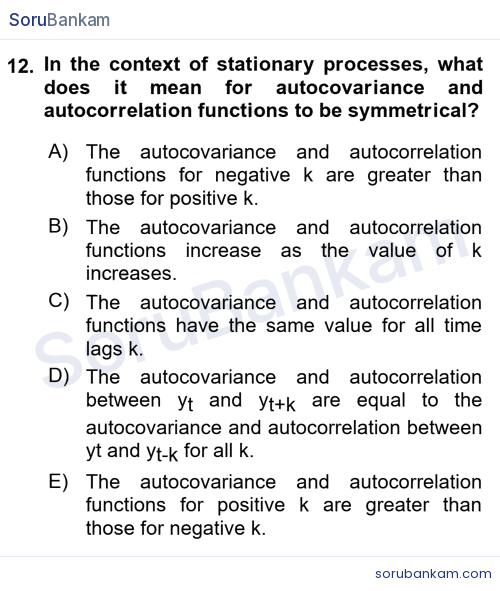
In the context of stationary processes, what does it mean for autocovariance and autocorrelation functions to be symmetrical? A) The 'autocovariance and autocorrelation 1. functions for negative k are greater than those for positive k. B) The autocovariance and autocorrelation functions increase as the value of k increases. C) . C) The autocovariance and autocorrelation functions have the same value for all time lags k. D) The autocovariance and autocorrelation between yt and yt+k are equal to the autocovariance and autocorrelation between yt and yt-k for all k. E) The autocovariance and autocorrelation functions for positive k are greater than those for negative k.
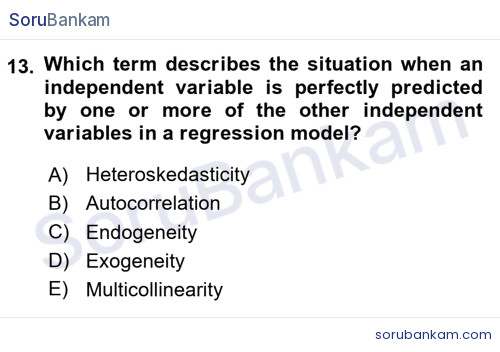
Which term describes the situation when an independent variable is perfectly predicted by one or more of the other independent variables in a regression model? A) Heteroskedasticity B) Autocorrelation C) Endogeneity • D) Exogeneity E) Multicollinearity
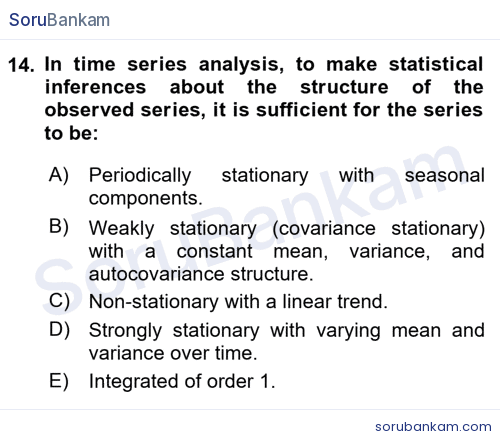
In time series analysis, to make statistical inferences about the structure of the observed series, it is sufficient for the series to be: A) Periodically stationary with seasonal components. B) Weakly stationary (covariance stationary) with a constant mean, variance, and autocovariance structure. C) Non-stationary with a linear trend. D) Strongly stationary with varying mean and variance over time. E) Integrated of order 1.
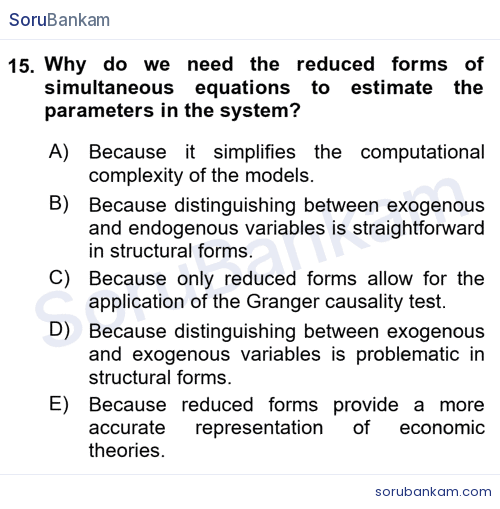
Why do we need the reduced forms of simultaneous equations to estimate the parameters in the system? A) Because it simplifies the computational complexity of the models. B) Because distinguishing between exogenous and endogenous variables is straightforward in structural forms. C) Because only reduced forms allow for the application of the Granger causality test. D) Because distinguishing between exogenous and exogenous variables is problematic in structural forms. E) Because reduced forms provide a more accurate representation of ecenomic theories.
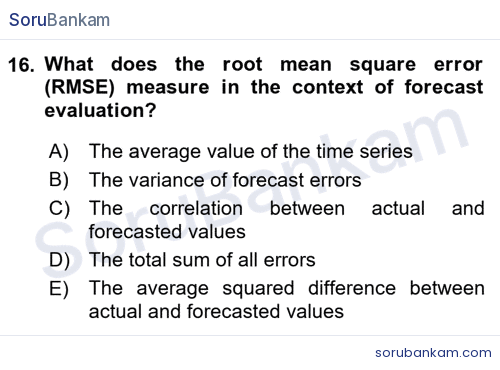
What does the root mean square erfor (RMSE) measure in the context of forecast evaluation? A) The average value ofte time series B) The variance of forecast errors C) The correlation between actual and forecasted values D) The total sum of all errors E) The average squared difference between actual and forecasted values
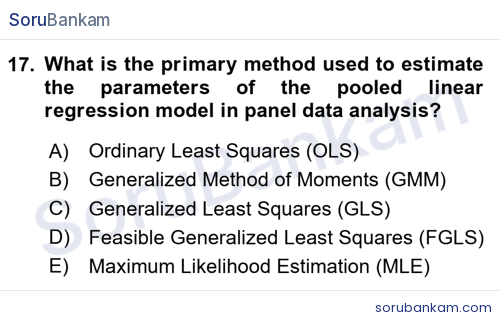
What is the primary method used to estimate the parameters of the pooled linear regression model in panel data analysis? A) Ordinary Least Squares (OLS) B) Generalized Method of Moments (GMM). C) Generalized Least Squares (GLS) D) Feasible Generalized Least Squares (FLS) E) Maximum Likelihood Estimation (MLE)
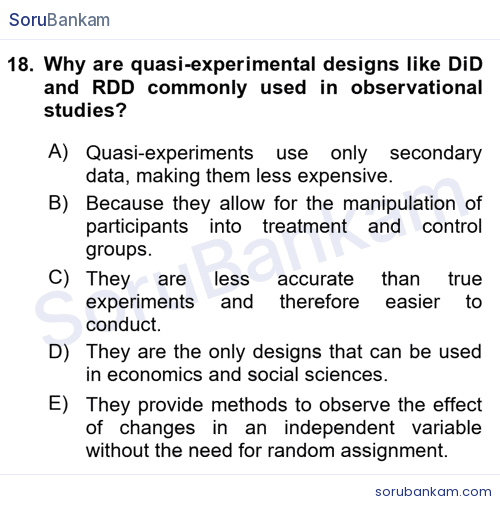
Why are quasi experimental designs like DiD and RDD commonly used in observational studies? A) Quasi-experiments use only secondary data, making them less expensive. B) Because they allow for the manipulation of participants into treatment and control groups. C) They are less accurate than true experiments and therefore easier to conduct. D) They are the only designs that can be used in economics and social sciences. E) They provide methods to observe the effect of changes in an independent variable without the need for random, assignment.
What regulation is mentioned as being agreed upon by the European Commission to lay down harmonized rules on Al systems? A) The Digital Single Market Strategy B) , B) The European Data Strategy C) The Al Act D) The General Data Protection Regulation (GDPR) E) The Cybersecurity Directive
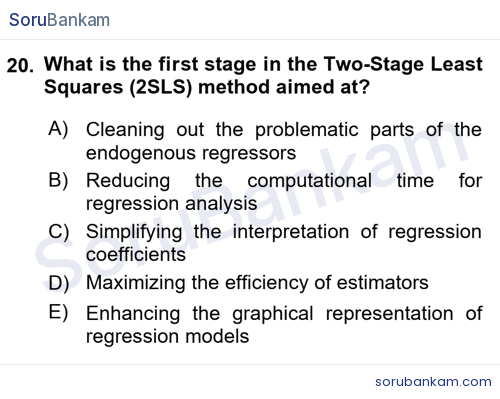
What is the first stage in the Two-Stage Least Squares (2SLS) method aimed at? A) Cleaning out the problematic parts of the endogenous regressors B) Reducing the computational time for regression analysis C) Simplifying the interpretation of regression coefficients D) Maximizing the efficiency of estimators E) Enhancing the graphical representation of regression models