IKT326U Econometrics 2 2023-2024 Vize Soruları
20 soru · Vize · 2023-2024
IKT326U Econometrics 2 dersinin 2023-2024 vize sınavı 20 sorudan oluşur; ders AÖF İktisat (İngilizce) bölümünde okutulur. Sorular aşağıda sırasıyla yer alır. Doğru cevaplar ve sonucun, testi çözdüğünde görünür.
Önizleme · 20 soru. Cevaplamak ve sonucunu görmek için sınavı başlat.
Sorular
20 soru
Soru 1
Soru 2
Soru 3
Soru 4
Soru 5
Soru 6
Soru 7
Soru 8
Soru 9
Soru 10
Soru 11
Soru 12
Soru 13
Soru 14
Soru 15
Soru 16
Soru 17
Soru 18
Soru 19
Soru 20
Sınav modunda süre tutulur, doğru cevaplar ve sonucun sınav bitince görünür.
Dersin üniteleri
IKT326U Econometrics 2 ders sayfası: bütün sınavlar ve üniteler
Soruların metni (otomatik okuma)
Görsellerden otomatik okunmuştur; hata içerebilir. Sorular, görsellerdeki hâliyle geçerlidir.
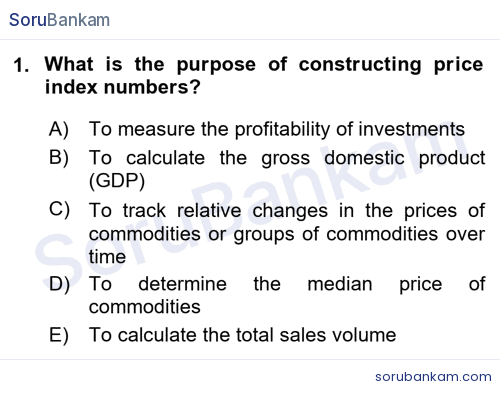
What is the purpose of constructing price index numbers? A) To measure the profitability of investments B) To calculate the gross domestic product (GDP) C) To track relative changes in the prices of commodities or groups of commodities over time D) To determine the median price of commodities E) To calculate the total sales volume
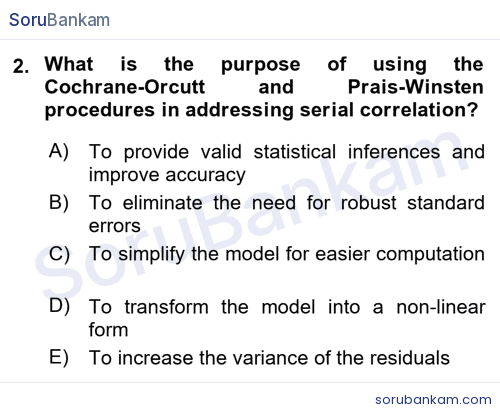
What is the purpose of using the Cochrane-Orcutt and Prais-Winsten procedures in addressing serial correlation? A) To provide valid statistical inferences and improve accuracy B) To eliminate the need for robust standard errors C) To simplity the model for easier computation D) To transform the model into a non-linear form E) To increase the variance of the residuals
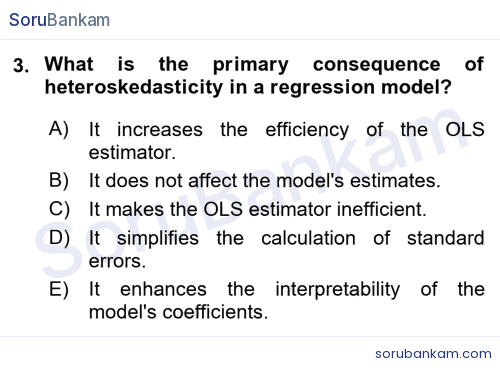
3. What is the primary consequence heteroskedasticity in a regression nochel? A) It increases the efficieney of the OLS estimator. B) It does not affect the model's estimates.,. J C) It makes the OLS estimator inefficient. " D) It simplifies the calculation of standard errors. It enhances the interpretability of the model's coefficients.
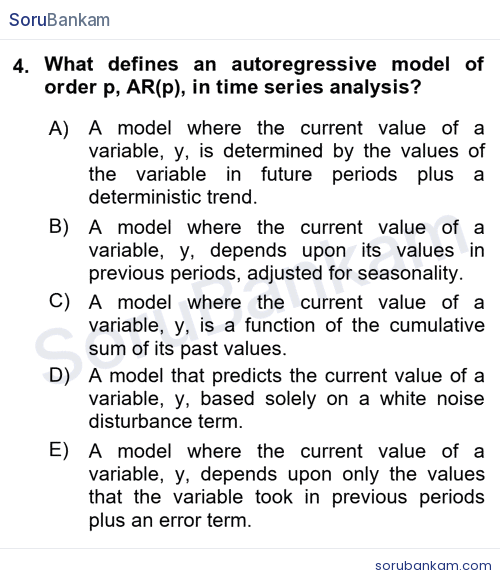
What defines an autoregressive model of order p, AR(p), in time series analysis? A) A model where the current value of a vanable, y, is determined by the values of the variable in future periods plus a deterministic trend. B) A model where the current value of a variable, y, depends upon its values in previous periods, adjusted for seasonality. C) A model where the current value of a variable, y, is a function of the cumulative sum of its past values. D) A model that predicts the current value of a variable, y, based solely on a white noise disturbance term. E) A model where the current value of a variable, y, depends upon only the values that the variable took in previous periods plus an error term.
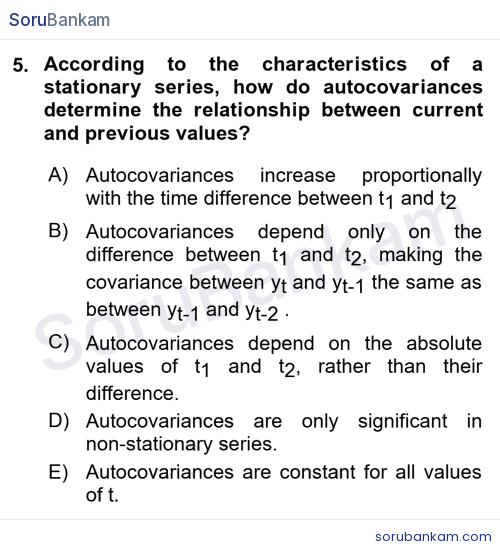
According to the characteristics of stationary series, how do autocovariances determine the relationship between current and previous values? A) Autocovariances increase proportionally with the time difference between t1 amd.t2 B) Autocovariances depend only on the difference between if and t2, making the covariance between yt and yt-1 the same as between yt-1 and yt-2 . C) Autocovariances depend on the absolute values of ty and t2, Wrather than their difference. D) Autocovariances are only significant in non-stationary series. E) Autocovarlances are, constant for all values oft.
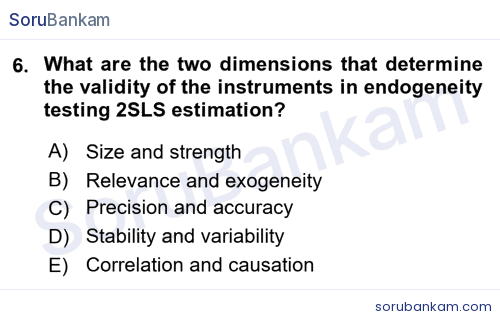
What are the two dimensions that determine the validity of the instruments in endogeneity testing 2SLS estimation? A) Size dand strength a B) ¡ By Relevance and exogeneity C) Precision and accuracy D) Stability and' variability E) Correlation and causation
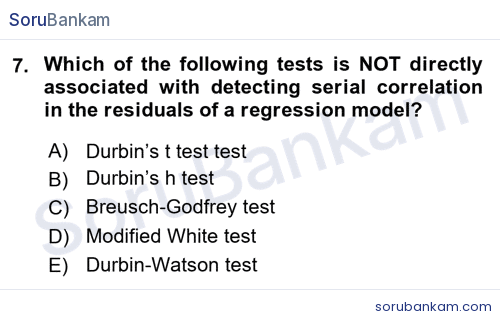
Which of the following tests is NOT directly associated with detecting serial correlation in the residuals of a regression model? A) Durbin's t test test B) Durbin's h test C) Breusch-Godfrey test D) Modified White test E) Durbini-Watson test
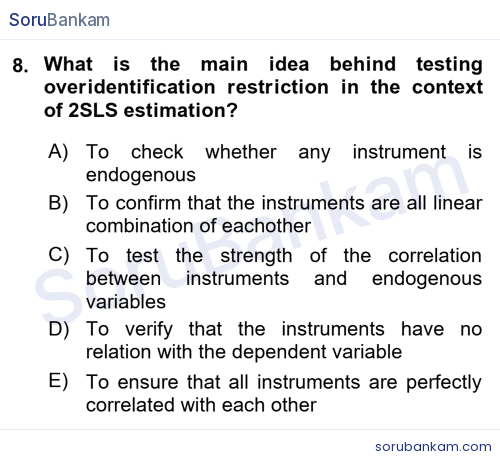
What is the main idea behind testing overidentification restriction in the context of 2SLS estimation? A) To check whether any instrument is endogenous B) To confirm that the instruments are all linear combination of eachother C) To test the strength of the correlation between instruments and endogenous variables D) To verify that the instruments have no relation with the dependent variable E) To ensure that all instruments are perfectly correlated with each other
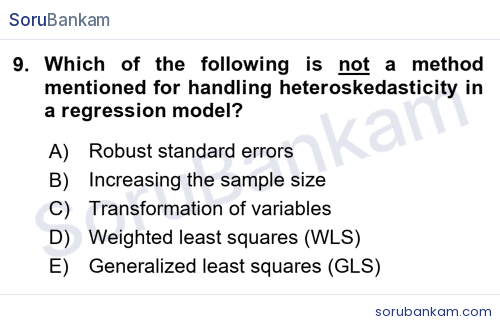
Which of the following is not a method mentloned for handing heteroskedasticity in a regression model? A) Robust standard errors B) Increasing the sample size C) Transformation of variables D) Weighted least squares (WLS) E) Generalized least squares (GLS)
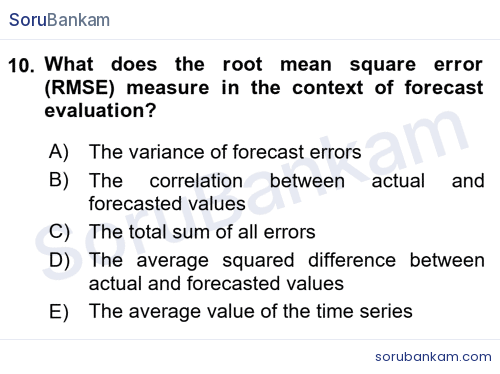
What does the root mean square error (RMSE) measure in the context of forecast evaluation? A) The variance of forecast errors B) The correlation between actual and forecasted values C) The total sum of all errors D) The average squared difference between actual and forecasted values E) The average value of the time series
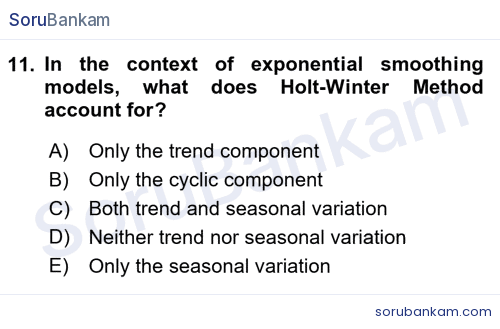
In the context of exponential smoothing models, what does Holt-Winter Method account for? A) Only the trend component B) Only the cyclic component C) Both trend and seasonal variation, D) Neither trend nor seasonal variation E) Only the seasonal vanation
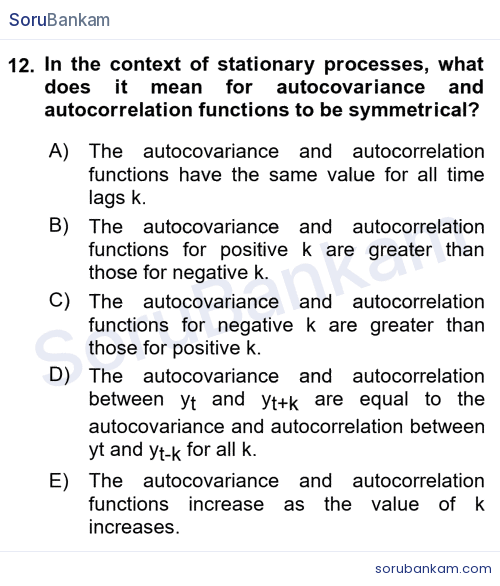
In the context of stationary processes, what does it mean for autocovariance. and autocorrelation functions to be symmetrical? A) The autocovariançe' and autocorrelation functions have the same value for all time lags k. B) The autocovariance and, autocorrelation functions for positiye * are greater than those for negative k. C) The autocovariance and autocorrelation functions for negative k are greater than those for positive k. "' D) The autocovariance and autocorrelation between yt and yt+k are equal to. the autocovariance and autocorrelation between yt and yt-k for all k. E) The autocovariance and autocorrelation functions increase as the value of k increases.
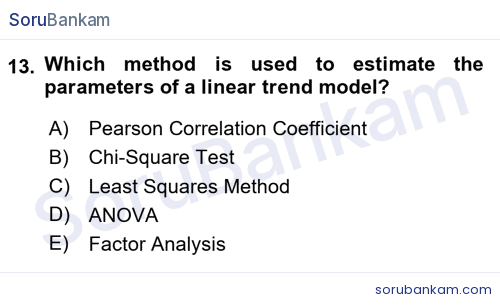
Which method is used to estimate the parameters of a linear trend model? A) Pearson Correlation Coefficient B) Chí-Square Test C) Least Squares Method D) ANOVA E) Factor Analysis
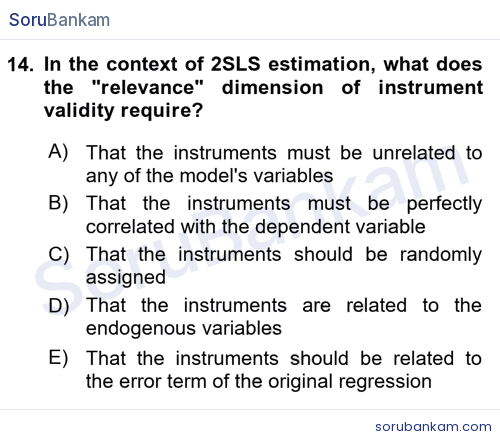
In the context of 2SLS estimation, what does the "relevance" dimension of instrument validity require? A) That the instruments must be unrelated to any of the model's variables B) That the instruments must be perfectly correlated with the dependent vanable C) That the instruments should be randomly assigned D) That the instruments are related to the endogenous variabies E) That the instruments should be related to the error term of the original regression
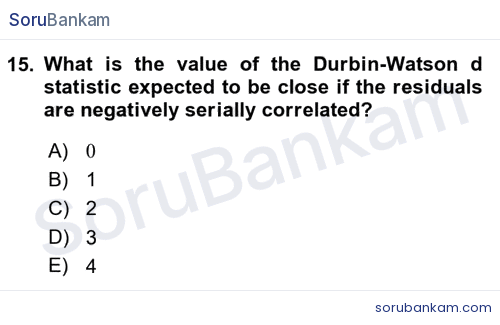
15. What is the value of the Durbin-Watson d statistic expected to be close if the residuals are negatively serlally correlated?. { A) 0 . B) 1 C) 2 D) E)
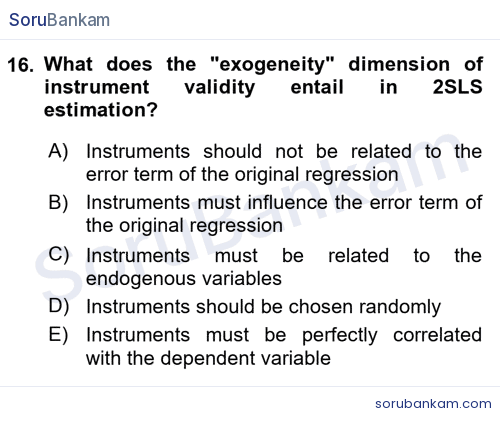
What does the "exogeneity" dimension of instrument validity entail in 2SLS estimation? A) Instruments should not be related to the error term of the original regression B) Instruments must influence the error term of the original regression C) Instruments must be • related to the endogenous variables D) Instruments should be chosen randomly E) Instruments must be perfecily correlated with the dependent variable
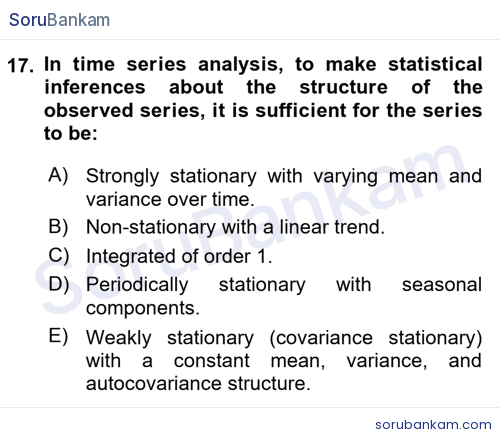
In time series analysis, to make statistical inferences about the structure of the observed series, it is sufficient for the series to be: A) Strongly stationary with varying mean and variance over time. B) Non-stationary with a linear trend. C) Integrated of order 1. D) Periodically stationary with seasonal components. E) Weakly stationary (covariance stationary) with a constant mean, variance, and autocovarance structure.
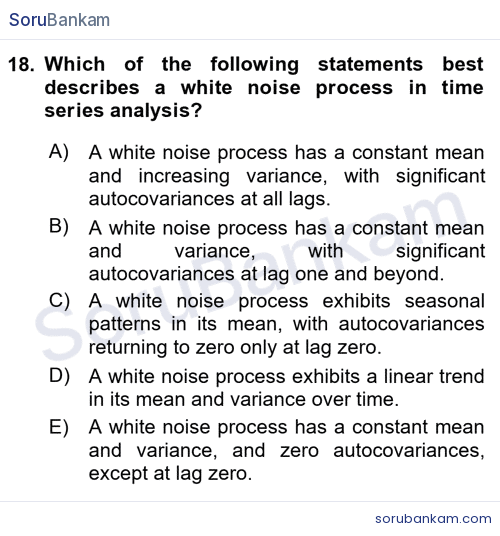
Which of the following statements best describes a white noise process In time series analysis? A) A white noise process has a constant mean and increasing variance, with significant autocovariances at all lags. B) A white noise process has a constant mean and variance, with significant autocovariances at lag one and beyond. C) A white noise process exhibits seasonal patterns in its mean, with autocovariances returning to zero only at lag zero. D) A white noise process exhibits a linear trend in its mean and variance over time. E) A white noise process has a constant mean and variance, and zero autocovariances, except at lag zero.
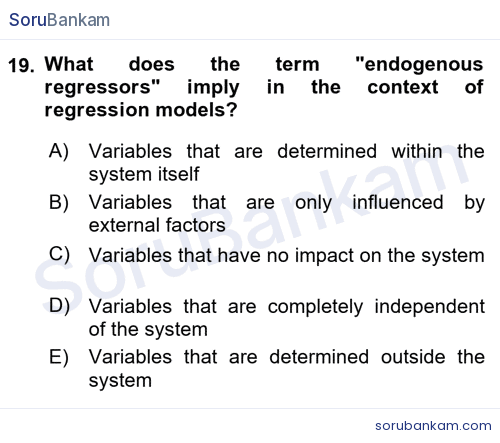
19. What does the term "endogenous regressors" imply in the context of regression models? A) Variables that are determined within the system itself B) Variables that are oniy influenced by external factors C) Variables that have no impact on the system D) Variables that are completely independent of the system Variables that are determined outside the system
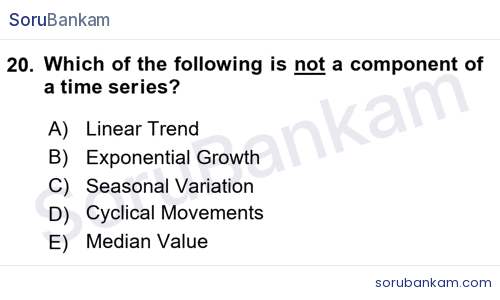
Which of the following is not a component of a time series? A) Linear Trend B) Exponential Growth C) Seasonal Variation D) Cyclical Movements E) Median Value