IKT326U Econometrics 2 2024-2025 Yaz Okulu Soruları
20 soru · Yaz okulu · 2024-2025
IKT326U Econometrics 2 dersinin 2024-2025 yaz okulu sınavı 20 sorudan oluşur; ders AÖF İktisat (İngilizce) bölümünde okutulur. Sorular aşağıda sırasıyla yer alır. Doğru cevaplar ve sonucun, testi çözdüğünde görünür.
Önizleme · 20 soru. Cevaplamak ve sonucunu görmek için sınavı başlat.
Sorular
20 soru
Soru 1
Soru 2
Soru 3
Soru 4
Soru 5
Soru 6
Soru 7
Soru 8
Soru 9
Soru 10
Soru 11
Soru 12
Soru 13
Soru 14
Soru 15
Soru 16
Soru 17
Soru 18
Soru 19
Soru 20
Sınav modunda süre tutulur, doğru cevaplar ve sonucun sınav bitince görünür.
Dersin üniteleri
IKT326U Econometrics 2 ders sayfası: bütün sınavlar ve üniteler
Soruların metni (otomatik okuma)
Görsellerden otomatik okunmuştur; hata içerebilir. Sorular, görsellerdeki hâliyle geçerlidir.
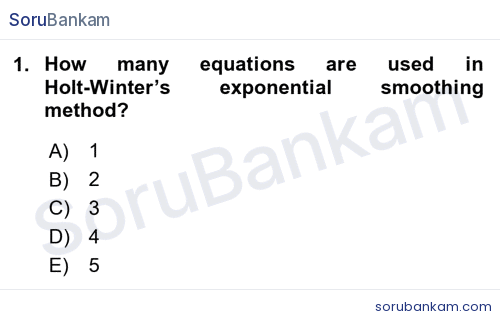
1. How many equations are used in Holt-Winter's exponential smoothing method? A) 1• B) C) 3 D) 4 E) 5
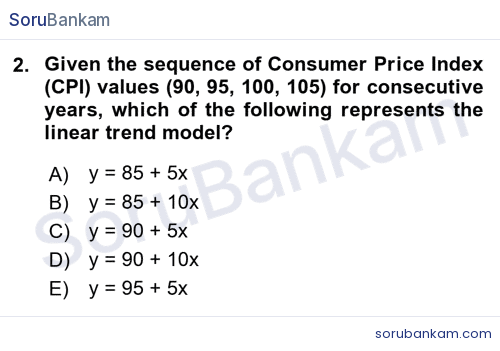
Given the sequence of Consumer Price Index (CPI) values (90, 95, 100, 105) for consecutive years, which of the following represents the linear trend model? A) y = 85 + 5x B) y = 85 + 10x C) y = 90 + 5x D) y = 90 + 10x E) y= 95 + 5x
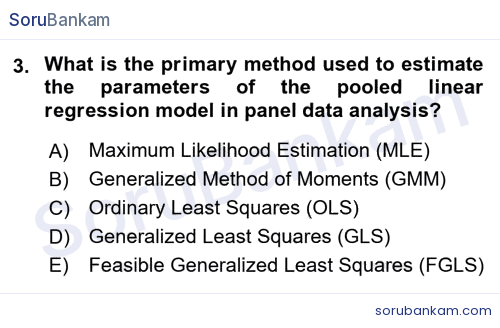
What is the primary method used to estimate! the parameters of the pooled jlihear regression model in panel data analysis? A) Maximum Likelihood Estimation (MLE) B) Generalized Method of Moments (GMM) ' C) Ordinary Least Squares (OLS) D) Generalized Least Squares (GLS) E) Feasible Generalized Least Squares (FGLS)
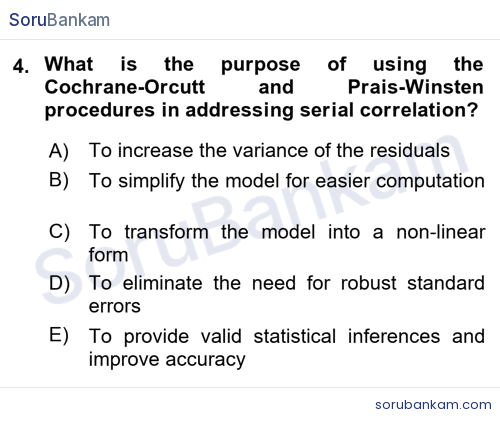
What is the purpose of using the Cochrane-Orcutt and Prais-Winsten procedures in addressing serial correlation? A) To increase the variance of the residuals B) To simplify the model for easier computation C) To transform the model into a non-linear form D) To eliminate the need for robust standard errors E) To provide valid statistical inferences and improve accuracy
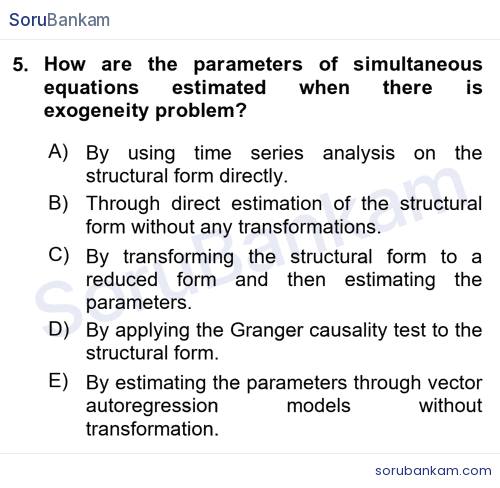
How are the parameters of simultaneous equations estimated when there Is exogeneity problem? A) By using time series analysis on the structural form directly. 6". B) Through direct estimation of the structural form without any transformations. C) By transforming the structural form to a reduced form and then estimating the parameters. D) By applying the Granger causality test to the structural form. E) By estimating the parameters through vector autoregression models without transformation.
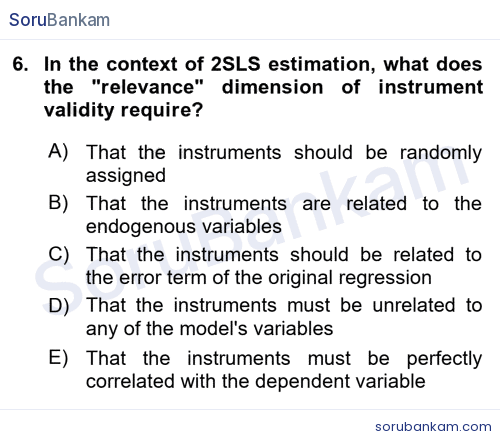
6. In the context of 2SLS estimation, what does the "relevance" dimension of instrument validity require?, A) That the instruments should be randomly assigned B) That the instruments are related to the endogenous variables C) That the instruments should be related to the error term of the original regression That the instruments must be unrelated to any of the model's variables E) That the instruments must be perfectly correlated with the dependent variable
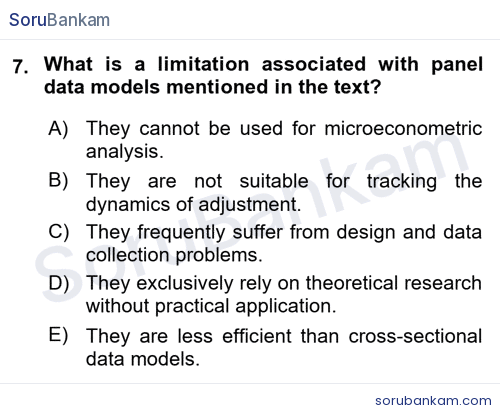
What is a limitation associated with panel data models mentioned in the text? A) They cannot be used for microeconometric analysis. B) They are not suitable for tracking the dynamics of adjustment. C) They frequently suffer from design and data collection problems. D) They exclusively rely on theoretical research without practical application. E) They are less efficient than cross-sectional data models.
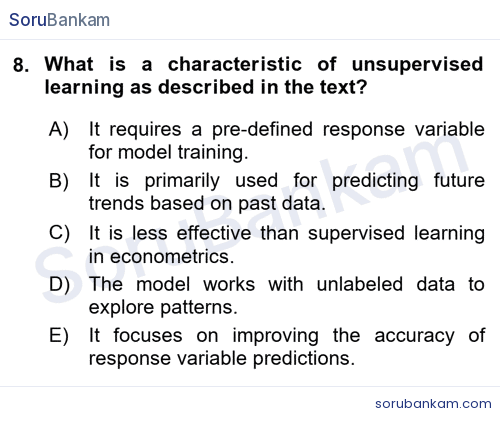
What is a characteristic of unsupervised learning as described in the text? A) It requires a pre-defined response variable for model training. B) It is primarily used for predicting future trends based on past data. C) It is less effective than supervised learning in econometrics. D) The model works with unlabeled data to explore pattems. E) It focuses on improving the accuracy of response variable predictions.
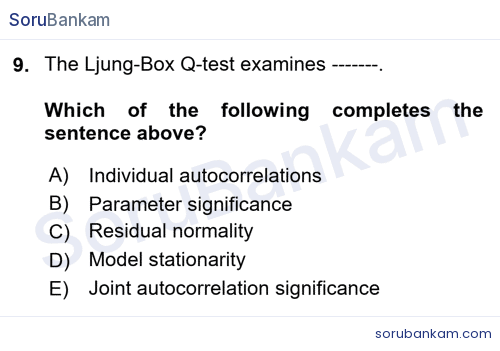
The Ljung-Box Q-test examines....... Which of the following completes the sentence above? A) Individual autocorrelations B) Parameter significance C) Residual normality D) Model stationarity E) Joint autocorrelation significance
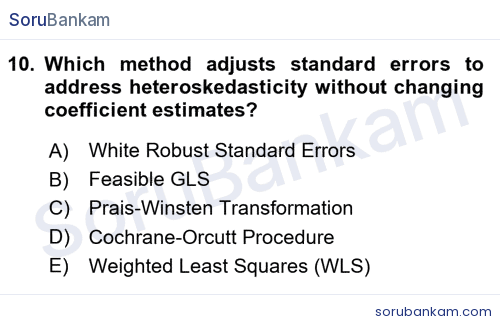
Which method adjusts standard errors to address heteroskedasticity without changing coefficient estimates? A) White Robust Standard Errors B) Feasible GLS C) Prais-Winsten Transformation D) Cochrane-Orcutt Procedure E) Weighted Least Squares (WLS)
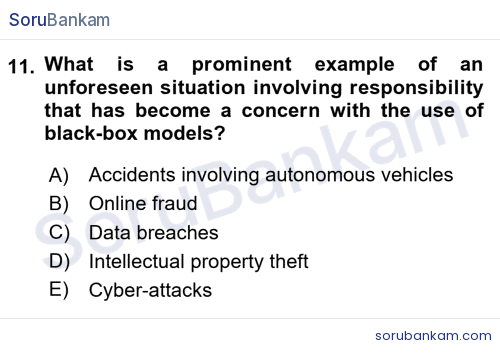
What is a prominent example of unforeseen situation involving responsibillty that has become a concern with the use of black-box models? A) Accidents involving autonomous vehicles B) Online fraud C) Data breaches D) Intellectual property theft E) e) Cyber-attacks
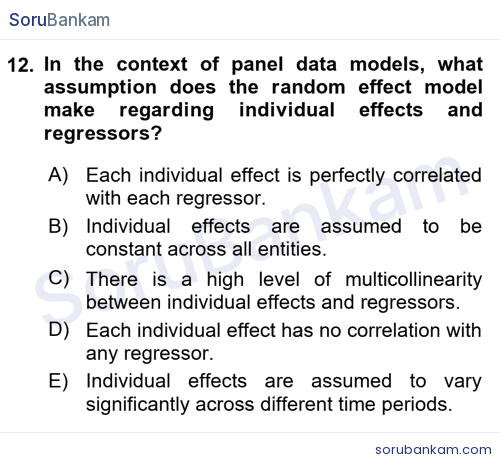
In the context of panel data models, what assumption does the random effect model make regarding individual effects and regressors? A) Each individual effect is perfectly correlated, with each regressor. B) Individual effects are assumed to be constant across all entities. C) There is a high level of multicollinearity between individual effects and regressors. D) Each individual effect has no correlation with any regressor. • E) Individual effects vare assumed to vary significantly across different time periods.
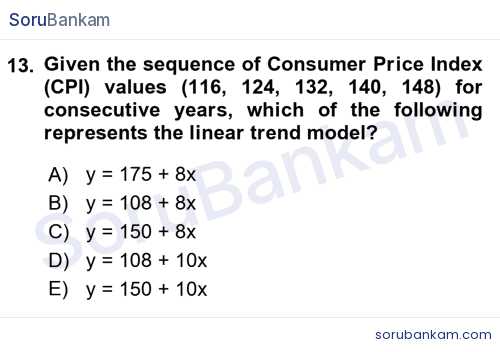
Given the sequence of Consumer Price Index (CPI) values (116, 124, 132, 140, 148) for consecutive years, which of the following represents the linear trend model? A) •y = 175 + 8x B) y = 108 + 8x C) y = 150 + 8x D) y = 108 + 10x E) y = 150 + 10x
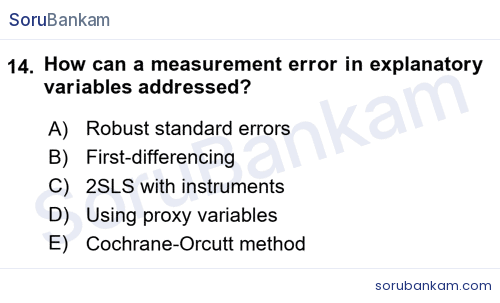
How can a measurement error in explanatory variables addressed? A) Robust standard errors B) First-differencing C) 2SLS with instruments D) Using proxy variables E) Cochrane-Orcutt method
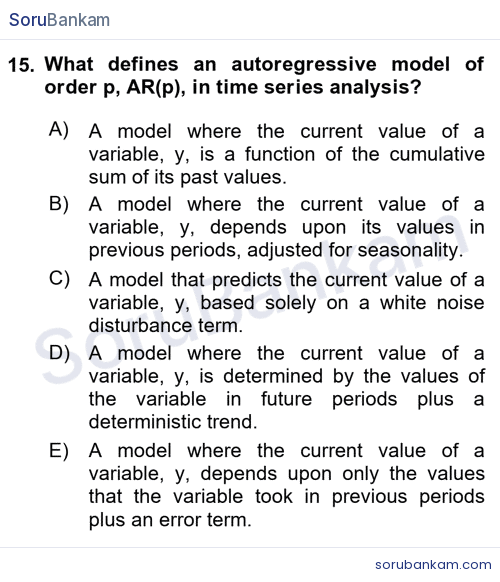
What defines an autoregressive model of order p, AR(p), in time series analysis? A) A model where the current value of a variable, y, is a function of the cumulative sum of its past values. B) A model where the current value of a variable, y, depends upon its values in previous periods, adjusted for seasonality. C) A model that predicts the current value of a variable, y, based solely on a white noise disturbance term. D) A model where the current value of a variable, y, is determined by the values of the variable in future periods plus a deterministic trend. E) A model where the current value of a variable, y, depends upon only the values that the variable took in previous periods plus an error term.
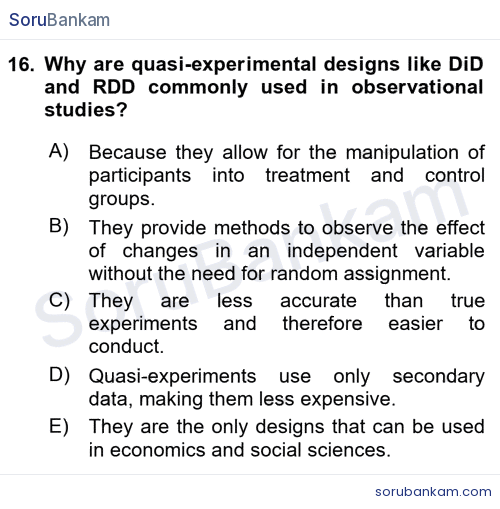
Why are quasi experimental designs like DIU and RDD commonly used in observational studies? A) Because they allow for the manipulation of participants into treatment and control groups. "'r. B) They provide methods to observe the effect of changes in an independent Variable without the need for random assignment. C) They are less accurate than true experiments and therefore easier to conduct. D) Quasi experiments 1 use only secondary . data, making them less expensive. E) "E) They are the only designs that can be used in economics and social sciences.
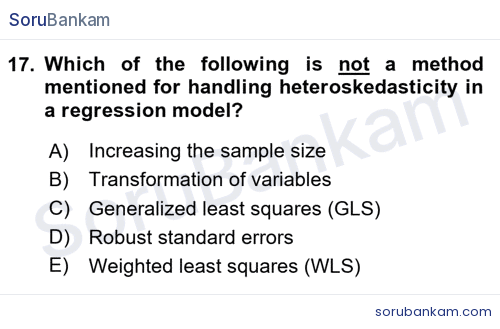
Which of the following is not a method mentioned for handling heteroskedasticity in a regression model? A) Increasing the sample size B) Transformation of variables C) Generalized least squares (GLS) D) Robust standard errors E) Weighted least squares (WLS)
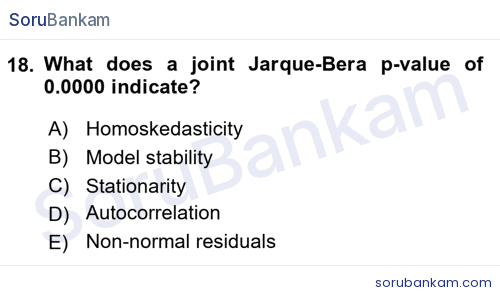
What does a joint Jarque-Bera p-value of 0.0000 indicate? A) Homoskedasticity B) Model stability C) Stationarity D) Autocorrelation , '' E) Non-normal residuals
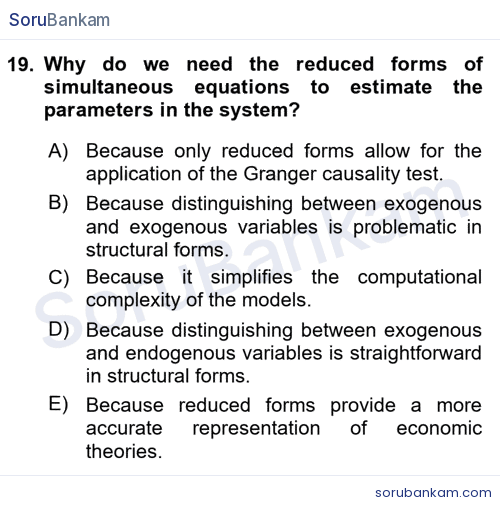
19. Why do we need the reduced forms of simultaneous equations to estimate the parameters in the system? A) Because only reduced forms allow for the application of the Granger causality test. B) Because distingujshing between exogenous and exogenpus variables is problematic in structusal forms. C) Because it simplifies the computational complexity of the models. D) Because distinguishing between exogenous and endogenous variables is straightforward in structural forms. Because reduced forms provide a more accurate representation of aconomic theories.
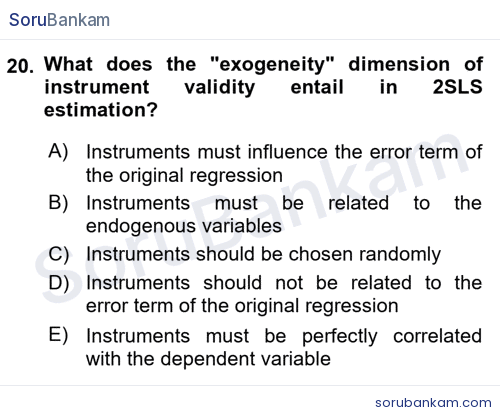
What does the "exogeneity" dimension of instrument validity entail in 2SLS estimation? A) Instruments must influence the error term of the original regression B) Instruments must be related to the endogenous variables C) Instruments should be chosen randomly D) Instruments should not be related to the error term of the original regression E) Instruments must be perfectly correlated with the dependent varable