IKT214U Macroeconomic Theory 2022-2023 Yaz Okulu Soruları
20 soru · Yaz okulu · 2022-2023
IKT214U Macroeconomic Theory dersinin 2022-2023 yaz okulu sınavı 20 sorudan oluşur; ders AÖF İktisat (İngilizce) bölümünde okutulur. Sorular aşağıda sırasıyla yer alır. Doğru cevaplar ve sonucun, testi çözdüğünde görünür.
Önizleme · 20 soru. Cevaplamak ve sonucunu görmek için sınavı başlat.
Sorular
20 soru
Soru 1
Soru 2
Soru 3
Soru 4
Soru 5
Soru 6
Soru 7
Soru 8
Soru 9
Soru 10
Soru 11
Soru 12
Soru 13
Soru 14
Soru 15
Soru 16
Soru 17
Soru 18
Soru 19
Soru 20
Sınav modunda süre tutulur, doğru cevaplar ve sonucun sınav bitince görünür.
Dersin üniteleri
IKT214U Macroeconomic Theory ders sayfası: bütün sınavlar ve üniteler
Soruların metni (otomatik okuma)
Görsellerden otomatik okunmuştur; hata içerebilir. Sorular, görsellerdeki hâliyle geçerlidir.
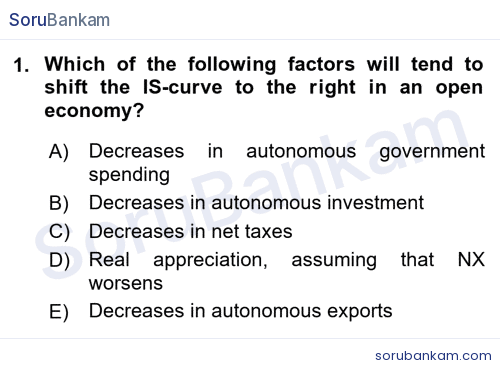
Which of the following factors will tend to shift the IS-curve to the right in . an open economy? A) Decreases in autonomous government spending B) Decreases in autonomous investment C) Decreases in net taxes D) Real appreciation, assuming that NX worsens E) Decreases in autonomous exports
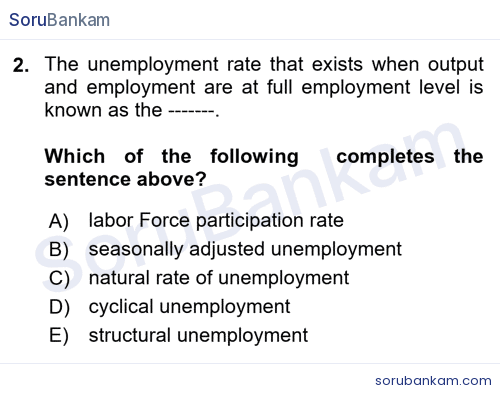
The unemployment rate that exists when output and employment are at full employment level is known as the -.. Which of the following completes the sentence above? A) labor Force participation rate B) seasonally adjusted unemployment C) natural rate of unemployment D) cyclical unemployment E) structural unemployment
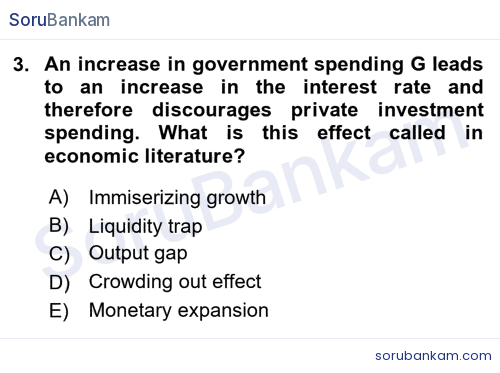
3. An increase in government sponding Glace to an increase in the interest rate. therefore discourages private investment spending. What is , this effect called in economic literature? A) Immiserizing growth B) Liquidity trap . C) Outpubgap Dy Frowding out effect "E) Monetary expansion
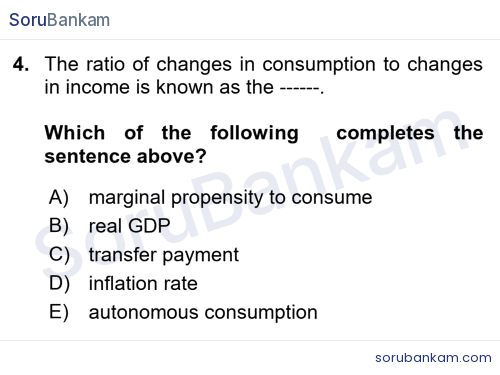
The ratio of changes in consumption to changes in income is known as the -_.. Which of the following completes the sentence above? A) marginal propensity to consume B) real GDP C) transter payment D) inflation rate E) autonomous consumption
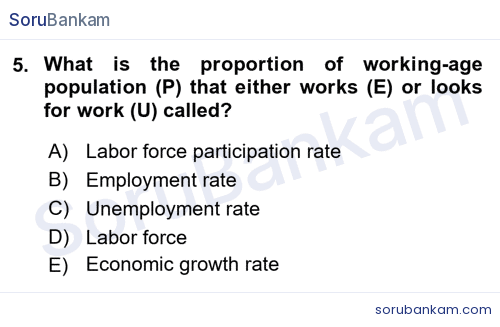
What is the proportion of working-age population (P) that either works (E) or looks for work (U) called? A) Labor force participation rate B) Employment rate C) Unemployment rate '. D) Labor force E) Economic growth rate
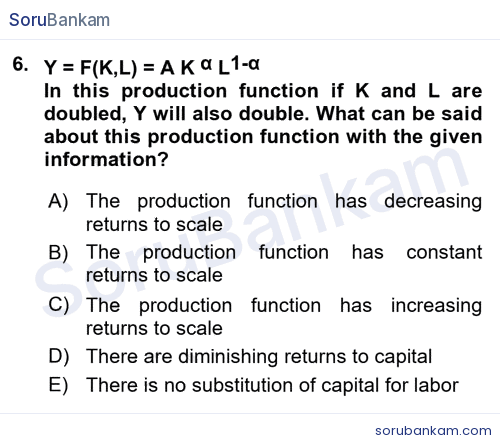
Y = F(K,L)=AKªL1-a In this production function If K and L are doubled, y will also double. What can be said about this production function with the given information? A) The production function has decreasing returns to scale B) The : production function has constant .. refurns to scale C) The production function has increasing returns to scale D) There are diminishing returns to capital E) There ís no substitution of capital for labor
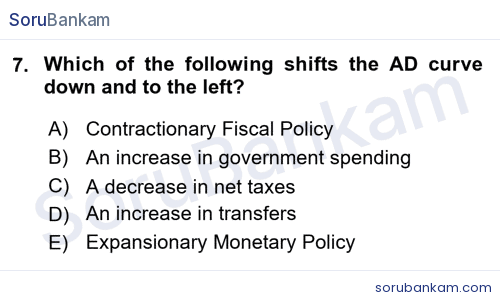
Which of the following shifts the AD curve down and to the left? A) Contractionary Fiscal Policy B) An increase in govemment spending C) A decrease in net taxes D) An increase in transfers E) E Expansionary Monetary Policy
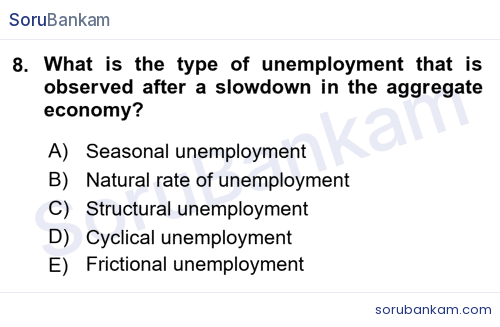
What is the type of unemployment that is observed after a slowdown in the aggregate есопоту? A) Seasonal unemployment B) Natural rate of unemployment C) Structural unemployment D) Cyclical unemployment E) Frictional unemployment
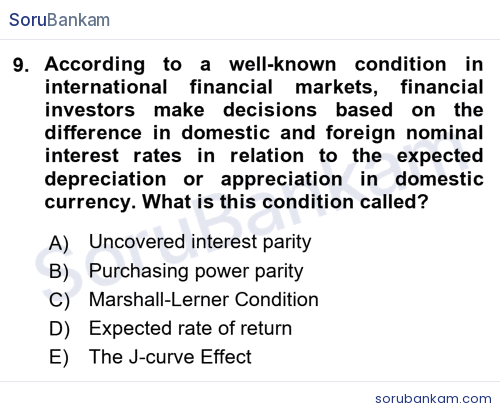
According to a well-known condition in international financial markets, financial investors make decisions based on the difference In domestic and foreign nominal Interest rates in relation to the expected depreciation or appreciation in domestic currency. What is this condition called? A) Uncovered interest parity B) Purchasing power parity C) Marshall-Lerner Condition D) Expected rate of return E) The J-curve Effect
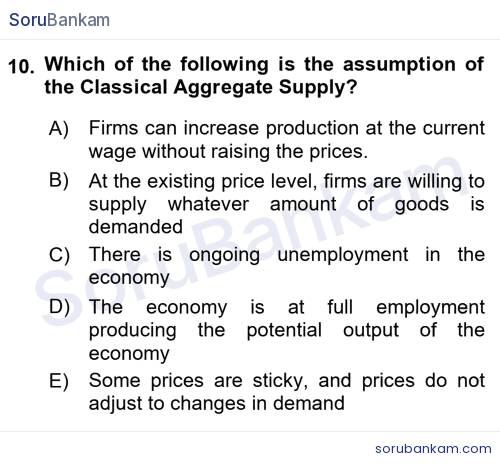
Which of the following is the assumption of the Classical Aggregate Supply? A) Firms can increase production at the current wage without raising the prices. B) At the existing price level, firms are willing to supply whatever amount of goods is demanded C) There is ongoing unemployment in the economy D) The economy is at full employment producing the potential output of the economy E) Some prices are sticky, and prices do not adjust to changes in demand
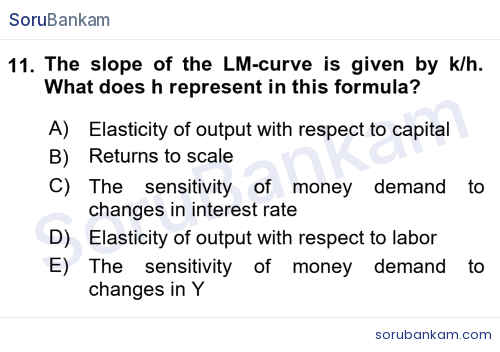
The slope of the LM-curve is given by kih. What does h represent in this formula? A) Elasticity of output with respect to capital B) Returns to scale C) . C) The sensitivity of money demand to changes in interest rate D) Elasticity of output with respect to labor E) The sensitivity of money demand to changes in
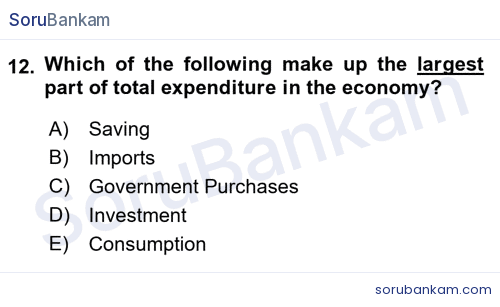
Which of the following make up the largest part of total expenditure in the economy? A) Saving B) Imports C) Government Purchases D) Investment E) Consumption
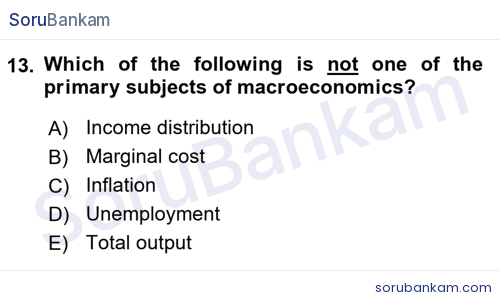
13. Which of the following is not one of the primary subjects of macroeconomics? Income distribution Marginal cost C) Inflation D) Unemployment .. l E) Total output
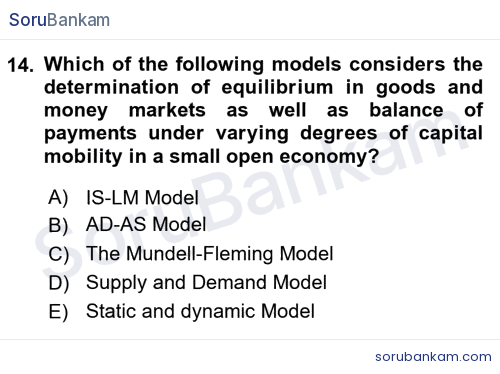
Which of the following models considers the determination of equilibrium in goods and money markets as well as balance of payments-ynder varying, degrees of capital mobillty in a small open economy? A) IS-LM Model B) AD-AS Mode!^ C) The Mandell-Fleming Model D) . Supply and Demand Model E) Static and dynamic Model
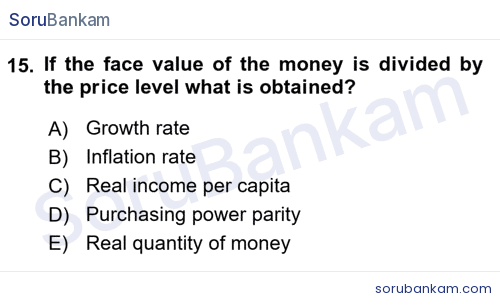
If the face value of the money is divided by the price level what is obtained? A) Growth rate B) Inflation rate C) Real income per capita D) Purchasing power parity E) Real quantity of money
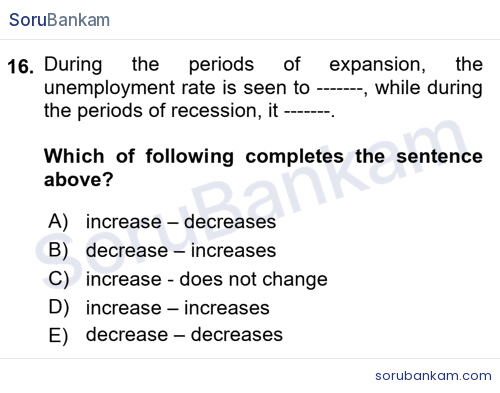
During the periods expansion, the unemployment rate is seen to -, While during the periods of recession, it -—. Which of following completes the sentence above? A) increase - decreases B) decrease - increases C) increase - does not change D) increase - increases E) decrease - decreases
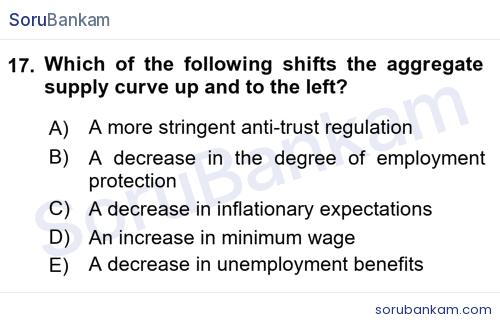
17. Which of the following shifts the aggregate supply curve up and to the left? A) A more stringent anti-trust regulation A decrease in the degree of employment protection C) A decrease in inflationary expectations D) An increase in minimum wage E) A decrease in unemployment benefits
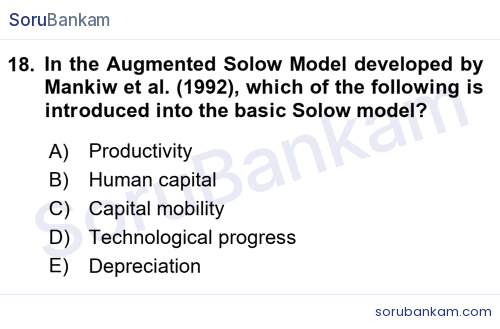
In the Augmented Solow Model developed by, Mankiw et al. (1992), which of the following is introduced Into the basic Solow model? A) Productivity B) Human capital C) Capital mobility D) Technological progress E) Depreciation
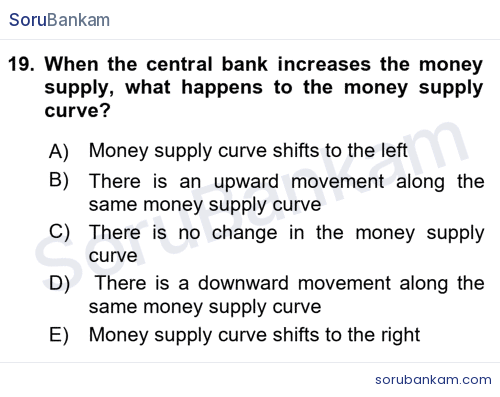
When the central bank increases the money supply, what happens to the money supply curve? A) Money supply curve shifts to the left B) There is an upward movement along the same money supply curve C) There is no change in the money supply curve D) There is a downward movement along the same money supply curve E) Money supply curve shifts to the right
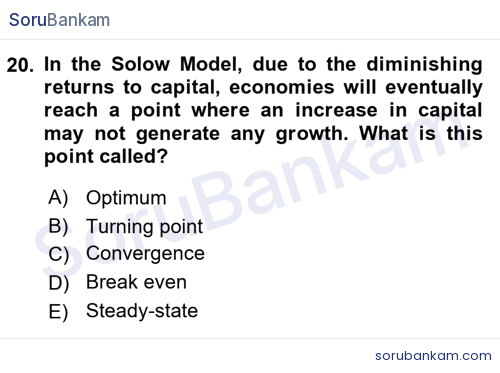
In the Solow Model, due to the diminishing returns to capital, economies will eventually reach a point where an increase in capital may not generate any growth. What is this point called? A) Optimum ... .. B) Turning point. C) Convergence D) Break even E) Steady-state