IKT214U Macroeconomic Theory 2024-2025 Vize Soruları
20 soru · Vize · 2024-2025
IKT214U Macroeconomic Theory dersinin 2024-2025 vize sınavı 20 sorudan oluşur; ders AÖF İktisat (İngilizce) bölümünde okutulur. Sorular aşağıda sırasıyla yer alır. Doğru cevaplar ve sonucun, testi çözdüğünde görünür.
Önizleme · 20 soru. Cevaplamak ve sonucunu görmek için sınavı başlat.
Sorular
20 soru
Soru 1
Soru 2
Soru 3
Soru 4
Soru 5
Soru 6
Soru 7
Soru 8
Soru 9
Soru 10
Soru 11
Soru 12
Soru 13
Soru 14
Soru 15
Soru 16
Soru 17
Soru 18
Soru 19
Soru 20
Sınav modunda süre tutulur, doğru cevaplar ve sonucun sınav bitince görünür.
Dersin üniteleri
IKT214U Macroeconomic Theory ders sayfası: bütün sınavlar ve üniteler
Soruların metni (otomatik okuma)
Görsellerden otomatik okunmuştur; hata içerebilir. Sorular, görsellerdeki hâliyle geçerlidir.
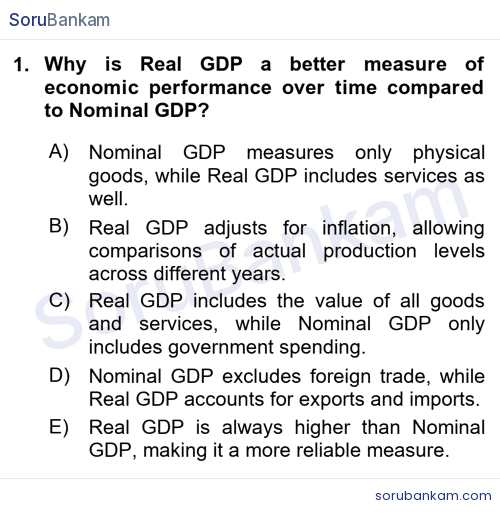
Why is Real GDP a better measure of economic performance over time compared to Nominal GDP? A) Nominal GDP measures only physical goods, while Real GDP includes services as well. B) Real GDP adjusts for inflation, allowing comparisons of actual production levels across different years. C) Real GDP includes the value of all goods and services, while Nominal GDP only includes government spending. D) Nominal GDP excludes foreign trade, while Real GDP accounts for exports and imports. E) Real GDP is always higher than Nominal GDP, making it a more reliable measure.
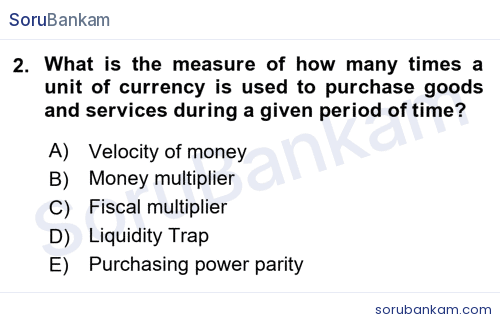
What is the measure of how many times a unit of currency is used to purchase goods and services during a given period of time? A) Velocity of money B) Money multiplier C) Fiscal multiplier D) Liquidity Trap E) Purchasing power parity
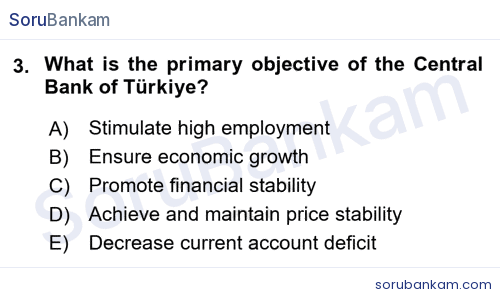
3. What is the primary objective of the Central Bank of Türkiye? Stimulate high employment? Ensure economic growth C) Promote financial stability D) Achieve and mamtain price stability E) Decrease current account deficit
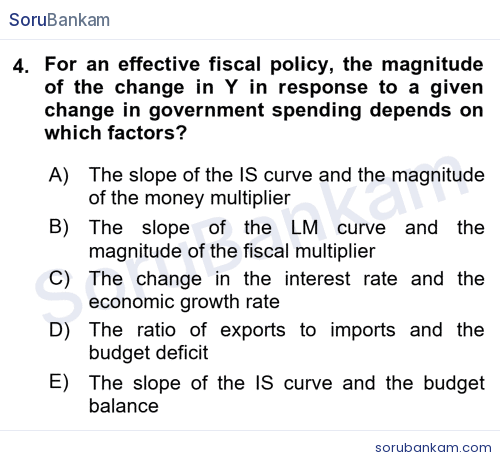
For an effective fiscal policy, the magnitude of the change in Y in response to a given change in government spending depends on which factors? A) The slope of the IS curve and the magnitude of the money multiplier B) The slope of the L curve and the magnitude of the fiscal multiplier C) The change in the interest rate and the economic growth rate D) The ratio of exports to imports and the budget deficit E) The slope of the 15 curve and the budget balance
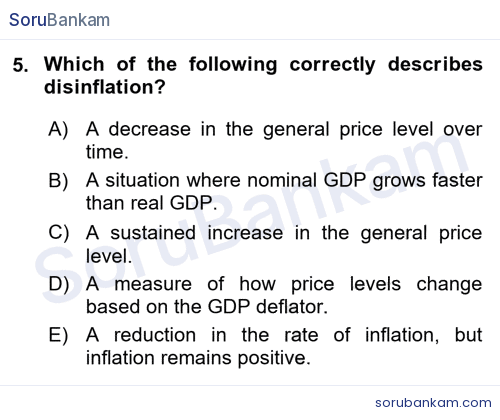
Which of the following correctly describes disinflation? A) A decrease in the general price level over time. B) A situation where nominal GDP grows faster than real GDP. C) A sustained increase in the general price level. D) A measure of how price levels change based on the GDP deflator. E) A reduction in the rate of inflation, but inflation remains positive
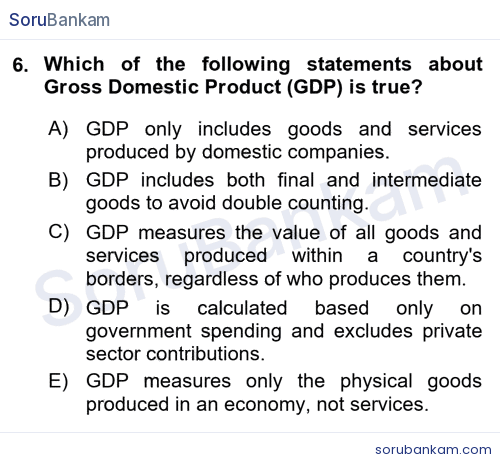
Which of the following statements about Gross Domestic Product (GDP) is true? A) GDP only includes goods and services produced by domestic companies. B) \B) GDP includes both final and intermediate goods to avoid double counting. C) GDP measures the value of all goods and services' produced within country's «Corders, regardless of who produces them. D) GDP is calculated based only. on government spending and exudes private sector contributions. E) GDP Measures only the physical goods produced in an economy, not services.
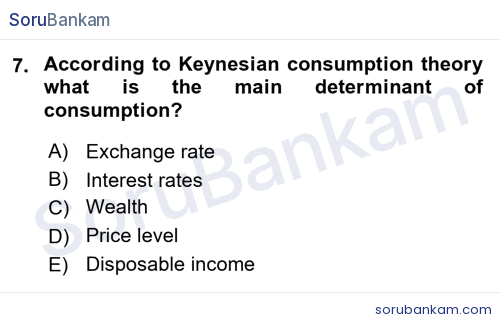
According to Keynesian consumption theory what is the main determinant consumption? A) Exchange rate B) Interest rates C) Wealth D) Price level E) Disposable income
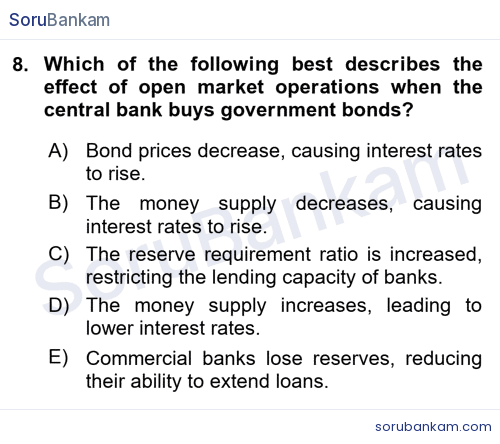
Which of the following best describes the effect of open market operations when the central bank buys government bonds? A) Bond prices decrease, causing interest rates to rise. B) The money supply decreases, causing interest rates to rise. C) The reserve requirement ratio is increased, restricting the lending capacity of banks. D) The money supply increases, leading to lower interest rates. E) Commercial banks lose reserves, reducing their ability to extend loans.
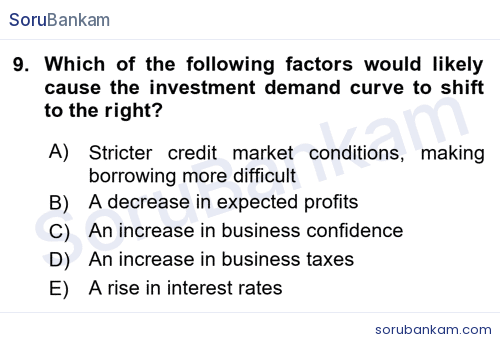
Which of the following factors would likely cause the investment demand curve to shift to the right? A) Stricter credit market conditions, making borrowing more difficult B) A decrease in expected profits C) An increase in business confidence D) An increase in business taxes E) A rise in interest rates
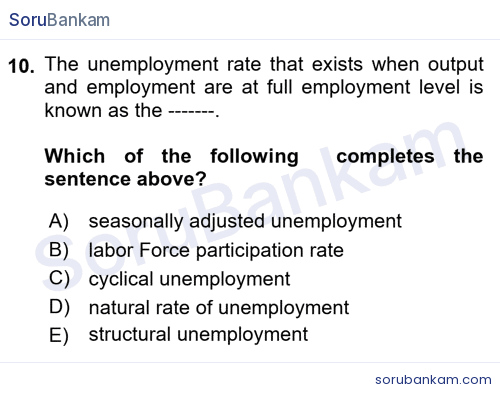
The unemployment rate that exists when output and employment are at full employment level is known as the -_. Which of the following completes the sentence above? A) seasonally adjusted unemployment B) labor Force participation rate C) cyclical unemployment D) natural rate of unemployment E) structural unemployment
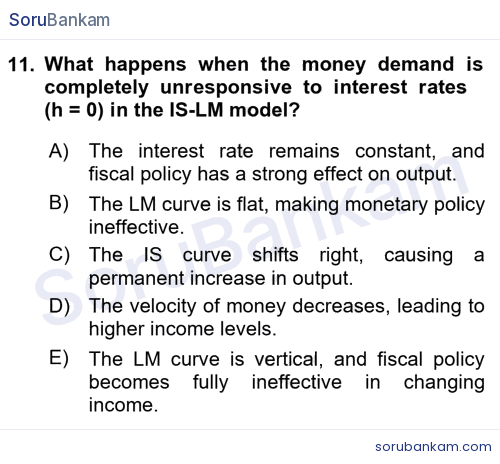
What happens when the money demand is! completely unresponsive to interest rates (h = 0) in the IS-LM model? A) The interest rate • remains constant, and fiscal policy has a strong effect on output. B) The LM curve is flat, making monetary policy ineffective. C) The. IS curve shifts right, causing a , permanent increase in output. D) "D) The velocity of money decreases, leading to higher income levels. E) The LM curve is vertiosi, and fiscal policy becomes fully ineffective in changing income.
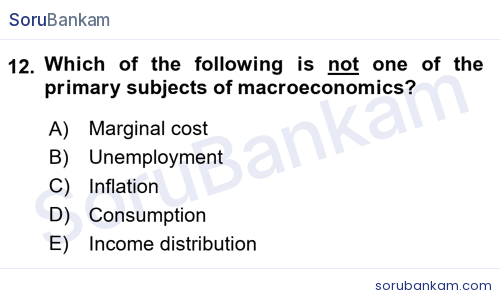
Which of the following is not one of the primary subjects of macroeconomics? A) Marginal cost B) Unemployment C) Inflation D) Consumption E) Income distribution
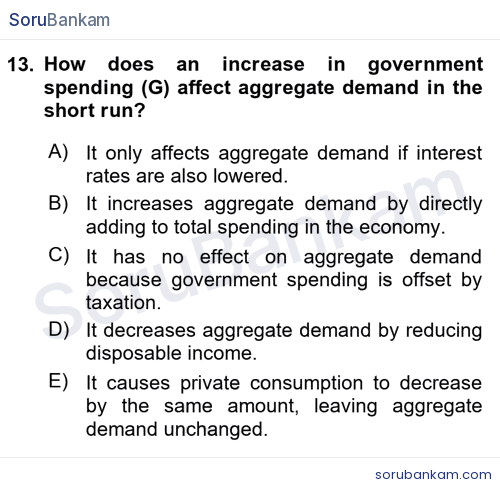
13. How does an increase in government spending (G) affect aggregate demand in the short run? A) It only affects aggregate demand if interest rates are also lowered. B) It increases aggregate demand by directly adding to total spending in the economy. It has no effect on aggregate demand because government spending is offset by taxation. D) It decreases aggregate demand by reducing disposable income. E) It causes private consumption to decrease by the same amount, leaving aggregate demand unchanged.
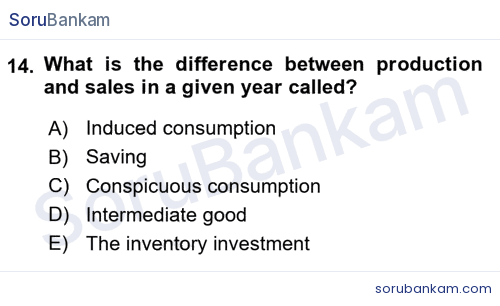
14. What is the difference between production and sales in a given year called? A) Induce, consumption *B) Conspi Conspicuous consumption D) Intermediate good E) The inventory investment
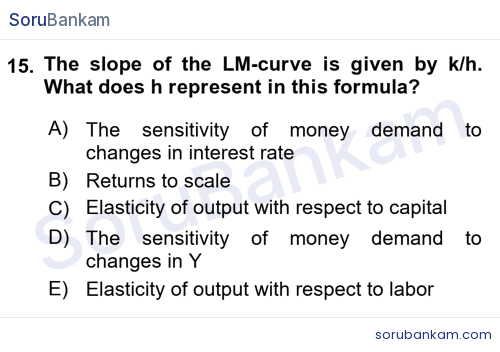
The slope of the Li-curve is given by kih. What does h represent in this formula? A) The sensitivity of money demand to changes in interest rate B) Returns to scale C) Elasticity of output with respect to capital D) The sensitivity of money demand to changes in E) Elasticity of output with respect to labor
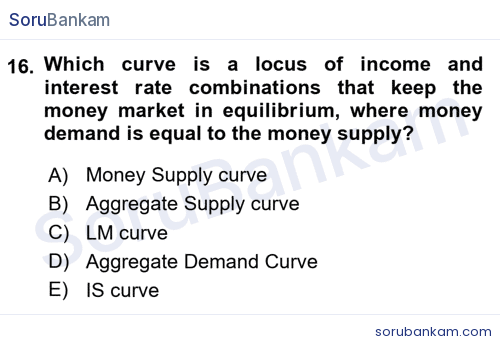
Which curve is a locus of income and interest rate combnations that keep the money market in equilibrium, where money demand is equal to the money supply? A) Money Supply curve B) Aggregate Supply curve C) LM curve D) Aggregate Demand Curve E) IS curve
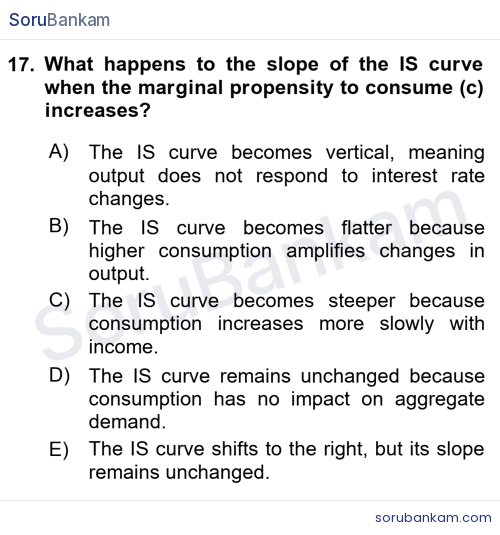
What happens to the slope of the IS curve when the marginal propensity to consume (c) increases? A) The IS curve becomes vertical, meaning output does not respond to interest rate changes. B) The IS curve becomes flatter because higher consumption amplifies changes in output. C) The IS curve becomes steeper because consumption increases more slowly with income. D) The IS curve remains unchanged because consumption has no impact on aggregate demand. E) The IS curve shifts to the right, but its slope remains unchanged.
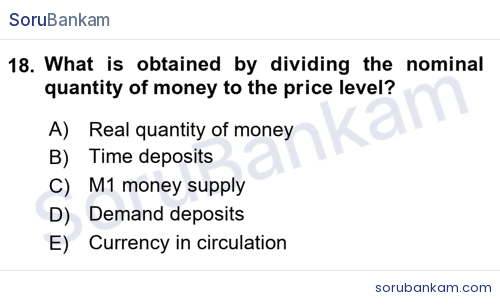
What is obtained by dividing the nominal quantity of money to the price level? A) Real quantity of money B) Time deposits C) M1 money supply D) Demand deposits INTI E) Currency in circulation
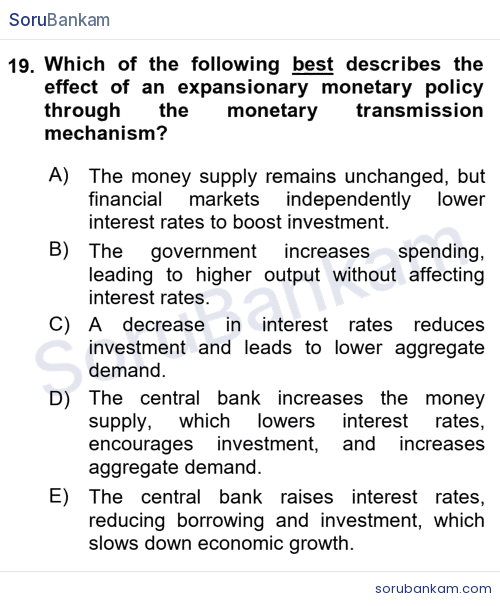
Which of the following best describes the effect of an expansionary monetary policy through the monetary, transmission A) mechanism? *A The money supply remains unchanged, but financial markets independently lower interest rates to boost investment. B) The government increases spending, leading to higher output without affecting interest rates. C) A decrease in interest rates reduces investment and leads to lower aggregate demand. D) The central bank increases the money supply, which lowers interest rates, encourages investment, and increases aggregate demand. E) The central bank raises interest rates, reducing borrowing and investment, which slows down economic growth.
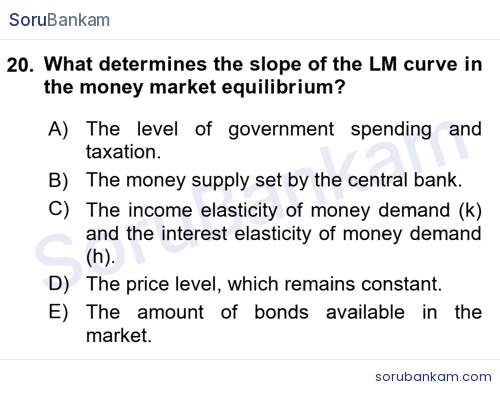
What determines the slope of the LM curve in the money market equilibrium? A) The level of government spending and taxation. B) The money supply set by the central bank," C) The income elasticity of money demand (k) and the interest elasticity of money demand (h). D) The price level, which remains constant. E) The amount of bonds available in the market.