IKT214U Macroeconomic Theory 2024-2025 Final Soruları
20 soru · Final · 2024-2025
IKT214U Macroeconomic Theory dersinin 2024-2025 final sınavı 20 sorudan oluşur; ders AÖF İktisat (İngilizce) bölümünde okutulur. Sorular aşağıda sırasıyla yer alır. Doğru cevaplar ve sonucun, testi çözdüğünde görünür.
Önizleme · 20 soru. Cevaplamak ve sonucunu görmek için sınavı başlat.
Sorular
20 soru
Soru 1
Soru 2
Soru 3
Soru 4
Soru 5
Soru 6
Soru 7
Soru 8
Soru 9
Soru 10
Soru 11
Soru 12
Soru 13
Soru 14
Soru 15
Soru 16
Soru 17
Soru 18
Soru 19
Soru 20
Sınav modunda süre tutulur, doğru cevaplar ve sonucun sınav bitince görünür.
Dersin üniteleri
IKT214U Macroeconomic Theory ders sayfası: bütün sınavlar ve üniteler
Soruların metni (otomatik okuma)
Görsellerden otomatik okunmuştur; hata içerebilir. Sorular, görsellerdeki hâliyle geçerlidir.
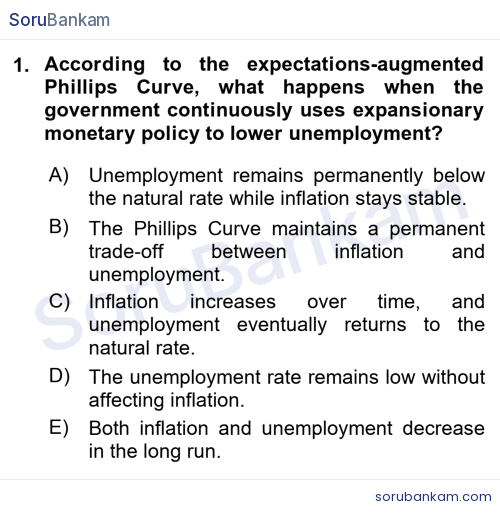
According to the expectations-augmented Phillips Curve, what happens when the government continuously uses expansionary monetary policy to lower unemployment? A) Unemployment remains permanently below the natural rate while inflation stays stable. B) The Phillips Curve maintains a permanent trade-off between inflation and unemployment. C) Inflation increases over time, and unemployment eventually returns to the natural rate. D) The unemployment rate remains low without affecting inflation. E) Both inflation and unemployment decrease in the long run.
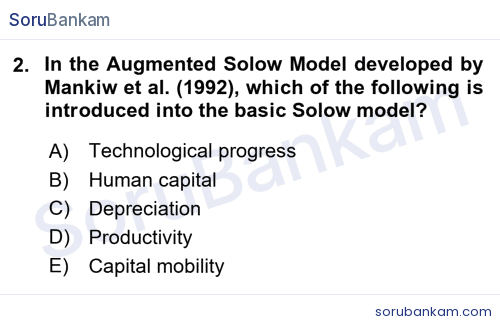
In the Augmented Solow Model developed by Mankiw et al. (1992), which of the following is introduced into the basic Solow model? A) Technological progress B) Human capital C) Depreciation D) Productivity E) Capital mobility
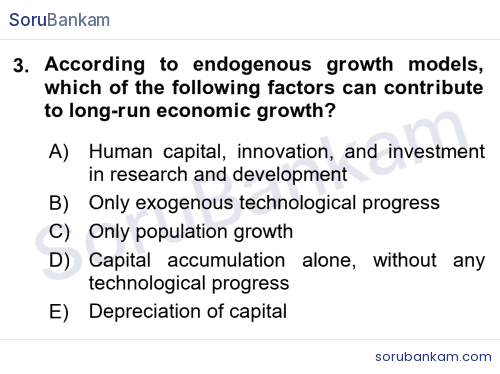
According to endogenous growth models, which of the tollowing factors can contribute to long-run econamic growth? A) Human capital, innovation, and investment in research and development B) Only exogenous technological progress C) Only population growth D) Capital accumulation alone, without any j. technological progress E) d YE) Depreciation of capital
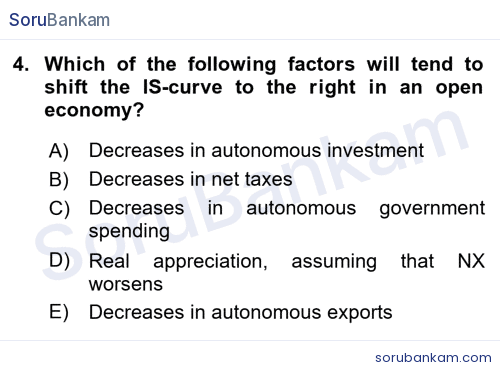
Which of the following factors will tend to shift the IS-curve to the right in an open economy? A) Decreases in autonomous investment B) Decreases in net taxes C) Decreases in autonomous government spending D) Real appreciation, assuming that NX worsens E) Decreases in autonomous exports
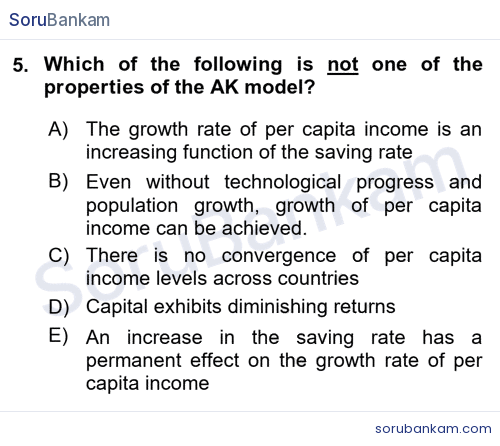
Which of the following is not one of the properties of the AK model? A) The growth rate of per capita income is an increasing function of the saving rate B) Even without technological progress and population growth, growth of per'capita income can be achieved. C) There is no convergence of per capita income levels across countries D) Capital exhibits diminishing returs E) An increase in the saving rate has a permanent effect on the growth rate of per capita income
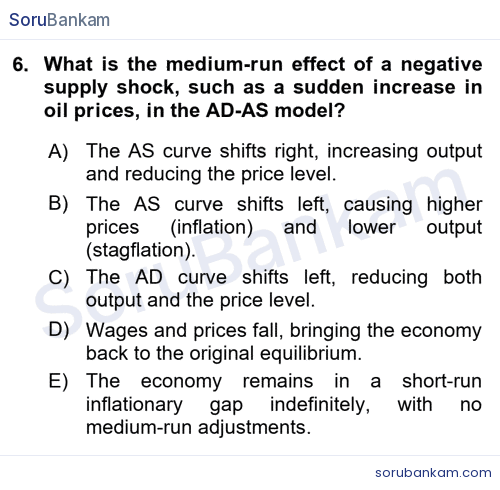
What is the medium-run effect of a negative supply shock, such as a sudden increase in oil prices, in the AD-AS model? A) The AS curve shifts right, increasing output ' • and reducing the price level. B) The AS curve shifts left, causing higher prices (inflation) and tower output (stagflation). C) ę) Ther "AD curve shifts left, reducing both output and the price level. D) Wages and prices fall, bringing the economy back to the original equilibrium. E) The economy remains in a short-run inflationary gap indefinitely, with medium-run adjustments.
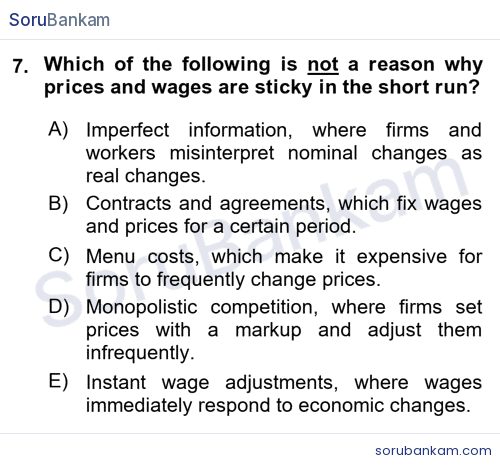
Which of the following is not a reason why prices and wages are sticky in the short run? A) Imperfect information, where firms and workers misinterpret nominal changes as real changes. B) Contracts and agreements, which fix wages and prices for a certain period. C) Menu costs, which make it expensive for firms to frequently change prices. D) Monopolistic competition, where firms set prices with a markup and adjust them infrequently. E) Instant wage adjustments, where wages immediately respond to economic changes.
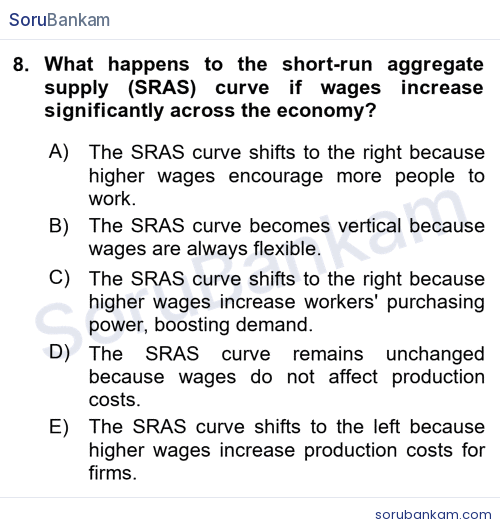
What happens to the short-run aggregate supply (SRAS) curve if wages increase significantly across the economy? A) The SRAS curve shifts to the right because higher wages encourage more people to work. B) The SRAS curve becomes vertical because wages are always flexible. C) The SRAS curve shifts to the right because higher wages increase workers' purchasing power, boosting demand. D) The SRAS curve remains unchanged because wages do not affect production costs. E) The SRAS curve shifts to the left because higher wages increase production costs for firms.
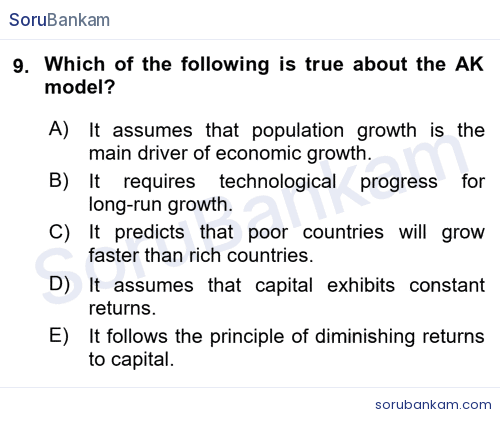
Which of the following is true about the AK model? A) It assumes that population growth is the main driver of economic growth. B) It requires technological progress i forl long-run growth. C) It predicts that poor countries will grow faster than rich countries. D) It assumes that capital exhibits constant returns. E) It follows the principle of diminishing retums to capital.
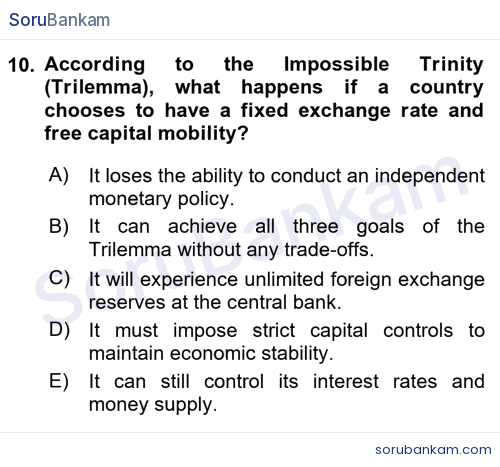
10. According to the Impossible Trinity (Trilemma), what happens if a country chooses to havęà fixed excharge rate and free capital mobility? A) It loses the ability to conduct an independent monetary policy. It can achieve all three goals of the Trilemma without any trade-offs. C) It will experience unlimited foreign exchange V. reserves at the central bank. D) It must impose, strict capital controls to maintain economic stability It can still control its interest rates and money supply.
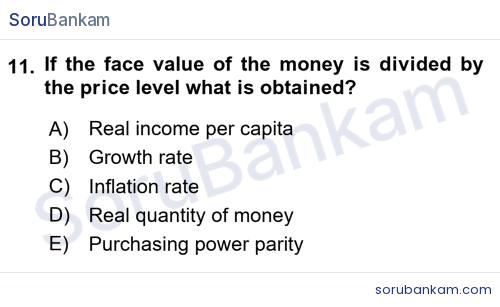
If the face value of the money is divided by the price level what is obtalned? A) Real income per capita B) Growth rate C) Inflation rate D) Real quantity of money E) E Purchasing power parity
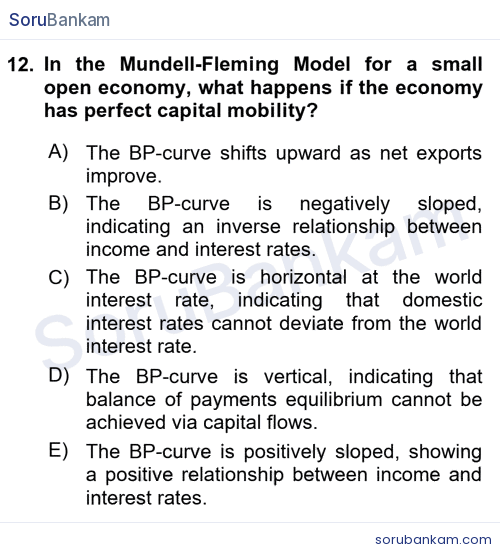
In the Mundell-Fleming Model for a small. open economy, what happens if the economy has perfect capital mobility? A) The BP-curve shifts upward as net exports improve. B) The BP-curve is negatively . sloped, indicating an inverse relationship between income and interest rates. C) The BP-curve is horizontal at the world interest rate, indicating that domestic interest rates cannot deviate from the world interest rate. • D) The BP-curve is vertical, indicating that balance of payments equilibrium cannot be achieved via capital flows. E) The BP-curve is positively sloped, showing a positiye relationship between income and interest rates.
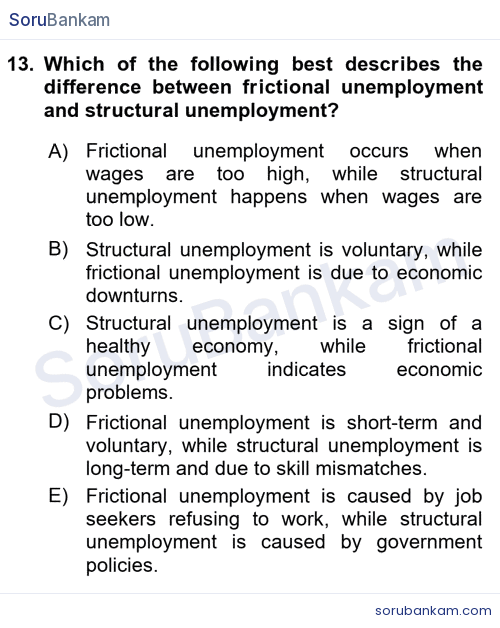
Which of the following best describes the difference between frictional unemployment and structural unemployment? A) Frictional unemployment occurs when wages are too high, while structural unemployment happens when wages are too low. B) Structural unemployment is voluntary, while frictional unemployment is due to economic y.d downturns. C) Structural unemployment is a sign of a healthy economy. while frictional unemployment indicates economic problems. D) Frictional unemployment is short-term and voluntary, while structural unemployment is long-term and due to skill mismatches. E) Frictional unemployment is caused by job. seekers refusing to work, while structural unemployment is caused by goverment policies.
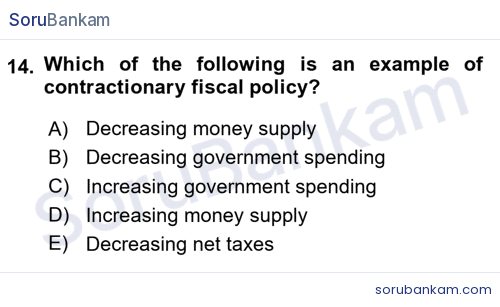
Which of the following is an example of contractionary fiscal policy? A) Decreasing money supply B) Decreasing government spending C) Increasing goverment spending D) Increasing money supply E) Decreasing net taxes
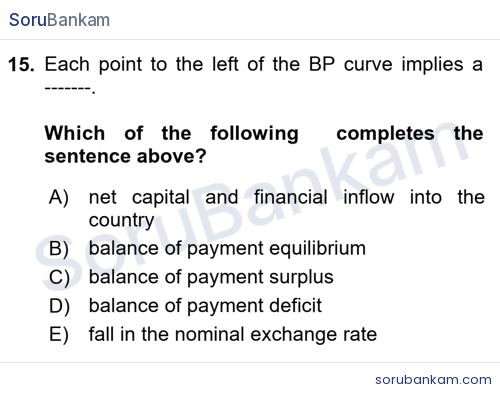
15. Each point to the left of the BP curve implies a -----. Which of the following completes the sentence above? A) net capital and financial inflow into the country balance of payment equilibrium C) balance of payment surplus D) balance of payment deficit E) fall in the nominal exchange rate
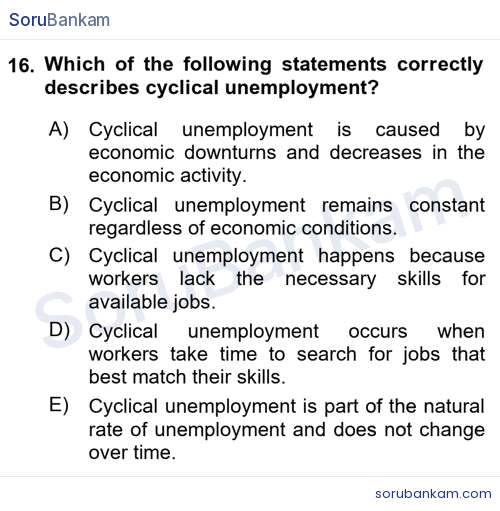
16. Which of the following statements correctly describes cyclical unemployment? A) Cyclical unemployment is caused by economic downturns and decreases in the economic activity. Cyclical unemployment remains constant regardless of economic conditions. C) Cyclical unemployment happens because workers lack the necessary skills for available jobs. D) Cyclical unemployment occurs when workers take time to search for jobs that best match their skills. E) Cyclical unemployment is part of the natural rate of unemployment and does not change over time.
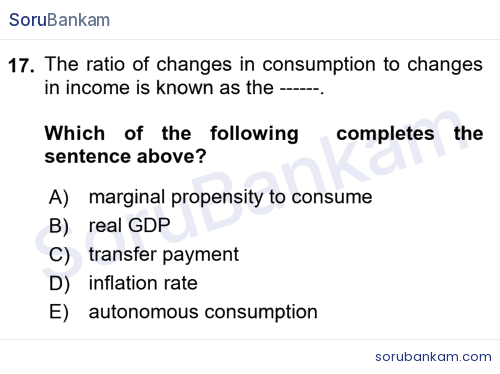
The ratio of changes in consumption to changes in income is known as the - Which of the following completes the sentence above? A) marginal propensity to consume B) real GDP C) transfer payment D) inflation rate E) autonomous consumption
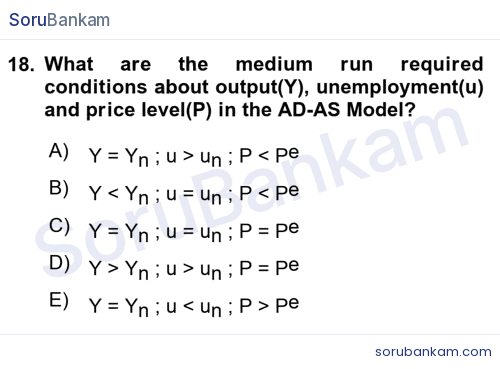
What 18. What are the medium run required required conditions about output(Y), unemployment(u) and price level(P) in the AD-AS Model? A) Y=Yn;u>Un;P<pe B) Y<Yn; u= un; P<pe C) Y= Yn:u=Un;P=pe D) Y> Yn;u>un;P=pe E) Y= Yn; 4<un;P>pe
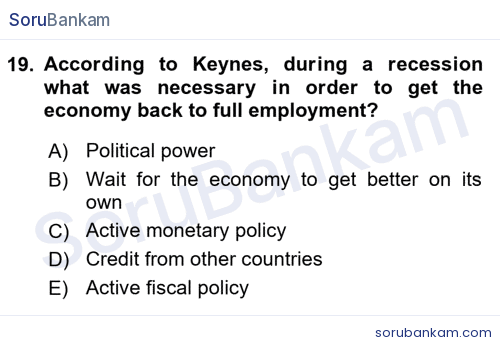
According to Keynes, during a recession what was necessary in order to get the economy back to full employment? A) Political power B) Wait for the economy to get better on uts own C) Active monetary policy D) Credit from other countries E) Active fiscal policy
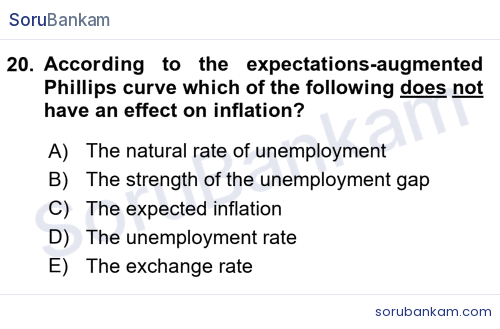
According to the expectations-augmented Phillips curve which of the following goes not have an effect on inflation? A) The natural rate of unemployment B) The strength of the unemployment gap C) The expected inflation D) The unemployment rate E) The exchange rate