HUK113U Introduction to Law 2017-2018 Final Soruları
20 soru · Final · 2017-2018
HUK113U Introduction to Law dersinin 2017-2018 final sınavı 20 sorudan oluşur; ders AÖF İktisat (İngilizce) bölümünde okutulur. Sorular aşağıda sırasıyla yer alır. Doğru cevaplar ve sonucun, testi çözdüğünde görünür.
Önizleme · 20 soru. Cevaplamak ve sonucunu görmek için sınavı başlat.
Sorular
20 soru
Soru 1
Soru 2
Soru 3
Soru 4
Soru 5
Soru 6
Soru 7
Soru 8
Soru 9
Soru 10
Soru 11
Soru 12
Soru 13
Soru 14
Soru 15
Soru 16
Soru 17
Soru 18
Soru 19
Soru 20
Sınav modunda süre tutulur, doğru cevaplar ve sonucun sınav bitince görünür.
Dersin üniteleri
Ünite özetleri ve konu anlatımları
- 1. Ünite: Fundamental Concepts Of Law
- 2. Ünite: Legal Methods
- 3. Ünite: Introduction To Human Rights Law
- 4. Ünite: Introduction To Administrative Law
- 5. Ünite: Criminal Law
- 6. Ünite: Introduction To Civil Law
- 7. Ünite: Law Of Civil Procedure, Compulsory Enforcement And Bankruptcy
- 8. Ünite: Commercial Law İn Turkey With Specific Reference To Rules Related To Competition İn Turkish Legal System
HUK113U Introduction to Law ders sayfası: bütün sınavlar ve üniteler
Soruların metni (otomatik okuma)
Görsellerden otomatik okunmuştur; hata içerebilir. Sorular, görsellerdeki hâliyle geçerlidir.
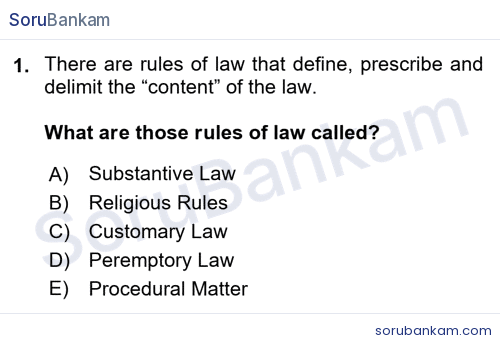
There are rules of law that define, prescribe and delimit the "content" of the law. What are those rules of law called? A) Substantive Law B) Religious Rules C) Customary Law D) Peremptory Law E) Procedural Matter
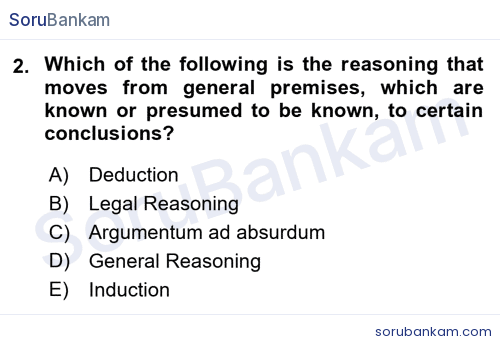
Which of the following is the reasoning that moves from general premises, which are known or presumed to be known, to certain conclusions? A) Deduction B) Legal Reasoning C) Argumentum ad absurdum D) General Reasoning E) Induction
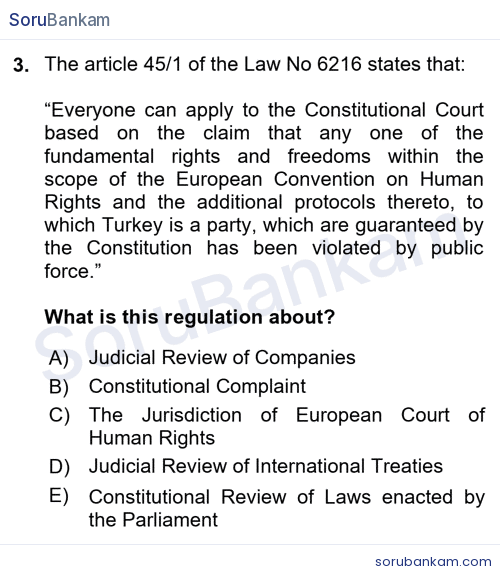
The article 45/1 of the Law No 6216 states that: "Everyone can apply to the Constitutional Court based on the claim that any one of the fundamental rights and freedoms within the d'vscope of the European Convention on Human Rights and the additional protocols thereto, to which Turkey is a party, which are guaranteed by the Constitution has been violated by public force." What is this regulation about? A) Judicial Review of Companies B) Constitutional Complaint C) The Jurisdiction of European Court of Human Rights D) Judicial Review of International Treaties E) Constitutional Revlew of Laws enacted by the Parliament
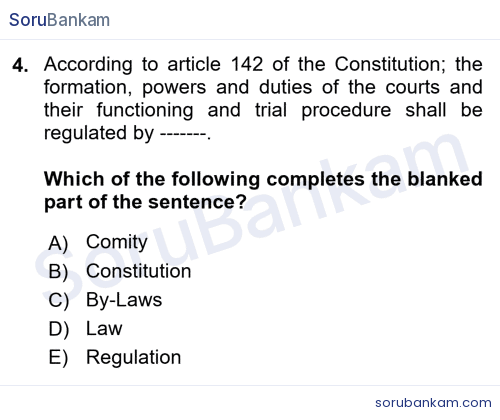
According to article 142 of the Constitution; the formation, powers and duties of the courts and their functioning and trial procedure shall be regulated by --. Which of the following completes the blanked part of the sentence? A) Comity B) Constitution C) By-Laws D) Law E) Regulation
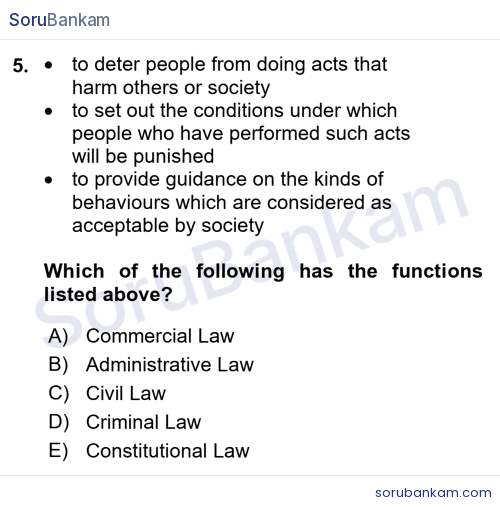
• to deter people from doing acts that harm others or society • to set out the conditions under which people who have performed such acts will be punished • to provide guidance on the kinds of behaviours which are considered as acceptable by society Which of the following has the functions listed above? A) Commercial Law B) Administrative Law C) Civil Law D) Criminal Law E) Constitutional Law
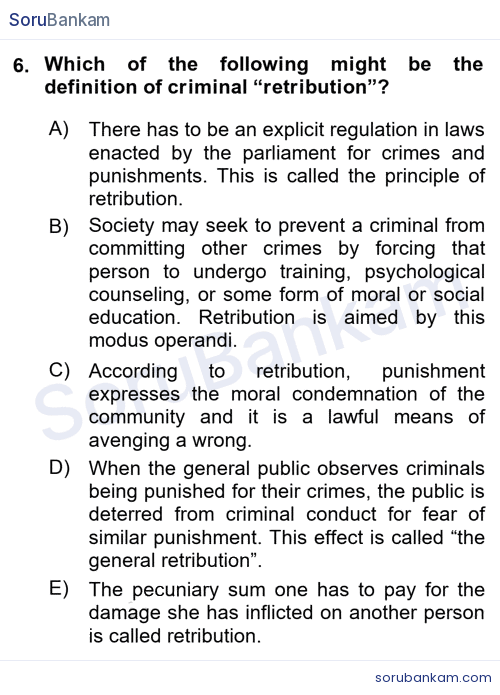
6. Which of the following might be the definition of criminal "retribution"? A) There has to be an explicit regulation in laws enacted by the parliament for crimes and punishments. This is called the principle of retribution. B) Society may seek to prevent a criminal from committing other crimes by forcing that person to undergo training, psychological counseling, or some form of moral or social education. Retribution is aimed by this modus operandi. C) According to retribution, punishment expresses the moral condemnation of the community and it is a lawful means of avenging a wrong. D) When the general public observes criminals being punished for their crimes, the public is deterred from criminal conduct for fear of similar punishment. This effect is called "the general retribution" The pecuniary sum one has to pay for the damage she has inflicted on another person is called retribution.
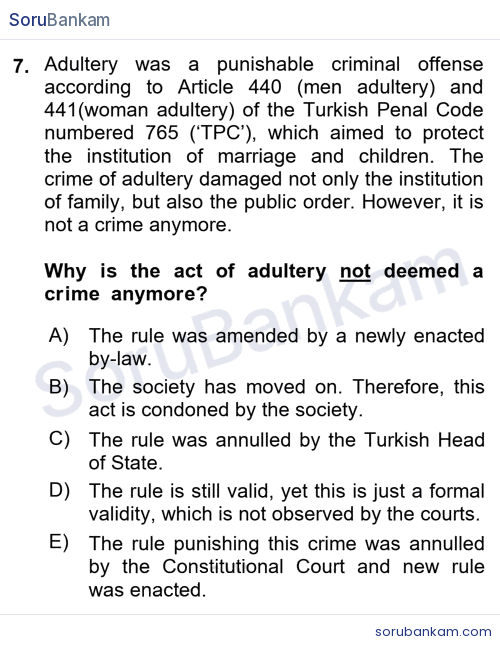
Adultery was a punishable criminal offense according to Article 440 (men adultery) and 441 (woman aduitery) of the Turkish Penal Code numbered 765 (TPC'), which aimed to protect the institution of marriage and children. The , crime of adultery damaged not only the institution of family, but also the public order. However, it is not a crime anymore. Why is the act of adultery not deemed a crime anymore? A) The rule was amended by a newly enacted by-law. B) The society has moved on. Therefore, this act is condoned by the society. C) The rule was annulled by the Turkish Head of State. D) The rule is still valid, yet this is just a formal validity, which is not observed by the courts. E) The rule punishing this crime was annulled by the Constitutional Court and new rule was enacted.
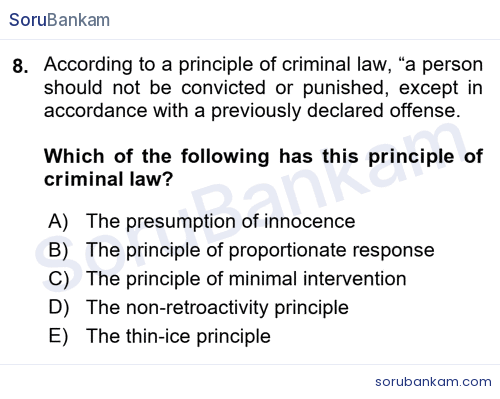
According to a principle of criminal law, "a person should not be convicted or punished, except in accordance with a previously declared offense. Which of the following has this principle of criminal law? A) The presumption of innocence B) The principle of proportionate response C) The principle of minimal intervention D) The non-retroactivity principle E) The thin-ice principle
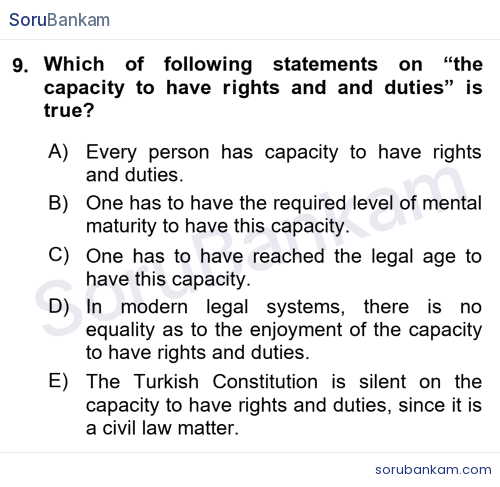
Which of following statements on "the capacity to have rights and and dutles" Is true? A) Every person has capacity to have rights • and duties. B) One has to have the required level of mental maturity to have this capacity. C) One has to have reached the legal age to have this capacity. D) In modern legal systems, there is no equality as to the enjoyment of the capacity to have rights and duties. E) The Turkish Constitution is silent on the capacity to have rights and duties, since it is a civil law matter.
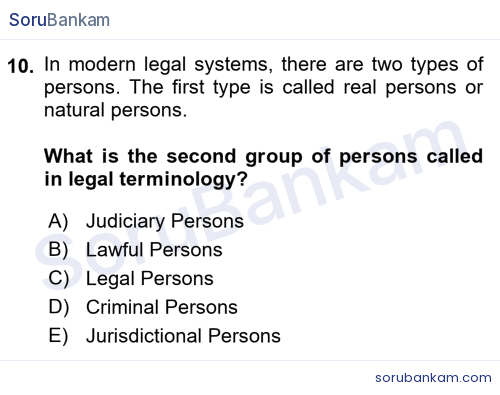
In modern legal systems, there are two types of persons. The first type is called real persons or natural persons. What is the second group of persons called in legal terminology? A) Judiciary Persons B) Lawful Persons C) Legal Persons D) Criminal Persons E) Jurisdictional Persons
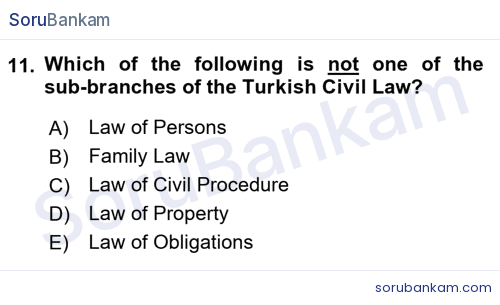
Which of the following is not one of the sub-branches of the Turkish Civil Law? A) Law of Persons B) Family Law C) Law of Civil Procedure D) Law of Property E) Law of Obligations
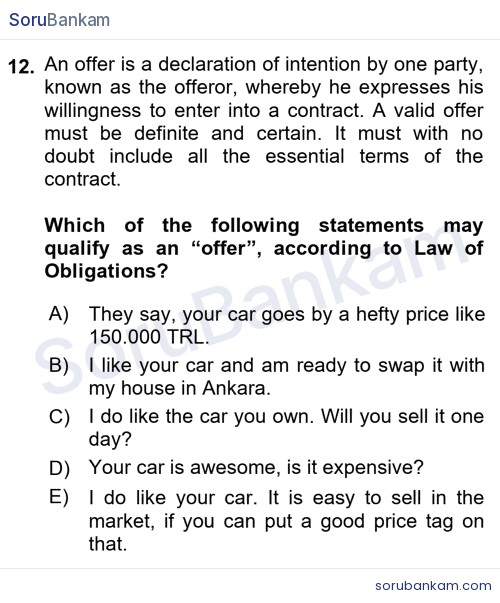
12. An offer is a declaration of intention by one party, known as the offeror, whereby he expresses his willingness to enter into a contract. A valid offer must be definite and certain. It must with no doubt include all the essential terms of the contract. Which of the following statements may qualify as an "offer", according to Law of Obligations? A) They say, your car goes by a hefty price like 150.000 TRL. I like your car and am ready to swap it with my house in Ankara. C) I do like the car you own. Will you sell it ne day? D) Your car is awesome, is it expensive? E) I do like your car. It is easy to sell in the market, if you can put a good price tag on that.
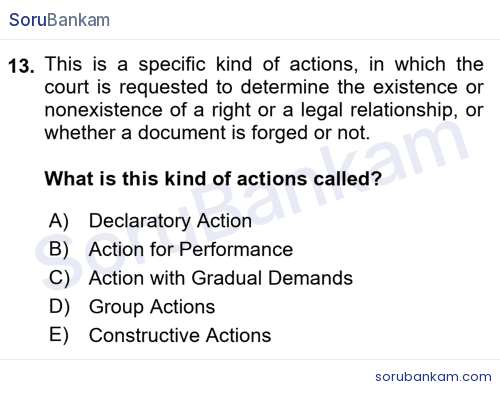
This is a specific kind of actions, in which the court is requested to determine the existence or nonexistence of a right or a legal relationship, or whether a document is forged or not. What is this kind of actions called? A) Declaratory Action B) Action for Performance C) Action with Gradual Demands D) Group Actions E) Constructive Actions
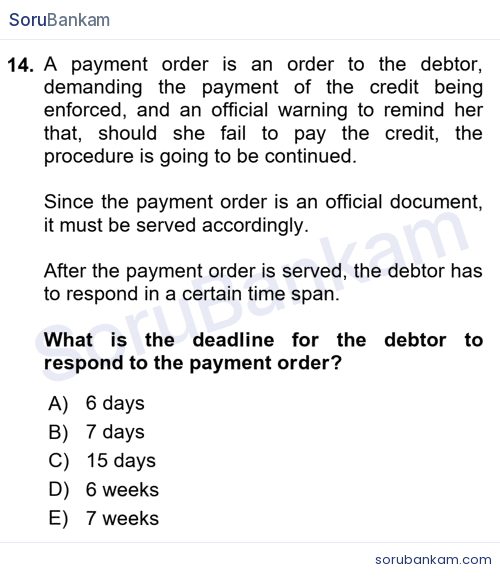
A payment order is an order to the debtor, demanding the payment of the credit being enforced, and an official warning to remind her that, should she fail to pay the credit, the procedure is going to be continued. Since the payment order is an official document, it must be served accordingly. After the payment order Is served, the debtor has to respond in a certain time span. What is the deadline for the debtor to respond to the payment order? A) 6 days B) 7 days C) 15 days D) 6 weeks E) 7 weeks
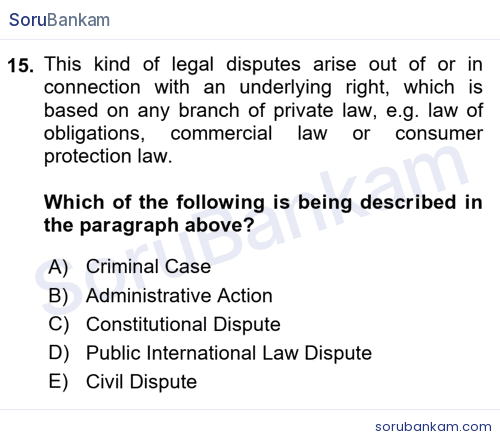
This kind of legal disputes arise out of or in connection with an underlying right, which is based on any branch of private law, e.g. law of obligations;, commercial law or consumer protection law. Which of the following is being described in the paragraph above? A) Criminal Case B) Administrative Action C) Constitutional Dispute D) Public International Law Dispute E) Civil Dispute
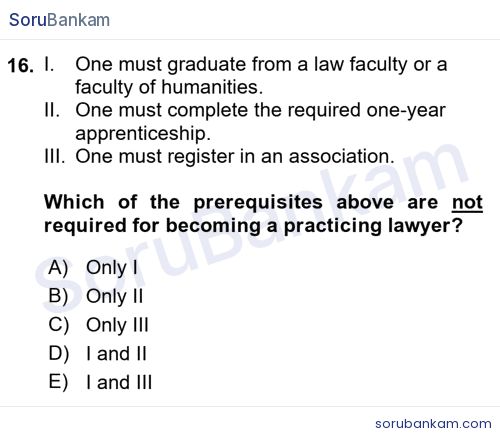
I. One must graduate from a law faculty or a faculty of humanities. II. One must complete the required one-year apprenticeship. III. One must register in an association. Which of the prerequisites above are not required for becoming a practicing lawyer? A) Only B) Only C) Only ill D) land E) I and IIf
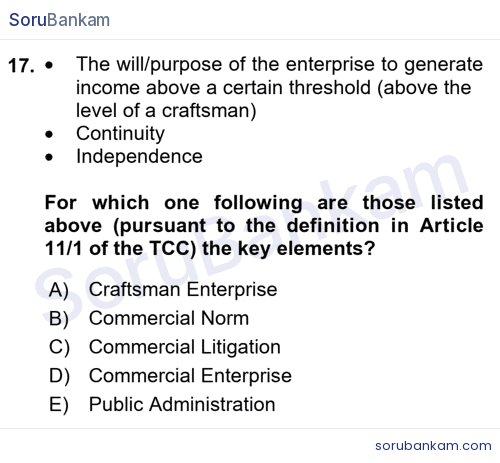
• The will/purpose of the enterprise to generate income above a certain threshold (above the level of a craftsman) • Continuity • Independence For which one following are those listed above (pursuant to the definition In Article 11/1 of the TCC) the key elements? A) Craftsman Enterprise B) Commercial Norm C) Commercial Litigation D) Commercial Enterprise E) Public Administration
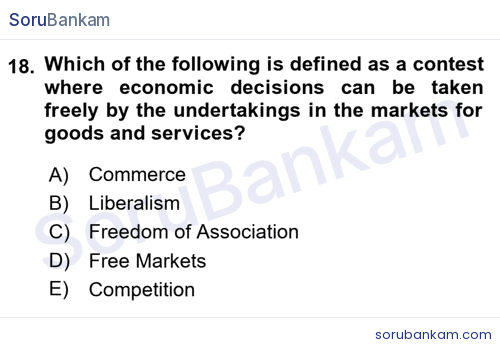
Which of the following is defined as a contest where economic decisions can be taken freely by the undertakings in the markets for goods and services? A) Commerce B) Liberalism C) Freedom of Association D) Free Markets E) Competition
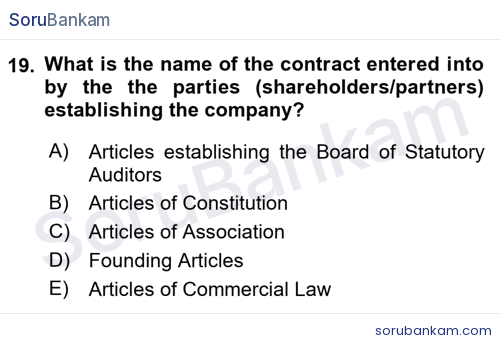
What is the name of the contract entered into by the the parties (shareholders/partners) establishing the company? A) Articies establishing the Board of Statutory Auditors B) Articles of Constitution C) Articles of Association D) Founding Articles E) Articles of Commercial Law
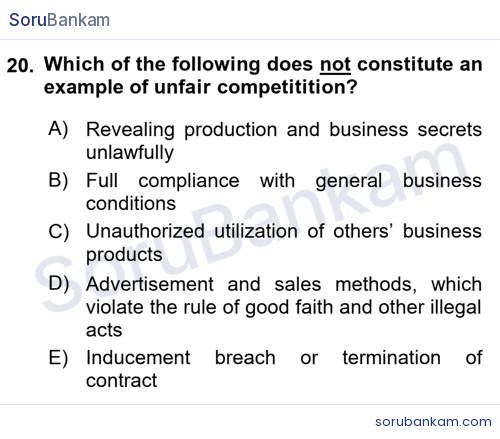
Which of the following does not constitute an example of unfair competitition? A) Revealing production and business secrets unlawfully B) Full compliance with general business conditions C) Unauthorized utilization of others' business products D) Advertisement and sales methods, which violate the rule of good faith and other illegal acts E) Inducement breach or termination of contract