HUK113U Introduction to Law 2023-2024 Vize Soruları
20 soru · Vize · 2023-2024
HUK113U Introduction to Law dersinin 2023-2024 vize sınavı 20 sorudan oluşur; ders AÖF İktisat (İngilizce) bölümünde okutulur. Sorular aşağıda sırasıyla yer alır. Doğru cevaplar ve sonucun, testi çözdüğünde görünür.
Önizleme · 20 soru. Cevaplamak ve sonucunu görmek için sınavı başlat.
Sorular
20 soru
Soru 1
Soru 2
Soru 3
Soru 4
Soru 5
Soru 6
Soru 7
Soru 8
Soru 9
Soru 10
Soru 11
Soru 12
Soru 13
Soru 14
Soru 15
Soru 16
Soru 17
Soru 18
Soru 19
Soru 20
Sınav modunda süre tutulur, doğru cevaplar ve sonucun sınav bitince görünür.
Dersin üniteleri
Ünite özetleri ve konu anlatımları
- 1. Ünite: Fundamental Concepts Of Law
- 2. Ünite: Legal Methods
- 3. Ünite: Introduction To Human Rights Law
- 4. Ünite: Introduction To Administrative Law
- 5. Ünite: Criminal Law
- 6. Ünite: Introduction To Civil Law
- 7. Ünite: Law Of Civil Procedure, Compulsory Enforcement And Bankruptcy
- 8. Ünite: Commercial Law İn Turkey With Specific Reference To Rules Related To Competition İn Turkish Legal System
HUK113U Introduction to Law ders sayfası: bütün sınavlar ve üniteler
Soruların metni (otomatik okuma)
Görsellerden otomatik okunmuştur; hata içerebilir. Sorular, görsellerdeki hâliyle geçerlidir.
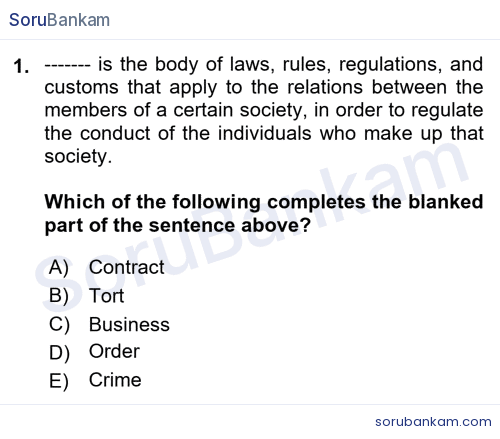
- is the body of laws, rules, regulations, and customs that apply to the relations between the members of a certain society, in order to regulate the conduct of the individuals who make up that society: Which of the following completes the blanked part of the sentence above? A) Contract B) Tort C) Business D) Order E) Crime
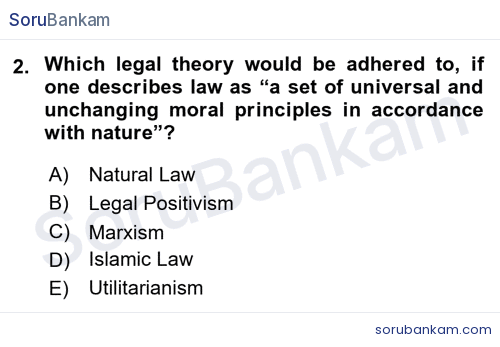
Which legal theory would be adhered to, if one describes law as *a set of universal and unchanging moral principles in accordance with nature"? A) Natural Law B) Legal Positivism C) Marxism D) Islamic Law E) Utilitarianism
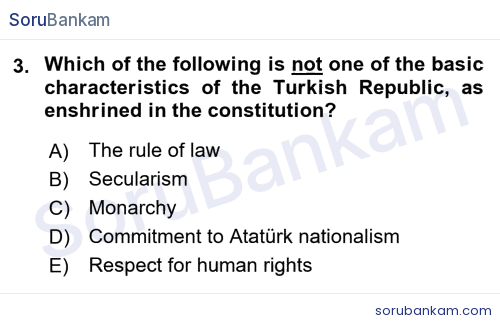
Which of the following is not one of the basia characteristics of the Turkish Repyblic, enshrined in the constitution? A) The rule of law B) Secularism C) Monarchy D) Commitment to Atatürk nationalism E) Respect for human rights
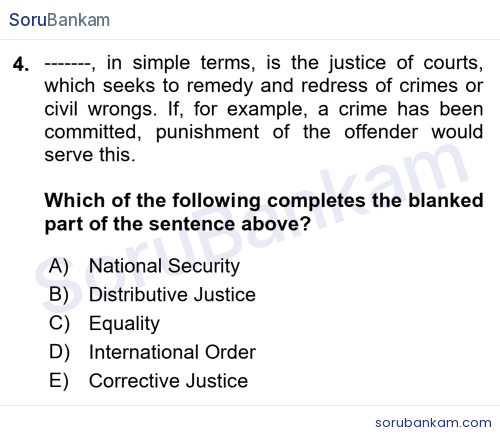
--, in simple terms, is the justice of courts, which seeks to remedy and redress of crimes or civil wrongs. If, for example, a crime has been committed, punishment of the offender would serve this. Which of the following completes the blanked part of the sentence above? A) National Security B) Distributive Justice C) Equality D) International Order E) Corrective Justice
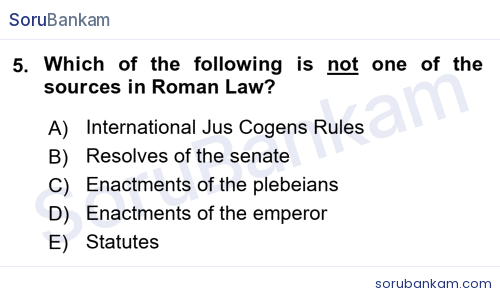
Which of the following is not one of the sources in Roman Law? A) International Jus Cogens Rules B) Resolves of the senate C) Enactments of the plebeians D) Enactments of the emperor .. E) Statutes
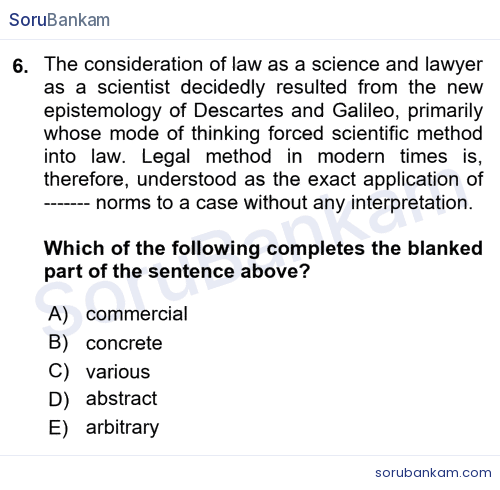
The consideration of law as a science and lawyer as a scientist decidedly resulted from the new epistemology of Descartes and Galileo, primarily whose mode of thinking forced scientific method into law." Legal method 'ih modern times is, therefore, understood as the exact application of - norms to a case without any interpretation. Which of the following completes the blanked part of the sentence above? A) commercial B) concrete C) various D) . abstract E) arbitrary
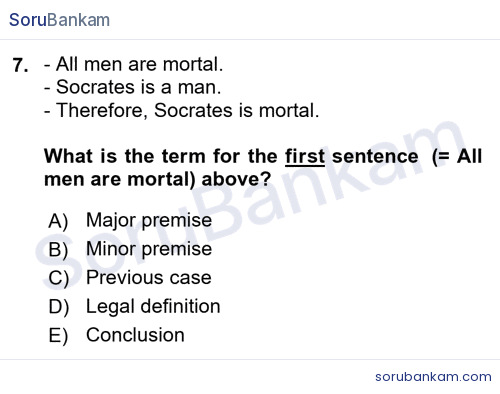
- All men are mortal. - Socrates is a man. - Therefore, Socrates is mortal. What is the term for the first sentence (= All men are mortal) above? A) Major premise B) Minor premise C) Previous case D) Legal definition E) Conclusion
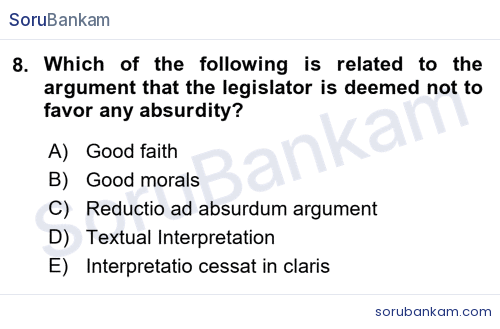
Which of the following is related to the argument that the legislator is deemed not to favor any absurdity? A) Good faith B) Good morals C) Reductio ad absurdum argument D) Textual Interpretation E) Interpretatio cessat in claris
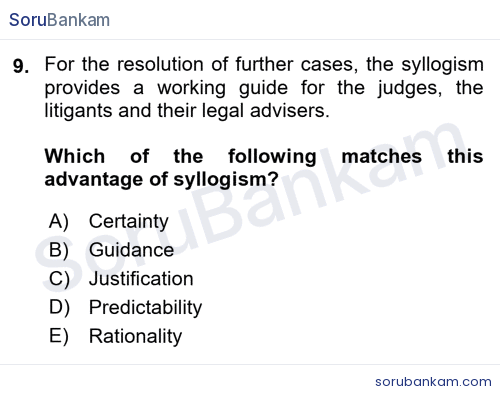
For the resolution of further cases, the syllogism provides a working guide for the judges, the litigants and their legal advisers. Which of the following matches this advantage of syllogism? A) Certainty B) Guidance C) Justification D) Predictability E) Rationality
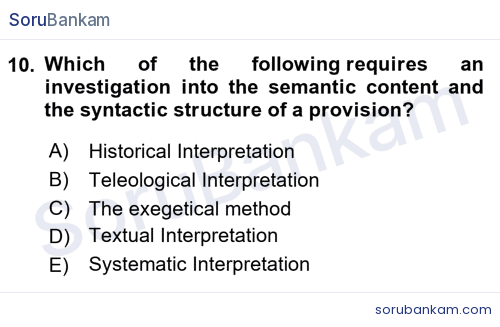
10. Which the following requires investigation into the semantic content and the syntactic structure of a provision? A) Historical Interpretation Teleological Interpretation The exegetical method D) Textual Interpretation E) Systematic Interpretation
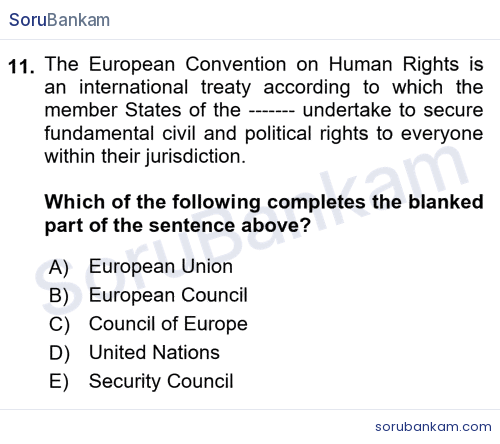
The European convention on Human Righs s an international treaty according to which the member States of the - undertake to secure fundamental civil and political rights to everyone within their jurisdiction. 7. Which of the following completes the, blanked part of the sentence above? A) European Union •4 B) European Council n. C) Council of Europe D) United Nations E) Security Council \
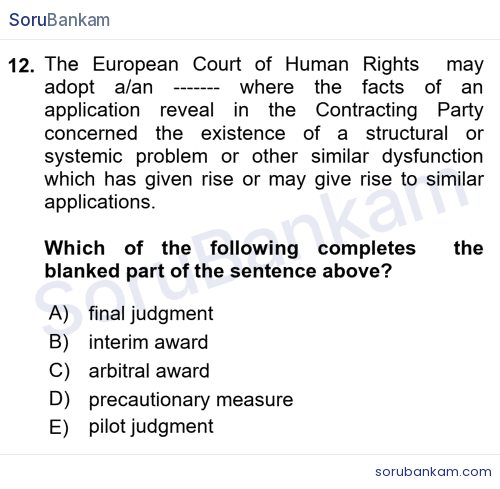
The European Court of Human Rights may adopt alan - where the facts of an application reveal in the Contracting Party concerned the existence of a structural or systemic problem or other similar dysfunction which has given rise or may give rise to similar applications. Which of the following completes the blanked part of the sentence above? A) final judgment B) interim award C) arbitral award D) precautionary measure E) pilot judgment
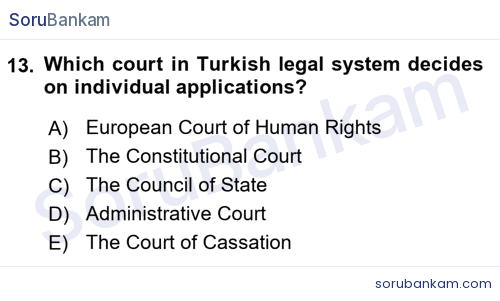
Which court in Turkish legal system decides on individual applications? A) European Court of Human Rights B) The Constitutional Court C) The Council of State D) Administrative Court .. E) The Court of Cassation
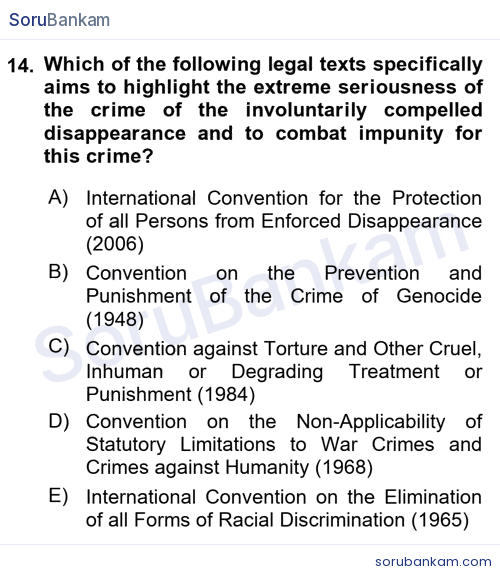
14. Which of the following legal texts specifically aims to highlight the extreme seriousness of the crime of the Involuntarily compelled disappearance and to combat impunity for this crime? A) International Convention for the Protection of all Persons from Enforced Disappearance (2006) B) Corvention the Prevention and * Punishment of the Crime of Genocide (1948) 6) nonvention against Torture and Other Cruel, Treatment or Degrading Punishment (1984) Convention …on the Non-Applicability of Statutory Limitations to War Crimes and Crimes against Humanity (1968) E) International Convention on the Elimination of all Forms of Racial Discrimination (1965)
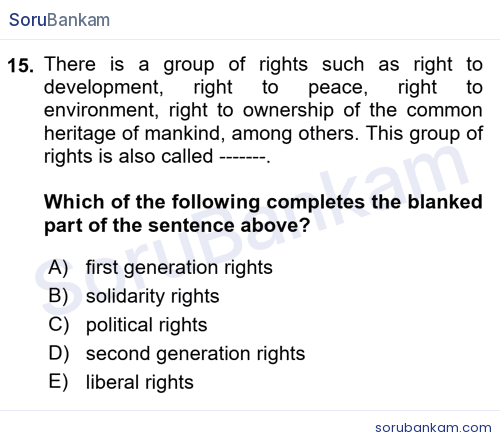
There is a group of rights such as right to development, right to peace, right to environment, right to ownership of the common heritage of mankind, among others. This group of rights is atso called -_. Which of the following completes the blanked part of the sentence above? A) first generation rights B) solidarity rights C) political rights D) second generation nghts E) liberal rights
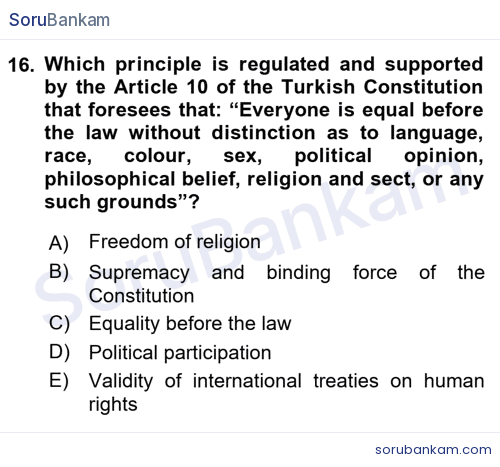
Which principle is regulated and supported by the Article 10 of the Turkish Constitution that foresees that: "Everyone is equal before the law without distinction as to language, race, colour, sex, political opinion, philosophical belief, religion and sect, or any such grounds"? A) Freedom of religion B) Supremacy and binding force of the Constitution C) Equality before the law D) Political participation E) Valldity of international treaties on human rights
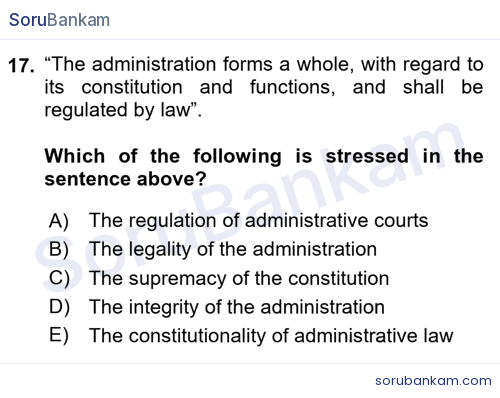
"The administration forms a whole, with regard to its constitution and functions, and shall be regulated by law". Which of the following is stressed in the sentence above? A) The regulation of administrative courts B) The legality of the administration C) The supremacy of the constitution D) The integrity of the administration E) The constitutionality of administrative law
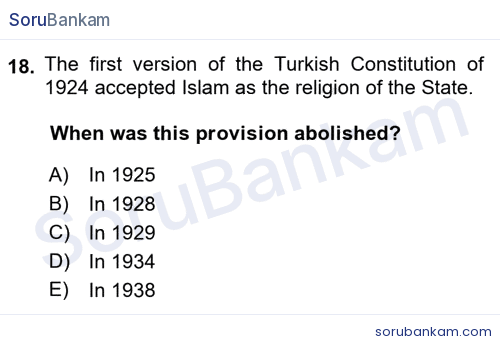
The first version of the Turkish Constitution of 1924 accepted Islam as the religion of the State. When was this provision abolished? A) In 1925 B) In 1928 C) In 1929 D) In 1934 E) In 1938
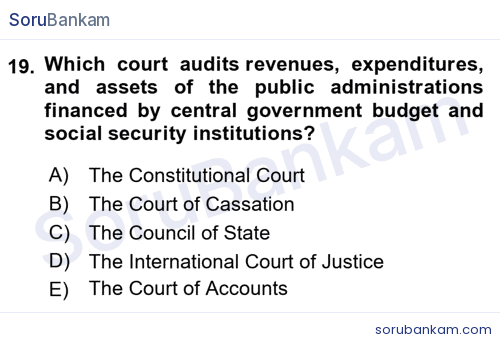
Which court audits revenues, expenditures, and assets of the public administrations financed by central government budget and social security institutions? A) The Constitutional Court B) The Court of Cassation C) The Council of State D) The International Court of Justice E) The Court of Accounts
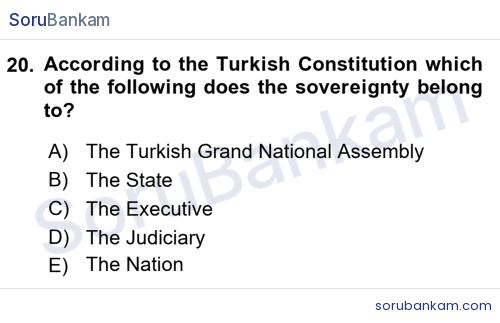
According to the Turkish Constitution which of the following does the sovereignty belong to? A) The Turkish Grand National Assembly B) The State C) The Executive D) The Judiciary E) The Nation