HUK113U Introduction to Law 2018-2019 Vize Soruları
20 soru · Vize · 2018-2019
HUK113U Introduction to Law dersinin 2018-2019 vize sınavı 20 sorudan oluşur; ders AÖF İktisat (İngilizce) bölümünde okutulur. Sorular aşağıda sırasıyla yer alır. Doğru cevaplar ve sonucun, testi çözdüğünde görünür.
Önizleme · 20 soru. Cevaplamak ve sonucunu görmek için sınavı başlat.
Sorular
20 soru
Soru 1
Soru 2
Soru 3
Soru 4
Soru 5
Soru 6
Soru 7
Soru 8
Soru 9
Soru 10
Soru 11
Soru 12
Soru 13
Soru 14
Soru 15
Soru 16
Soru 17
Soru 18
Soru 19
Soru 20
Sınav modunda süre tutulur, doğru cevaplar ve sonucun sınav bitince görünür.
Dersin üniteleri
Ünite özetleri ve konu anlatımları
- 1. Ünite: Fundamental Concepts Of Law
- 2. Ünite: Legal Methods
- 3. Ünite: Introduction To Human Rights Law
- 4. Ünite: Introduction To Administrative Law
- 5. Ünite: Criminal Law
- 6. Ünite: Introduction To Civil Law
- 7. Ünite: Law Of Civil Procedure, Compulsory Enforcement And Bankruptcy
- 8. Ünite: Commercial Law İn Turkey With Specific Reference To Rules Related To Competition İn Turkish Legal System
HUK113U Introduction to Law ders sayfası: bütün sınavlar ve üniteler
Soruların metni (otomatik okuma)
Görsellerden otomatik okunmuştur; hata içerebilir. Sorular, görsellerdeki hâliyle geçerlidir.
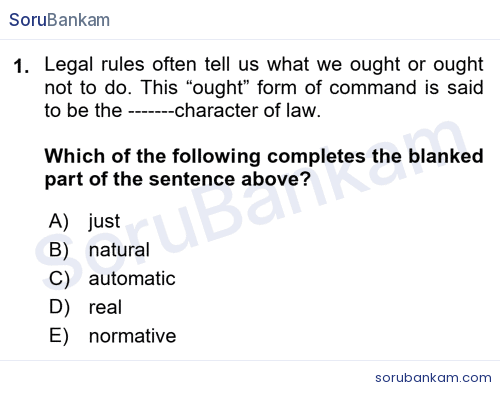
Legal rules often tell us what we ought or ought not to do. This "ought" form of command is said to be the ---character of law. Which of the following completes the blanked part of the sentence above? A) just B) natural C) automatic D) real E) normative
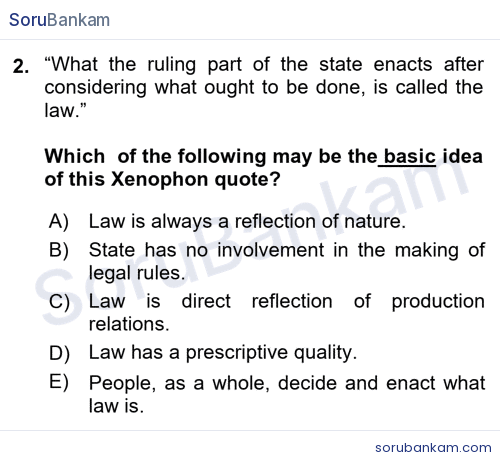
"What the ruling part of the state enacts after considering what ought to be done, is called the law." Which of the following may be the basic idea of this Xenophon quote? A) Law is always a reflection of nature. B) State has no involvement in the making of legal rules. C) Law is direct reflection production relations. D) Law has a prescriptive quality. E) People, as a whole, decide and enact what law is.
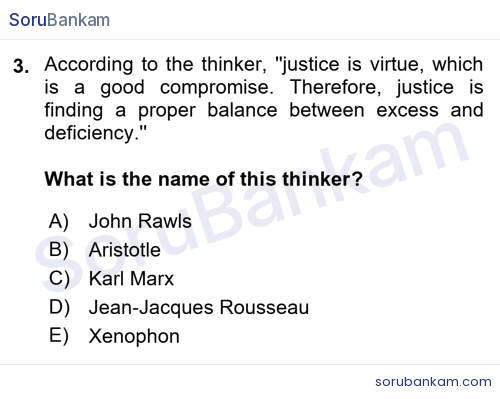
According to the thinker, "justice is virtue, which is a good compromise. Therefore, justice is finding a proper balance between excess and deficiency." What is the name of this thinker? A) John Rawls B) Aristotle C) Karl Marx D) Jean-Jacques Rousseau E) Xenophon
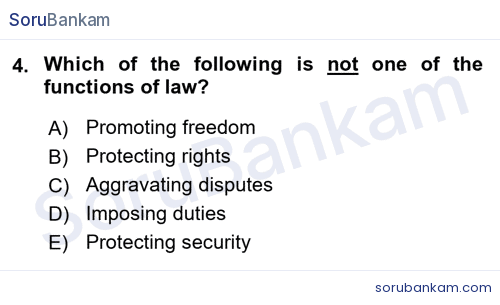
Which of the following is not one of the functions of law? A) Promoting freedom B) Protecting rights C) Aggravating disputes D) Imposing duties E) Protecting security
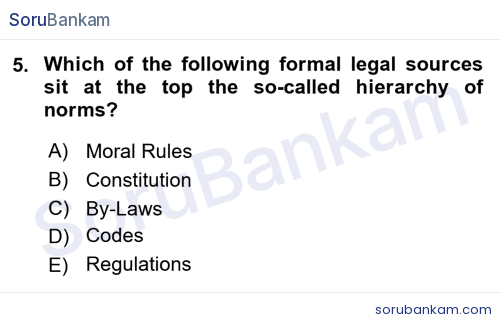
Which of the following formal legal sources sit at the top the so-called hierarchy of norms? A) Moral Rules liv B) i B) Constitution C) By-Laws D) Codes E) Regulations
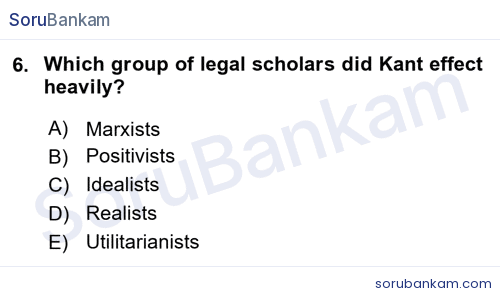
Which group of legal scholars did Kant effect heavily? A) Marxists B) Positivists C) Idealists D) Realists E) Utilitarianists
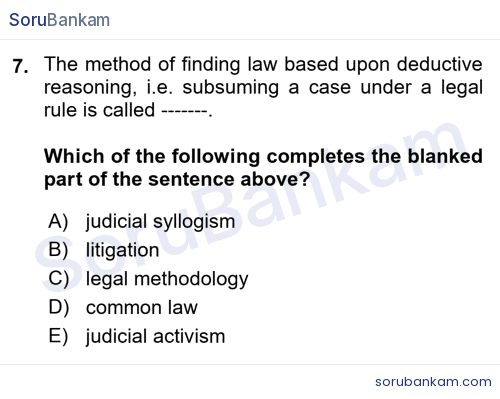
The method of finding law based upon deductive reasoning, i.e. subsuming a case under a legal rule is called --. Which of the following completes the blanked part of the sentence above? A) judicial syllogism B) litigation C) legal methodology D) common law E) judicial activism
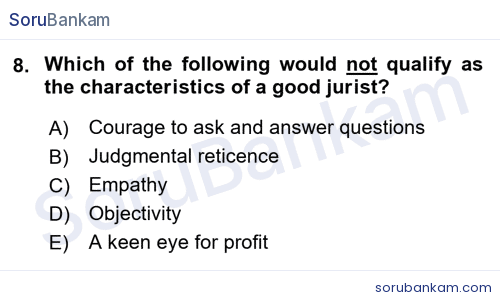
Which of the following would not qualify as the characteristics of a good jurist? A) Courage to ask and answer questions B) Judgmental reticence C) Empathy D) Objectivity E) A keen eye for profit
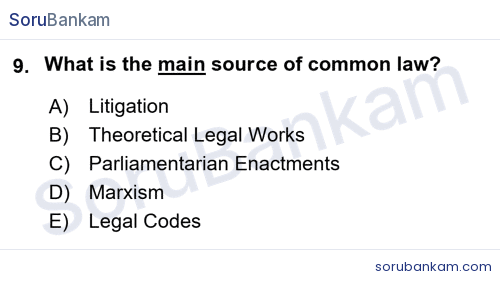
What is the main source of common law? A) Litigation B) Theoretical Legal Works C) Parliamentarian Enactments D) Marxism E) Legal Codes
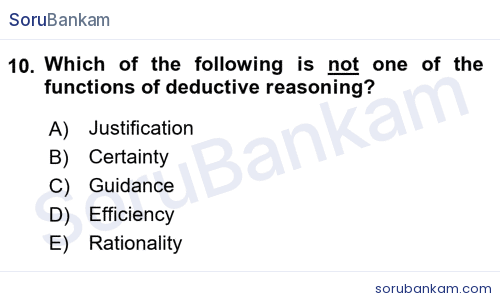
Which of the following is not one of the functions of deductive reasoning? A) Justification B) Certainty C) Guidance D) Efficiency E) Rationality
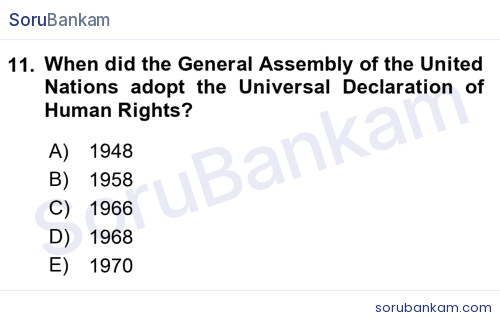
When did the General Assembly of the United Nations adopt the Universal Declaration of Human Rights? A) 1948 B) 1958 C) 1966 D) 1968 E) 1970
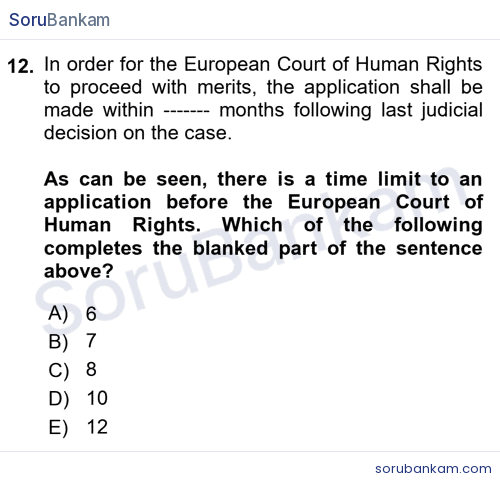
In order for the European Court of Human Rights to proceed with ments, the application shall be made within -- months following last judicial decision on the case. As can be seen, there is a time limit to ani application before the European Court of Human Rights. Which of the : following completes the blanked part of the sentence above? A) 6 B) 7 C) 8 D) 10 E) 12
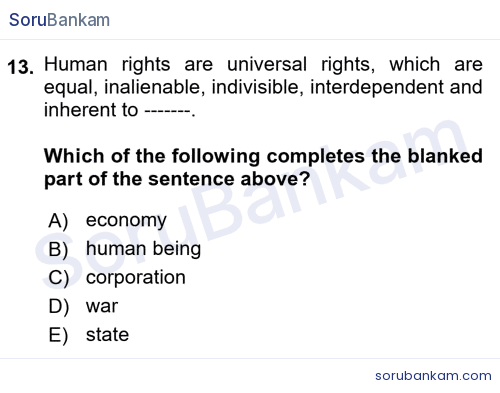
Human rights are universal rights, which are equal, inalienable, indivisible, interdependent and inherent to - Which of the following completes the blanked » part of the sentence above? A) economy B) human being C) corporation D) war E) state
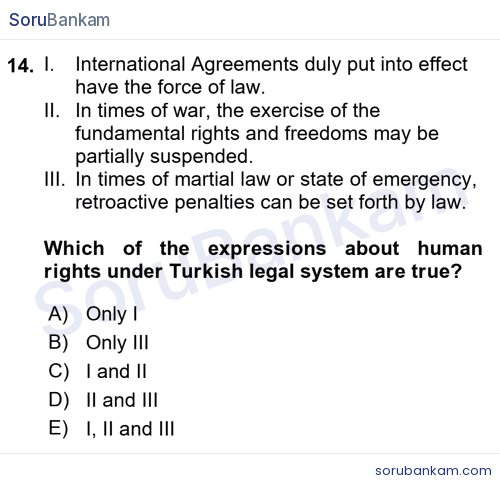
I. International Agreements duly put into effect have the force of law. II. In times of war, the exercise of the fundamental rights and freedoms may be partially suspended. Ill: In times of martial law or state of emergency, retroactive penalties can be set forth by law. Which of the expressions about human rights under Turkish legal system are true? A) Only B) Only III C) I and D) Il and Ill E) I, Il and Ill
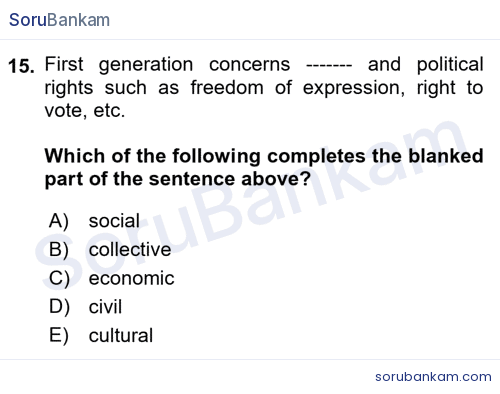
First generation concerns ... and political rights such as freedom of expression, right to vote, etc. Which of the following completes the blanked part of the sentence above? A) social B) collective C) economic D) civil E) cultural
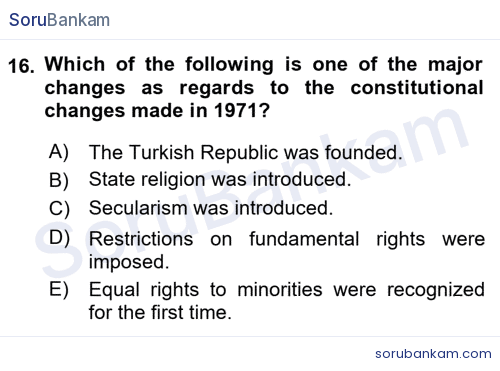
16. Which of the following is one of the major? changes as regards to the constitutional changes made in 1971? A) The Turkish Republic was founded. B) State religion was introduced. C) Secularism was introduced. D) Restrictions on fundamental rights were imposed. Equal rights to minorities were recognized for the first time.
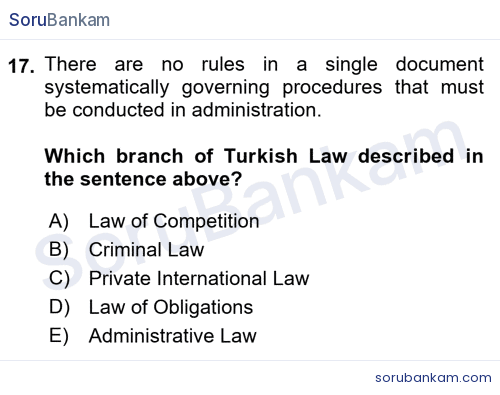
There are no rules in a single document systematically governing procedures that must be conducted in administration. Which branch of Turkish Law described in the sentence above? A) Law of Competition B) Criminal Law C) Private International Law D) Law of Obligations E) Administrative Law
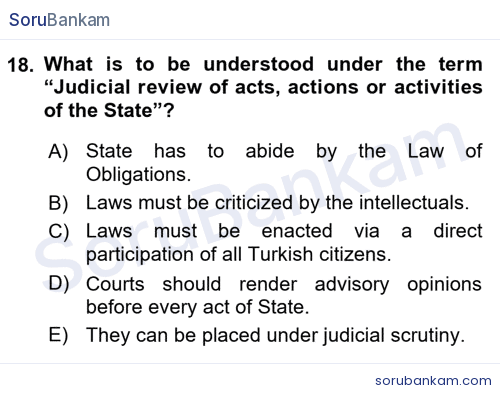
What is to be understood under the term "Judicial review of acts, actions or activities of the State"? A) State has to abide by the Law of Obligations. B) Laws must be criticized by the intellectuals. a direct C) participation of all Turkish citizens. D) Courts should render advisory opinions before every act of State. E) They can be placed under judicial scrutiny.
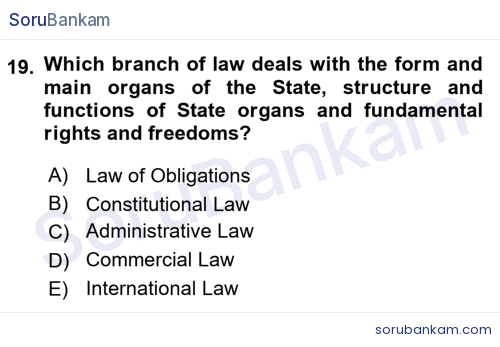
Which branch of law deals with the form and main organs of the State, structure and functions of State organs and fundamental rights and freedoms? A) Law of Obligations B) Constitutional Law C) Administrative Law D) Commercial Law E) International Law
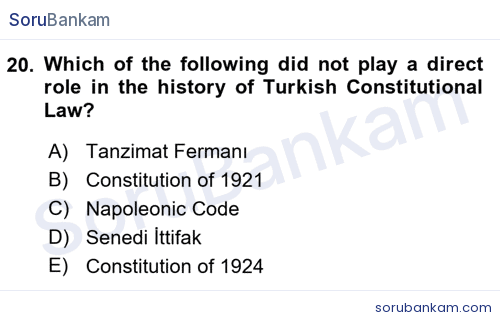
Which of the following did not play a direct role in the history of Turkish Constitutional Law? A) Tanzimat Fermanı B) Constitution of 1921 C) Napoleonic Code D) Senedi Ittifak E) Constitution of 1924