ULI456U The Balkans 2024-2025 Vize Soruları
20 soru · Vize · 2024-2025
ULI456U The Balkans dersinin 2024-2025 vize sınavı 20 sorudan oluşur; ders AÖF Uluslararası İlişkiler (İngilizce) bölümünde okutulur. Sorular aşağıda sırasıyla yer alır. Doğru cevaplar ve sonucun, testi çözdüğünde görünür.
Önizleme · 20 soru. Cevaplamak ve sonucunu görmek için sınavı başlat.
Sorular
20 soru
Soru 1
Soru 2
Soru 3
Soru 4
Soru 5
Soru 6
Soru 7
Soru 8
Soru 9
Soru 10
Soru 11
Soru 12
Soru 13
Soru 14
Soru 15
Soru 16
Soru 17
Soru 18
Soru 19
Soru 20
Sınav modunda süre tutulur, doğru cevaplar ve sonucun sınav bitince görünür.
Dersin üniteleri
ULI456U The Balkans ders sayfası: bütün sınavlar ve üniteler
Soruların metni (otomatik okuma)
Görsellerden otomatik okunmuştur; hata içerebilir. Sorular, görsellerdeki hâliyle geçerlidir.
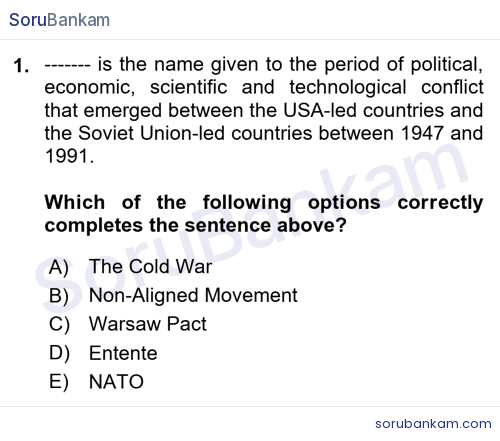
- is the name given to the period of political, economic, scientific and technological conflict that emerged between the USA-led countries and the Soviet Union-led countries between 1947 and 1991. Which of the following options correctly completes the sentence above? A) The Cold War B) Non-Aligned Movement C) Warsaw Pact D) Entente E) NATO
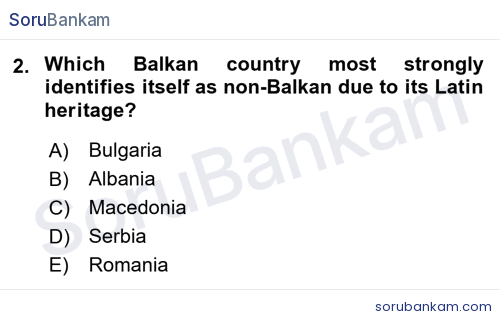
Which Balkan country most strongly identifies itself as non-Balkan due to its Latin heritage? A) Bulgaria B) Albania C) Macedonia D) Serbia E) Romania
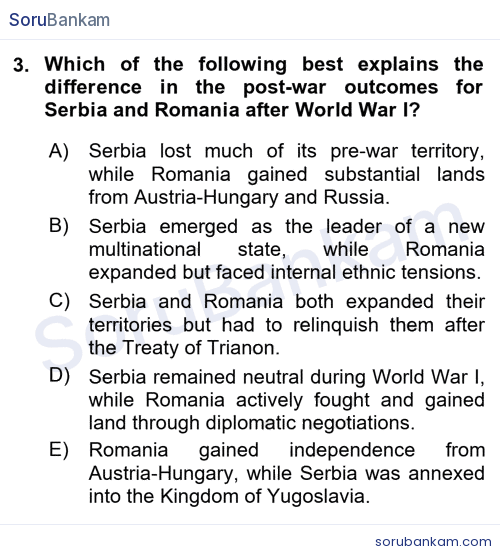
Which of the following best explains the difference in the post-war outcomes for Serbia and Romania after World, War I? A) Serbla lost much pril pre-war territory, while Romania gained substantial lands from Austria-Hungary and Russia. B) Serbia emerged as the leader of a new multinational state y"v while Romania expanded but taced internal ethnic tensions. C) Serbia and Romania both expanded their territories but bad to relinquish, them after the Treaty of Trianon. D) Serbia remained neutral during World War I, 1. while Romania actively fought and gained land through diplomatic negotiations. E) Romania gained independence from Austria-Hungary, while Serbia was annexed into the Kingdom of Yugoslavia.
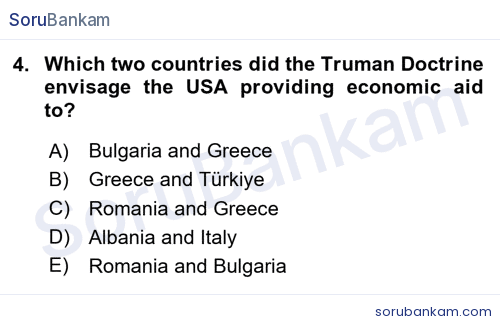
Which two countries did the Truman Doctrine envisage the USA providing economic aid A) Bulgaria and Greece B) Greece and Turkiye C) Romania and Greece D) Albania and Italy E) Romania and Bulgana
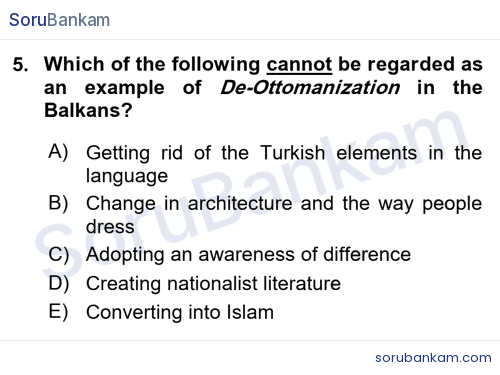
Which of the following cannot be regarded as an example of De-Ottomanization in the Balkans? A) Getting rid of the Turkish elements in the language B) Change in architecture and the way people dress C) Adopting an awareness of difference D) Creating nationalist fiterature E) Converting into Islam
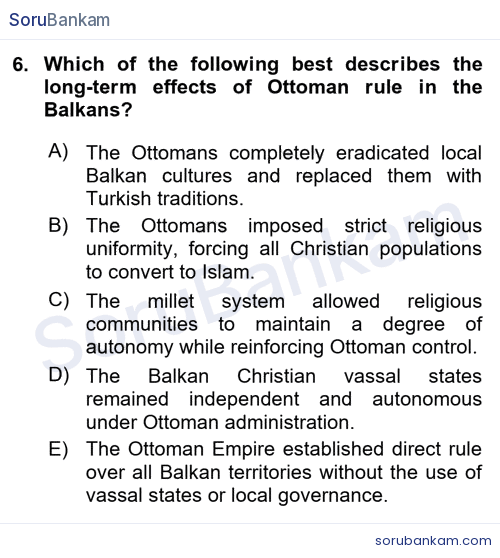
Which of the following best describes the long-term effects of Ottoman rule in the Balkans? ac.s r.. A) The Oftomans corpletely eradicated local Balkan cultures and replaced them with Turkish traditions. B) The Ottomans imposed strict religious uniformity, forcing all Christian populations to convert to Islam. C) The millet system allowed religious communities to maintain a degree of autonomy while reinforcing Ottoman control. D) Thé Balkan Christian vassal states w'w': remained independent and autonomous under Ottoman administration. E) The Ottoman Empire established direct rule over all Balkan territories without the use of vassal states or local governance.
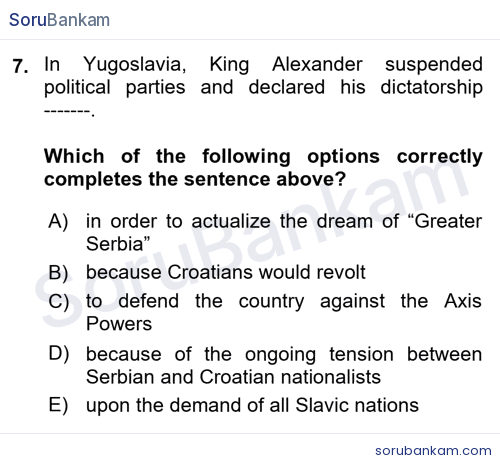
T. In Yugoslavia, King Alexander suspended political parties and declared his dictatorship mangann, Which of the following options correctly completes the sentence above? A) in order to actualize the dream of "Greater Serbia" B) because Croatians would revolt C) to defend the country against the Axis Powers D) because of the ongoing tension between Serbian and Croatian nationalists E) upon the demand of all Slavic nations
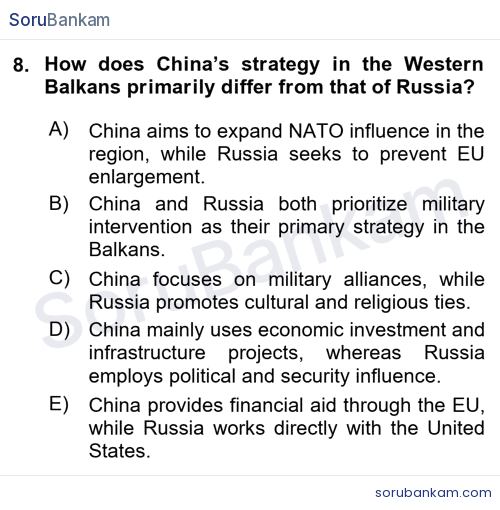
8. How does China's strategy in the Western Balkans primarily differ from that of Russia? A) China aims to expand NATO influence in the region, while Russia seeks to prevent EU enlargement. China and Russia both prioritize military intervention as their primary strategy in the Balkans. C) China focuses on military alliances, while Russia promotes cultural and religious ties. D) China mainly uses economic investment and infrastructure projects, whereas Russia employs political and security influence. E) China provides financial aid through the EU, while Russia works directly with the United States.
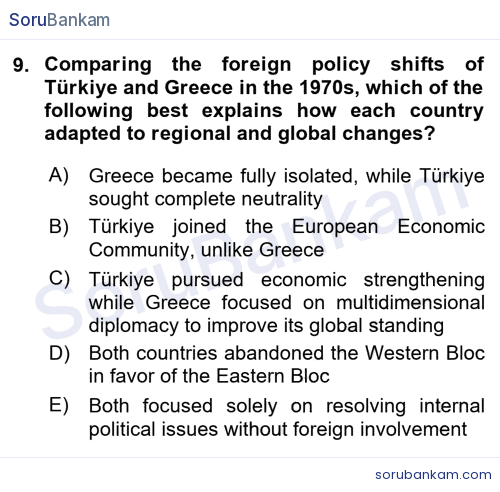
Comparing the foreign policy shifts of Türkiye and Greece in the 1970s, which of the following best explains how each country adapted to regional and global changes? A) Greece became fully isolated, while Türkiye? sought complete neutrality B) Türkiye joined the European Economic Community, unlike Greece C) Türkiye pursued economic strengthening while Greece focused on multidimensional diplomacy to improve its global starding D) Both countries abandoned fhe Western Bloc in favor of the Eastern Bloc E) Both focused solely on resolving internal political issues without foreign involvement
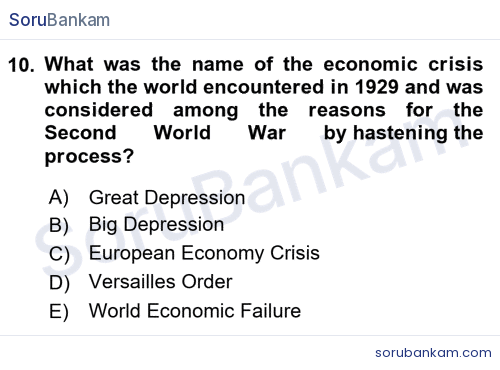
What was the name of the economic crisis.' which the world encountered in 1929 and was considered amond the reasons^ for the Second, World War by hastening the process? A) Great Depression B) Big Depression C) European Economy Crisis D) Versailles Order E) World Economic Failure
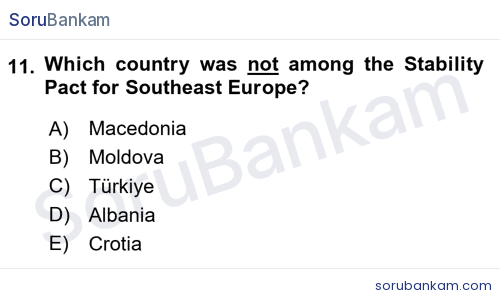
11. Which country was not among the Stability Pact for Southeast Europe? Macedonia Moldova C) Türkiye D) Albania E) Crotia
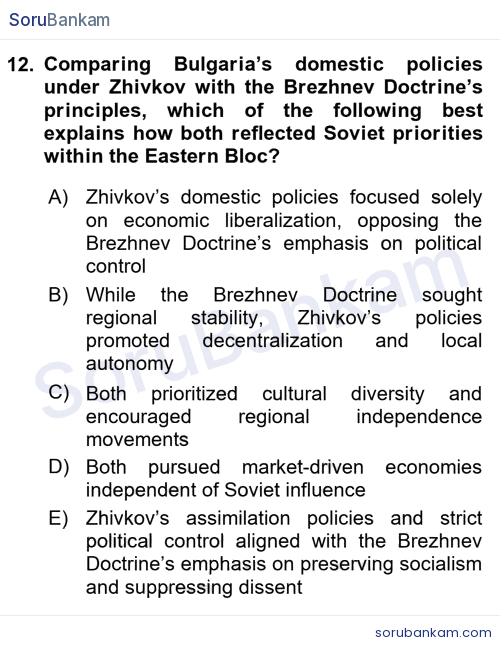
Comparing Bulgaria's domestic policies under Zhivkov with the Brezhnev Doctrine's principles, which of the following best explains how both reflected Soviet priorities within the Eastern Bloc? A) Zhivkov's domestic policies focused solély on economic liberalization, opposing the Brezhnev Doctrine's emphasis on political control B) While the Brezhnev Doctrine sought regional stability, Zhivkov's policies promoted decentralization and local autonomy C) Both prioritized Y cultural diversity and encouraged regional independence movements D) Both pursued marketdriven economies independent of Soviet influence E) Zhivkov's assimilation policies and strict political control aligned with the Brezhnev Doctrine's emphasis on preşeiving socialism and suppressing dissent
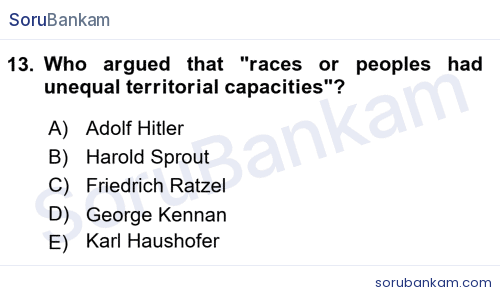
Who argued that "races or peoples had unequal territorial capacities"? A) Adolf Hitler B) Harold Sprout C) Friedrich Ratzel D) George Kennan E) Karl Haushofer
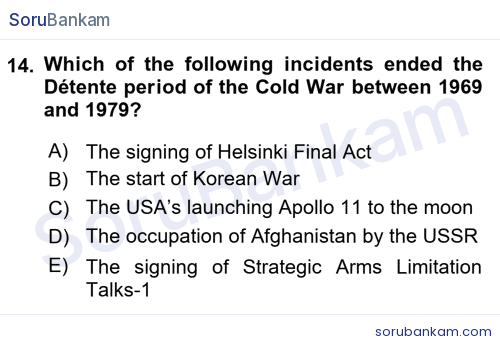
Which of the following incidents ended the Détente period of the Cold War between 1969 and 1979? A) The signing of Helsinki Final Act B) The start of Korean War C) The USA's launching Apollo 11 to the moon D) The occupation of Afghanistan by the USSR E) The signing of Strategic Arms Limitation Talks-1
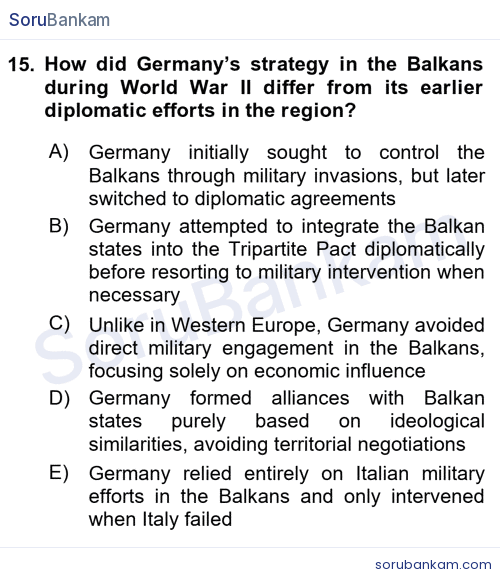
How did Germany's strategy in the Balkans during World War I differ from Its earlier diplomatic efforts in the region? A) Germany initially sought to control the Balkans through military invasions, but later switched to diplomatic agreements B) Germany attempted to integrate the Balkan states into the Tripartite Pact diplomatically before resorting to military intervention when necessary C) Unlike in Western Europe, Germany avoided direct military engagement in the Balkans, focusing solely on economic influence D) Germany formed alliances with Balkan states purely based on ideological similarities, avoiding territorial negotiations E) Germany relied entirely on Italian military efforts in the Balkans and only intervened when Italy failed
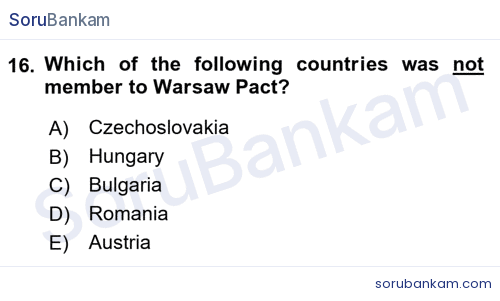
Which of the following countries was not member to Warsaw Pact? A) Czechosłovakia B) Hungary C) Bulgaria D) Romania E) Austria
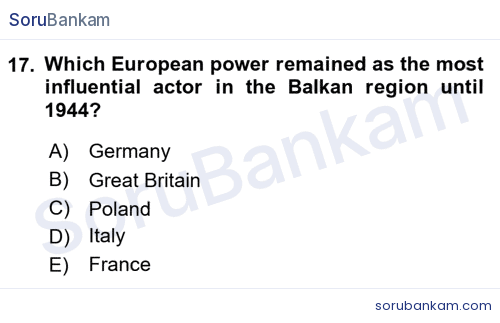
Which European power remained as the most influential actor in the Balkan region antil 19447 A) Germany B) Great Britain C) Poland D) Italy E) France
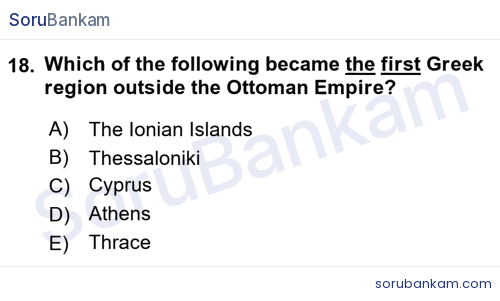
Which of the following became the first Greek reglon outside the Ottoman Empire? A) The lonian Islands B) Thessaloniki C) Cyprus D) Athens E) Thrace
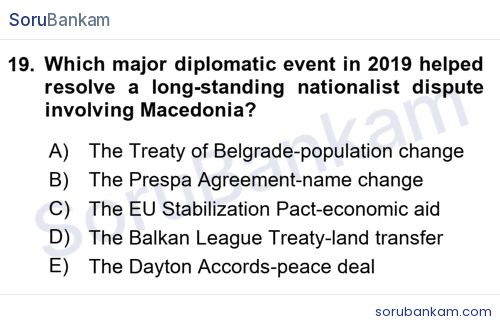
Which major diplomatic event in 2019 helped resolve a long-standing nationalist dispute involving Macedonia? A) The Treaty of Belgrade-population change B) The Prespa Agreement-name change C) The EU Stabilization Pact-economic ald D) The Balkan League Treaty-land transfer E) The Dayton Accords-peace deal
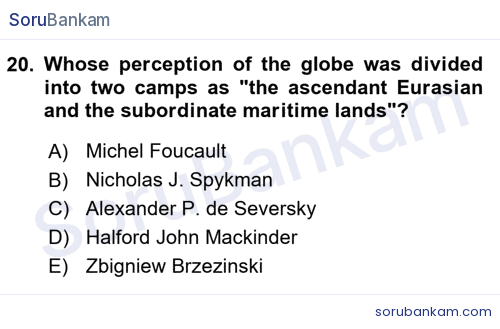
Whose perception of the globe was divided into two camps as "the ascendant Euraslan and the subordinate maritime lands"? A) Michel Foucault B) Nicholas v. Spykman C) : Alexander P. de Seversky D) Halford John Mackinder E) Zbigniew Brzezinski