INO302U Dilbilim 2 2013-2014 Tek Ders Soruları
20 soru · Tek ders · 2013-2014
INO302U Dilbilim 2 dersinin 2013-2014 tek ders sınavı 20 sorudan oluşur; ders AÖF İngilizce Öğretmenliği bölümünde okutulur. Sorular aşağıda sırasıyla yer alır. Doğru cevaplar ve sonucun, testi çözdüğünde görünür.
Önizleme · 20 soru. Cevaplamak ve sonucunu görmek için sınavı başlat.
Sorular
20 soru
Soru 1
Soru 2
Soru 3
Soru 4
Soru 5
Soru 6
Soru 7
Soru 8
Soru 9
Soru 10
Soru 11
Soru 12
Soru 13
Soru 14
Soru 15
Soru 16
Soru 17
Soru 18
Soru 19
Soru 20
Sınav modunda süre tutulur, doğru cevaplar ve sonucun sınav bitince görünür.
Dersin üniteleri
Soruların metni (otomatik okuma)
Görsellerden otomatik okunmuştur; hata içerebilir. Sorular, görsellerdeki hâliyle geçerlidir.
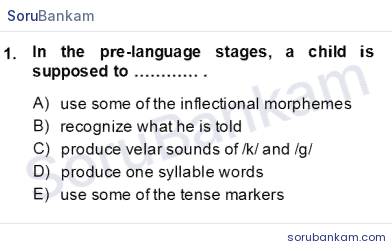
In the pre-language stages, a child is supposed to ... A) l use some of the inflectional morphemes B) recognize what he is told C) produce velar sounds of /k/ and /g/ D) produce one syllable words E) use sprae of the tense markers
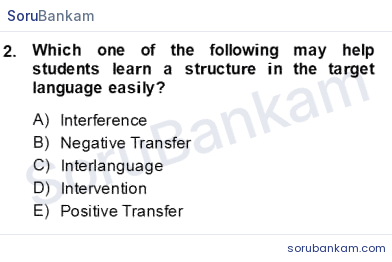
Which one of the following may help. students learn a structure in the target language easily? A) Interference B) Negative Transfer C) Interlanguage, D) Interventiah E) Rosiive Transfer
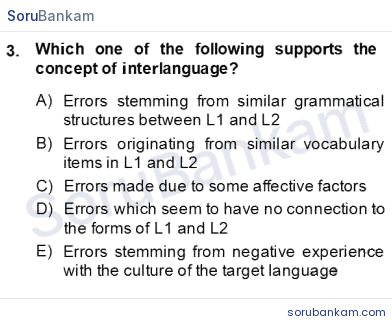
Which one of the following supports the concept of interlanguage? A) Errors stemming from simiar grammatical structures between Lf and L2 B) Errors originating from similar vocabulary items in L1 and l2 C) Errors made due to some alective factors D) Errors which seem to have no connection to it '''.. the forms of L1 and L2 E) Errors stemming from negative experiel with the culture of the target language
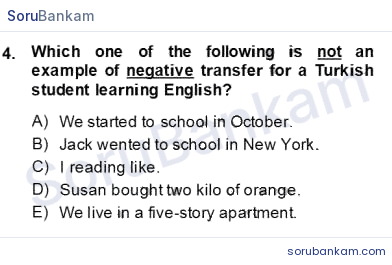
4. Which one of the following not an example of negative transfe Turkish student learning English? A) We started to schõe i-actober B) Jack wented 1o getaphin New E) Walive'in a five-stor apasment.
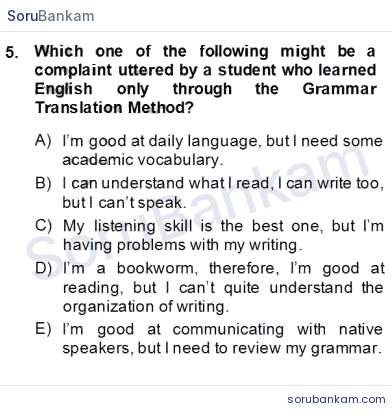
5. ranslatin Mathrowsh the Grammar A) I lI gond at dally language, but need some ademic vocabulary. B) Eah understand what I read 1 cari write too, butt bah't speak. My listening skill is the best one, but I'm having problems with my writing. D) I'm a booksoim, therefore, I'm good at reading. but 1 can't quite understand the organization of writing. E) I'm good at communicating with nafive speakers, but need to review ty grammar.
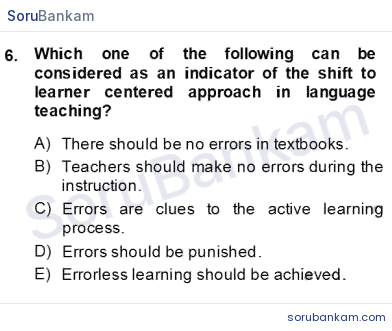
6. Which one of the following can considered as an indicator of the shift to learner centered approach in language teaching? A) There should be no errors in textbooks. • 3) Teachers should make no errors outing the instruco: c) Errors are clues to the active learning ¡*"'!!. process. D) Errors should be punished. E) Errorless ieaming should be achibi
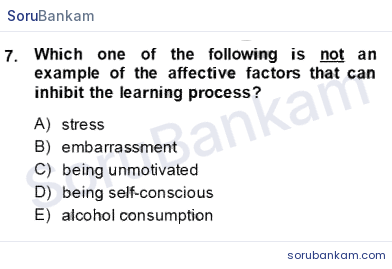
7. Which one of the following example of the affective factors inhibit the learning A) stress Kitap •B) embarrassi C) beingunmoprated .1.. beins sef conscious sohol sonsumpflo
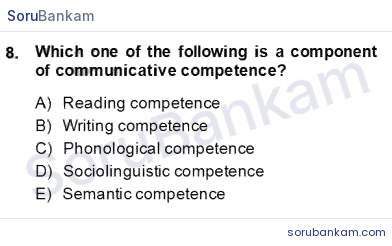
arian eate oming ne component. Ar Reading competence Writing competence Phonological competence D) Socialinguistiç.competence E) Semantic competence
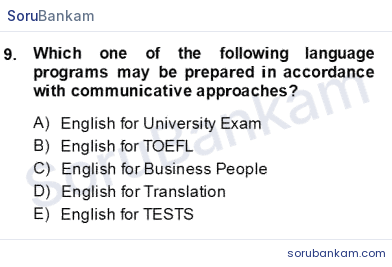
Which one the following language programs may be prepared in accordance with communicative approaches? A) English for University Exam B) English for TOEFL C) c) English for Business People D) English,for Translation E) English for TESTS
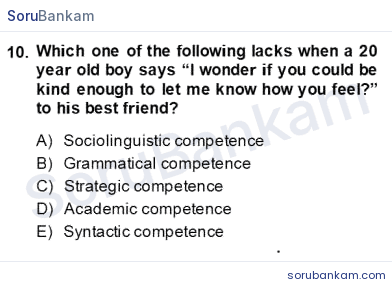
Which one of the following lacks when a 20 year old toy says "J wonder if you could be kind enough to let me know how you feel?" • to his best friend? A) Sociolinguistic competence B) Grammatical competence C) Strategicioompetence D) Academic competence E) i! " E) Syntactic competence
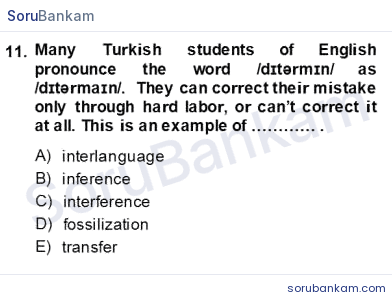
Many Turkish students of English pronounce the word (ditermin/ idmermain. They can correct their mistake •onty through hard labor, or can't correct it at all. This is an examplé of ....... A) interlanguage B) inference, " C) inferference D) fossilization E) transfer
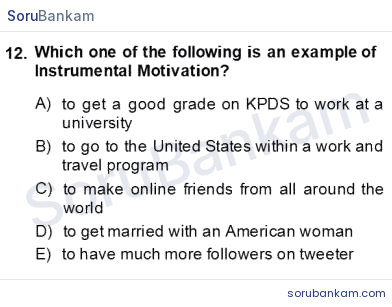
Which one of the following is an example of Instrumental Motivation? A) to get a good grade on KPDS to work at a university B) to go to the United States within a work and travel program C) to make bhilne friends from all around the world D) i D) to get married with an American woman E) to have much mere followers an tweeter
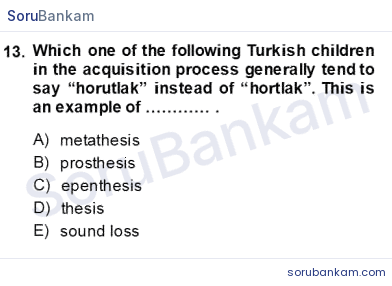
Which one of the following Turkish children in the acquisition process generally tend to say "horutiak" instead of "hortlak". This is an example of ….. A) metathesis B) prosthesis C) epenthesis. " .... D) thesis E) "E) sound loss
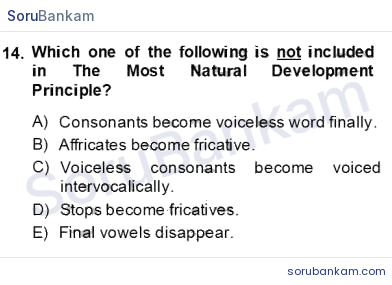
Natana Principle? A, Consonadis beathe volcapes word inally: B) Affricates beggate fricative. C) Voiceless become • Voiced become fri
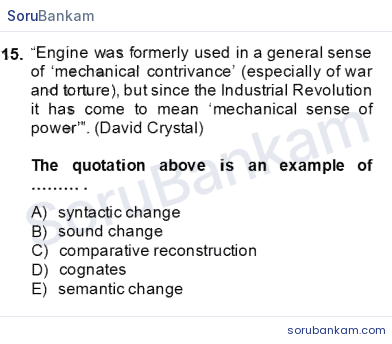
Engine was offerly used in a general sense ¡ 'mactanical contrivance' (especially of war age-purs), but since the Industrial Revoluton 19 (David stan " nechanical sense of The quotation ¡above is example of A) syntactic change B) * "By sound change C) comparative reconstruction D) cognates E) semantic change
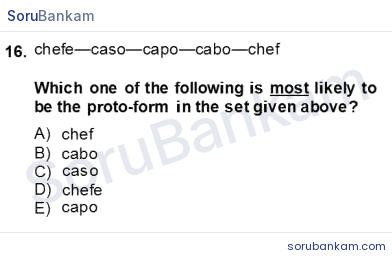
16, chefe-caso-capo-cabo-chef Which one of the following is most likely to be the proto-form in the set given above? A) •čhef B) cabo C) caso D) chefe
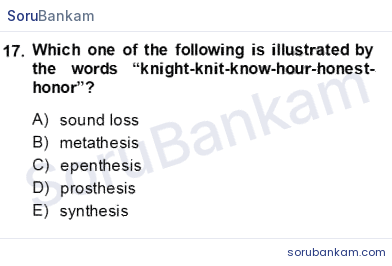
Which one of the following is illustrate Tby the words "knight-knit-knows honor"? A) sound lo55 B) metathesis C) epenthesis D) prosthesis E) synthesis
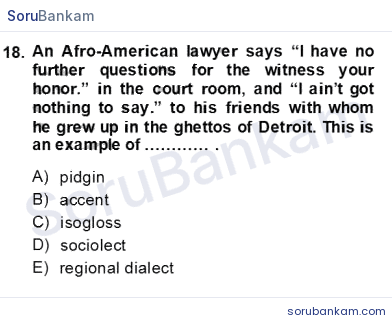
18. An Atrolamerican A wyer says "J have no Tor the witness your aunt room, and "l ain't got grew up in the ghettos of Detroit. This is 1e артрі pidgin Scent: "' isogloss D) saciolect E) regional dialect
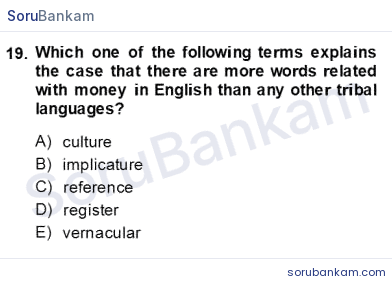
Which one of the following terms explains the case that there are more words related with money in English than any other tribal languages? A) culture B) implicature ..1.* C) reference " D) register E) NES vemacular
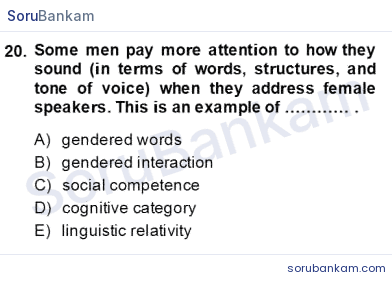
20. Some men pay more attention to how they sound (in terms of words, structures, and tone of voice) when they address female speakers. This is an example of ... A.) gendered words B) gendered interaction C) social corsetence D) eaghitive category ¡* e) linguistic relativity