INO302U Dilbilim 2 2014-2015 Final Soruları
20 soru · Final · 2014-2015
INO302U Dilbilim 2 dersinin 2014-2015 final sınavı 20 sorudan oluşur; ders AÖF İngilizce Öğretmenliği bölümünde okutulur. Sorular aşağıda sırasıyla yer alır. Doğru cevaplar ve sonucun, testi çözdüğünde görünür.
Önizleme · 20 soru. Cevaplamak ve sonucunu görmek için sınavı başlat.
Sorular
20 soru
Soru 1
Soru 2
Soru 3
Soru 4
Soru 5
Soru 6
Soru 7
Soru 8
Soru 9
Soru 10
Soru 11
Soru 12
Soru 13
Soru 14
Soru 15
Soru 16
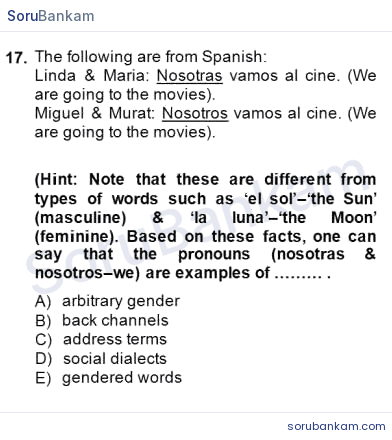
Soru 17
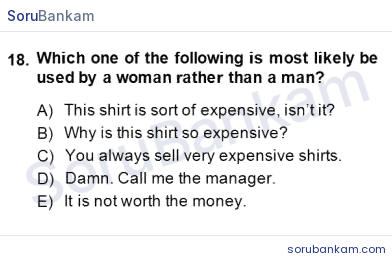
Soru 18
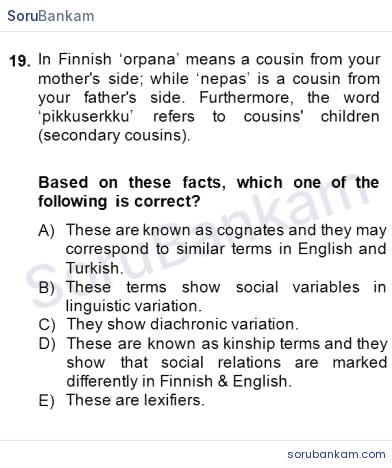
Soru 19
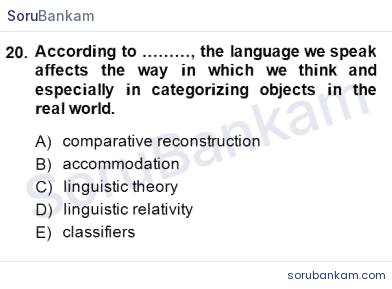
Soru 20
Sınav modunda süre tutulur, doğru cevaplar ve sonucun sınav bitince görünür.
Dersin üniteleri
Soruların metni (otomatik okuma)
Görsellerden otomatik okunmuştur; hata içerebilir. Sorular, görsellerdeki hâliyle geçerlidir.
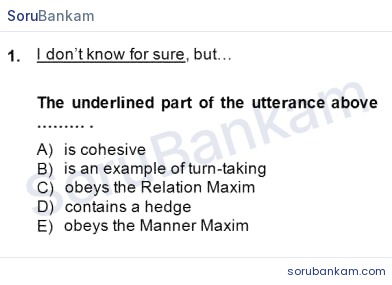
1. I don'tknow for sure, but... The underlined part of the utterance above A) is cohesive B) is an example afturn-taking obeys the Relation Maxim. D) gaptains a hedge * E) obeys the Manner Maxim
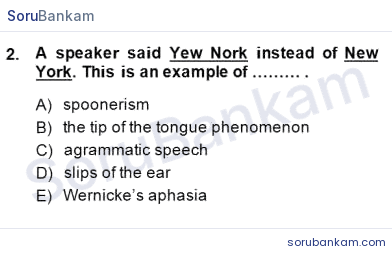
2. A speaker said Yew Nork instead of New York. This is an example of spoonersm the tip of the tongue phenomenon agrammatic speech D) slips of the qar E) Wernicke's aphasia
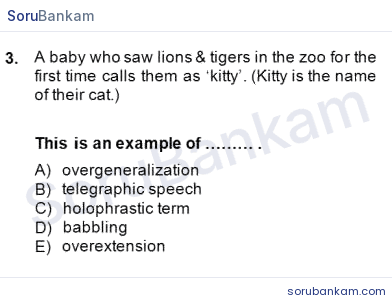
A baby who saw lions & tigers in the zoo for the first time calls them as 'kitty'. (Kitty is the name of their cat.) This is an example of A) overgeneralization B) telegrapme speech C) halophrastic term D) babbling E) overextension
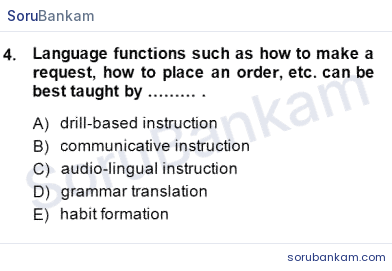
Language functions such as how to make a request, how to place an order, etc. can be best taught by .......... A) drill-based instruction B) communicative instruction C) audio-lingual instruction D) grammar ranslation E) Ey. habit formation
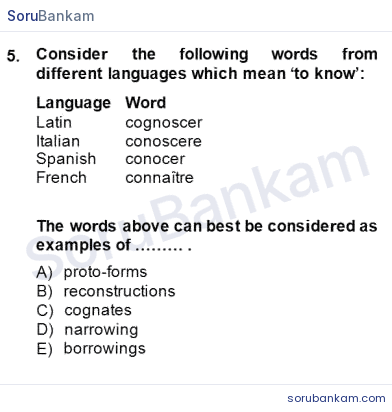
Consider the following words from different languages which mean to know': Language Word Latin cognoscer Italian conoscere Spanish conocer French commitre it the words above can best be considered as examples of ......... A) proto-forms B) reconstructions C) cognates D) Narrowing E) borrowings
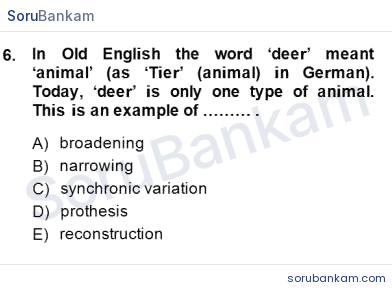
6. In Old English the word 'deer' meant 'animal' (as 'Tier' (animal) in German). Today, 'deer" is only one type of animal. • This iș an example of ..... A) broadening B) narrowing synchronic variation D) Frothiesis reconstruction
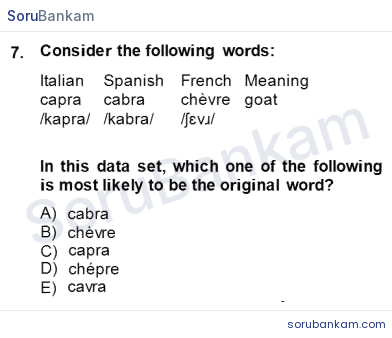
Consider the following words: Italian Spanish French Meaning. capra cabra Chevre l goat /kara/ abra/ level • tnis 088 ger which one of the following is most likely to be the originat word? A) cabra B) i* "'B) chèvre C) capra D) chépre E) cavra.
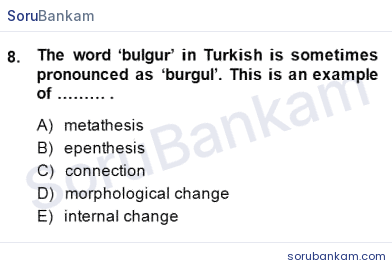
The word 'bulgur in Turkish is sometimes pronounced as 'burgul'. This is an example of....... A) metathesis B) epenthesis C) connection .d-: D) morpholagical change E) internal change
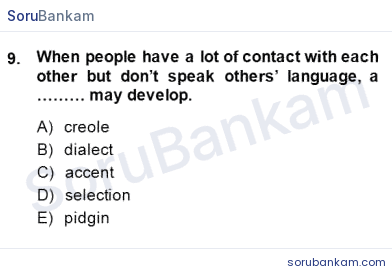
9. When people have a lot of contact with each other but don't speak others' language, a ... may develop. A). • creole B) dialect C) accent D) seleçtion"
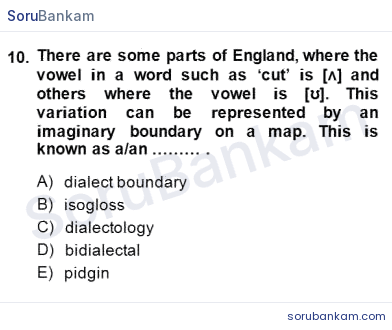
There are some parts of England, where the vowel in a word such as cut is (al and others where the vowe! is [ul. This variation can be represented imaginary boundary on a map. This is, • known as alan.... A) dialect bourdary B) ispoloss C) dialeciology D) bidialectal E) pidgin
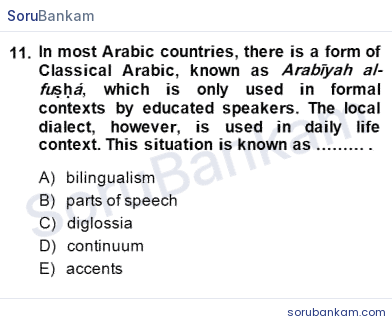
11. In most Arabic countries, there is a form of Classical Arabic, known as Arabiyah al- fusha, which is only used in formal contexts by educated speakers. The local dialect, however, is used in daily life context. This situation is known as A) bilingualism! 3) parts ofspeech ,.G) diglossia D) continuum E) accents
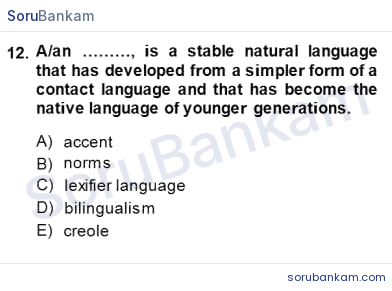
Alan **g is a stable natural language that has developed from a simpler form of a contact language and that has become the • native language of younger generations. A) accent B) norms C) lexifer Janguage D) girigualism E) i. " E) creole
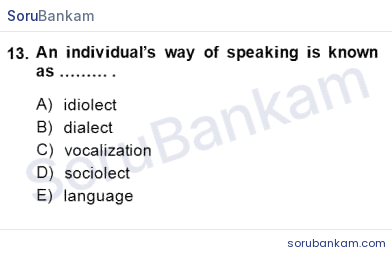
An individual's way of speaking is Known as ......... A) idiolect B) dialect C) vocalization D) sociolect E) language) " ...*
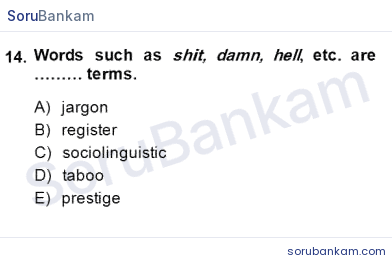
Words such as shit, damn, hell, etc. are …......• terms. A) jargon. B) register C) sociolinguistic D) taboo E) prestige
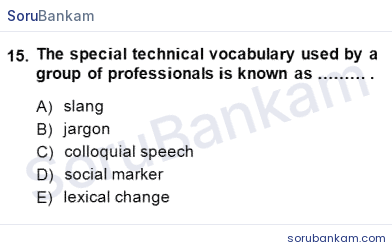
The special technical vocabulary used by a group of professionals is known as ... A) siang B) Jargon C) •C) colloquial speech D) social markęn E) lexicatchange
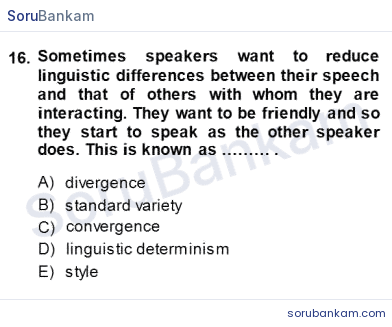
Sometimes speakers want to reduce linguistic differences between their speech and that of others with whom they are interacting. They want to be friendly and so they start to speak as the other speaker does. This is known as ... A) divergençe: " B) grandard variety C) convergence D) linguistic determinism E) style
The following are from Spanish: Linda & Maria: Nosotras vamos al sine. (We are going to the movies): Miguel & Murat: Nosotos vamos al cine. (We are going to the movies). (Hint: Note that these are diffetent from types. of words such as taf sol-the Sun' masculine) *la luna'-the Moon' i (feminine). Based on these facts, one can say that the pronouns (nosotras nosotros-we) are examples of .......... A) arbitrary gender B) • back channels C) address terms D) social dialects E) gendered words
Which one of the following is most fikely be used by a woman rather than a man? A) This shirt is sort of expensive, isn't it? B) Why is this shirt so expensive? C) You always sell very expensive shirts.. D) Damn. Call te the manager.: E) Iisnotworth the money:
19. In Finnish 'orpana' means a cousin from your mother's side; white nepas' is a cousin from your father's: side. Furthermore, the word 'pikkuşerkku" refers to cousins' children (secondary cousins). Based on these facts, which one of the following Is correct? * "'A) These are known as cognates and they may correspond to similar terms in English and Turkish. B) These terms show social vanables in linguistic variation. C) They show diachronic variation. • D) These are known as kinship terms and they show that social relations are marked differently in Finnish & English. E) Fhese are lexifiers.
According to - ., the language we speak affects the way in which we think and especially in categorizing objects in the real world. A) comparative reconstruction B) accommodation C) linguistic thebły D) linguistic relativity E) i. "È) classifiers