IKT452U Health Economics 2024-2025 Final Soruları
20 soru · Final · 2024-2025
IKT452U Health Economics dersinin 2024-2025 final sınavı 20 sorudan oluşur; ders AÖF İktisat (İngilizce) bölümünde okutulur. Sorular aşağıda sırasıyla yer alır. Doğru cevaplar ve sonucun, testi çözdüğünde görünür.
Önizleme · 20 soru. Cevaplamak ve sonucunu görmek için sınavı başlat.
Sorular
20 soru
Soru 1
Soru 2
Soru 3
Soru 4
Soru 5
Soru 6
Soru 7
Soru 8
Soru 9
Soru 10
Soru 11
Soru 12
Soru 13
Soru 14
Soru 15
Soru 16
Soru 17
Soru 18
Soru 19
Soru 20
Sınav modunda süre tutulur, doğru cevaplar ve sonucun sınav bitince görünür.
Dersin üniteleri
IKT452U Health Economics ders sayfası: bütün sınavlar ve üniteler
Soruların metni (otomatik okuma)
Görsellerden otomatik okunmuştur; hata içerebilir. Sorular, görsellerdeki hâliyle geçerlidir.
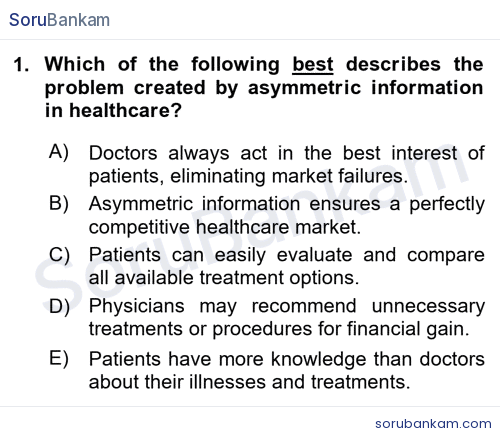
Which of the following best describes the problem created by asymmetric information in healthcare? A) Doctors always act in the best interest of patients, eliminating market failures. B) Asymmetric information ensures a perfectly competitive healthcare market. C) Patients can easily evaluate and compare all available treatment options. D) Physicians may recommend unnecessary treatments or procedures for financial gain. E) Patients have more knowledge than doctors about their illnesses and treatments.
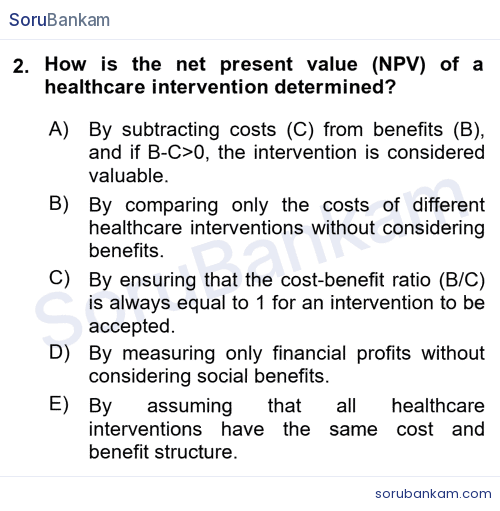
2. How is the net present value (NPV) of a healthcare intervention determined? A) By subtracting costs (C) from benefits (B), and if B-C>0, the intervention is considered valuable. By comparing only the costs of different healthcare interventions without considering benefits. C) By ensuring that the cost-benefit ratio (B/C) is always equal to 1 for an intervention to be accepted. D) By measuring only financial profits without considering social bènétits. E) By assuming that all healthcare interventions have the same cost and benefit structuré.
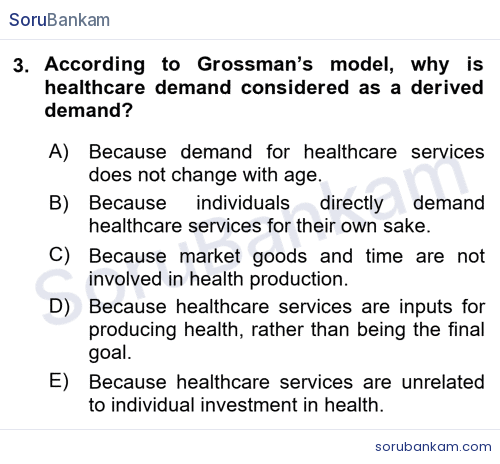
According to Grossman's model, why is healthcare demand considered as a derived demand? A) Because demand for healthcare services does not change with age. B) Because individuals directly demand healthcare services for their own sake. C) Because market goods and time are not Involved in health production. D) Because healthcare services are inputs for producing health, rather than being the final goal. E) Because healthcare services are unrelated to individual investment in health.
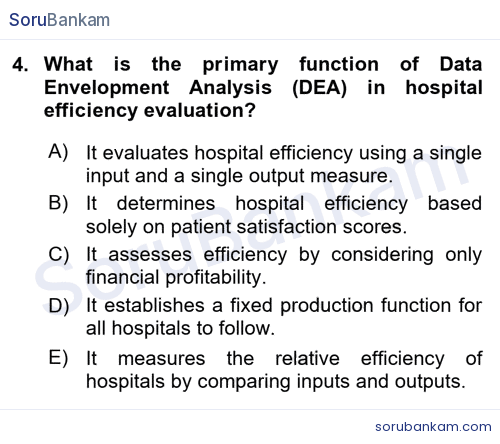
What is the primary function of Data Envelopment Analysis (DEA) in hospital efficiency evaluation? A) It evaluates hospital efficiency using a single input and a single output measure. B) It determines hospital efficiency 1 based solely on patient satisfaction scores. C) It assesses efficiency by considering only financial profitability. D) It establishes a fixed production function for all hospitals to follow. E) It measures the relative efficiency of hospitals by comparing inputs and outputs.
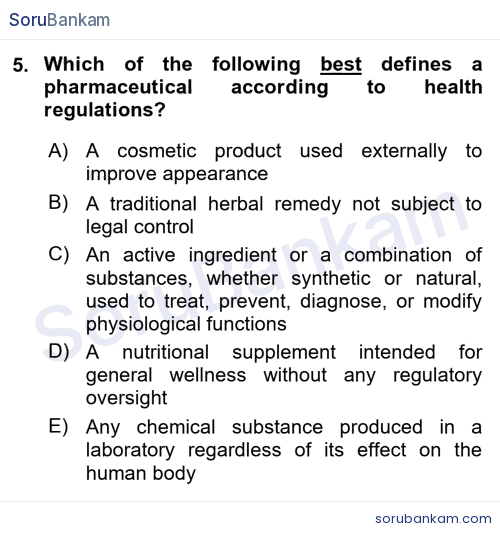
Which of the following best defines pharmaceutical according to health regulations? A) A›cosmetic prodyct" used externally to • improve appearance B) A traditional herbal remedy not subject to legal control, : C) An active ingredient or a combination of substances, whether synthetic or natural, used to treat, prevent, diagnose, or modify physiological functions D) A nutritional supplement intended for general wellness without any regulatory oversight E) Any chemical substance produced in a laboratory regardless of its effect on the human body
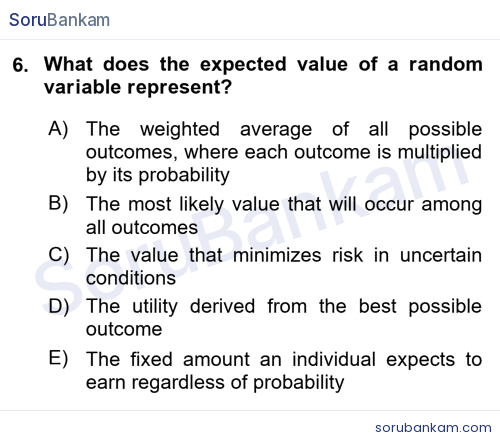
What does the expected value of a random variable represent? A) The weighted average of all possible outcomes, where each outcome is multiplied by its probability B) The most likely value that will occur among all outcomes C) The value that minimizes risk in uncertain conditions D) The utility derived from the best possible outcome E) The fixed amount an individual expects to earn regardless of probability
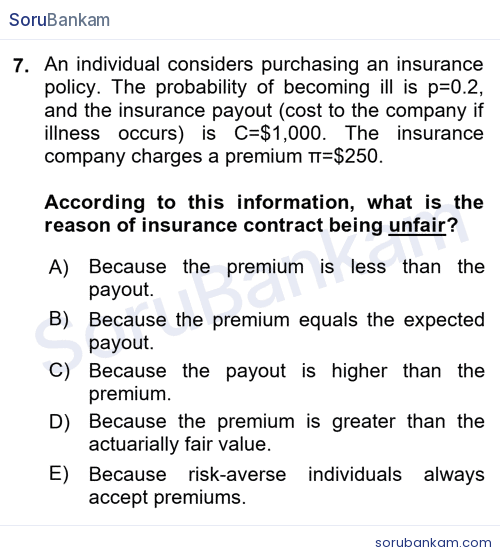
An individual considers purchasing an insurance policy. The probability of becoming ill is p=0.2, and the insurance payout (cost to the company if iliness occurs) is C=$1,000. The insurance company charges a premium T=$250. According to this information, what is the reason of insurance contract being unfair? A) Because the premium is less than the payout. B) Because the premium equals the expected payout. C) Because the payout is higher than the premium. D) Because the premium is greater than the actuarially fair value. E) Because risk-averse individuals always accept premiums.
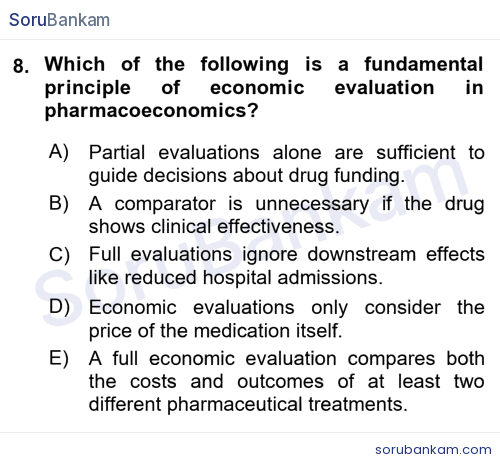
Which of the following is a fundamental principle of economic evaluation in pharmacoeconomics? A) Partial evaluations alone are sufficient to guide decisions about drug funding. B) A comparator is unnecessary if the drug shows clinical effectiveness. ^' C) Ful evaluations ignofe downstream effects like reduced hospital admissions. D) Economic evaluations only consider the price of the medication itsell.. E) A full poondmic evalyation compares both the costs and outcomes of at least two different pharmaceutical treatments.
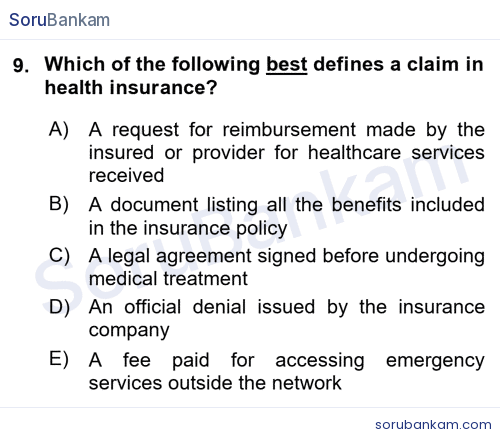
Which of the following best defines a claim in health insurance? A) A request for reimbursement made by the insured or provider for healthcare services received B) A document listing all the benefits included in the insurance policy C) A legal agreement signed before undergoing medical treatment D) An official denial issued by the insurance company E) A fee paid for açcessing emergency services outside the network
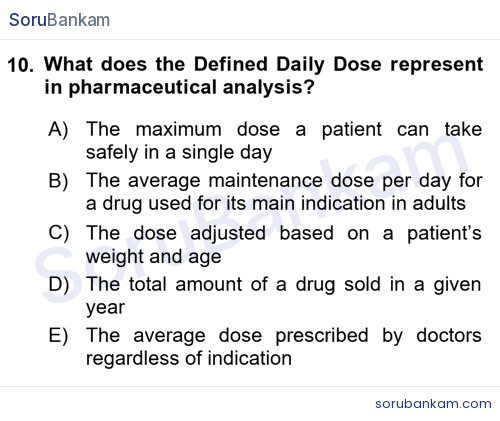
What does the Defined Daily Dose represent in pharmaceutical analysis? A) Thẹ maximum dose a patient can take safely in a single day B) The average maintenance dose per day for a drug used for its main indication in adults C) The dose adjusted based or a patient's weight and age D) The total amount of a drug sold in a given year E) The average dose prescribed by doctors regardless of indication
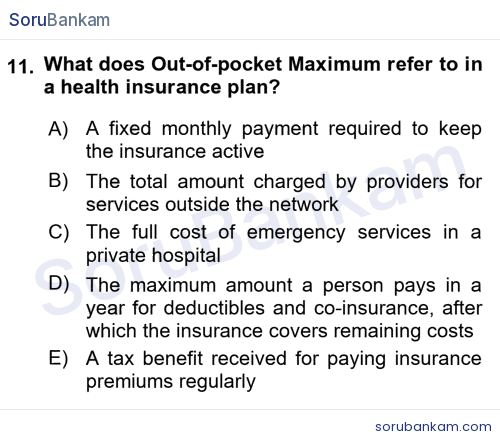
What does Out-of-pocket Maximum refer to in a health insurance plan? A) A fixed monthly payment required to keep the insurance active B) . B) *The total amount charged by providers for services outside the network C) The full, gost of emergency services in a private hospital D) The maximum amount a person pays in a year for deductibles and co-insurance, after which the insurance covers remaining costs E) A tax benefit received for paying insurance premiums regularly
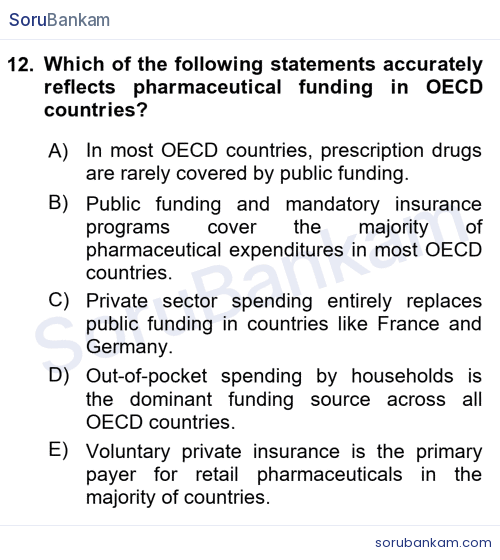
Which of the following statements accurately reflects pharmaceutical funding in OECD countries? A) In most OECD countries, prescription drugs are rarely covered by public funding. B) Public funding and mandatory insurance programs cover the majority pharmaceutical expenditures in most OECD countries. C) Private sector spending entirely replaces public funding in countries like France and Germany. D) Out-of-pocket spending by households is the dominant funding source across all OECD countries. E) Voluntary private insurance is the primary payer for retail pharmaceuticals in the majonty of countries.
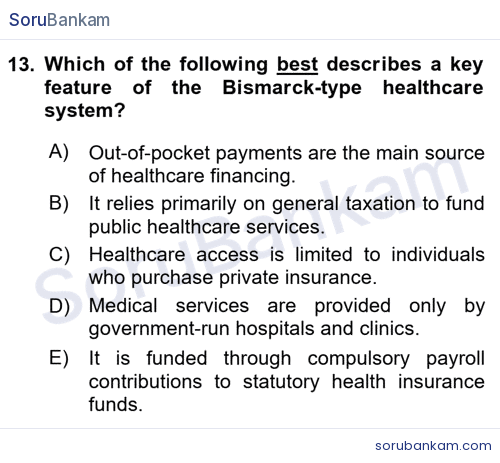
13. Which of the following best describes a key feature of the Bismarck-type healthcare system? A) Out-of-pocket payments are the main source of healthcare financing. It relies primarily on general taxation to fund public healthcare services. C) Healthcare access is limited to individuals who purchase private insurance. D) Medical services are provided only by government-run hospitals and clinics. E) It is funded through compulsory payroll contributions to statutory health insurance funds.
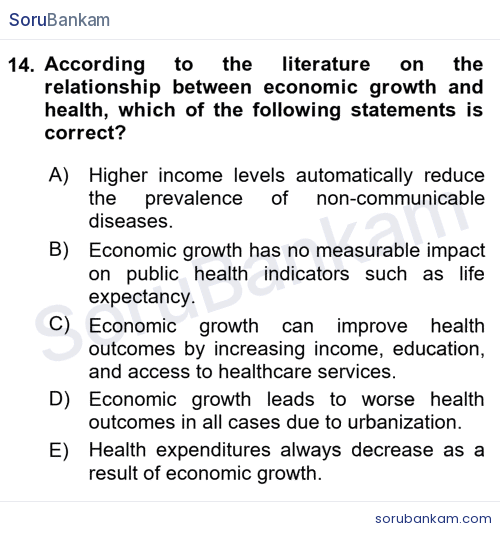
According to the literature on the relationship between economic growth and health, which of the following statements is correct? A) Higher income levels automatically reduce the prevalence of non-communicable diseases. B) Economic growth has no measurable impact on public health indicators such as life, expectancy. C) Economic growth can improve health outcomes by increasing income, education, and access to healthcare services. D) Economic growth leads to worse health outcomes in all cases due to urbanization. E) Health expenditures always decrease as a result of economic growtii:
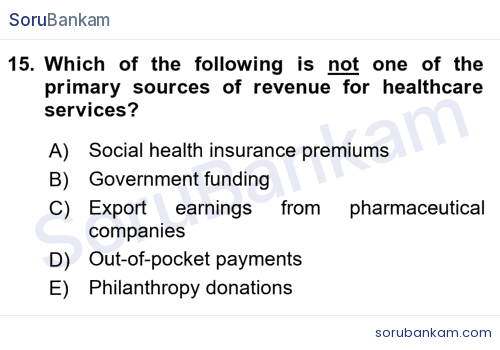
15. Which of the following is not one of the primary sources of, revenue for healthcare services? A) Social health insurance premiums B) Government funding C) Export earnings from phamaceutical companies Out-ol-pocket payments (E) Philanthropy donations
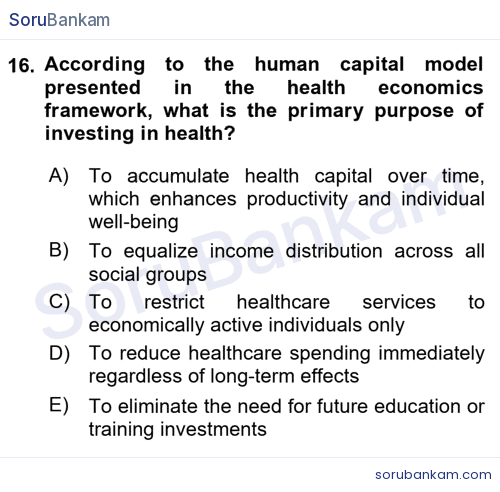
According to the human capital model presented the health economics framework, what is' the primary purpose of investing in health? A) To accumulate health capital over time, which enhances productivity and individual well-being B) To equalize income distribution across all social groups C) To restrict healthcare services to economically active individuals only D) To reduce healthcare spending immediately regardless of long-term effects E) To eliminate the need for future education or training investments
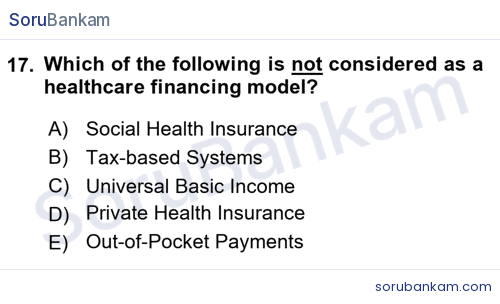
Which of the following is not considered as a healthcare financing model? A) Social Health Insurance B) Tax-based Systems C) Universal Basic Income D) Private Health Insurance E) Out-of-Pocket Payments
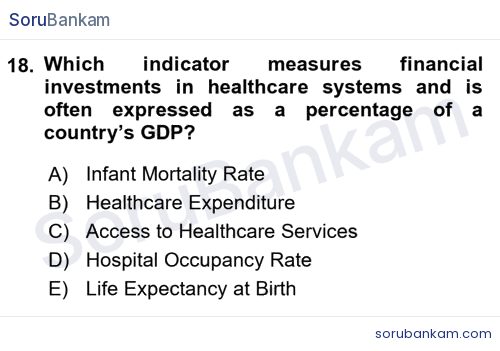
Which indicator measures financial. investments in healthcare systems and is often expressed as a percentage of a country's GDP? • N A) Înfant Mortality Rate B) Healthcare Expenditure ni' C) Access to Healthcare Services D) Hospital Occupancy Rate " E) . E) Life Expectancy at Birth
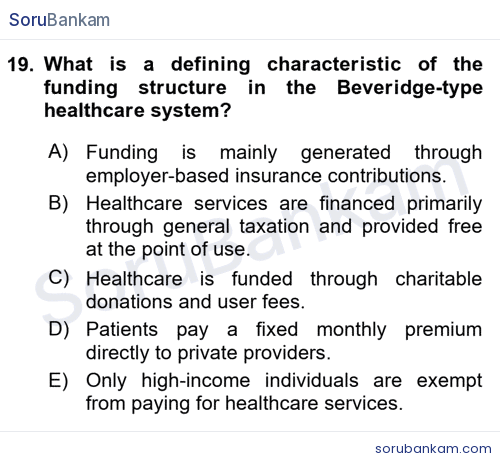
What is a defining characteristic of the funding structure in the Beveridge-type healthcare system? A) Funding is mainly generated through w' employer-based insurance contributions. B) Healthcare services are financed primarily through general taxation and provided free at the point of use. C) Healthcare is funded through charitable donations and user fees. D) Patients pay a fixed monthly premium directly to private providers. E) Only high-income individuals are exempt from paying for healthcare services.
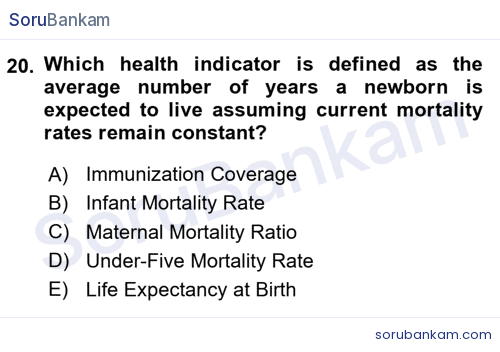
Which health indicator is defined as the average number of years a newborn is expected to live assuming current mortality rates remain constant? A) Immunization Coverage B) Infant Mortality Rate C) Maternal Mortality Ratio D) Under-Five Mortality Rate E) Life Expectancy at Birth