IKT452U Health Economics 2024-2025 Vize Soruları
20 soru · Vize · 2024-2025
IKT452U Health Economics dersinin 2024-2025 vize sınavı 20 sorudan oluşur; ders AÖF İktisat (İngilizce) bölümünde okutulur. Sorular aşağıda sırasıyla yer alır. Doğru cevaplar ve sonucun, testi çözdüğünde görünür.
Önizleme · 20 soru. Cevaplamak ve sonucunu görmek için sınavı başlat.
Sorular
20 soru
Soru 1
Soru 2
Soru 3
Soru 4
Soru 5
Soru 6
Soru 7
Soru 8
Soru 9
Soru 10
Soru 11
Soru 12
Soru 13
Soru 14
Soru 15
Soru 16
Soru 17
Soru 18
Soru 19
Soru 20
Sınav modunda süre tutulur, doğru cevaplar ve sonucun sınav bitince görünür.
Dersin üniteleri
IKT452U Health Economics ders sayfası: bütün sınavlar ve üniteler
Soruların metni (otomatik okuma)
Görsellerden otomatik okunmuştur; hata içerebilir. Sorular, görsellerdeki hâliyle geçerlidir.
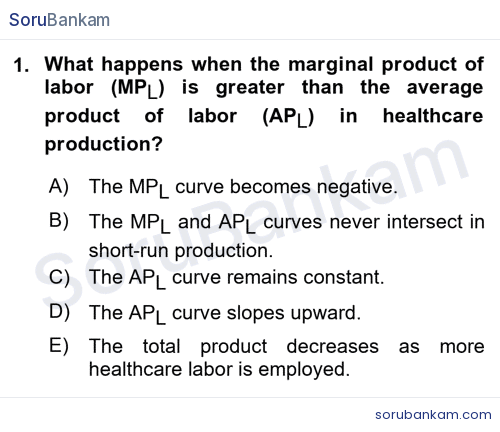
What happens when the marginal product of labor (MPL) is greater than the average product of labor (APL) in healthcare production? A) The MPL curve becomes negative. B) The MPL and APL curves never intersect in short-run production. C) The APL curve remains constant. D) The APL curve slopes upward. E) The total product decreases as more healthcare labor is employed.
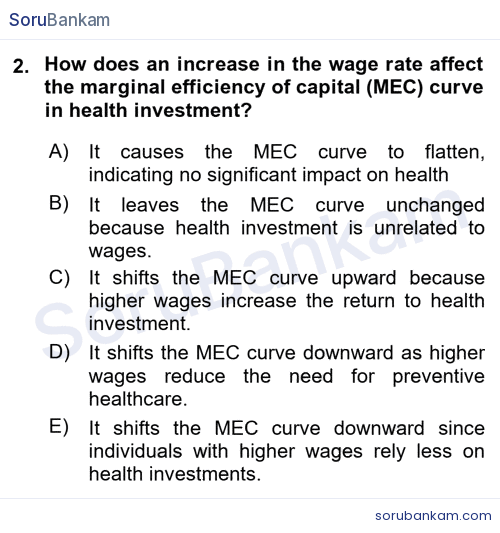
2. How does an increase in the wage rate affect the marginal efficiency of capital (MEC) curve in health investment? A) It causes the MEC curve to flatten, indicating no significant impact on health B) It leaves the MEC curve unchanged because health investment is unrelated to wages. C) It shifts the MEC curve upward because higher wages increase the return to health investment. D) It shifts the MEC curve downward as higher wages reduce the need for preventive healthcare. It shifts the MEC curve downward since individuals with higher wages rely less on health investments.,**
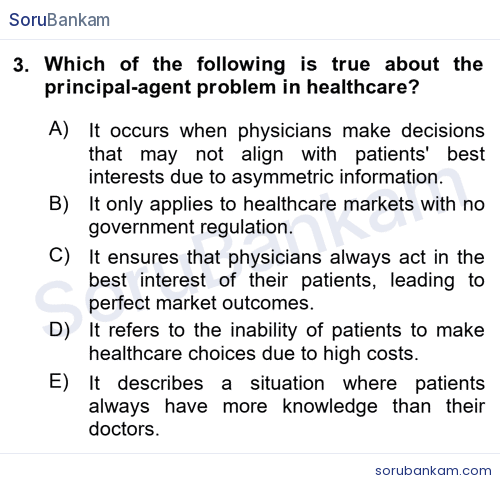
Which of the following is true about the principal-agent problem in healthcare? A) It occurs when physicians make decisions that may not align with patients' best interests due to asymmetric information.. B) It only applies to healthcare markets with no government regulation. C) It ensures that physicians always act in the best interest of their patients, leading to perfect market outcomes. D) It refers to the inability of patients to make healthcare choices due to high costs. E) It describes a situation where patients always have more knowledge than their doctors.
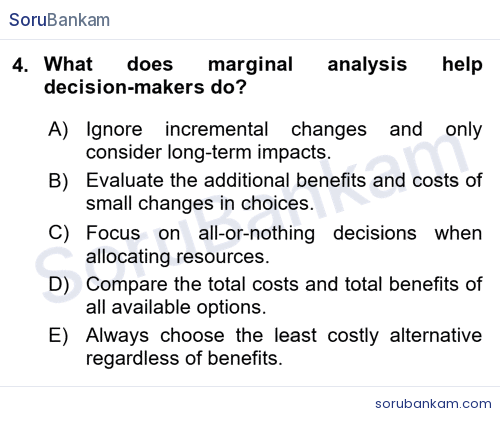
What does marginal analysis help decision-makers do? A) Ignore incremental changes and only consider long-term impacts. B) Evaluate the additional benefits and costs of small changes in choices. C) Focus on all-or-nothing decisions when allocating resources. D) Compare the total costs and total benefits of all available options. E) Always choose the least costly alternative regardless of benefits. .
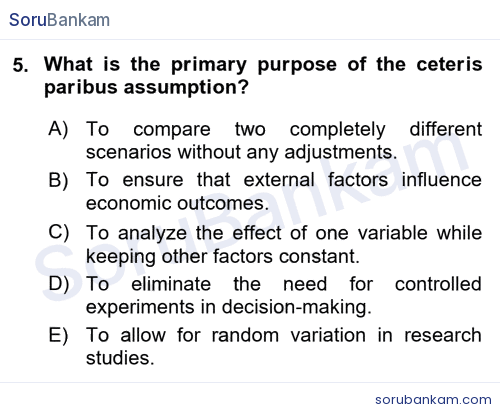
5. What is the primary purpose of the ceteris paribus assumption? A) To,, compare two completely different scenarios without any adjustments. BJ To ensure that external factors influence economic outcomes. C) To analyze the effect of one Wariable while keeping other factors constant. • D). To eliminate the need for controlled experiments in decision-making. E) To allow fog random variation in research studies.
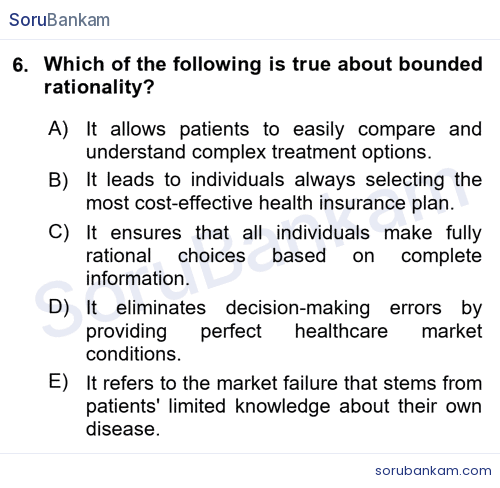
Which of the following is true about bounded rationality? A) It allows patients to easily compare and understand complex treatment options. B) "B) It leads to individuals always selecting the most cost-effective health insurance plan. C) It ensures that all individuals make fully rational choices based on complete information. D) It eliminates decision-making errors by providing perfect healthcare market conditions. E) It refers to the market failure that stems from patients' limited knowledge about their own disease.
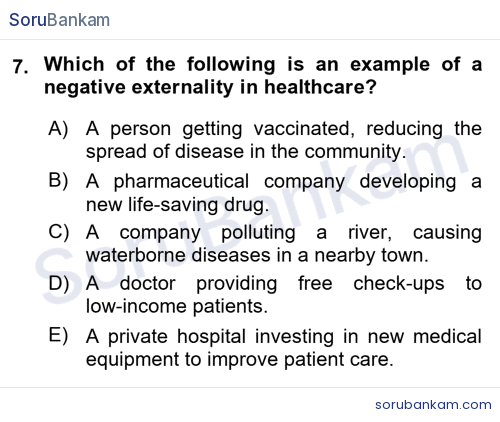
Which of the following is an example of a negative externality in healthcare? A) A person getting vaccinated, reducing the spread of disease in the community. B) A pharmaceutical company developing a new life-saving drug. C) A company polluting a river, causing waterborne diseases in a nearby town. D) A doctor providing free check-ups to low-income patients. E) A private hospital investing in new medical equipment to improve patient care.
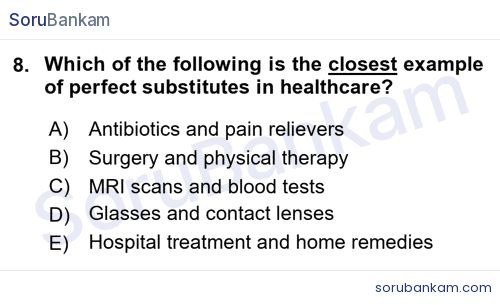
Which of the following is the closest example of perfect substitutes in healthcare? A) Antibiotics and pain relievers B) Surgery and physical therapy C) MRi scans and blood tests D) Glasses and contact lenses E) Hospital treatment and home remedies
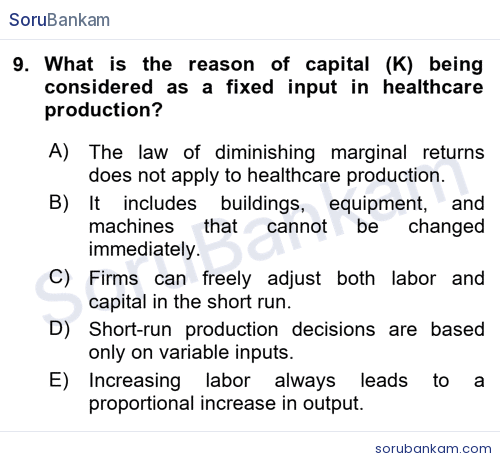
What is the reason of capital (K) being considered as a fixed input in healthcare production? A) The law of diminishing marginal returns does not apply to healthcare production. B) It includes buildings, equipment, and machines that cannot be changed immediately. C) Firms can freely adjust both labor and capital in the short run. D) Short-run production decisions are based only on variable inputs. E) Increasing labor always leads to a proportional increase in output.
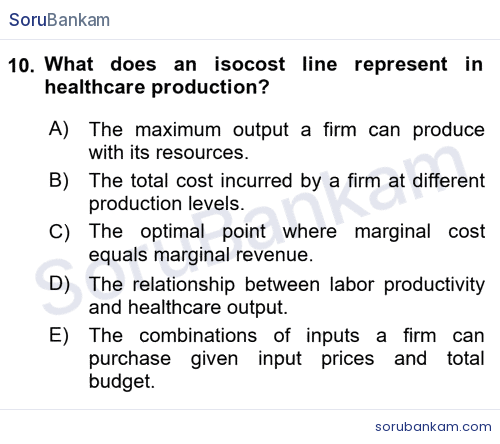
10. What does an isocost line represent in healthcare production? • 11 A) The maximum output a, fim can produce with its resources. B) The total cost incurred by a firm at different production levels, C) The optimal point where marginai cost equals marginal revenue. D) The relationship between labor productivity and healthcare output. The combinations of inputs a firm can purchase given input prices and total budget.
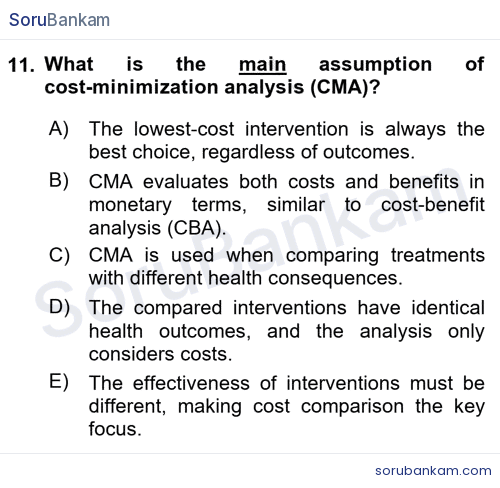
What the main assumption of cost-minimization analysis (CMA)? A) The lowest-cost intervention is always the best choice, regardless of outcomes. B) CMA evaluates both costs and benefits in monetary terms, similar to cost-benefit analysis (CBA). C) CMA is used when comparing treatments with different health consequences. D) The compared interventions have identical health outcomes, and the analysis only considers costs. E) The effectiveness of interventions must be different, making cost comparison the key focus.
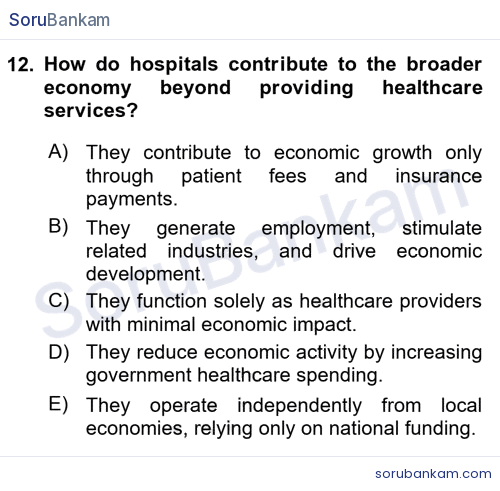
How do hospitals contribute to the broader economy beyond providing healthcare services? A) They contribute to economic growth only through patient fees and insurance payments. B) They generate employment, stimulate related industries, and drive economic development. C) They function solely as healthcare providers with minimal economic impact. D) They reduce economic, gotivity by increasing government healthcare spending. E) They operate independently from • local economies, relying only on national funding.
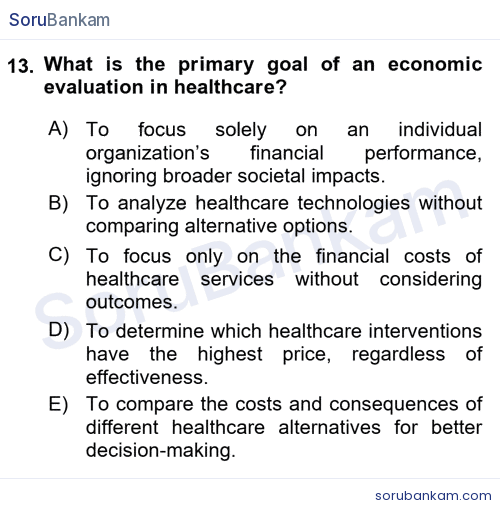
What is the primary goal of an economic evaluation in healthcare? solely on an individual A) Al arnizations finiticial performance. " ignoring broader societal impacts. B) To analyze healthcare technologies without comparing alternative options. C) To fotus only on the financial costs of Pealthcare services without considering outcomes. D) To determine which healthcare interventions have the highest price, regardless of effectiveness. E) To compare the costs and consequences of different healthcare alternatives for better decision-making.
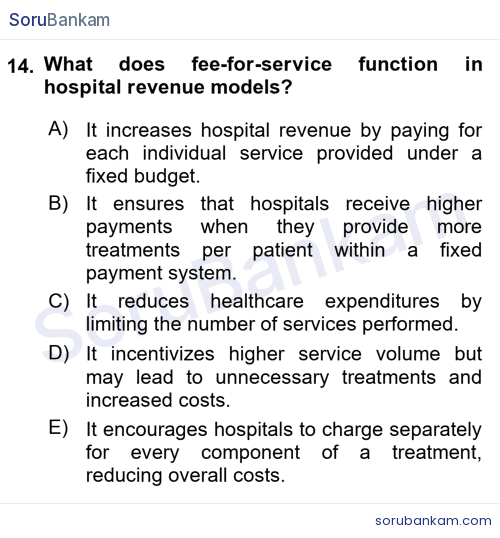
What does fee-for-service function in hospital revenue models? A) It increases hospital revenue by paying for each individual service provided under a fixed budget. B) It ensures that hospitals receive higher payments when they provide more treatments per patient within a fixed payment system. C) It reduces healthcare expenditures by limiting the number of services performed. D) It incentivizes higher service volume but may lead to unnecessary treatments and increased costs. E) It encourages hospitals to charge separately for every component of a treatment, reducing overall costs.
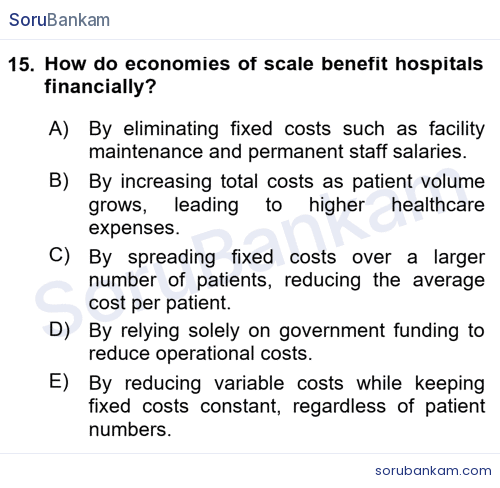
How do economies of scale beneflt hospitals financially? A) By eliminating fixed costs such as facility maintenance and permanent staff salaries. B) By increasing total costs as patient volume grows, leading to higher healthcare expenses. C) By spreading fixed costs over a larger number of patients, reducing the average cost per patient. D) By relying solely on goverment funding to reduce operational costs. E) By reducing variable costs while keeping fixed costs constant, regardless of patient numbers.
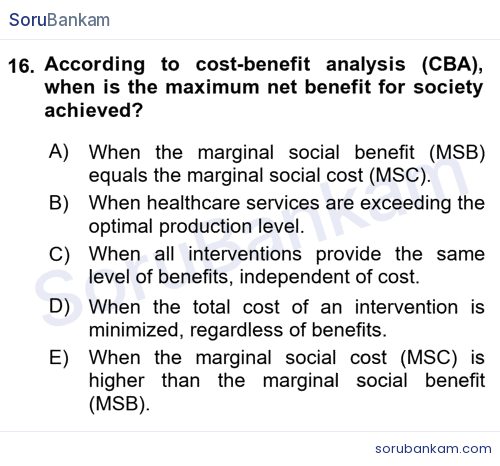
According to cost-benefit analysis (CBA), when is the maximum net benefit for society achieved? A) When the marginal social benefit (MSB) equals the marginal social cost (MSC). B) When healthcare services are exceeding the optimal production level. C) When all interventions provide the same level of benefits, independent of cost. D) When the total cost of an intervention is minimized, regardless of benefits. E) When the marginal social cost (MSC) is higher than the marginal social benefit (MSB).
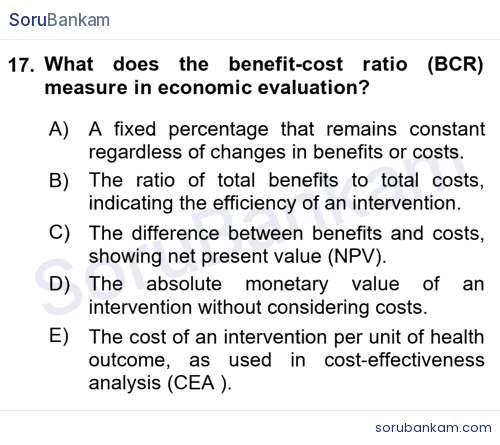
17. What does the benefit-cost ratio (BCR) measure in economiç evaluation? A) A fixed, percentage that rèmains constant regardless of changes In benefits or costs. The ratio of total benefits to total costs, indicating the efficiency of an interyention. C) The difference between benefits and costs, showing net present value (NPV). The absolute monetary value of an intervention without considering costs. E) The cost of an intervention per unit of health outcome, as used in cost-effectiveness analysis (CEA).
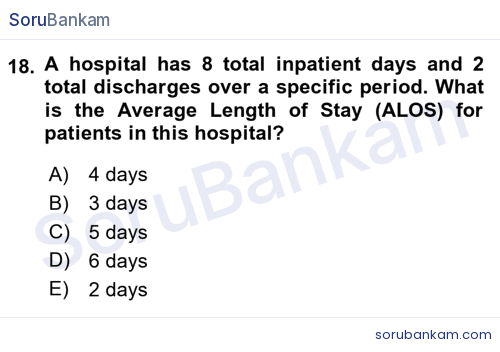
A hospital has 8 total inpatient days and 2 total discharges over a specific period. What is the Average Length of Stay (ALOS) for patients in this hospital? A) 4 days B) 3 days C) 5 days D) 6 days E) 2 days
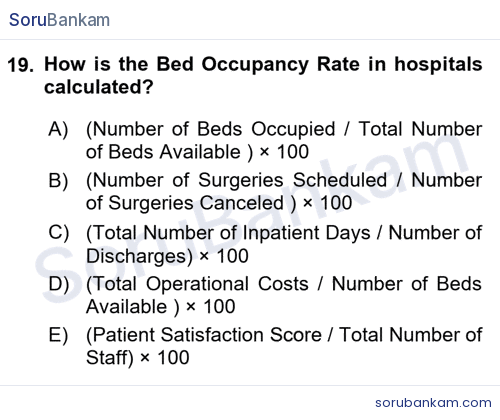
How is the Bed Occupancy Rate in hospitals calculated? A) (Number of Beds Occupied / Total Number of Beds Available ) × 100 B) (Number of Surgeries Scheduled / Number of Surgeries Canceled) × 100 C) (Total Number of Inpatient Days / Number of Discharges) × 100 D) (Total Operational Costs / Number of Beds Available) * 100 E) (Patient Satisfaction Score /. Total Number of Staff) × 100
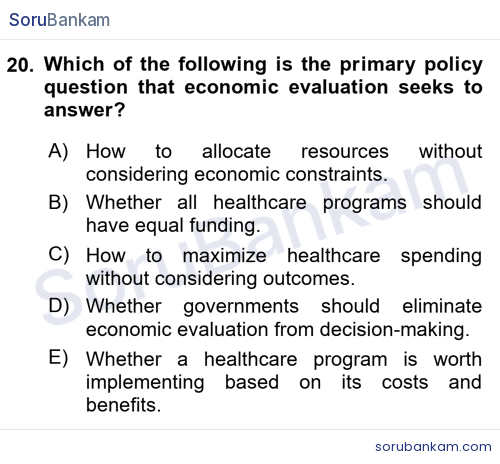
Which of the following is the primary policy question that economic evaluation seeks to answer? A) How to allocate resources without considering economic constraints. B) Whether all healthcare programs should have equal funding. C) How to maximize healthcare spending without considering outcomes. D) Whether governments should eliminate economic evaluation from decision-making. E) Whether a healthcare program is worth implementing based on its costs and benefits.