ULI454U The European Union and Global Politics 2023-2024 Vize Soruları
20 soru · Vize · 2023-2024
ULI454U The European Union and Global Politics dersinin 2023-2024 vize sınavı 20 sorudan oluşur; ders AÖF İktisat (İngilizce) bölümünde okutulur. Sorular aşağıda sırasıyla yer alır. Doğru cevaplar ve sonucun, testi çözdüğünde görünür.
Önizleme · 20 soru. Cevaplamak ve sonucunu görmek için sınavı başlat.
Sorular
20 soru
Soru 1
Soru 2
Soru 3
Soru 4
Soru 5
Soru 6
Soru 7
Soru 8
Soru 9
Soru 10
Soru 11
Soru 12
Soru 13
Soru 14
Soru 15
Soru 16
Soru 17
Soru 18
Soru 19
Soru 20
Sınav modunda süre tutulur, doğru cevaplar ve sonucun sınav bitince görünür.
Dersin üniteleri
ULI454U The European Union and Global Politics ders sayfası: bütün sınavlar ve üniteler
Soruların metni (otomatik okuma)
Görsellerden otomatik okunmuştur; hata içerebilir. Sorular, görsellerdeki hâliyle geçerlidir.
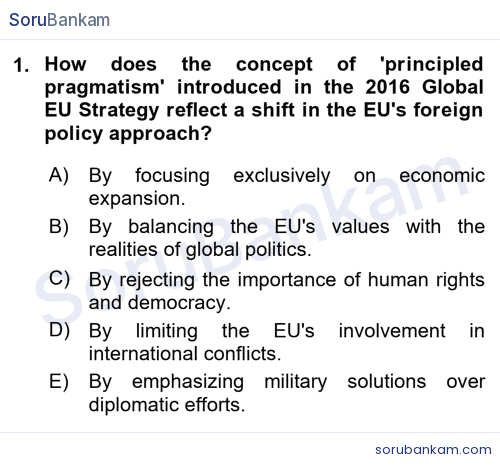
How does the concept of 'principled pragmatism' introduced in the 2016 Global EU Strategy reflect a shift in the EU's foreign policy approach? A) By focusing exclusively on economic expansion. B) By balancing. the EU's values with the realities of global politics. C) By rejecting the importance of human rights and democracy. D) By limiting the EU's involvement in international conflicts. E) By emphasizing military solutions over diplomatic efforts.
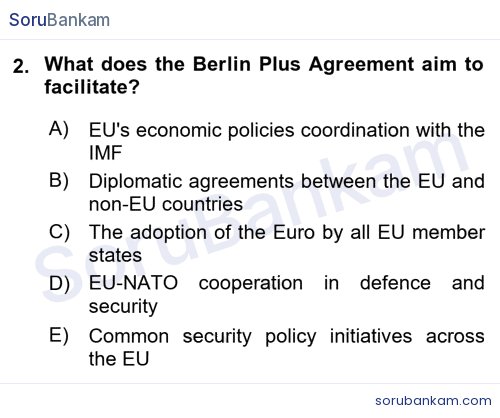
2. What does the Berlin Plus Agreement aim to facilitate? A) EU's economic policies coordination with the IMF B) Diplomatic agreements between the EU and non-EU countries C) The adoption of the Euro by all EU member states D) EU-NATO cooperation in defence and security Common sęcurity policy initätives across the EUr
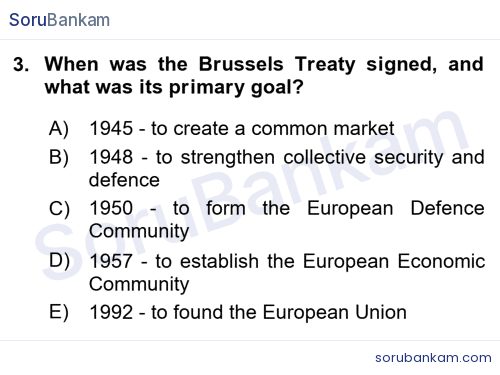
3. When was the Brussels Treaty signed, and what was its primary goal? A) 1945 - to create a common market 1948 - to strengthen collective security and defence C) 1950 - to form the European Defence Community D) 1957 - to establish the European Economic Community 1992 - to found the European Union
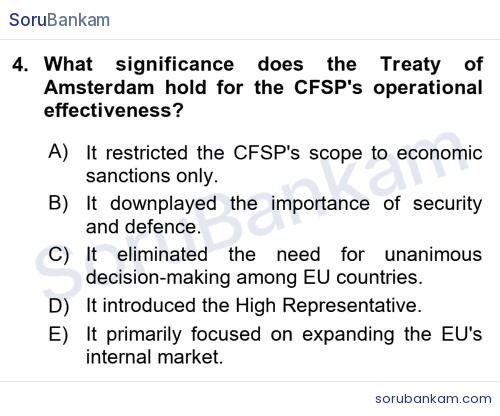
What significance does the Treaty of Amsterdam hold for the CFSP's operational effectiveness? A) It restricted the CFSP's scope to economic sanctions only. B) It downplayed the importance of security and defence: C) It eliminated the need for unanimous decision-making among EU countries. D) It introduced the High Representative. E) It primarily focused on expanding the EU's internal market.
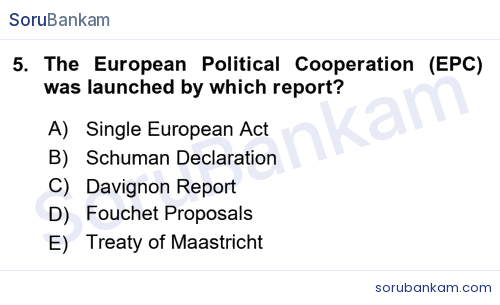
The European Political Cooperation (EPC) was launched by which report? A) Singlę, European Act B) Schuman Declaration C) • C) Davignon Report D) Fouchet Proposals E) Treaty of maastricht
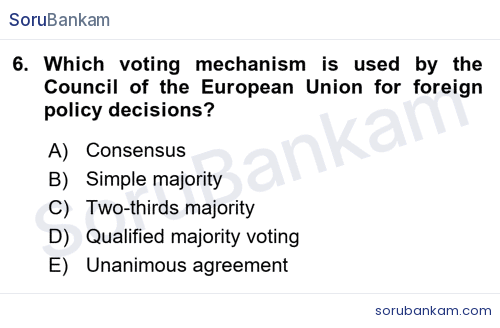
Which voting mechanism is used by the Council of the European Union for foreign policy decisions? A) Consensus B) Simple majority C) Two-thirds majority D) Qualified majority voting E) Unanimous agreement
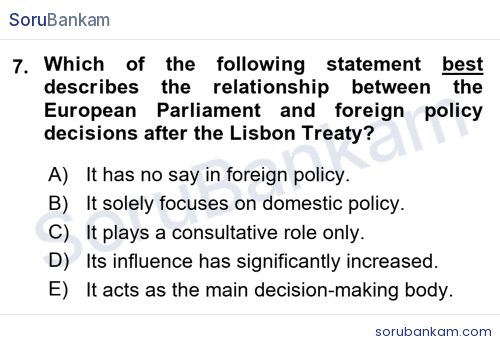
Which of the following statement best describes the relationship between the European Parliament and foreign policy decisions after the Lisbon Treaty? A) It has no say in foreign policy. B) It solely focuses on domestic policy. C) It plays a consultative role only. D) Its influence has significantly increased. E) It acts as the main decision-making body.
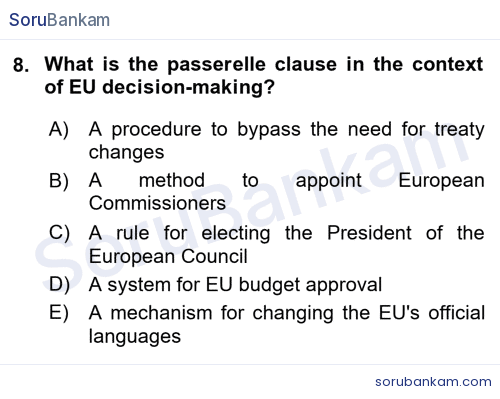
What is the passerelle clause in the context of EU decision-making? A) A procedure to bypass the need for treaty changes B) A method to appoint European Commissioners C) A rule for electing the President of the European Council D) A system for EU budget approval E) A mechanism for changing the EU's official languages
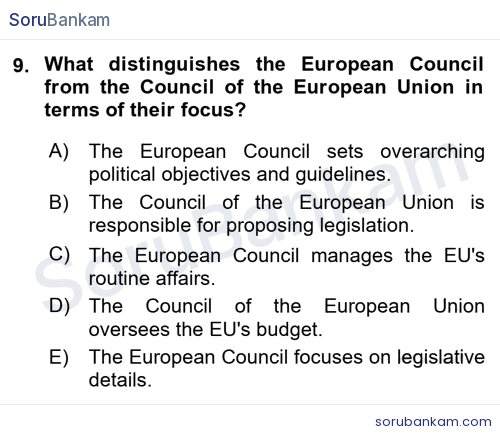
9. What distinguishes the European Council from the Council of the European Union in terms of their focus? A) The European Council sets overarching political objectives and guidelines. B) The Council of the European Union is responsible for proposing legislation. C) The European Council manages the EU's routine affairs. D) The Council of the European Union oversees the EU's budget. The European Council focuses on legislative details.
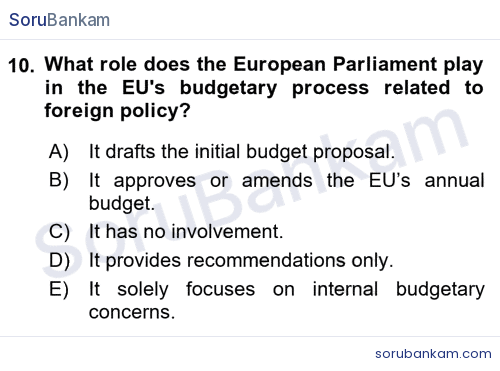
10. What role does the European Parliament play In the EU's budgefary process related to foreign policy? A) It drafts the initial budget proposal. It approves or amends the EU's annual' budget. C) It has no involvement. D) It provides recommendations only. - v8 solely focuses on internal budgetary concerns.
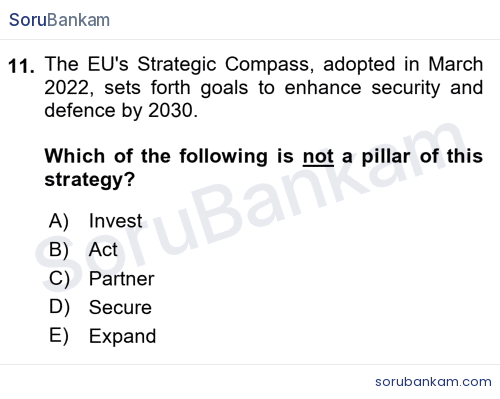
The EU's Strategic Compass, adopted in March 2022, sets forth goals to enhance security and defence by 2030. Which of the following is not a pillar of this strategy? A) Invest B) Act C) Partner D) Secure E) Expand
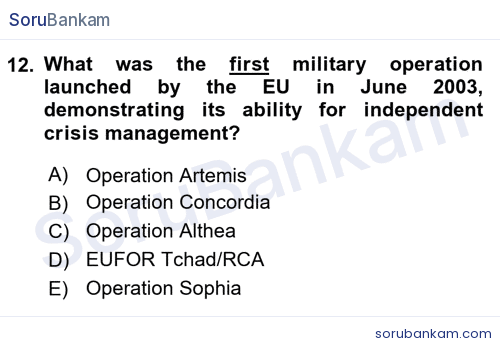
What was the first military operation launched by the EU in June 2003, demonstrating its ability for independent crisis management? A) Operation Artemis B) Operation Concordia C) Operation Althea D) EUFOR Tchad/RCA E) Operation Sophia
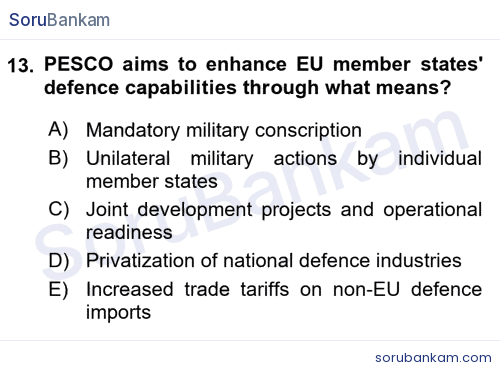
PESCO aims to enhance EU member states* defence capabilitles through what means? A) Mandatory military conscription B) Whilateral military actions by individual member states C) Joint development projects and operational readiness D) Privatization of natigpal defence industries E) ,ey Increased trade tarifts on non-EU defence imports
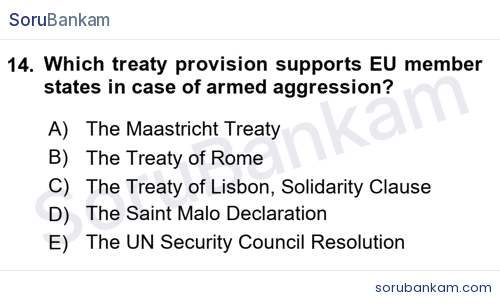
Which treaty provision supports E member states in case of armed aggression? A) The Maastricht Treaty B) The Treaty of Rome C) The Treaty of Lisbon, Solidarity Clause D) The Saint Malo Declaration E) The UN Security Council Resolution
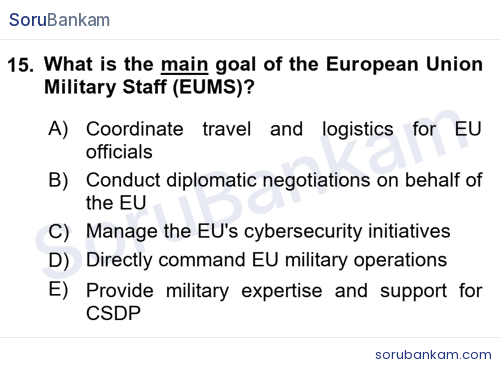
15. What is the main goal of the European Union Military Staff (EUMS)? A) Coordinate travel and logistics for EU officials B) Conduct diplomatic negotiations on behalf of the EU Manage the EU's cybersecunty initiatives D) Directly command EU military operations E) Provide military expertise and support for CSDP
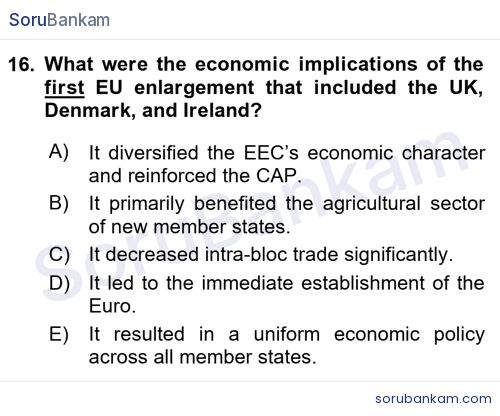
What were the economic implications of the first EU enlargement that Included the UK, Denmark, and Ireland? A) It diversified the EEC's economic character and reinforced the CAP. B) It primarily benefited the agricultural sector of new member states. C) It decreased intra-bloc trade significantly. D) It led to the immediate establishment of the Euro. E) It resulted in a uniform economic policy across all member states.
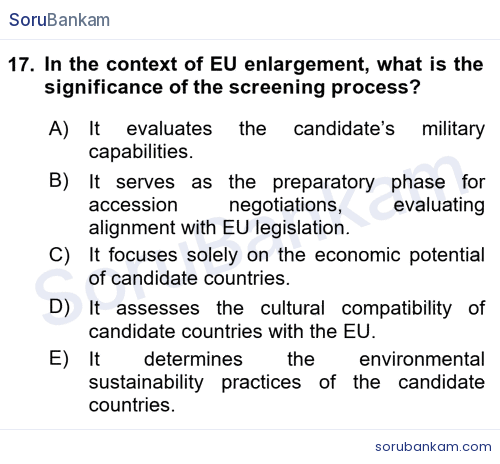
In the context of EU enlargement, what is the significance of the screening process? A) It evaluates the candidate's military capabilities. B) It serves as the preparatory phase Jot accession negotiations, qvaluating alignment with EU legislation, C) It focuses solely on the economic potential of candidate countries. D) It assesses the cultural compatibility of candidate countries with the EU. E) It determines ythe environmental sustainability practices of the candidate countries.
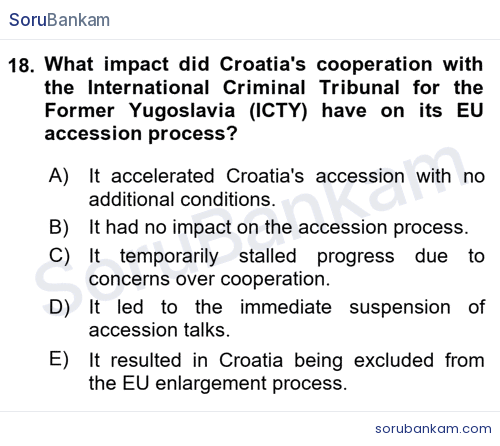
What impact did Croatia's cooperation with the International CrimInal Tribunal for the Former Yugoslavia (ICTY) have on its EU accession process? A) It accelerated Croatia's accession with no additional conditions. B) It had no impact on the accession process. C) It temporarily stalled progress due to concerns over cooperation. D) It led to the immediate suspension of accession talks. E) It resulted in Croatia being excluded from the EU enlargement process.
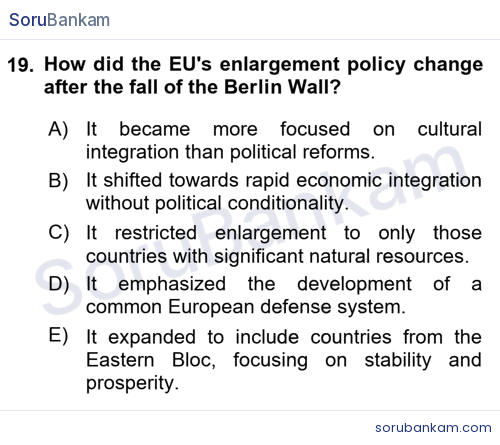
How did the EU's enlargement policy change after the fall of the Berlin Wall? A) It became more focused on cultural integration than political reforms. B) It shifted towards rapid economic integratigh without political conditionality. C) It restricted enlargement to only those countries with significant natural resources. D) It emphasized the development of a common European defense system. E) It expanded to include countries from the Eastern Bloc, focusing on stability and prosperity.
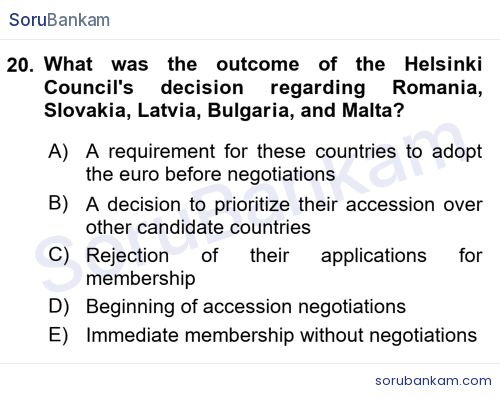
What was the outcome of the Helsinki Council's decision regarding Romania, Slovakia, Latvia, Bulgaria, and Malta? A) A requirement for these countries to adopt the euro before negotiations B) A decision to prioritize their accession over other candidate countries C) Rejection of their applications for membership D) Beginning of accession negotiations E) Immediate membership without negotiations