ULI454U The European Union and Global Politics 2024-2025 Vize Soruları
20 soru · Vize · 2024-2025
ULI454U The European Union and Global Politics dersinin 2024-2025 vize sınavı 20 sorudan oluşur; ders AÖF İktisat (İngilizce) bölümünde okutulur. Sorular aşağıda sırasıyla yer alır. Doğru cevaplar ve sonucun, testi çözdüğünde görünür.
Önizleme · 20 soru. Cevaplamak ve sonucunu görmek için sınavı başlat.
Sorular
20 soru
Soru 1
Soru 2
Soru 3
Soru 4
Soru 5
Soru 6
Soru 7
Soru 8
Soru 9
Soru 10
Soru 11
Soru 12
Soru 13
Soru 14
Soru 15
Soru 16
Soru 17
Soru 18
Soru 19
Soru 20
Sınav modunda süre tutulur, doğru cevaplar ve sonucun sınav bitince görünür.
Dersin üniteleri
ULI454U The European Union and Global Politics ders sayfası: bütün sınavlar ve üniteler
Soruların metni (otomatik okuma)
Görsellerden otomatik okunmuştur; hata içerebilir. Sorular, görsellerdeki hâliyle geçerlidir.
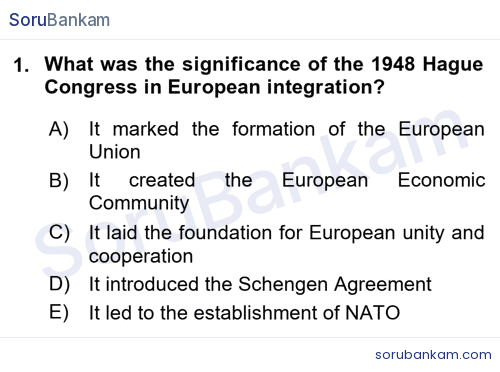
What was the significance of the 1948 Hague Congress in European integration? A) It marked the formation of the European Union B) It created the European Economio Community C) It laid the foundation for European unity and cooperation D) It introduced the Schengen Agreement E) It led to the establishment of NATO
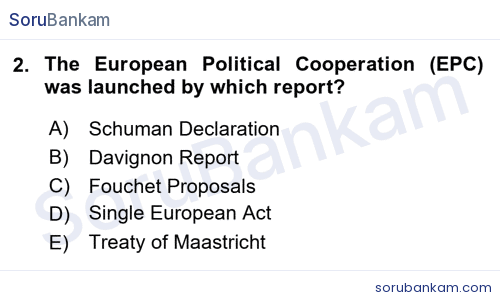
The European Political Cooperation (EPC) was launched by which report? A) Schuman Declaration B) Davignon Report C) Fouchet Proposals D) Single European Act E) Treaty of Maastricht
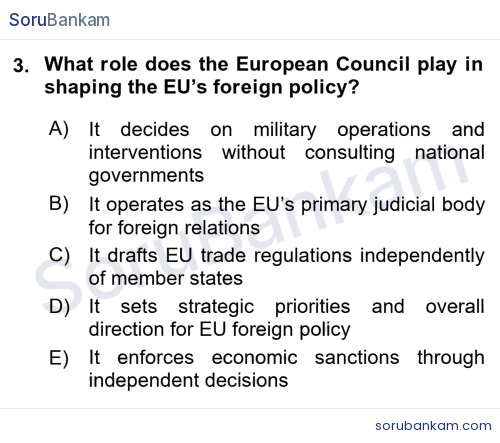
3. What role does the European Council play in shaping the EU's foreign policy? 'ss." A) It decides on military, ¿operations and interventions without consulting national governments It operates as the EU's primary judicial body for foreign relations C) It drafts' EU trade regulations independently of member states D) It sets strategic priorities and overall direction for EU foreign policy E) It enforces economie sanctions through independent decistons
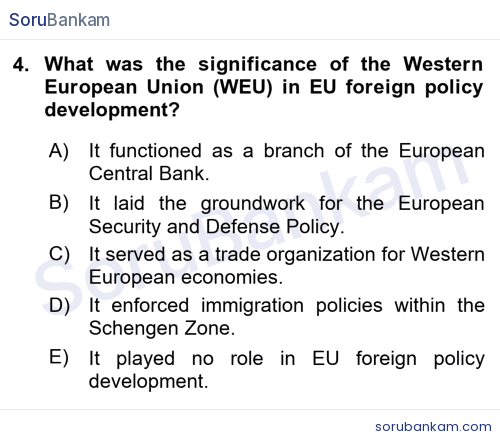
What was the significance of the Western European Union (WEU) in EU foreign policy development? A) It functioned as a branch of the European Central Bank. B) It laid the groundwork for the European Security and Defense Policy. C) It served as a trade organization for Western European economies. D) It enforced immigration policies within the Schengen Zone. E) It played no role in EU foreign policy development.
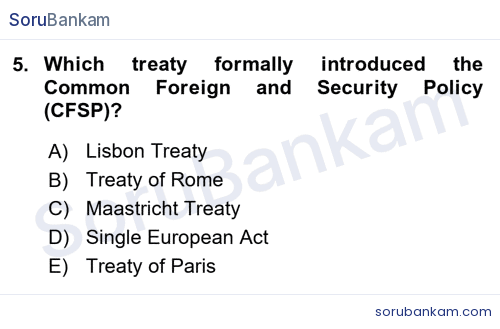
Which treaty formally introduced the Common Foreign and Security Pollcy (CFSP)? A) Lisbon Treaty B) Treaty of Rome C) Maastricht Treaty D) Single European Act E) Treaty of Paris
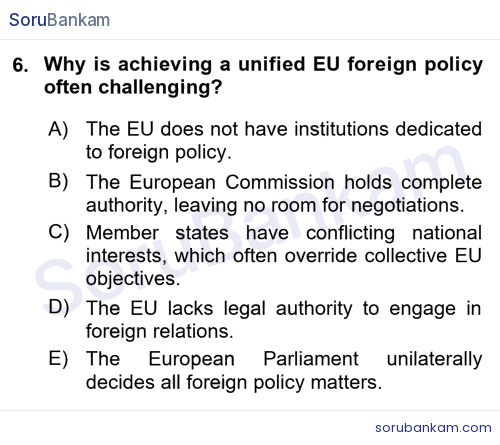
Why is achieving a unified EU foreign policy often challenging? A) The EU does not have institutions dedicated to foreign policy. • 1% B) The European Commission holds complete authority, leaving no room for negotiations. C) Merests, sales man overde collected , which often override collective EU objectives. D) " D) The EU lacks legal authority to engage in foreign relations. E) The European Parliament unilaterally decides all foreign policy matters.
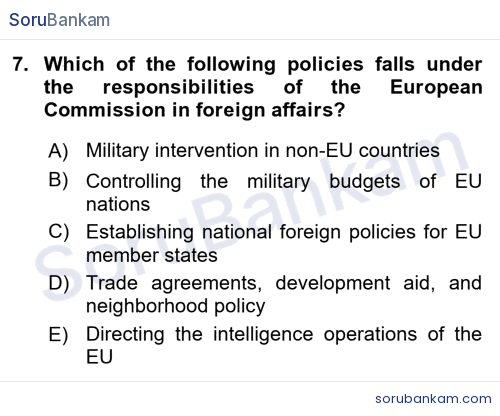
Which of the following policies falls under the responsibilities of the European Commission in foreign affairs? A) Military intervention in non-EU countries B) Controlling the military budgets of EU nations C) Establishing national foreign policies for EU member states D) Trade agreements, development aid, and neighborhood policy E) Directing the intelligence operations of the
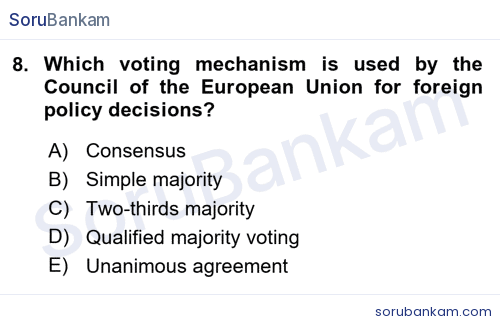
Which voting mechanism is used by the Council of the European Union for foreign policy decisions? A) Consensus B) Simple majority C) Two-thirds majority D) Qualified majority voting E) Unánimous agreement
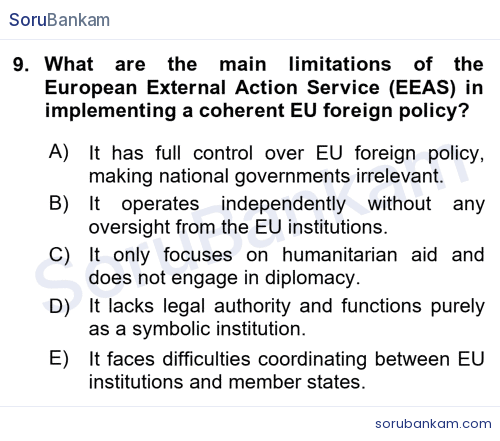
What are the main limitations of the European External Action Service (EEAS) in implementing a coherent EU foreign policy? A) It has full control over EU foreign policy, making national governments irrelevant. B) It operates independenty without any oversight from the EU institutions. C) It only focuses on humanitarian aid and does not engage in diplomacy. D) It lacks legal authority and functions purely as a symbolic institution. E) It faces difficulties coordinating between EU institutions and member states.
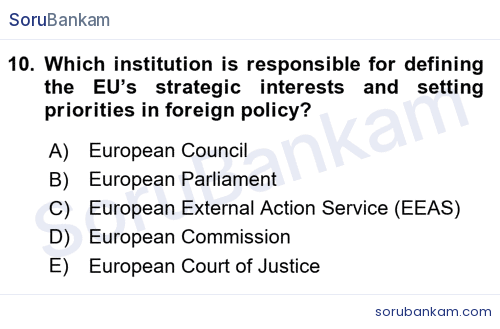
Which institution is responsible for defining the EU's strategic interests and setting priorities in foreign policy? A) European Council B) European Parliament C) European External Action Service (EEAS) D) European Commission E) European Court of Justice
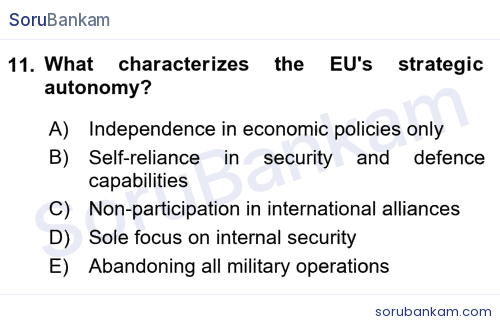
11. What characterizes the EU's strategic autonomy? A) Independende in economic policies only Self-reliance in security and defence capabilities C) Non-participation in international allandes D) Sole focus on internal security E) Abandoning all military operations
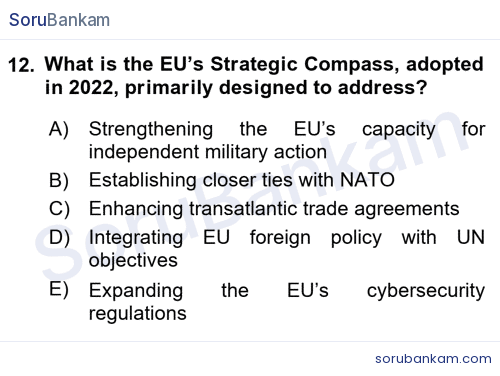
What is the EU's Strategic Compass, adopted in 2022, primarily designed to address? A) Strengthening the EU's capacity for independent military action B) Establishing closer ties with NATO C) Enhancing transatlantic trade agreements D) Integrating EU foreign policy with UN objectives E) Expanding the EU's cybersecurity regulations
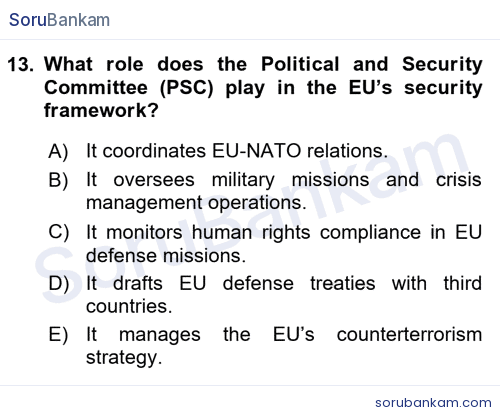
What role does the Political and Security Committee (PSC) play in the EU's security framework? A) It coordinates EU-NATO relations. B) It oversees military missions and crisisi management operations. C) It monitors human rights compliance in EU defense missions. D) It drafts EU defense treaties with third countries. E) It manages the EU's counterterrorism strategy.
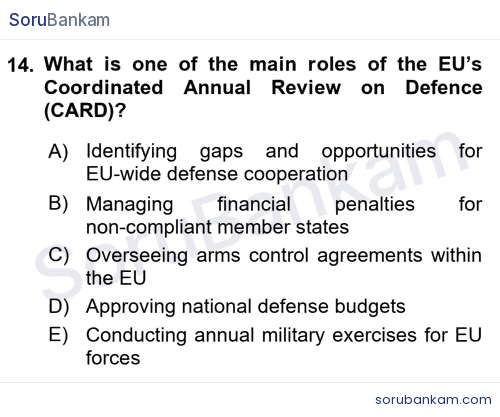
14. What is one of the main roles of the EU's Coordinated Annual Review on Defence (CARD)? A) Identifying gaps and opportunities for EU-wide defense cooperation B) Managing financial penalties for non-compliant member states C) Overseeing arms control agreements within the EU Approving national defense budgets. E) Conducting annual military exercises for EU forces
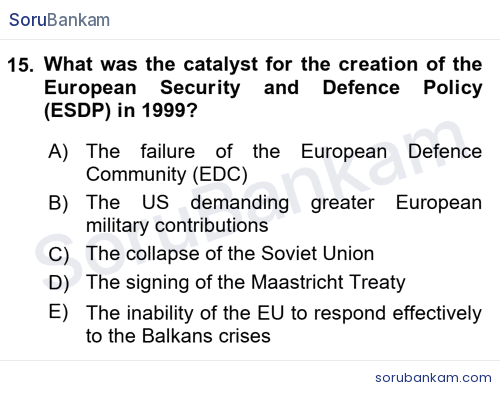
What was the catalyst for the creation of the European Security and Defence Policy (ESDP) in 1999? A) The failure of the European Defence Community (EDC) B) The US demanding greater European military contributions C) The collapse of the Soviet Union D) The signing of the Maastricht Treaty E) The inability of the EU to respond effectively to the Balkans crises
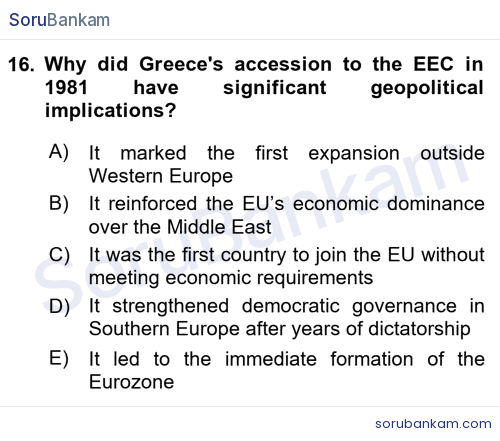
Why dia Greece's accession to the EEC in 1981 have significant geopolitical implications? A) It marked the first expansion outside Wester Europe B) It reinforced the EU's economic dominance over the Middle East C) It was the first country to join the EU without meeting economic requirements D) It strengthened democratic governance in Southern Europe after years of dictatorship E) It led to the immediate formation of the Eurozone
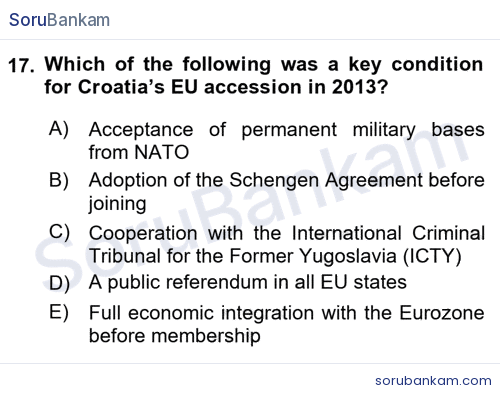
Which of the following was a key condition? for Croatia's EU accession in 2013? A) Acceptance of permanent military bases from NATO B) Adoption of the Schengen Agreement before joining C) Cooperation with the Intemational Criminal Tribunal for the Formeç Yugoslavia (ICTY) D) A public referendum in all EU states E) Full economic integration with the Eurozone before membership
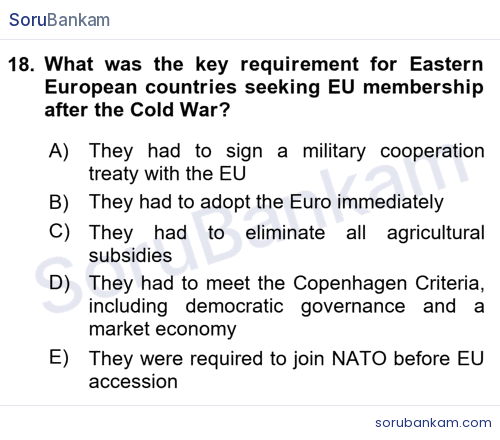
What was the key requirement for Eastern European countries seeking EU membership after the Cold War? A) They had to sign a military cooperation treaty with the B) They had to adopt the Euro immediately C) They had to eliminate all agricultural subsidies D) They had to meet the Copenhagen Criteria, including democratic governance and a market economy E) They were required to join NATO before EU accession
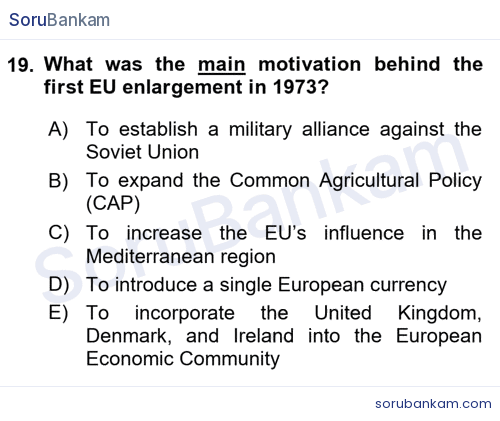
What was the main motivation behind the first EU enlargement in 1973? A) To establish a military alliance against the Soviet Union B) To expand the Common Agricultural Pouch (CAP) C) To increase the EU's influence in the Mediterranean region D) To introduce a single European currency E) To incorporate the United Kingdom, Denmark, and Ireland into the European Economic Community •
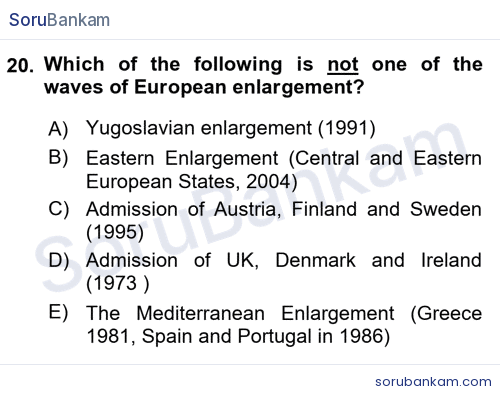
Which of the following is not one of the waves of European enlargement? A) Yugoslavian enlargement (1991) B) Eastern Enlargement (Central and Eastern European States, 2004) C) Admission of Austria, Finland and Sweden (1995) D) Admission of UK, Denmark and Ireland (1973) E) The Mediterranean Enlargement (Greece 1981, Spain and Portugal in 1986)