IKT459U Agricultural Economics 2024-2025 Yaz Okulu Soruları
20 soru · Yaz okulu · 2024-2025
IKT459U Agricultural Economics dersinin 2024-2025 yaz okulu sınavı 20 sorudan oluşur; ders AÖF İktisat (İngilizce) bölümünde okutulur. Sorular aşağıda sırasıyla yer alır. Doğru cevaplar ve sonucun, testi çözdüğünde görünür.
Önizleme · 20 soru. Cevaplamak ve sonucunu görmek için sınavı başlat.
Sorular
20 soru
Soru 1
Soru 2
Soru 3
Soru 4
Soru 5
Soru 6
Soru 7
Soru 8
Soru 9
Soru 10
Soru 11
Soru 12
Soru 13
Soru 14
Soru 15
Soru 16
Soru 17
Soru 18
Soru 19
Soru 20
Sınav modunda süre tutulur, doğru cevaplar ve sonucun sınav bitince görünür.
Dersin üniteleri
IKT459U Agricultural Economics ders sayfası: bütün sınavlar ve üniteler
Soruların metni (otomatik okuma)
Görsellerden otomatik okunmuştur; hata içerebilir. Sorular, görsellerdeki hâliyle geçerlidir.
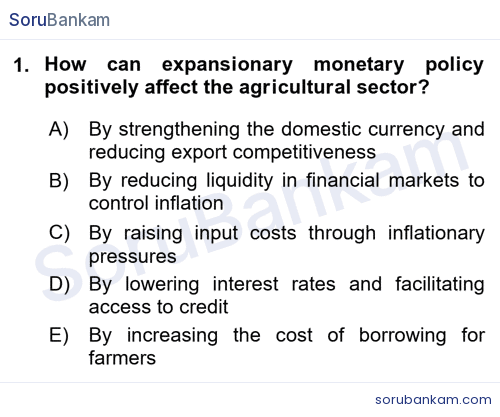
1. How can expansionary monetary policy positively affect the agricultural sector? A) By strengthening the domestic currency and reducing export competitiveness B) By reducing liquidity in financial markets to control inflation C) By raising input costs through inflationary pressures D) By lowering interest rates and facilitating access to credit By increasing the cost of borrowing for farmers
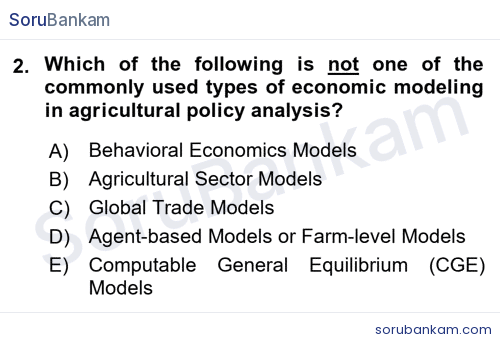
2. Which of the following is not one of the commonly used types of economic modeling in agricultural policy analysis? A) Behavioral Economics Models B) Agricultural Sector Models C) Global Trade Models D) Agent-based Models or Farm-level Models Computable General Equilibrium (CGE) Models
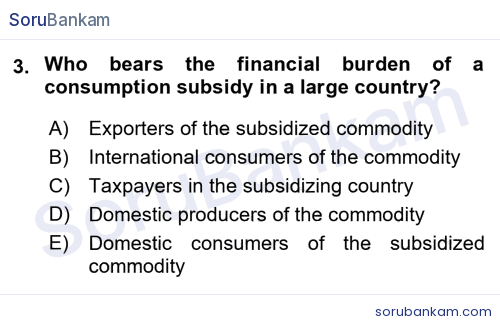
3. Who bears the financial burden consumption subsidy in a large country? N A) Exporters of the subsidized commodity International consumers of the commodity C) Taxpayers in the subsidizing country D) Domestic producers of the commodity 5) Domestic: consumers, of the subsidized fommodity
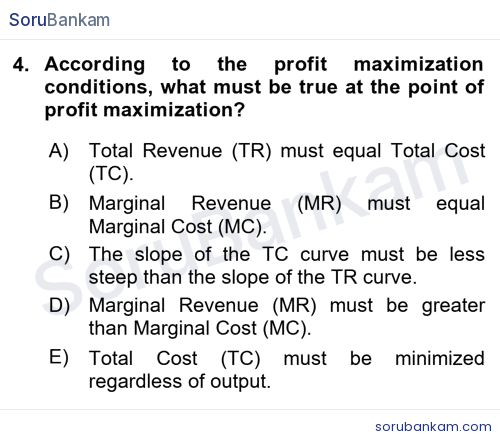
According to the profit maximization conditions, what must be true at the point of profit maximization? A) Total Revenue (TR) must equal Total Cost (TC). B) Marginal Revenue (MR) must equal Marginal Cost (MC). C) The slope of the TC curve must be less steep than the slope of the TR curve. D) Marginal Revenue (MR) must be greater than Marginal Cost (MC). E) Total Cost (TC) must be minimized regardless of output.
How do multinational corporations contribute to distortions in domestic agricultural markets? A) By encouraging small-scale farming to increase local market participation. B) By increasing government subsidies to balance the global market. C) By eliminating the role of domestic buyers and sellers entirely. D) By promoting free competition and reducing the influence of local producers. E) By controlling national input markets through imports, patents, and partnerships.
What distinguishes the Cournot model from the Bertrand model in oligopoly theory? A) The Coumot model involves firms competing jI) quantities, while the Bertrand model • involves firms competing in prices. B) The Cournot model involves leader-follower dynamic, white the Bertrand model assumes simultaneous decisions. C) C Jhe Cournot model focuses on firms producing differentiated products, whereas the Bertrand model assumes homogeneous products. D) The Coumot model is based on cooperative strategies, while the Bertrand model is non-cooperative. E) The Cournot model assumes firms compete in prices, while the Bertrand model assumes they compete in quantities.
Which agricultural practice helps prevent soil erosion? A) Ploughing steep slopes for better drainage B) Crop rotation to enhance soil nutrients C) Increasing irrigation frequency during dry seasons D) Clearing forests to create more farmland E) Planting vegetation with deep roots to stabilize soil
Which of the following intervention tools has been used in Türkiye's agricultural policies? A) Universal basic income for farmers B) Abolition of all agricultural subsidies C) Input support and price interventions D) Exclusive reliance on import tariffs E) Privatization of agricultural fand
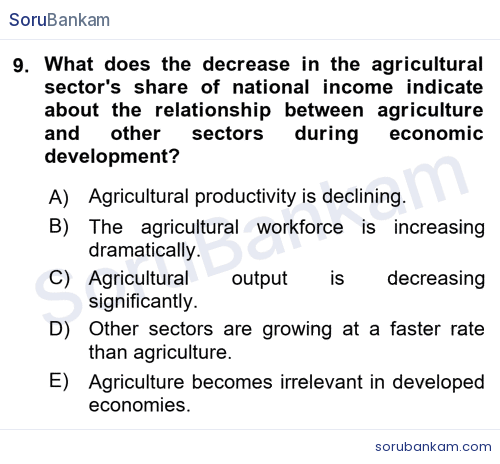
What does the decrease in the agricultural sector's share of national income indicate about the relationship between agriculture and other sectors during economic development? A) Agricultural productivity is declining. ..." B) The agricultural workforce is increasing dramatically. C) Agricultural output is decreasing significantly. D) Other sectors are growing atra faster rate than agriculture. E) Agriculture becomes irrelevant in developed economies.
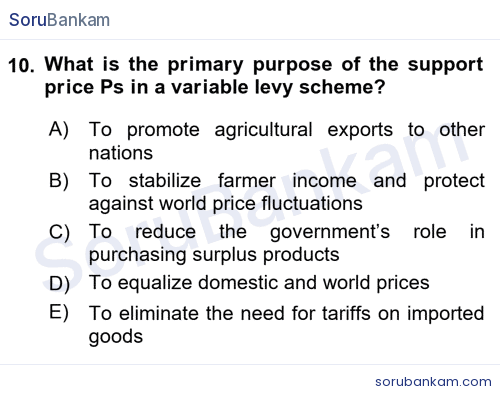
What is the primary purpose of the support price Ps in a variable levy scheme? A) To promote agricultural exports to other nations B) To stabilize farmer income and protect against world price fluctuations C) To reduçe the goverment's role in purchasing surplus products D) To equalize domestic and world prices E) To eliminate the need for tariffs on imported goods
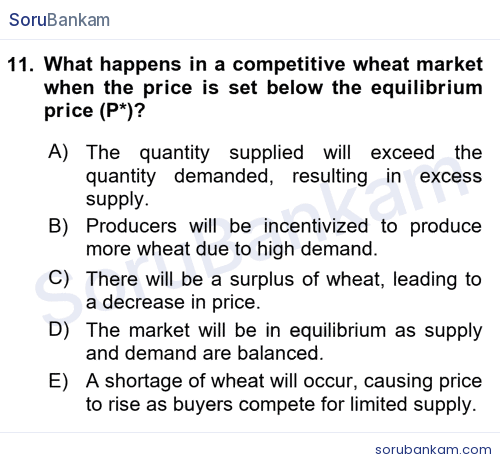
What happens in a competitive wheat market when the price is set below the equilibrium price (P*)? A) The quantity supplied will exceed the quantity demanded, resulting in excess supply. B) Producers will be incentivized to produce more wheat due to high demand. C) There will be a surplus of wheat, leading to a decrease in price. D) The market will be in equilibrium as supply and demand are balanced. E) A shortage of wheat will occur, causing price to rise as buyers compete for limited supply.
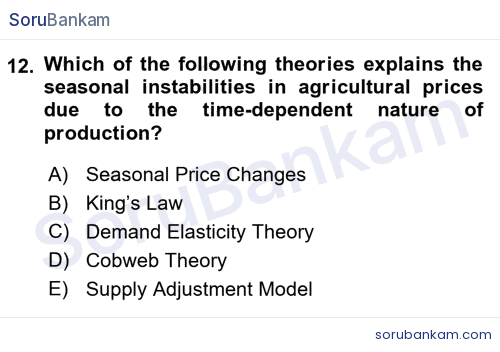
Which of the following theories explains the seasonal instabilities in agricultural prices due to production? unme-dependent nature of A) Seasonal Price Changes B) King's Law C) Demand Elasticity Theory D) Cobweb Theory E) Supply Adjustment Model
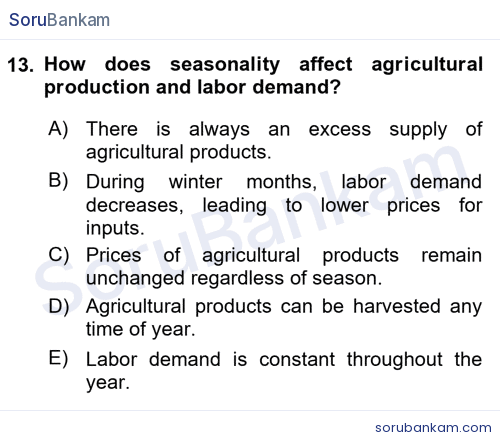
How does seasonality affect agricultural production and labor demand? A) There is always an excess supply of agricultural products. B) During winter months, labor demand decreases, leading to lower prices for inputs. C) Prices of agricultural products remain unchanged regardless of season. D) Agricultural products can be harvested any time of year. E) Labor demand is constant throughout the year.
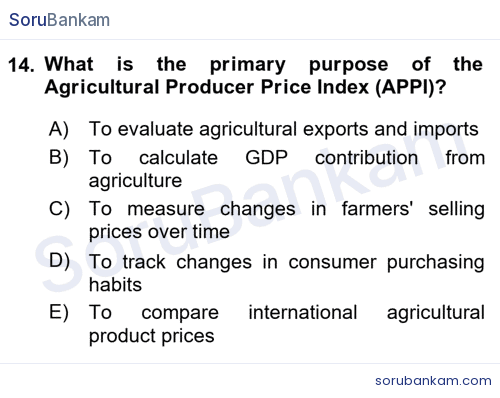
What is the primary purpose of the Agricultural Producer Price Index (APPI)? A) To evaluate agricultural exports and imports B) To calculate GDP contribution from agriculture C) To measure changes in farmers' selling prices over time D) To track changes in consumer purchasing habits E) To compare international agricultural product prices
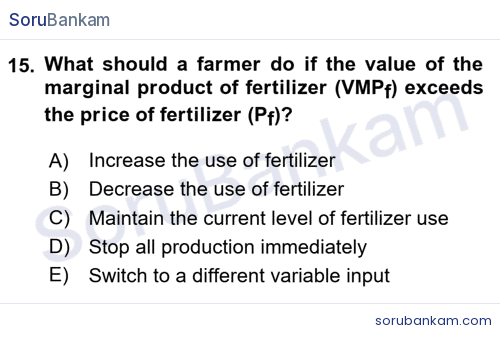
What should a farmer do if the value of the marginal product of fertilizer (VMPf) exceeds the price of fertilizer (Pf)? A) Increase the use of fertilizer B) Decrease the use of fertilizer C) Maintain the current level of fertilizer use D) Stop all production immediately E) Switch to a different variable input
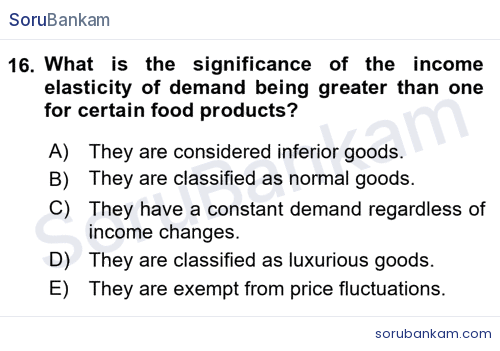
What is the significance of the income elasticity of demand belng greater than one for certain food products? A) They are considered inferior goods. B) They are classified as normal goods. + 0" C) They have a constant demand regardless of income changes. D) They are classified as luxurious goods. E) • They are exempt from price fluctuations.
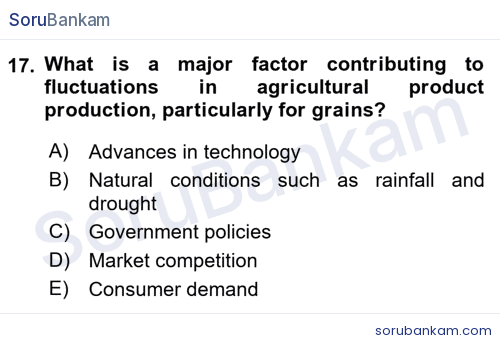
What is a major factor contributing to fluctuations agricultural product production, particularly for grains? A) Advances in technology B) Natural conditions such as rainfall and drought C) Government policies D) Market competition E) Consumer demand
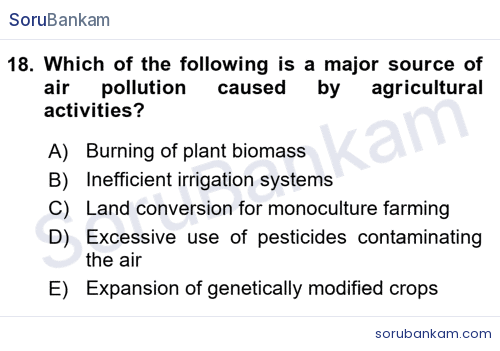
Which of the following is a major source of air pollution caused by agricultural activities? A) Buming of plant biomass B) Inefficient irrigation systems C) Land conversion for monoculture farrhing D) Excessive use of pesticides contaminating the air E) Expansion of genetically modified crops
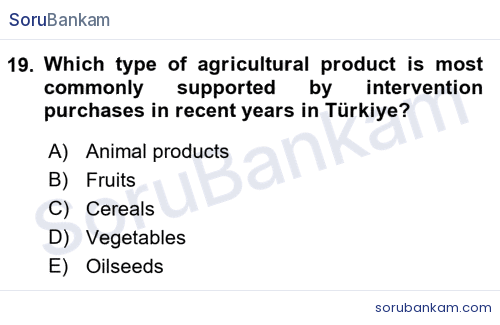
Which type of agricultural product is most commonly, supported by. intervention purchases in reçeht years in Türkiye? A) Animal'products B) Fruits C) Cereals D) Vegetables E) Oilseeds
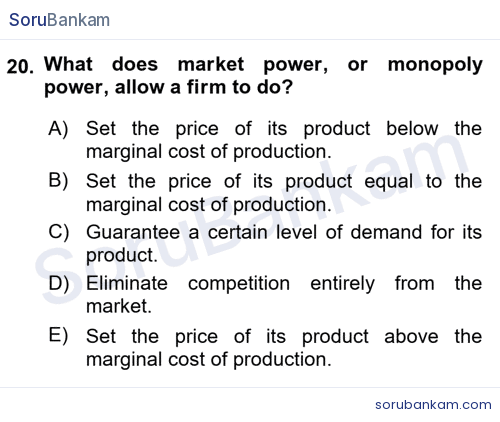
What does market power, or monopoly power, allow a firm to do? A) Set the price of its product below the marginal cost of production. B) Set the price of its product equal to the marginal cost of production. C) Guarantee a certain level of demand for its product. D) Eliminate competition entirely from the market. E) Set the price of its product above the marginal cost of production.