IKT459U Agricultural Economics 2024-2025 Vize Soruları
20 soru · Vize · 2024-2025
IKT459U Agricultural Economics dersinin 2024-2025 vize sınavı 20 sorudan oluşur; ders AÖF İktisat (İngilizce) bölümünde okutulur. Sorular aşağıda sırasıyla yer alır. Doğru cevaplar ve sonucun, testi çözdüğünde görünür.
Önizleme · 20 soru. Cevaplamak ve sonucunu görmek için sınavı başlat.
Sorular
20 soru
Soru 1
Soru 2
Soru 3
Soru 4
Soru 5
Soru 6
Soru 7
Soru 8
Soru 9
Soru 10
Soru 11
Soru 12
Soru 13
Soru 14
Soru 15
Soru 16
Soru 17
Soru 18
Soru 19
Soru 20
Sınav modunda süre tutulur, doğru cevaplar ve sonucun sınav bitince görünür.
Dersin üniteleri
IKT459U Agricultural Economics ders sayfası: bütün sınavlar ve üniteler
Soruların metni (otomatik okuma)
Görsellerden otomatik okunmuştur; hata içerebilir. Sorular, görsellerdeki hâliyle geçerlidir.
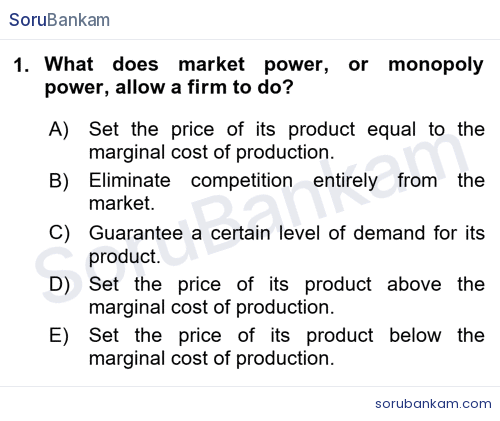
What does market power, or monopoly power, allow a firm to do? A) Set the price of its product equal to the marginal cost of production. B) Eliminate competition entirely from. the market. C) Guarantee a certain level of demand for its product. D) Set the price of its product above the marginal cost of production. E) Set the price of its product below the marginal cost of production.
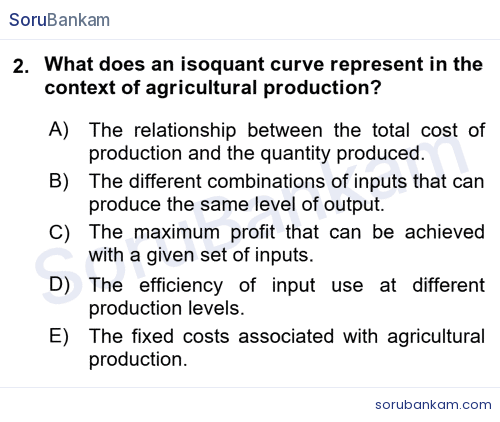
What does an isoquant curve represent in that context of agricultural production? A) The relationship between the total cost of production and the quantity produced. B) The different combinations of inputs that can produce the same level of output C) The maximum profit that gan Be achieved with a given set of inputs.' D) The efficiency of input use at different production levels. E) The fixed costs associated with agricultural production.
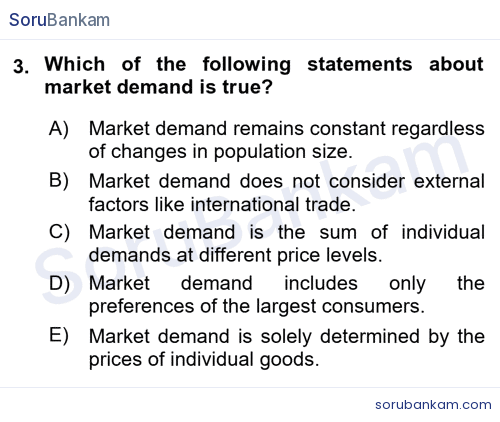
Which of the following statements about market demand is true? A) Market demand remains constant regardless of changes in population size. B) Market demand does not consider external factors like international trade. C) Market demand is the sum of individual demands at different price levels. D) Market demand includes only the preferences of the largest consumers. E) Market demand is solely determined by the prices of individual goods.
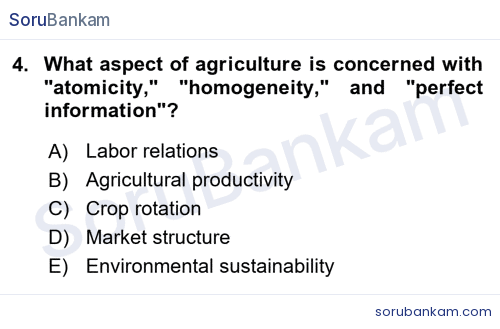
What aspect of agriculture is concerned with "atomicity," "homogeneity," and "perfect information"? A) Labor relations B) Agriculturai productivity C) Crop rotation D) Market structure E) Environmental sustainability
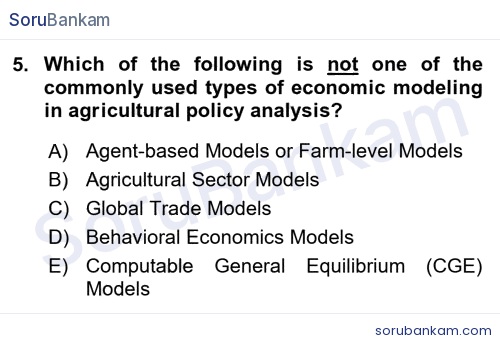
Which of the following is not one of the commonly used types of economic modeling in agricultural policy analysis? A) , Agert-based Modelsor Farm-level Models B) Agricultural Sector Models C) Global Trade Models D) Behavioral Economics Models E) Computable General Equilibrium (CGE) Models
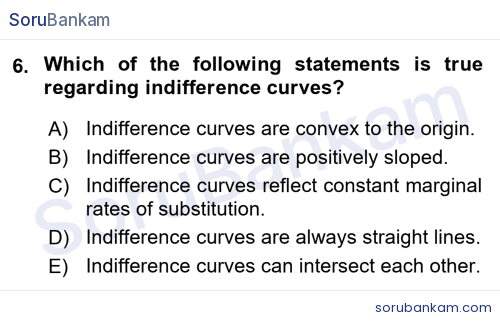
Which of the following statements is true regarding indifference curves? A) Indifference curves are convex to the origin. B) Indifference curves are positively sloped. C) Indifference curves reflect constant marginal rates of substitution. D) Indifference curves are always straight lines. E) Indifference curves can intersect each other.
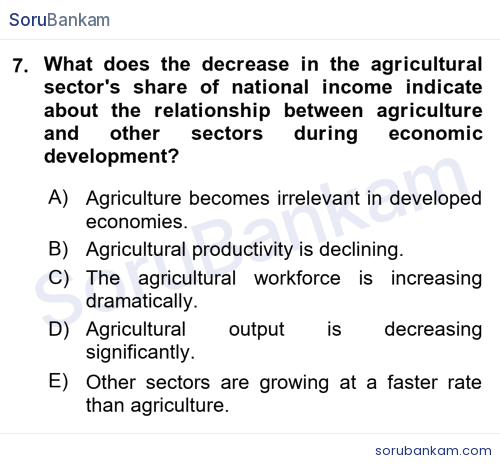
What does the decrease in the agricultural sector's share of national income indicate about the relationship between agriculture and other sectors during economic development? A) Agriculture becomes irrelevant in developed economies. B) Agricultural productivity is declining. C) The agricultural workforce is increasing dramatically. D) Agricultural output is decreasing significantly. E) Other sectors are growing at a faster rate than agriculture.
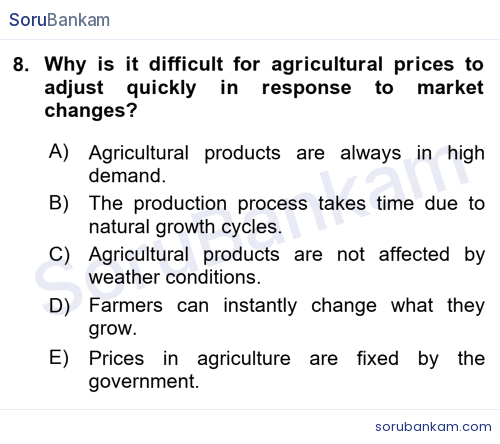
Why is it difficult for agricultural prices to adjust quickly in response to market changes? A) Agricultural products are always in high demand. B) The production process takes time due to natural growth cycles. C) Agricultural products are not affected by weather conditions. D) Farmers can instantly change what they grow. E) Prices in agriculture are fixed by the government.
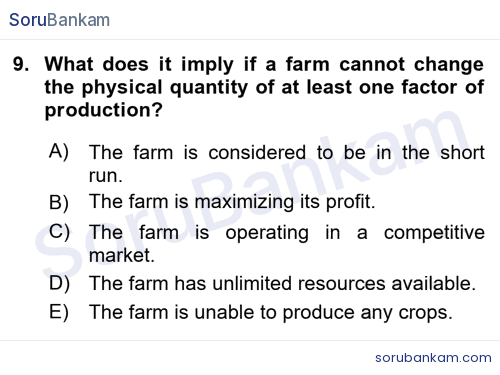
What does it imply if a farm cannot change the physical quantity of at least one factor of production? A) The farm is considered to be in the short run. B) The farm is maximizing its profit. C) The farm is operating in competitive market: D) The farm has unlimited resources available. E) The farm is unable to produce any grops.
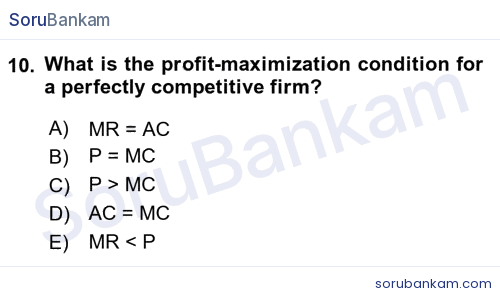
What is the profit-maximization condition for a perfectly competitive firm? A) MR = B) PEMC C) P> D) AC =MC E) MR<
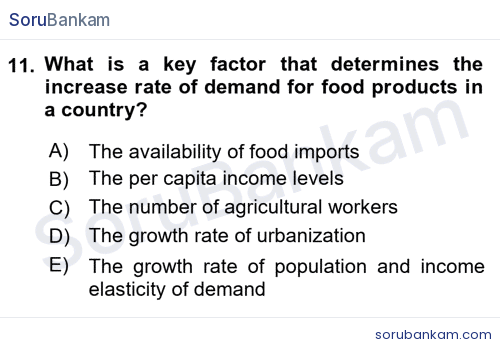
What is a key factor that determines the increase rate of demand for food products in a country? A) The availability of food imports B) The per capita income levels C) The number of agricultural workers D) The growth rate of urbanization E) The growth rate of population and income elasticity of demand
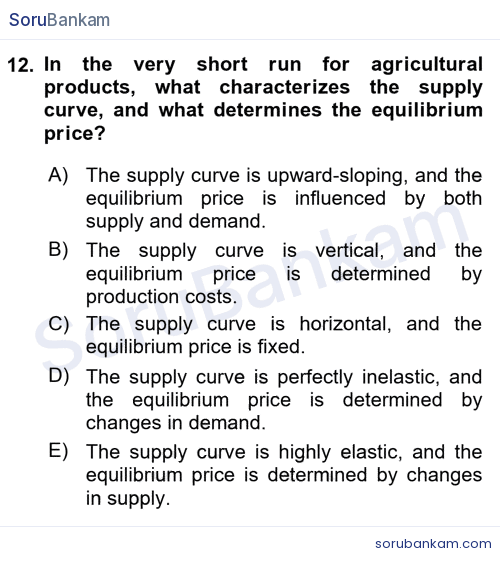
In the very short run for agricultural products, what characterizes the supply curve, and what determines the equilibrium price? A) The supply curve is upward-sloping, and the equilibrium price is influenced by - both supply and demand. B) The supply curve is vertical, and the equilibrium price is determined by production costs. C) The supply curve is horizontal, and the equilibrium price is fixedin D) The supply curve is perfectly inelastic, and the equilibrium price is determined by changes in demand. E) The supply curve is highly elastic, and the equilibrium price is determined by changes in supply.
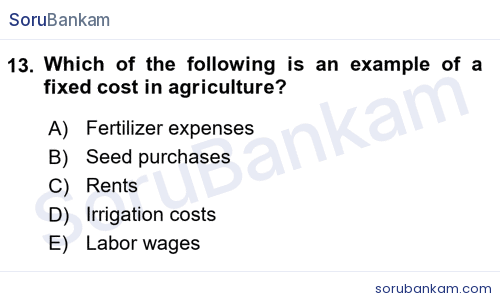
Which of the following is an example of a fixed cost in agriculture? A) Fertilizer expenses B) Seed purchases C) Rents D) Irrigation costs E) Labor wages
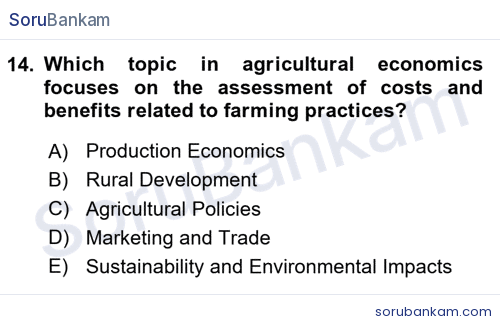
Which topic in agricultural economics focuses on the assessment of costs and benefits related to farming practices? A) Production Economics B) Rural Development C) Agricultural Policies D) Marketing and Trade E) Sustainability and Environmental Impacts
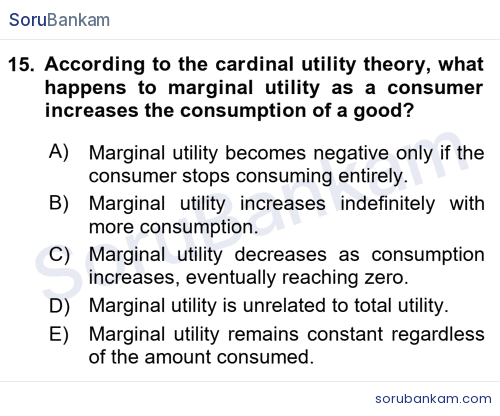
According to the cardinal utility theory, what happens to marginal utility as a consumer increases the consumption of a good? A) Marginal utility becomes negative only if the consumer stops consuming entirely. B) Marginal utility increases indefinitely with more consumption. C) Marginal utility decreases as consumption increases, eventually reaching zero. D) Marginal utility is unrelated to total utility. E) Marginal utility remains constant regardless of the amount consumed.
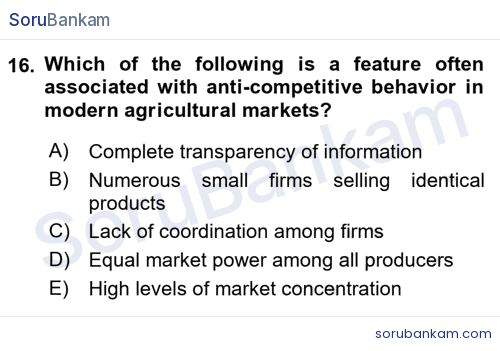
Which of the following is a feature ofteni associated with anti-competitive behavior in modern agricultural markets? A) Complete transparency of information B) _ Numerous small firms selling identical products C) Lack of coordination among firms D) Equal market power among all producers E) High levels of market concentration
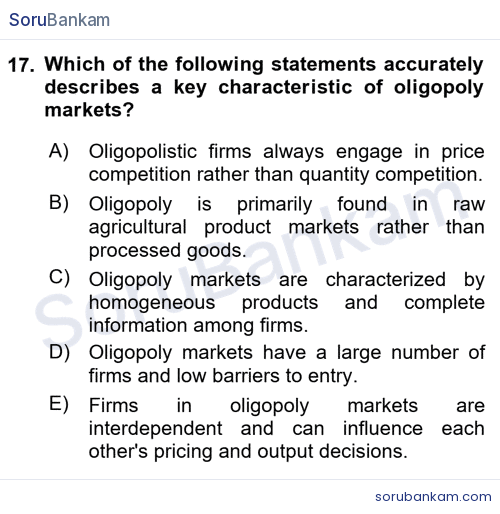
Which of the following statements accurately describes a key characteristic of oligopoly markets? A) Oligopolistic firms always engage in price competition rather than quantity competition. B) Oligopoly is primarily found in raw agricultural product markets rather than processed goods. C) Oligopoly markets are characterized by homogeneous products and complete information among firms. D) Oligopoly markets have a large number of firms and low barriers to entry. E) Firms in oligopoly markets are interdependent and can influence each other's pricing and output decisions.
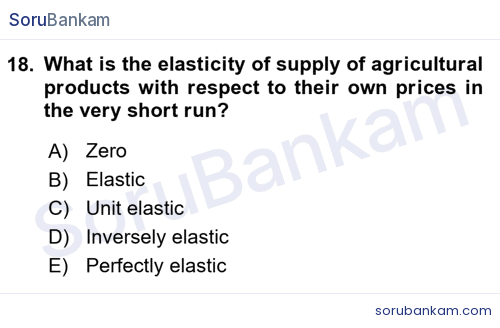
What is the elasticity of supply of agricultural products with respect to their own prices in the very short run? A) Zero B) Elastic C) Unit elastic D) Inversely elastic E) Perfectly elastic
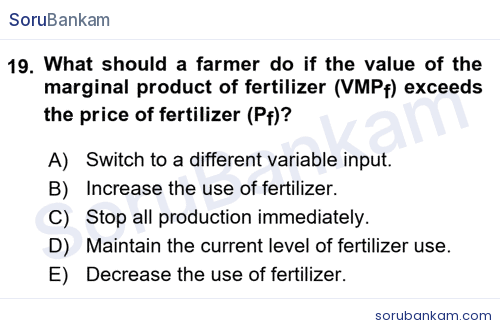
What should a farmer do if the value of the marginal product of fertilizer (VMPf) exceeds the price of fertilizer (Pt)? A) Switch to a different variable input. B) Increase the use of fertilizer. C) Stop all production immediately. D) Maintain the current level of fertilizer use. E) Decrease the use of fertilizer.
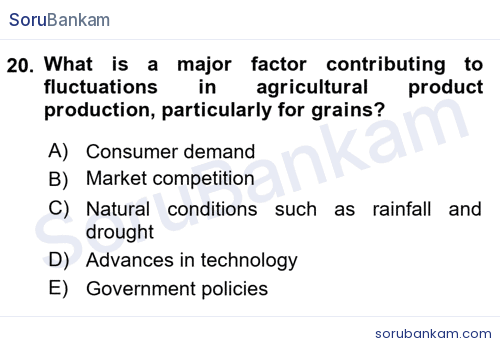
What is a major factor contributing to fluctuations agricuitural product production, particularly for grains? A) Consumer demand B) Market competition C) Natural conditions such as rainfall and drought D) Advances in technology E) Goverment policies