IKT318U Public Finance 2024-2025 Final Soruları
20 soru · Final · 2024-2025
IKT318U Public Finance dersinin 2024-2025 final sınavı 20 sorudan oluşur; ders AÖF İktisat (İngilizce) bölümünde okutulur. Sorular aşağıda sırasıyla yer alır. Doğru cevaplar ve sonucun, testi çözdüğünde görünür.
Önizleme · 20 soru. Cevaplamak ve sonucunu görmek için sınavı başlat.
Sorular
20 soru
Soru 1
Soru 2
Soru 3
Soru 4
Soru 5
Soru 6
Soru 7
Soru 8
Soru 9
Soru 10
Soru 11
Soru 12
Soru 13
Soru 14
Soru 15
Soru 16
Soru 17
Soru 18
Soru 19
Soru 20
Sınav modunda süre tutulur, doğru cevaplar ve sonucun sınav bitince görünür.
Dersin üniteleri
IKT318U Public Finance ders sayfası: bütün sınavlar ve üniteler
Soruların metni (otomatik okuma)
Görsellerden otomatik okunmuştur; hata içerebilir. Sorular, görsellerdeki hâliyle geçerlidir.
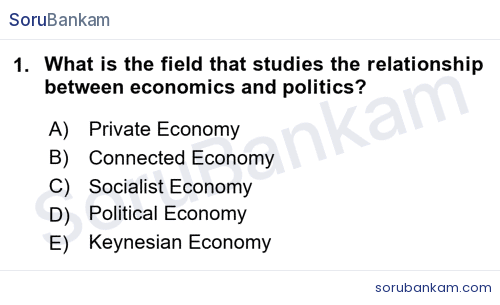
What is the field that studies the relationship between economics and politics? A) Private Economy B) Connected Economy C) Socialist Economy D) Political Economy E) Keynesian Economy
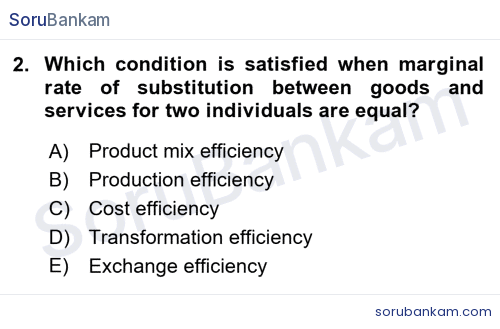
Which condition is satisfied when marginal rate of substitution between goods and services for two individuals are equal? A) Product mix efficiency B) Production efficiency C) Cost efficiency D) Transformation efficiency E) Exchange efficiency
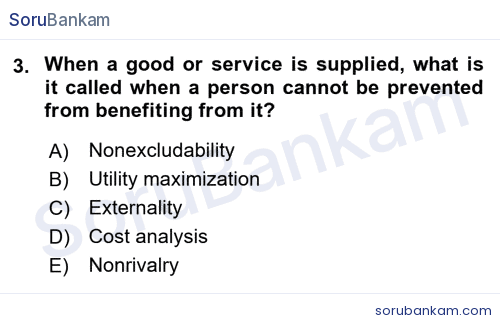
When a good or service is supplied, what is! It called when a person cannot be prevented from benefiting from it? A) Nonexcludability + B) S Utility maximization C) Extemality D) Cost analysis E) Notarivalry
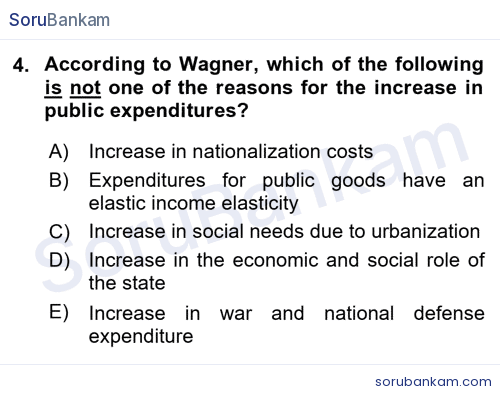
4. According to Wagner, which of the following Is not one of the reasons for the increase in public expenditures? A) Increase in nationalization costs B) Expenditures for public goods have an elastic income elasticity C) Increase in social needs due to urbanization D) Increase in the economic and social role of the state Increase in war and national defense expenditure
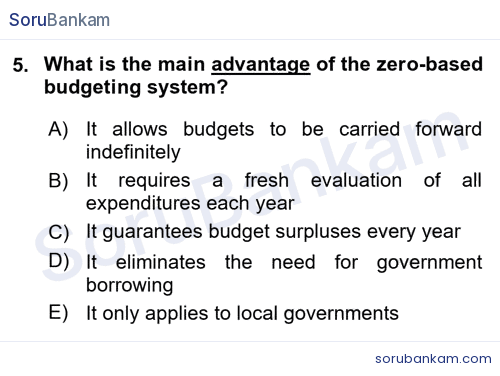
5. What is the main advantage of the zero-based budgeting system? A) It allows budgets to be carried forward indefinitely B) It requires fresh evaluation call expenditures each year C) It guarantees budget surpluses every year It eliminates the need for government borrowing E) It only applies to local governments
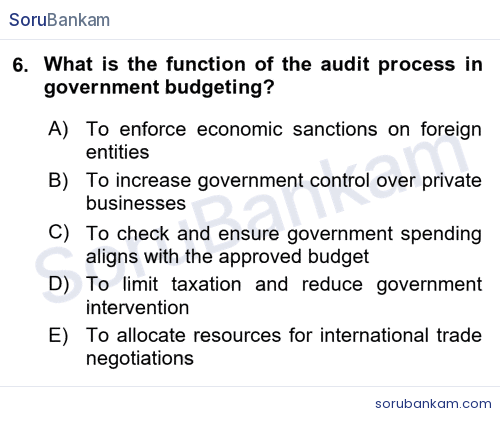
What is the function of the audit process in. government budgeting? A) To enforce economic sanctions on foreign entries B) "B) To increase government control over private businesses C) lo check and ensure goverment spending aligns with the approved budget D) . to limit taxation and reduce government intervention E) To allocate resources for international trade negotiatjons
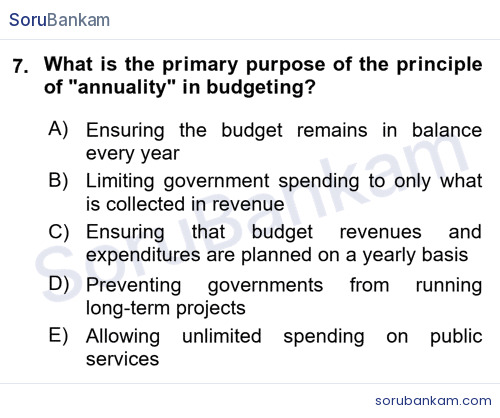
What is the primary purpose of the principle of "annuality" in budgeting? A) Ensuring the budget remains in balance every year B) Limiting government spending to only what is collected in revenue C) Ensuring that budget revenues and expenditures are planned on a yearly basis D) D.) Preventing governments from running long-term projects E) Allowing unlimited spending on public services
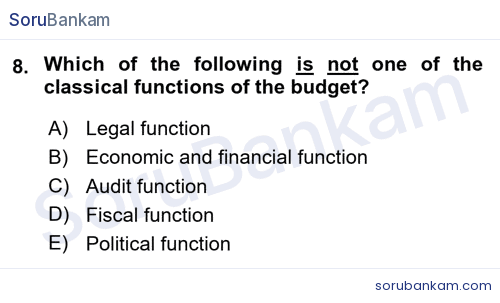
Which of the following is not one of the classical functions of the budget? A) Legal furiction B) Economic and financial function C) Audit function D) Fiscal function E) Political function
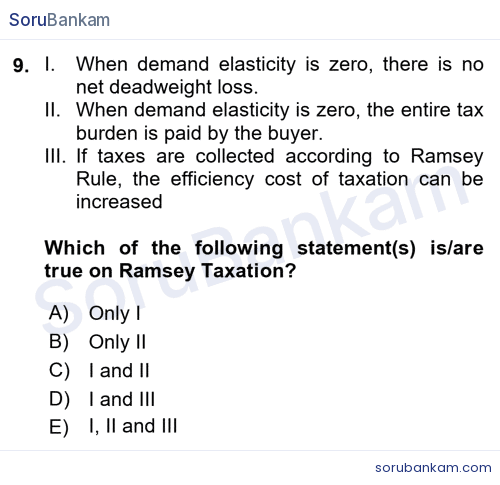
1. When demand elasticity is zero, there is no net deadweight loss. II. When demand elasticity is zero, the entire tax burden is paid by the buyer. lil. If taxes are collected according to Ramsey Rule, the efficiency cost of taxation can be increased Which of the following statements) is/are true on Ramsey Taxation? A) Only B) Only !! C) I and I/ D) I and Ill E) I, Il and I|l
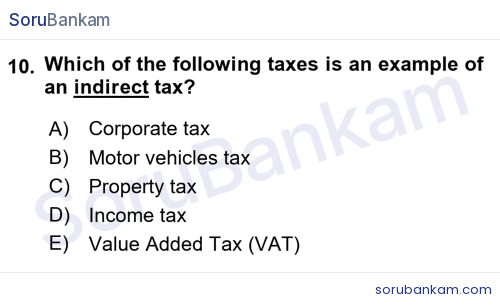
Which of the following taxes is an example of an indirect tax? A) Corporate tax B) Motor vehicles tax C) Property tax D) Income tax E) Value Added Tax (VAT)
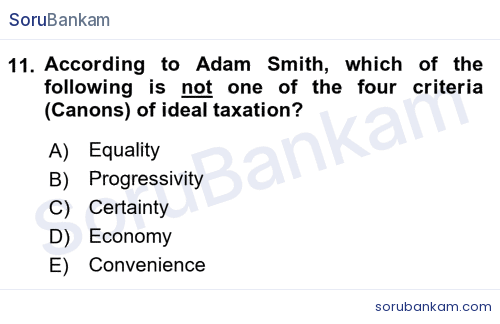
According to Adam Smith, which of the' following is not one of the four criteria (Canons) of ideal/taxation? A) Equälty B) Progressivity C) Certainty D) Economy E) Convenience
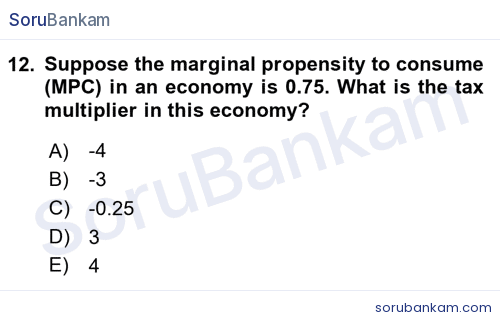
Suppose the marginal propensity to consume (MPC) in an economy is 0.75. What is the tax multiplier in this economy? A) -4 B) -3 C) -0.25 D) 3 E) 4
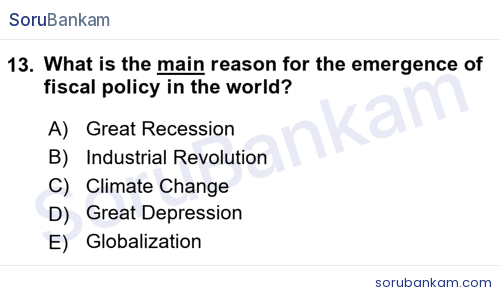
What is the main reason for the emergence of fiscal policy in the world? A) Great Recession B) Industrial Revolution C) Climate Change D) Great Depression E) Globalizationi
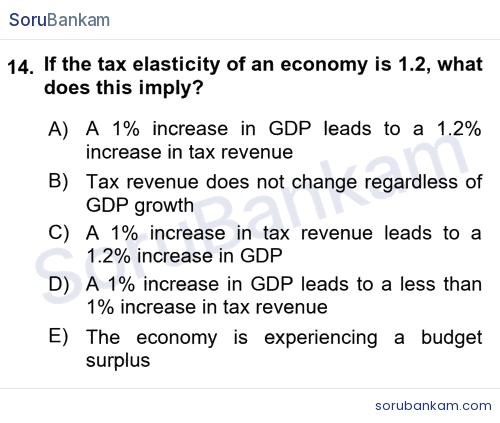
If the tax elasticity of an economy is 1.2, what does this Imply? A 1% i notese in GDR baits 1o a 1.2% A) increase in tax revenue B) Tax revenue does not change regardiess of GDP growth C) A 1% increase in tax revenue leads to a 1.2% increase in GDP D) „D) A 1% increase in GDP leads to a less than 1% increase in tax revenue E) The economy is experiencing a budget surplus
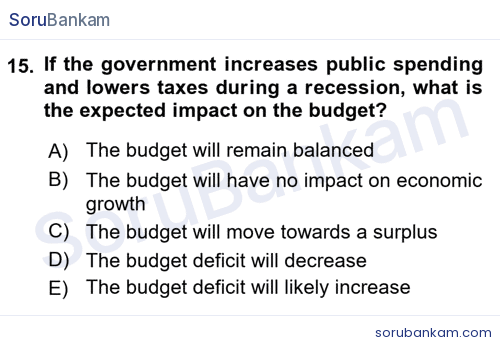
If the government increases public spending and lowers taxes during a recession, what is the expected impact on the budget? A) The budget will remain balanced B) The budget will have no impact on economic growth C) The budget will move towards a surplus D) The budget deficit will decrease E) The budget deficit will likely increase
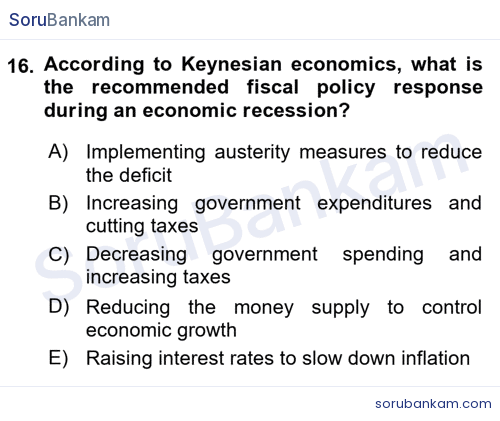
16. According to Keynesian economics, what is the recommended fiscal policy response during an economic recession? A) Implementing austerity measures to reduce the deficit B) Increasing govemment expenditures and cutting taxes Decreasing govemment spending and increasing taxes D) Reducing the money supply to control economic growth E) Raising interest rates to slow down inflation
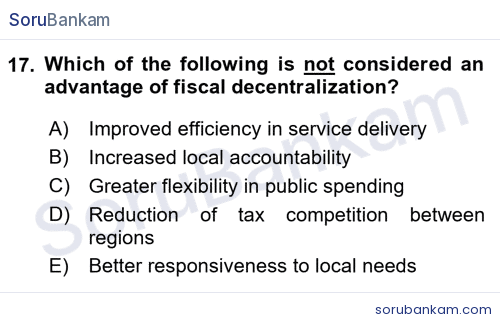
Which of the following is not considered an advantage of fiscal decentralization? A) Improved efficiency in servie delivery B) Increased local accountability C) Greater flexibility in public spending D) Reduction of tax competition between regions E) Better responsiveness to local needs
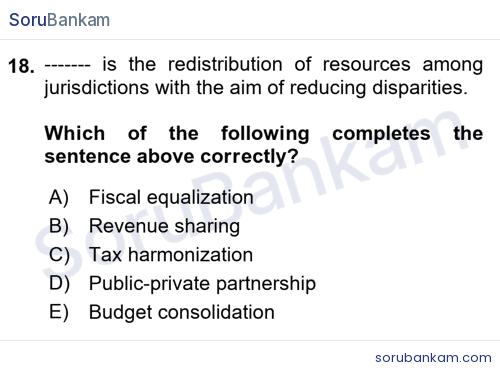
- is the redistribution of resources among jurisdictions with the aim of reducing disparities. Which of the following completes the sentence above correctly? A) Fiscal equalization B) Revenue sharing C) Tax harmonization D) Public-private partnership E) Budget consolidation
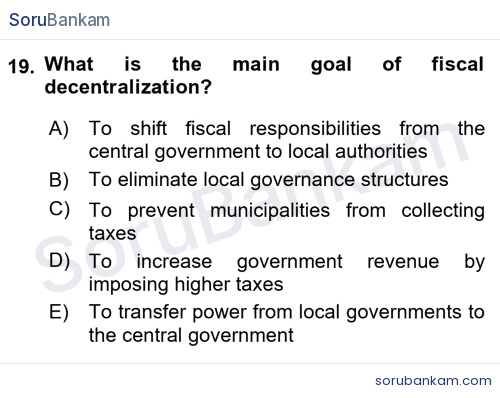
What is the main goal of fiscal decentralization? A) Al To shitt fiscal responsibilities from the central government to tocal authorities B) To eliminate local governance structures C) To prevent municipalities from collecting taxes D) To increase government revenue by imposing higher taxes E) To transfer power from local governments to the central government
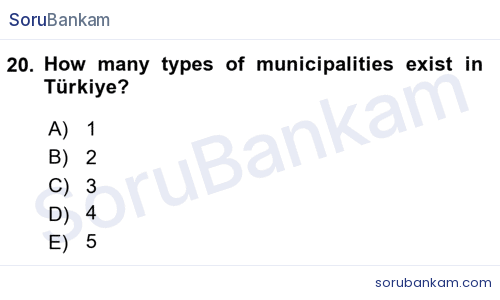
How many types of municipalities exist in Türkiye? A) 1 B) . C) 3 • c" D) 4 E) 5