IKT318U Public Finance 2023-2024 Vize Soruları
20 soru · Vize · 2023-2024
IKT318U Public Finance dersinin 2023-2024 vize sınavı 20 sorudan oluşur; ders AÖF İktisat (İngilizce) bölümünde okutulur. Sorular aşağıda sırasıyla yer alır. Doğru cevaplar ve sonucun, testi çözdüğünde görünür.
Önizleme · 20 soru. Cevaplamak ve sonucunu görmek için sınavı başlat.
Sorular
20 soru
Soru 1
Soru 2
Soru 3
Soru 4
Soru 5
Soru 6
Soru 7
Soru 8
Soru 9
Soru 10
Soru 11
Soru 12
Soru 13
Soru 14
Soru 15
Soru 16
Soru 17
Soru 18
Soru 19
Soru 20
Sınav modunda süre tutulur, doğru cevaplar ve sonucun sınav bitince görünür.
Dersin üniteleri
IKT318U Public Finance ders sayfası: bütün sınavlar ve üniteler
Soruların metni (otomatik okuma)
Görsellerden otomatik okunmuştur; hata içerebilir. Sorular, görsellerdeki hâliyle geçerlidir.
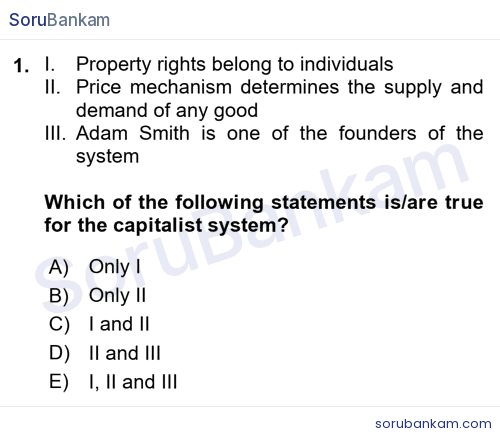
I. Property rights belong to individuals II. Price mechanism determines the supply and demand of any good III. Adam Smith is one of the founders of the system Which of the following statements is/are true for the capitalist system? A) Only B) Only I! C) I and D) Il and Ill E) I, ll and I|l
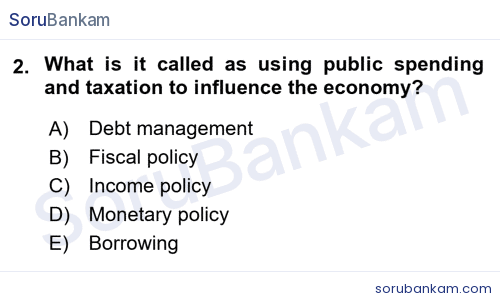
What is it called as using public spending and taxation to Influence the economy? A) Debt management B) Fiscal policy C) Income policy D) Monetary policy E) Borrowing
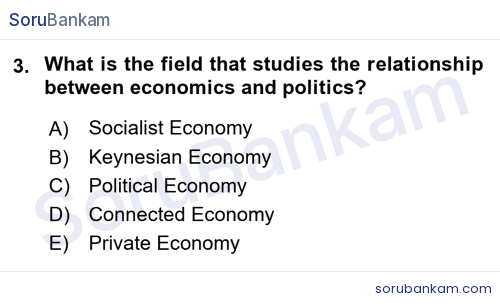
What is the field that studies the relationship between economics and politics? A) Socialist Economy .J. B) Keynesian Economy C) Political Economy D) Connected Econpmy E) Private Economy
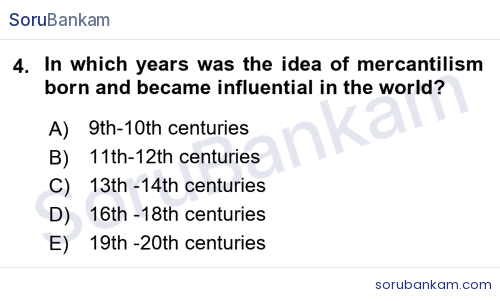
4. In which years was the idea of mercantilism born and became influential in the world? 9th-10th centuries ...? 11th-12th centuries v. NC) 13th-14th centuries D) 16th - 18th centuries E) 19th -20th centuries
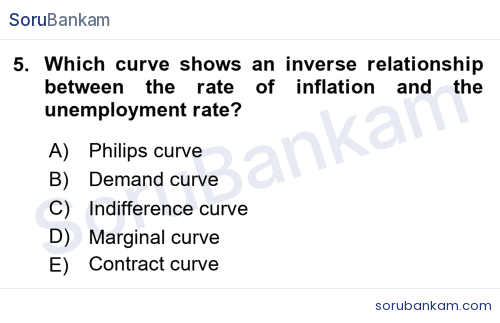
Which curve shows an inverse relationship between the rate inflation and the unemployment rate? A) Philips curve B) Demand curve C) Indifference curve D) Marginal curve E) Contract curve
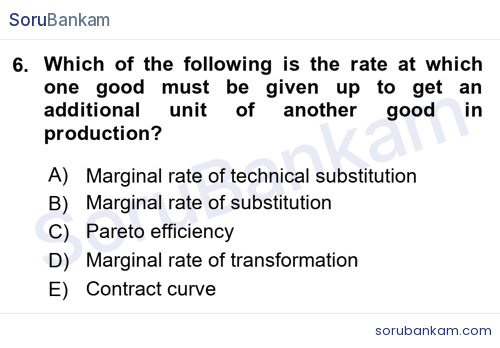
Which of the following is the rate at which one good must be given up to get an additional unit of another good in production? A) Marginal rate of technical substitution B) Marginal rate of substitution C) Pareto efficiency D) Marginal rate of transformation E) Contract curve
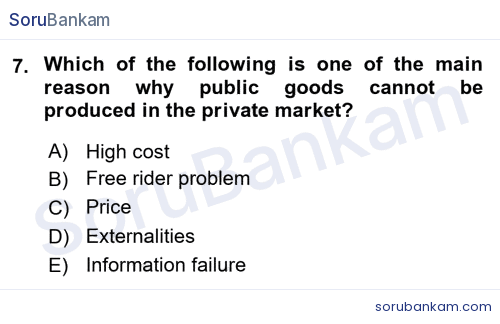
Which of the following is one of the main reason why public goods cannot be produced in the private market? A) High cost B) Free rider problem C) Price D) Externalities E) Information failure
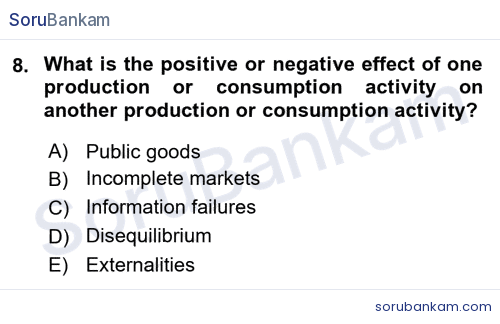
8. What is the positive or negative effect of one production or consumption activity on another production or consumption activity? A) PRAlic Goods • A * B) • Incomplete markets C) Dieuten miles E) Externalities
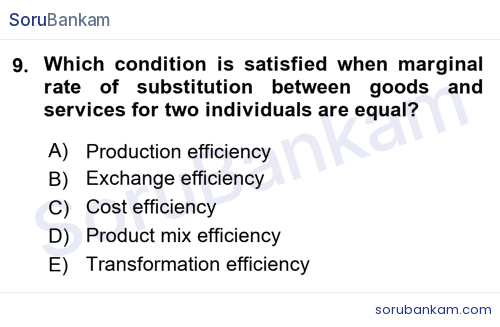
Which condition is satisfied when marginal rate of substitution between goods and services for two individuals are equal? A) Production efficiency B) Exchange efficiency C) Cost efficiency D) Product mix efficiency E) Transformation efficiency
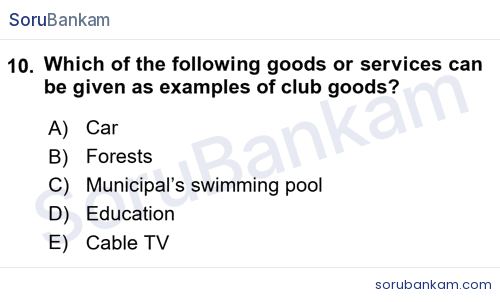
Which of the following goods or services can be given as examples of club goods? A) Car B) Forests C) Municipal's swimming pool D) Education E) Cable
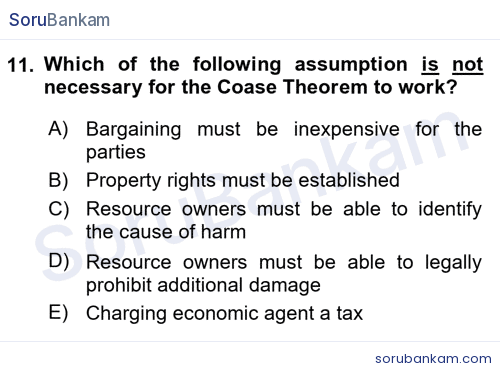
11. Which of the following assumption is not necessary for the Coase Theorem to work? A) Bargaining must be inexpensive for the parties B) Property rights must be established Resource owners must be able to identify the cause of harm Resource owners must be able to legally prohibit additional damage E) Charging economic agent a tax
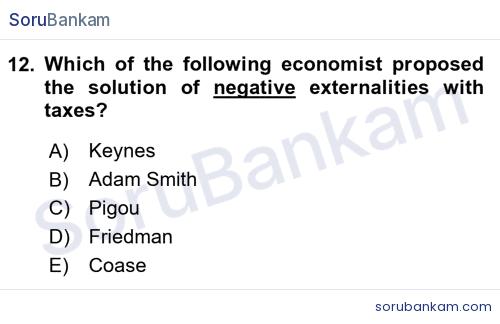
Which of the following economist proposed the solution of negative externalities with taxes? A) Keynes B) Adam Smith C) Pigou D) Friedman E) Coase
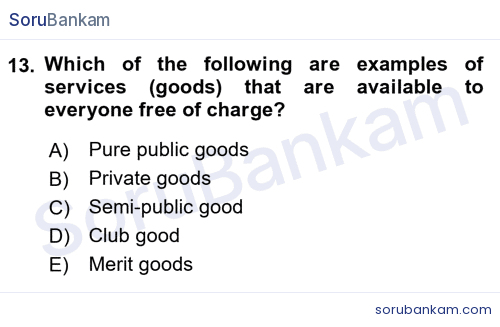
Which of the following are examples of services (goods) that are available to everyone free of charge? A) Pure public goods B) Private goods C) Semi-public good D) Club good E) Merit goods
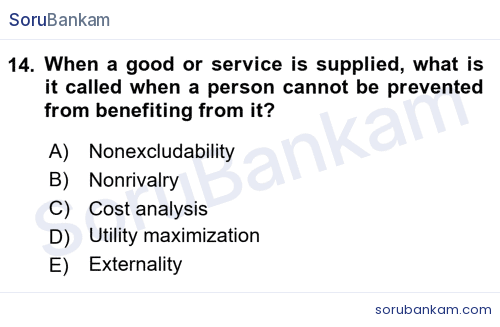
When a good or service is supplied, what is it called when a person cannot be prevented from benefiting from it? A) Nonexcludability B) Nonrivalry C) Cost analysis D) Utility maximization E) Extemality
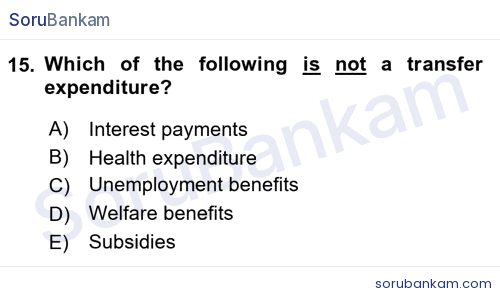
Which of the following is not a transfer expenditure? A) Interest payments B) Health expenditures C) Unemployment benefits D) Welfare benefits E) Subsidies
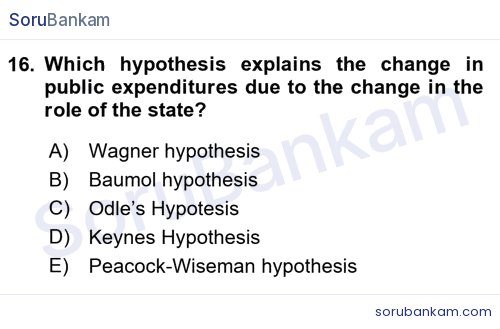
Which hypothesis explains the change in public expenditures due to the change in the role of the state? A) Wagner hypothesis B) Baumol hypothesis C) Odle's Hypotesis D) Keynes Hypothesis E) Peacock-Wiseman hypothesis
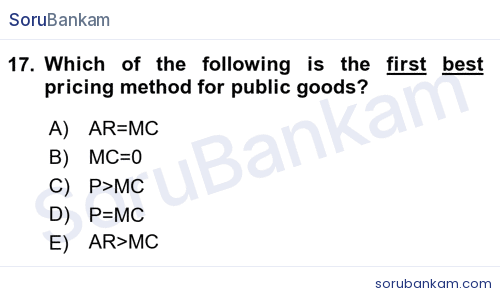
Which of the following is the first best pricing method for public goods? A) AR=MC B) MC=0 C) P>MC D) P=MC E) AR>MC
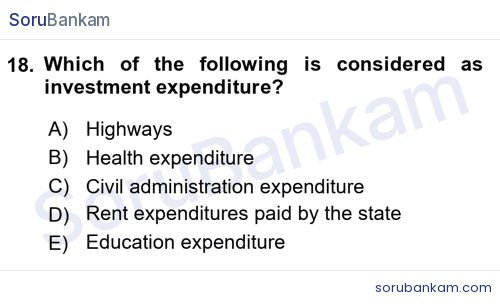
Which of the following is considered as investment expenditure? A) Highways B) Health expenditure C) Civil administration expenditure D) Rent expenditures paid by the state E) Education expenditure
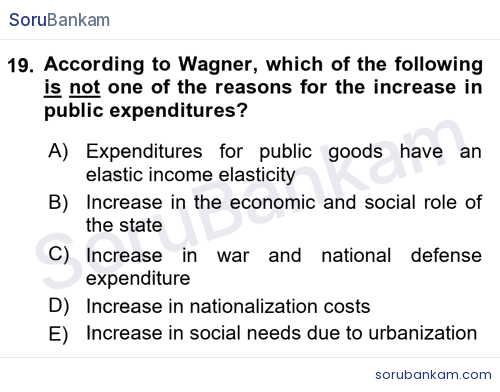
19. According to Wagner, which of the following is not one of the reasons for the increase in public expenditures? A) Expenditures for public goods have an A • elastic income elasticity Increase in the economic and social role of the state Increase • in war and national defense expenditure D) Increase in nationalization costs E) Increase in social needs due to urbanization
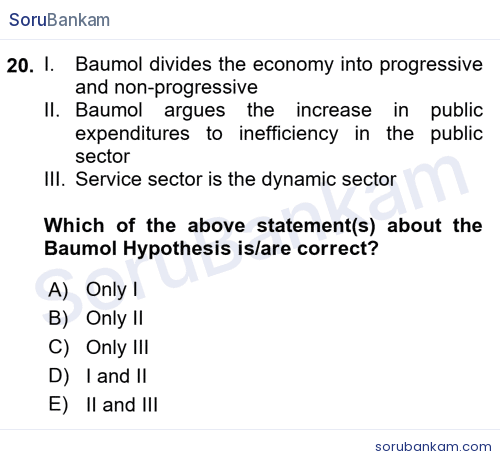
I. Baumol divides the economy into progressive and non-progressive II. Baumol argues the increase in public expenditures to inefficiency in the public sector III. Service sector is the dynamic sector Which of the above statements) about the Baumol Hypothesis is/are correct? A) Only B) Only C) Only ill D) I and E) If and III