TAR228U Principles Of Ataturk And The History Of Turkish Revolution 2 2018-2019 Yaz Okulu Soruları
20 soru · Yaz okulu · 2018-2019
TAR228U Principles Of Ataturk And The History Of Turkish Revolution 2 dersinin 2018-2019 yaz okulu sınavı 20 sorudan oluşur; ders AÖF İktisat (İngilizce) bölümünde okutulur. Sorular aşağıda sırasıyla yer alır. Doğru cevaplar ve sonucun, testi çözdüğünde görünür.
Önizleme · 20 soru. Cevaplamak ve sonucunu görmek için sınavı başlat.
Sorular
20 soru
Soru 1
Soru 2
Soru 3
Soru 4
Soru 5
Soru 6
Soru 7
Soru 8
Soru 9
Soru 10
Soru 11
Soru 12
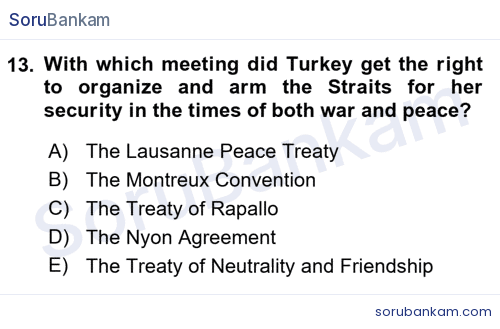
Soru 13
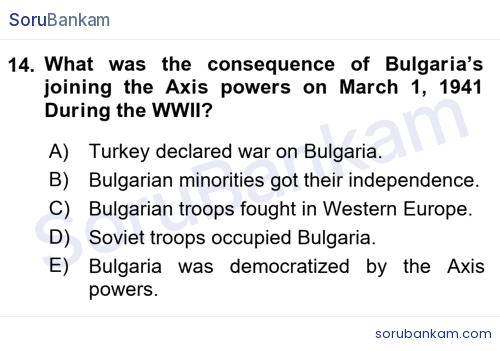
Soru 14
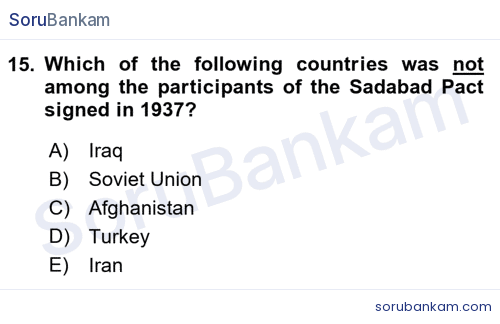
Soru 15
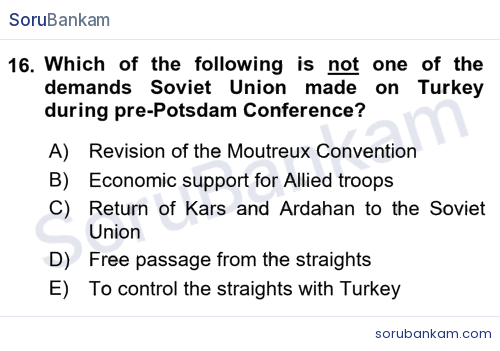
Soru 16
Soru 17
Soru 18
Soru 19
Soru 20
Sınav modunda süre tutulur, doğru cevaplar ve sonucun sınav bitince görünür.
Dersin üniteleri
Soruların metni (otomatik okuma)
Görsellerden otomatik okunmuştur; hata içerebilir. Sorular, görsellerdeki hâliyle geçerlidir.
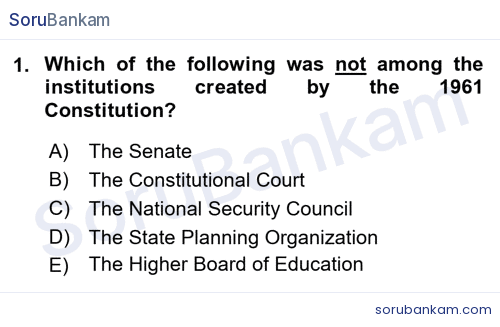
Which of the following was not among the institutions created the 1961 Constitution? A) The Senate B) The Constitutional Court C) The National Security Council D) The State Planning Organization E) The Higher Board of Education
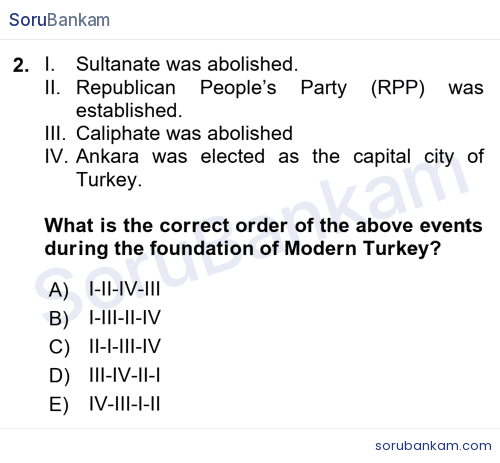
I. Sultanate was abolished. II. Republican People's Party (RPP) was established. III. Caliphate was abolished IV. Ankara was elected as the capital city of Turkey. What is the correct order of the above events during the foundation of Modern Turkey? A) I-II-IV-III B) 1--I-V C) I--I|I-IV D) III-IV-It-l E) IV-I--I
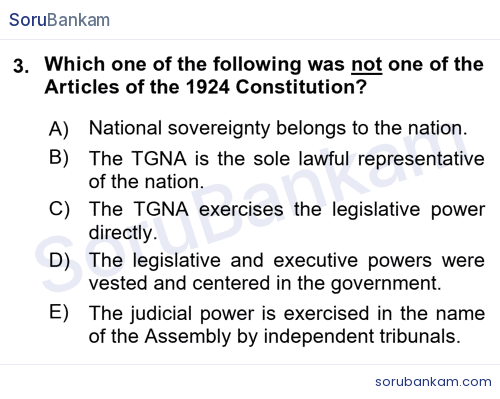
3. Which one of the following was not one of the Articles of the 1924 Constitution? A) National sovereignty belongs to the nation. The TGNA is the sole lawful representative of the nation. C) The TGNA exercises the legislative power directly. D) The legislative and executive powers were vested and centered in the government. E) The judicial power is exercised in the name of the Assembly by independent tribunals.
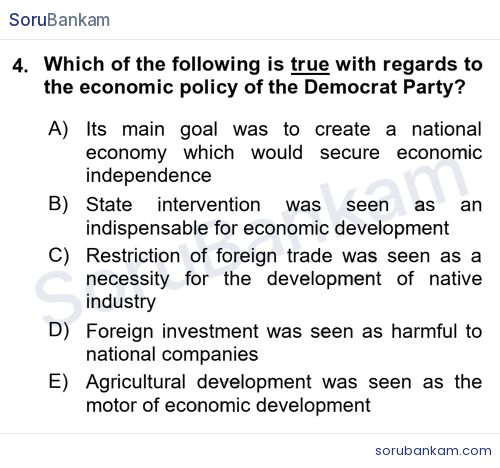
4. Which of the following is true with regards to the economic policy of the Democrat Party? A) Its main goal was to create a national economy which would secure economic independence State intervention was seen. as indispensable for economic development Restriction of foreign trade was seen as a necessity for the development of native industry D) Foreign investment was seen as harmful to national companies E) Agricultural development was seen as the motor of economic development
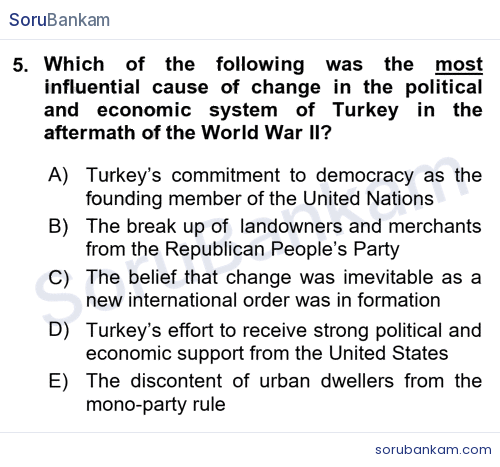
Which of the following was the most influențial cause of change in the political and economic system of Turkey in the aftermath af the World War II? A) Turkey's commitment to democracy as the founding member of the United Nations B) The break up of landowners and merchants from the Republican People's Party C) The belief that change was imevitable as a new international order was in formation D) Turkey's effort to receive strong political and economic support from the United States E) The discontent of urban dwellers from the mono-party rule
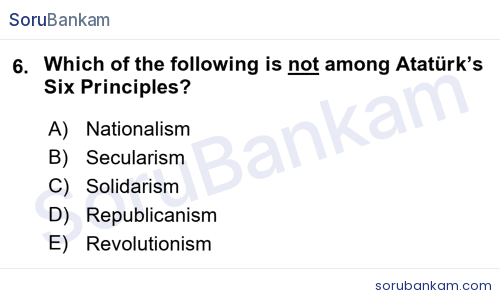
Which of the following is not among Atatürk's Six Principles? A) Nationalism B) Secularism C) Solidarism D) Republicanism E) Revolutionism
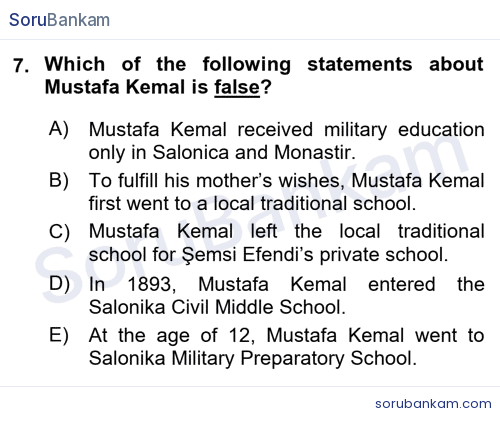
7. Which of the following statements about Mustafa Kemal is false? A) Mustafa Kemal received military education only in Salonica and Monastir. B) To fulfill his mother's wishes, Mustafa Kemal first went to a local traditional school. C) Mustafa Kemal left the local traditional school for Şemsi Efendi's private school. D) In 1893, Mustafa Kemal entered the Salonika Civil Middle School. At the age of 12, Mustafa Kemal went to Salonika Military Preparatory School.
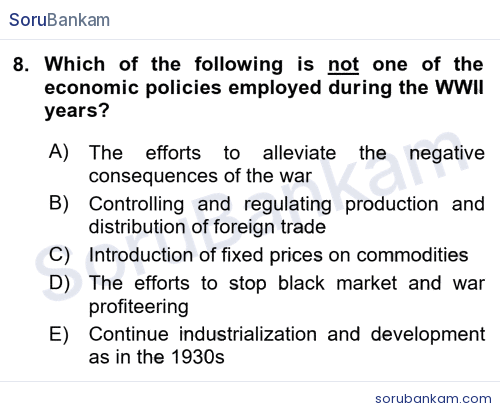
8. Which of the following is not one of the economic policies employed during the Il years? A) The efforts to alleviate the negative consequences of the war Controlling and regulating Production and distribution of foreign trade, C) Introduction of fixed prices' on commodities D) The efforts to stop black market and war profiteering E) Continue inglustrialization and development as in the 1930s
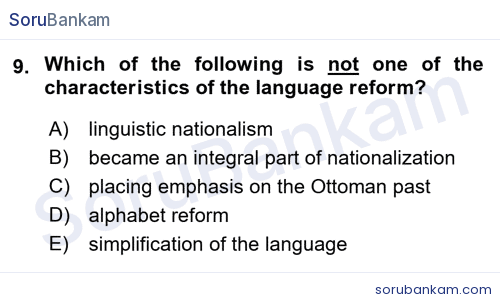
9. Which of the following is not one of the characteristics of the language reform? linguistic nationalism became an integral part of nationalization C) placing emphasis on the Ottoman past D) alphabet reform E) simplification of the language
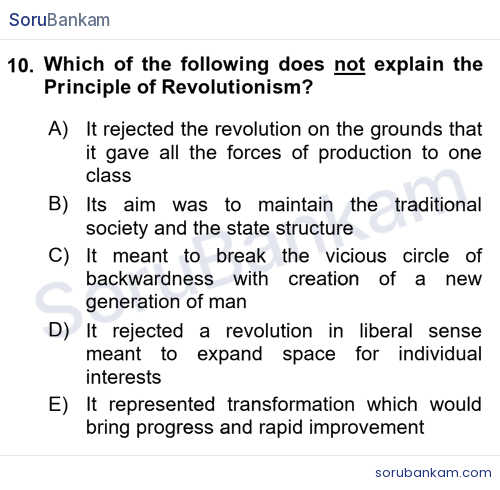
Which of the following does not explain the Principle of Revolutionism? A) It rejected the revolution on the grounds that it gave all the forces of production to one class B) Its aim was to maintain the fairional society and the state structure. C) It meant to break the vicious circle of backwardness with creation of a new generation of man D) It rejected a revolution in liberal sense meant to expand space for individual interests E) It represented transformation which would bring progress and rapid improvement
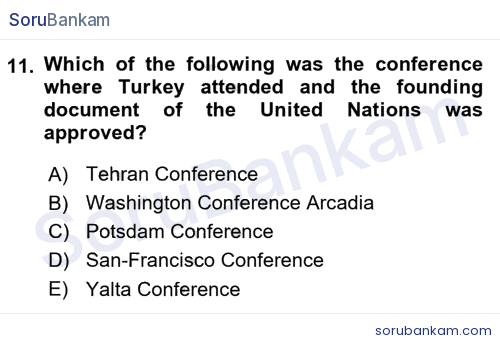
Which of the following was the conference where Turkey attended and the founding document "the United Nations was approved? A) • A) Tehran Conference B) Washington Conference Arcadia C) Potsdam Çolference D) San-ffahcisco Conference E) Yalta Conference
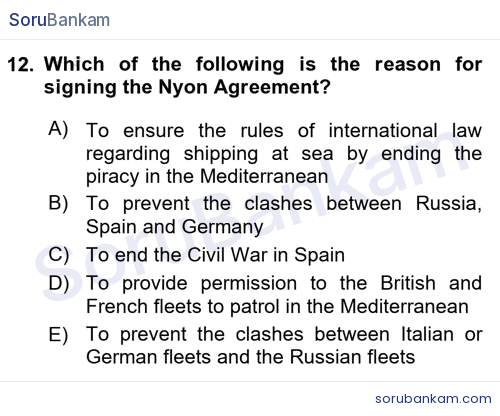
Which of the following is the reason for signing the Nyon Agreement? A) To ensure the rules of international law regarding shipping at sea by ending the piracy in the Mediterranean B) To prevent the clashes between Russia, Spain and Germany C) To end the Civil War in Spain D) To provide permission to the British and French fleets to patrol in the Mediterranean E) To prevent the clashes between Italian or German fleets and the Russian fleets
With which meeting did Turkey get the right to organize and arm the Straits for her security in the times of both war and peace? A) The Lausanne Peace Treaty B) The Montreux Convention C) The Treaty of Rapallo D) The Nyon Agreement E) The Treaty of Neutrality and Friendship
What was the consequence of Bulgaria's joining the Axis powers on March 1, 1941 During the Il? A) Turkey declared war on Bulgaria. B) Bulgarian minorities got their independence. C) Bulgarian troops fought in Westem Europe. D) Soviet troops occupied Bulgaria. E) e) Bulgaria was democratized by the Axis powers.
Which of the following countries was not among the participants of the Sadabad Pact signed in 1937? A) Iraq B) Soviet Union C) Afghanistan D) Turkey E) Iran
16. Which of the following is not one of fbie demands Soviet Union made on Jurkey during pre-Potsdar ConferenceR A) Revision of the Moutreux Convention Economic support for Allied troops C) Return of Kars and Ardahan to the Soviet Union D) Free passage from the straights siE. To control the straights with Turkey
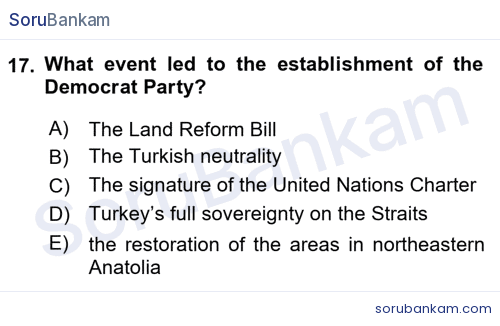
17. What event led to the establishment of the Democrat Party? A) The Land Reform Bill B) The Turkish neutrality C) The signature of the United Nations Charter D) Turkey's full sovereignty on the Straits the restoration of the areas in northeastern Anatolia
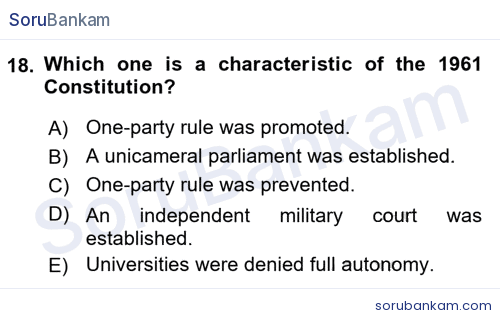
Which one is a characteristic of the 1961 Constitution? A) One-party rule was promoted. B) A unicameral parliament was established. C) One-party rule was prevented. D) An independent military çour was established. E) Universities were denied full autonomy.
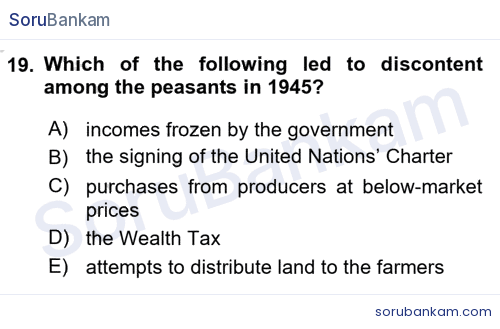
Which of the following led to discontent among the peasants In 1945? A) incomes, frozen by the govemment B) the signing of the United Nations' Charter C) purchases from producers at below-market prices D) the Wealth Tax E) attempts to distribute land to the farmers
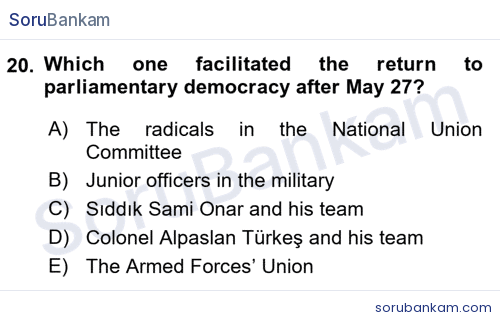
Which one facilitated the return to parliamentary democracy after May 27? A) The radicals in the National Union Committee B) Junior officers in the military C) Siddık Sami Onar and his team D) Colonel Alpaslan Türkes and his team E) The Armed Forces' Union