TAR228U Principles Of Ataturk And The History Of Turkish Revolution 2 2018-2019 Vize Soruları
20 soru · Vize · 2018-2019
TAR228U Principles Of Ataturk And The History Of Turkish Revolution 2 dersinin 2018-2019 vize sınavı 20 sorudan oluşur; ders AÖF İktisat (İngilizce) bölümünde okutulur. Sorular aşağıda sırasıyla yer alır. Doğru cevaplar ve sonucun, testi çözdüğünde görünür.
Önizleme · 20 soru. Cevaplamak ve sonucunu görmek için sınavı başlat.
Sorular
20 soru
Soru 1
Soru 2
Soru 3
Soru 4
Soru 5
Soru 6
Soru 7
Soru 8
Soru 9
Soru 10
Soru 11
Soru 12
Soru 13
Soru 14
Soru 15
Soru 16
Soru 17
Soru 18
Soru 19
Soru 20
Sınav modunda süre tutulur, doğru cevaplar ve sonucun sınav bitince görünür.
Dersin üniteleri
Soruların metni (otomatik okuma)
Görsellerden otomatik okunmuştur; hata içerebilir. Sorular, görsellerdeki hâliyle geçerlidir.
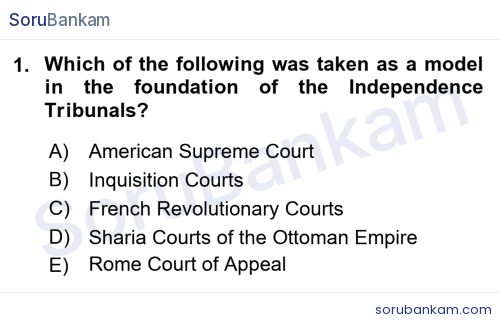
Which of the following was taken as a model in the foundation of the Independence Tribunals? A) American Supreme Court B) Inquisition Courts C) French Revolutionary Courts D) Sharia Courts of the Ottoman Empire E) Rome Court of Appeal
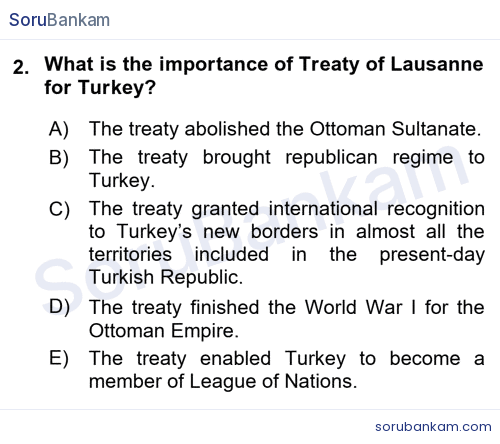
What is the importance of Treaty of Lausanne for Turkey? A) The treaty abolished the Ottoman Sultanate. B) The treaty brought republican regime to Turkey. C) The treaty granted international recognition to Turkey's new borders in almost all the territories included in the present-day Turkish Republic. D) The treaty finished the World War I for the Ottoman Empire. E) The treaty enabled Turkey to become a member of League of Nations.
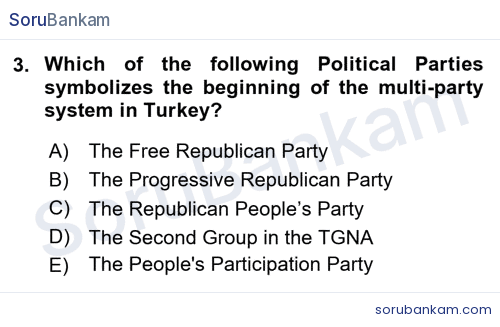
Which of the following Political Parties symbolizes the beginning of the multi-party system in Turkey? A) The Free Republican Party B) The Progressive Republican Party C) The Republican People's Party D) The Second Group in the TGNA E) Thé People's Participation Party
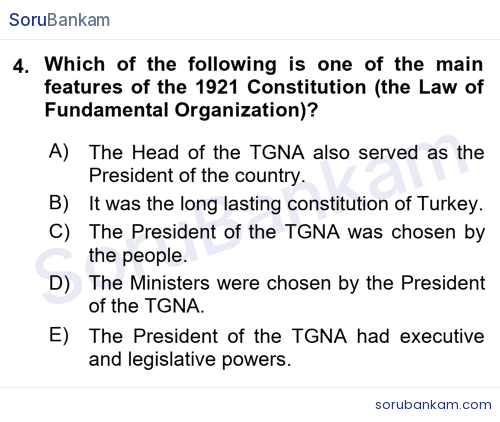
Which of the following is one of the main features of the 1921 Constitution (the Law of Fundamental Organization)? A) The Head of the TGNA also served as the President of the country. B) It was the long lasting constitution of Turkey. C) The President of the TGNA was chosen by the people. D) The Ministers were chosen by the President of the TGNA. E) The President of the TGNA had executive and legislative powers.
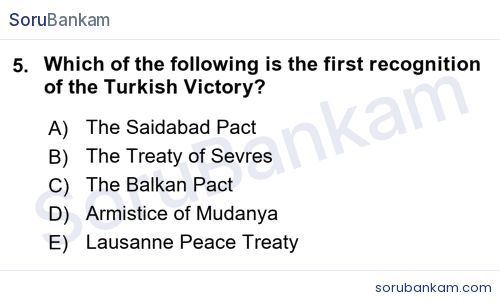
Which of the following is the first recognition of the Turkish Victory? A) The Saidabad Pact B) The Treaty of Sevres C) The Balkan Pact D) Armistice of Mudanya E) Lausanne Peace Treaty
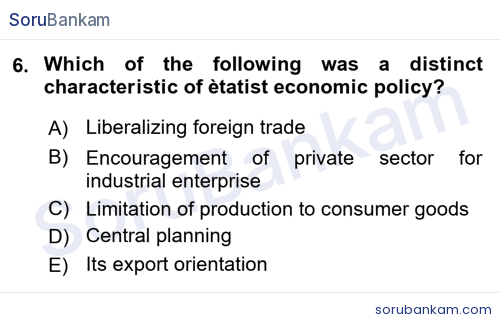
Which of the following was a distinct characteristic of ètatist economic policy? A) Liberalizing foreign trade. Encouragement of private sector for B) B!, industrial enterprise C) Limitation of production to consumer goods D) Central planning E) Its export orientation
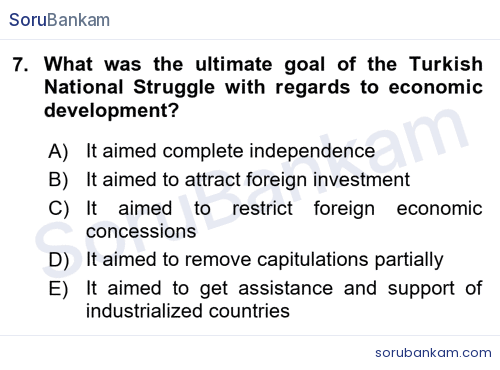
What was the ultimate goal of the Turkish National Struggle with regards to economic development? A) It aimed complete independence B) It aimed to attract foreign investment C) It aimed to restrict foreign economic concessions D) It aimed to remove capitulations partially E) It aimed to get assistance and support of industrialized countries
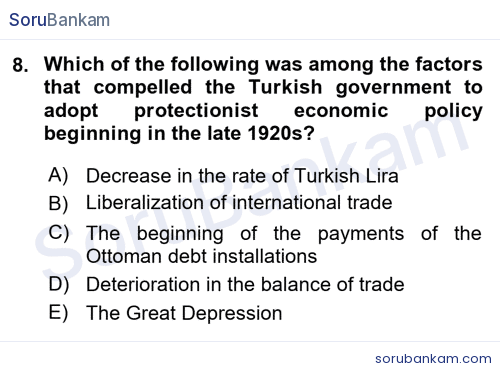
Which of the following was among the factors that compelled the Turkish government to adopt protectionist economic policy beginning in the late 1920s? A) Decrease in the rate of Turkish Lira B) Liberalization of international trade C) The beginning of the payments of the Ottoman debt installations D) Deterioration in the balance of trade E) The Great Depression
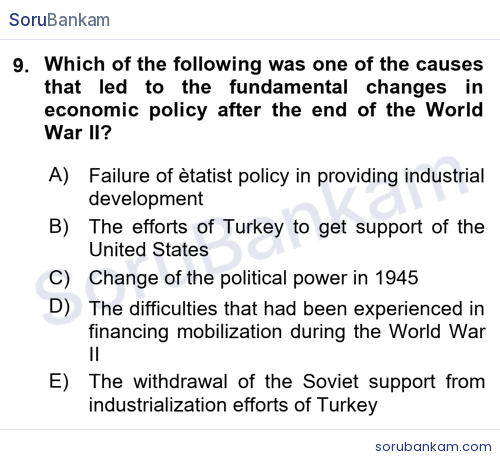
Which of the following was one of the causes that led to the fundamental changes in economic policy after the end of the World War II? A) Failure of etatist policy in providing industrial development B) The efforts of Turkey to get support of the United States C) Change of the political power in 1945 D) The difficulties that had been experienced in financing mobilization during the World War E) The withdrawal of the Soviet support from industrialization efforts of Turkey
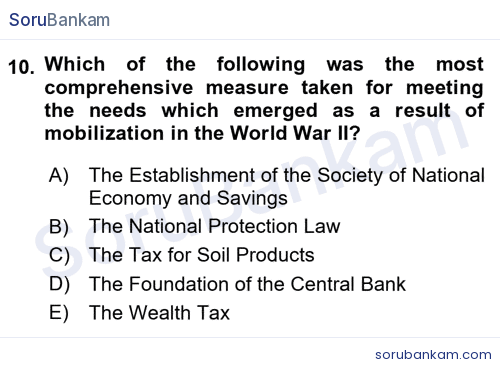
Which of the following was the most comprehensive measure taken for meeting the needs which emerged as a result of mobilization in the World War II? A) The Establishment of the Society of National Economy and Savings B) The National Protection Law C) The Tax for Soil Products' D) The Foundation of the Central Bank E) The Wealth Tax
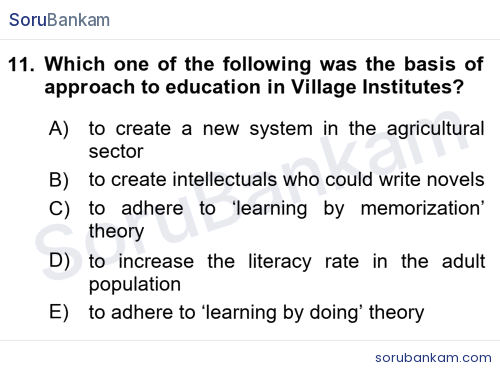
Which one of the following was the basis of approach to education in Village Institutes? A) to create a new system in the agricultural sector B) to create intellectuals who could write novels C) to adhere to learning by memorization' theory D) to increase the literacy rate in the adult population E) to adhere to 'learning by doing' theory
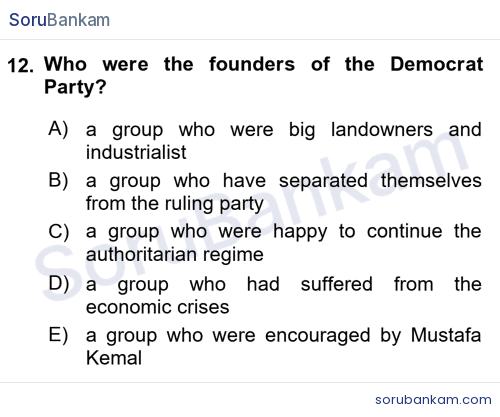
Who were the founders of the Democrat Party? A) a group who were big landowners and industrialist B) a group who have separated themselves from the ruling party C) a group who were happy to continue the authoritarian regime D) a group who had suffered from the economic crises E) a group who were encouraged by Mustafa Kemal
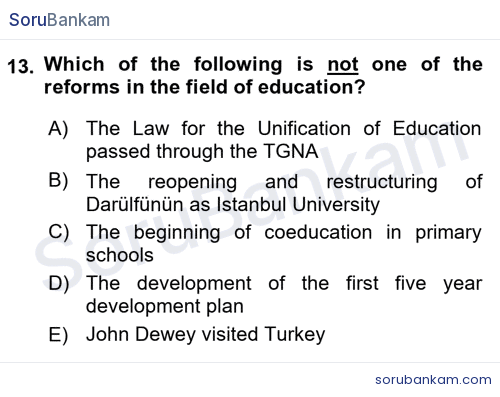
Which of the following is not one of the reforms in the field of education? A) The Law for the Unification of Education passed through the TGNA B) vAB) The reopening and restructuring of Darülfünün as Istanbul University C) The beginning of coeducation in primary schools D) . The development of the first five year development plan E) John Dewey visited Turkey
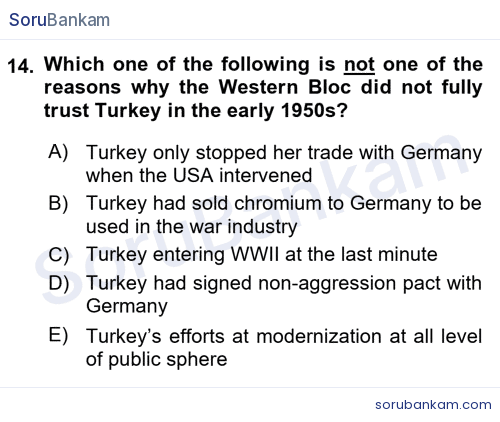
Which one of the following is not one of the reasons why the Western Bloc did not fully trust Turkey in the early 1950s?. A) Turkey only stopped her trade with Germany when the USA intervened B) Turkey had sold chromium to Germany to be used in the war industry C) Turkey entering at the last minute D) Turkey had signed non-aggression pact with Germany E) Turkey's efforts at modernization at all level of public sphere
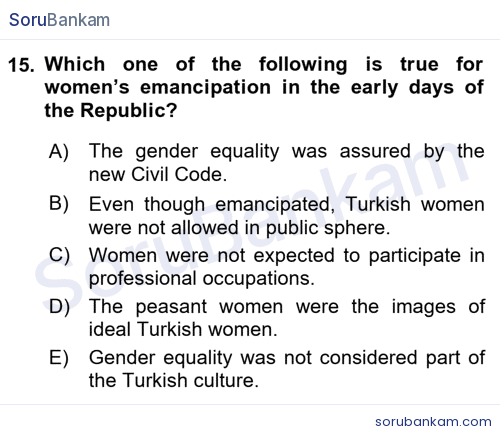
Which one of the following is true for women's emancipation in the early days of the Republic? A) The gender equality was assured by the new Civil Code. B) Even though emancipated, Turkish women were not allowed in public sphere. C) Women were not expected to participate in professional occupations. D) The peasant women were the images of ideal Turkish women. E) Gender equality was not considered part of the Turkish culture.
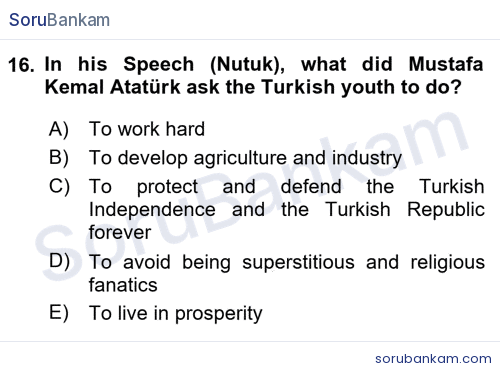
In his Speech (Nutuk), what did Mustafa Komal Atatürk ask the Turkish youth to do? A) To work hard B) To develop agriculture and industry C) To protect and defend the Turkish Independence and the Turkish Republic forever D) To avoid being superstitious and religious fanatics E) To live in prosperity
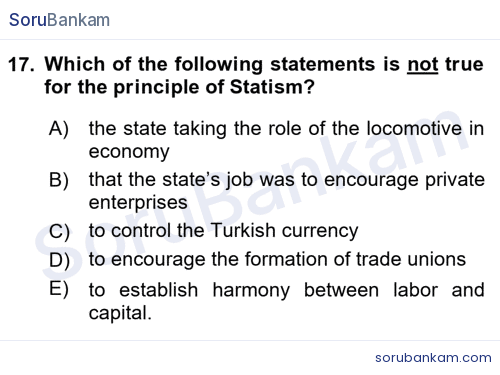
17. Which of the following statements is not true for the principle of Statism? A) the state taking the role of the locomotive in economy that the state's job was to encourage private enterprises C) to control the Turkish currency D) to encourage the formation of trade unions E) to establish harmony between labor and capital.
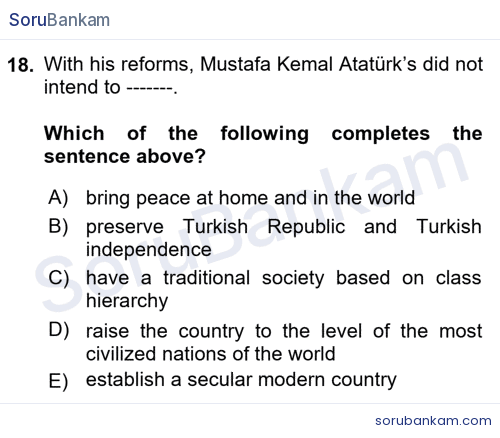
With his reforms, Mustafa Kemal Atatürk's did not intend to-.-.- Which of the following completes the senterice above? A) bring peace at home and in the world B) preserve Turkish Republic. and Turkish independence C) have a traditional society based on class hierarchy D) raise the country to the level of the most civilized nations of the world E) establish a secular modern country
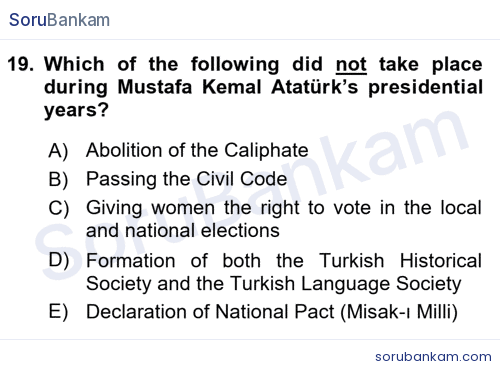
Which of the following did not take place during Mustafa Kemal Atatürk's presidential years? A) Abolition of the Caliphate B) Passing the Civil Code C) Giving women the right to vote in the local and national elections D) Formation of both the Turkish Historical Society and the Turkish Language Society E) Declaration of National Pact (Misak-1 Milli)
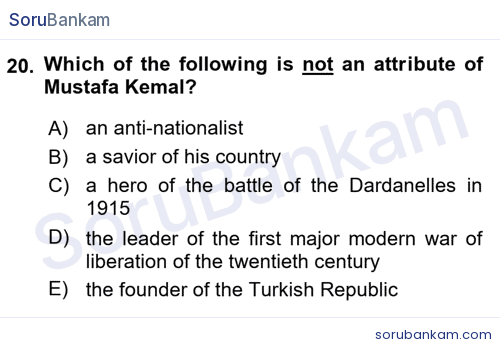
Which of the following is not an attribute of Mustafa Kemal? A) an anti-nationalist B) a savior of his country C) a hero of the battle of the Dardanelles in 1915 D) the leader of the first major modern war of liberation of the twentieth century E) the founder of the Turkish Republic