IKT205U Microeconomic Theory 2024-2025 Final Soruları
20 soru · Final · 2024-2025
IKT205U Microeconomic Theory dersinin 2024-2025 final sınavı 20 sorudan oluşur; ders AÖF İktisat (İngilizce) bölümünde okutulur. Sorular aşağıda sırasıyla yer alır. Doğru cevaplar ve sonucun, testi çözdüğünde görünür.
Önizleme · 20 soru. Cevaplamak ve sonucunu görmek için sınavı başlat.
Sorular
20 soru
Soru 1
Soru 2
Soru 3
Soru 4
Soru 5
Soru 6
Soru 7
Soru 8
Soru 9
Soru 10
Soru 11
Soru 12
Soru 13
Soru 14
Soru 15
Soru 16
Soru 17
Soru 18
Soru 19
Soru 20
Sınav modunda süre tutulur, doğru cevaplar ve sonucun sınav bitince görünür.
Dersin üniteleri
IKT205U Microeconomic Theory ders sayfası: bütün sınavlar ve üniteler
Soruların metni (otomatik okuma)
Görsellerden otomatik okunmuştur; hata içerebilir. Sorular, görsellerdeki hâliyle geçerlidir.
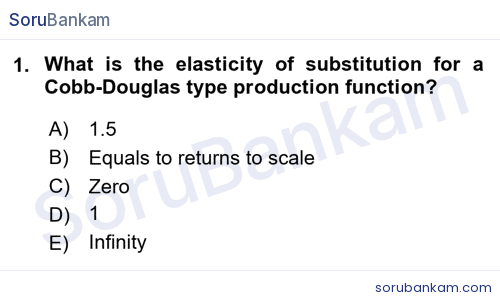
What is the elasticity of substitution for a Cobb-Douglas type production function? A) 1.5 B) Equals to returns to scale C) Zero D) 1 E) Infinity
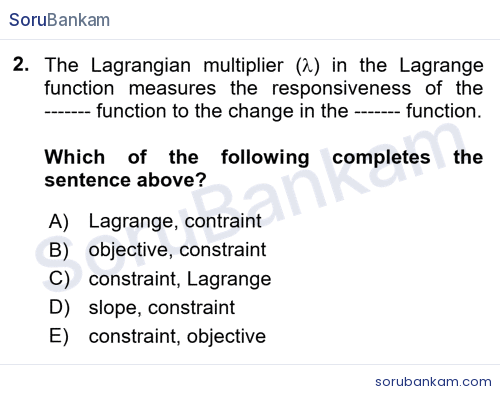
The Lagrangian multiplier (2) in the Lagrange function measures the responsiveness of the -function to the change in the-- function. Which of the following completes the sentence above? A) Lagrange, contraint B) objective, constraint C) constraint, Lagrange D) slope, constraint E) constraint, objective
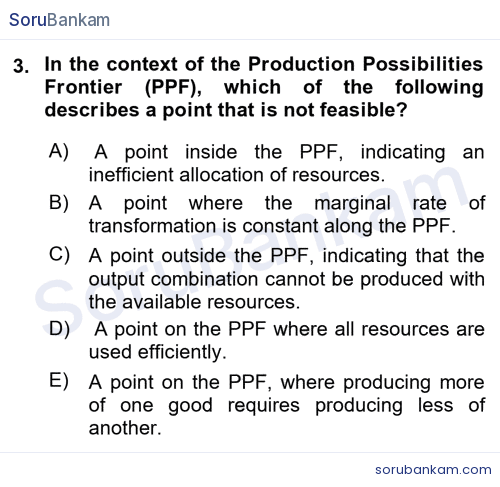
In the context of the Production Possibilities Frontier (PPF), which of the following describes a point that is not feasible? A) A point inside the PPF, indicating an inefficient allocation of resources. B) 3} A point where the mardinal, core transformation is constant along the PPF. C) A point outside the PPF, indicating that the output combination cannot be produced with the available resources. D) A point on the PPF where all resources are used efficiently. « в' E) A point on the PPE! where producing more of one good requires producing less of another.
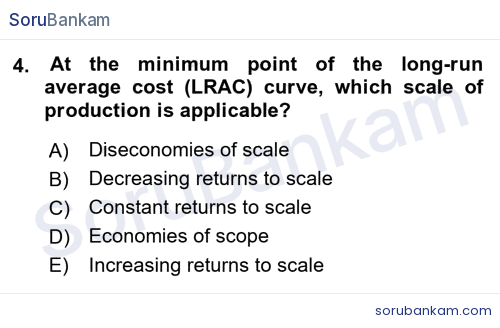
4. At the minimum point of the long-rum production is applicable? average cost (LRAG) curve, which, scale of A) Diseconomies of scale Any By Decreasing returns to scale C) Constant returns to scale Economies of scope E) Increasing returns to scale
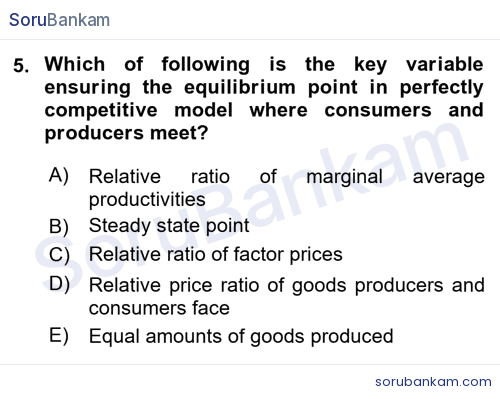
Which of following is the key variable ensuring the equilibrium point in perfectly competitive model where consumers and producers meet? A) Relative ratio of marginal average productivities B) Steady state point C) Relative ratio of factor prices D) Relative price ratio of goods producers and consumers face E) Equal amounts of goods produced
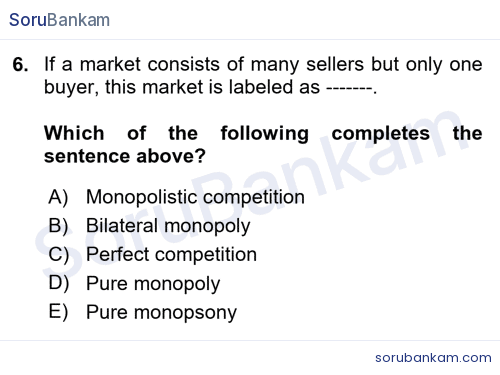
If a market consists of many sellers but only one buyer, this market is labeled as .... Which of the following completes the sentence above? A) Monopolistic competition B) Bilateral monopoly C) Perfect competition D) Pure monopoly E) Pure monopsony
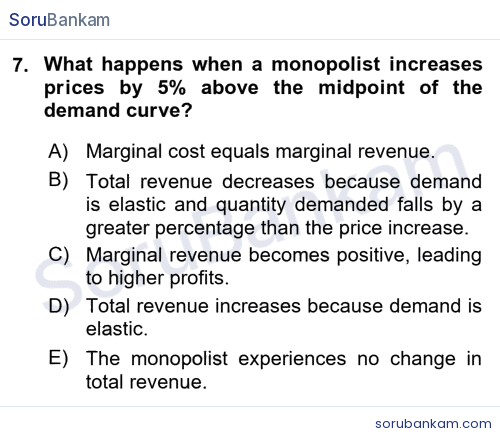
7. What happens when a monopolist increases prices by 5% above the midpoint of the demand curve? A) Merginal cost equalstarginal revenue. B) *Total revenue decreases because demand is elastic and quantity demanded falls by a greater percentage than the price increase. Marginal revenue beceites positive, leading to higher profits. D) Total revenue increases because demand is elastic. E) The monopdlist experiences no change in total revenue.
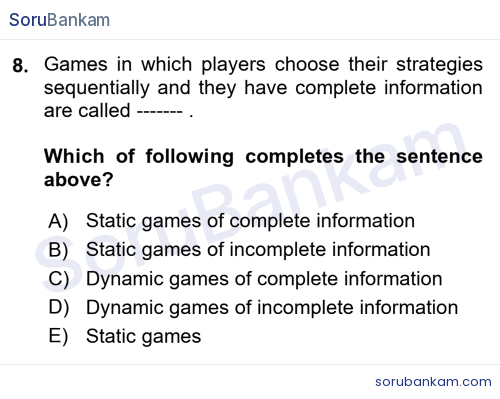
Games in which players choose their strategies sequentially and they have complete information are called ——_- _ Which of following completes the sentence above? A) Static games of complete information B) Static games of incomplete information C) Dynamic games of complete information D) Dynamic games of incomplete information E) Static games
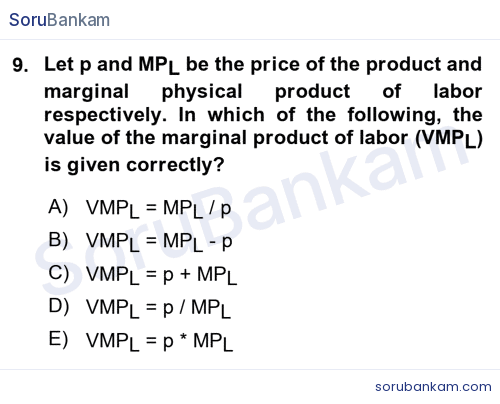
Let p and MPL be the price of the product and marginal physical product of labor respectively. In which of the following, the value of the marginal product of labor (VMPL) is given correctly? A) VMPL = MPL/P B) VMPL= MPL-P C) VMPL = p + MPL D) VMPL= p/ MPL E) VMPL=p*MPL
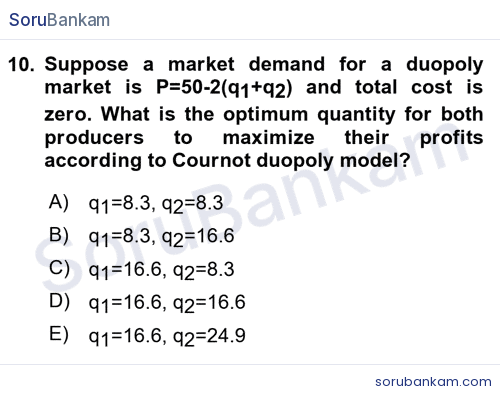
Suppose a market demand for a duopoly market is P=50-2(91+42) and total cost is zero. What is the optimum quantity for both producers to maximize their profits açcording to Cournot duopoly model? A) 91=8.3, 92=8.3 B) 91=8.3, 92=16.6 C) 91=16.6, 42=8.3 D) 91=16.6, 92=16.6 E) 41=16.6, 92=24.9
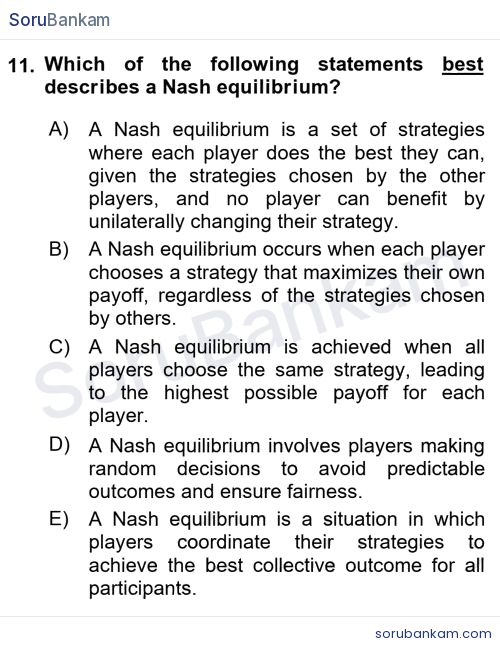
Which of the following statements best describes a Nash equilibrium? A) A Nash equilibrium is a set of strategies where each player does the best they can, given the strategies chosen by the other players, and no player can benefit by unilaterally changing their strategy. B) A Nash equilibrium occurs when each player chooses a strategy that maximizes their own payoff, regardless of the strategies chosen by others. C) A Nash equllibrium is achleved when all players choose the same strategy, leading to the highest possible payoff for each player. D) A Nash equilibrium involves players making random decisions towavoid predictable outcomes and ensure fairness. E) A Nash equilibrium is a situation in which players coordinate their strategies to achieve the best collective outcome for all participants.'
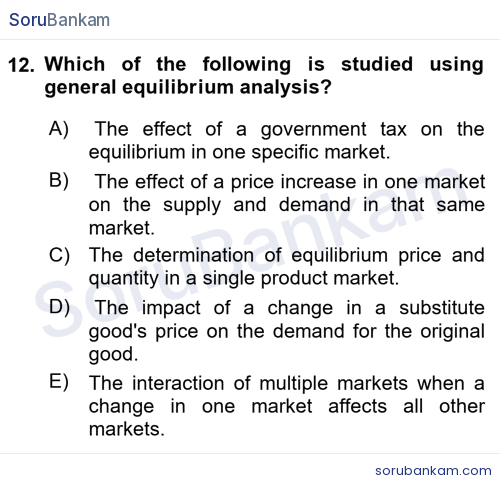
Which of the following is studied using general equilibrium analysis? A) The effect of a government tax on the equilibrium in one specific market. B) The effect of a price increase in one market on the supply and demand in that same market. C) The determination of equilibrium price and quantity in a singie product market. D) The impact of a change in a substitute good's price on the demand for the original good. E) The interaction of multiple markets when a change in one market affects all other markets.
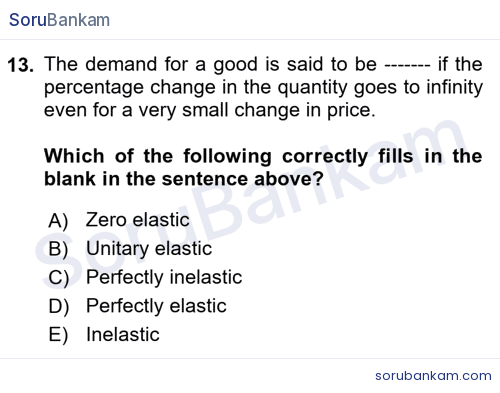
The demand for a good issaid tobe if the percentage change in the quantity goes to infinity even for a very small change in price. Which of the following correctly fills in the blank in the sentence above? A) Zero elastic B) Unitary elastic C) Perfectly inelastic D) Perfectly elastic E) Inelastic
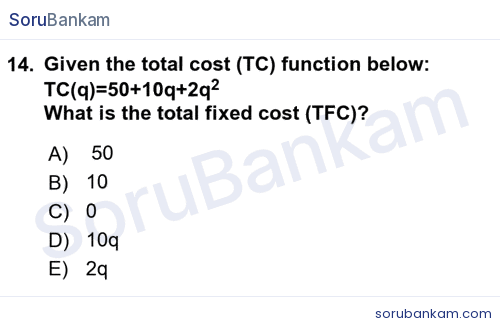
14. Given the total cost (TC) function below: ТC(q)=50+10q+2q^ What is the total fixed cost (TFC)? A) 50 10 C) 0 D) 10q E)
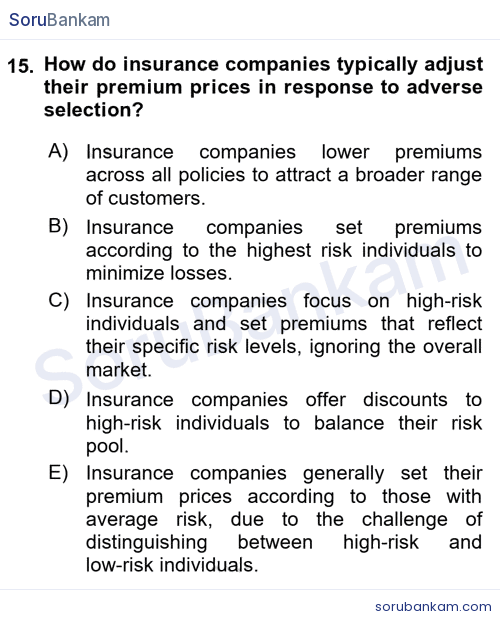
How do insurance companies typically adjust their premium prices in response to adverse selection? A) freurance companies lower premiums i across all polices to attract a broader range of customers. B) Insurance companies set premiums according to the highest risk individuals to minimize losses. C) Insurance companies focus on high-risk individuals and set premiums that reflect their specific risk levels, ignoring the overall market. D) Insurance companies offer discounts to high-risk individuals to balance their risk pool. E) Insurance companies generally set their premium prices according to those with average risk, due to the challenge of distinguishing between high-risk and low-risk individuals.
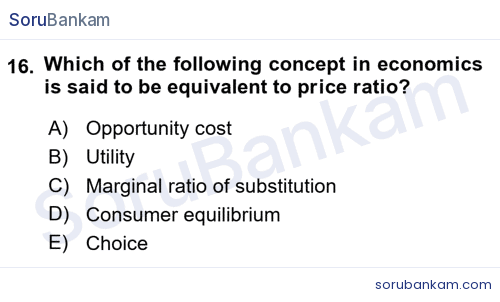
Which of the following concept in economics is said to be equivalent to price ratio?. A) Opportunity cost B) Utility C) Marginal ratio of substitution D) Consumer equilibrium E) Choice
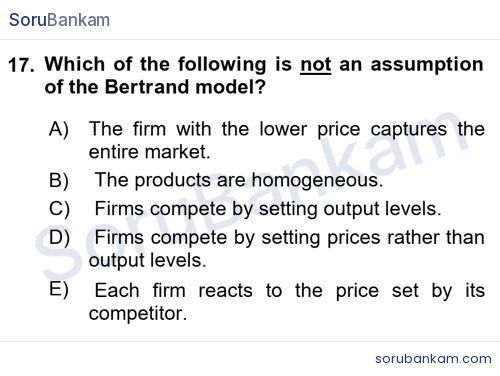
Which of the following is not an assumption of the Bertrand model? A) The firm with the lower price captures the entire market. B) The products are homogeneous. C) Firms compete by setting output levels. D) Firms compete by setting prices rather than output levels. E) Each firm reacts to the price set by its competitor.
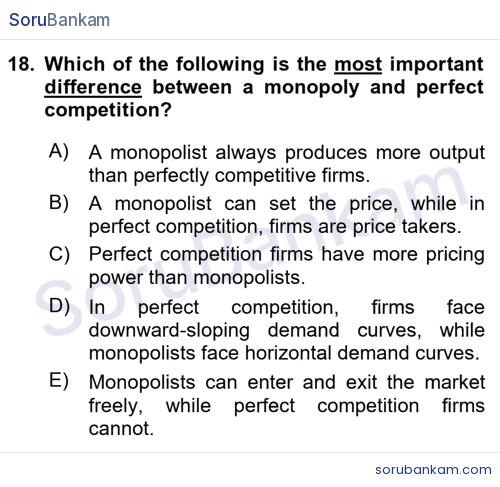
18. Which of the following is the most important difference between a monopoly and perfect competition? A) A monopolist always produces more output than perfectly competitive firms. B) A monopolist can set the price, while in perfect competition, firms are price takers. C) Perfect competition firms have more pricing power than monopolists. D) In perfect competition, firms face downward-sloping demand. curves, while monopolists face horizontal demand curves. Monopolists can enter and exit the market freely, while perfect competition firms cannot.
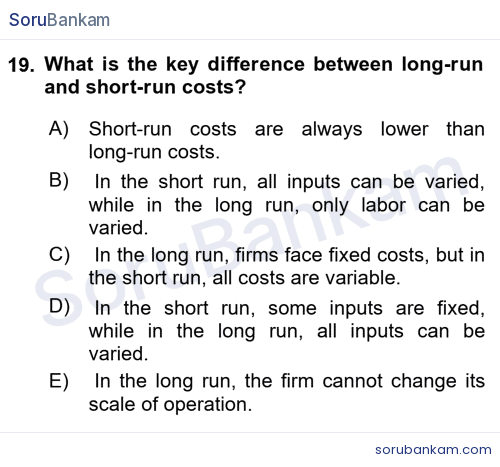
What is the key difference between long-run and short-run costs? A) Short-run costs are always lower than long-run costs. B) In the short run, all inputs can be varied, while in the long run, only labor can be varied. C) In the long run, firms face fixed costs, but in the short run, all costs are variable. D) In the short run, some inputs are fixed, while in the long run, all inputs can be varied. E) In the long run, the firm cannot change its scale of operation.
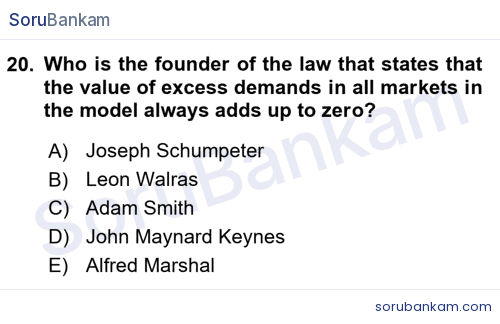
Who is the founder of the law that states that the value of excess demands in all markets in the model always adds up to zero? A) Joseph Schumpeter B) Leon Walras C) Adam Smith • 1• D) John Maynard Keynes E) Aifred Marshal