IKT205U Microeconomic Theory 2024-2025 Vize Soruları
20 soru · Vize · 2024-2025
IKT205U Microeconomic Theory dersinin 2024-2025 vize sınavı 20 sorudan oluşur; ders AÖF İktisat (İngilizce) bölümünde okutulur. Sorular aşağıda sırasıyla yer alır. Doğru cevaplar ve sonucun, testi çözdüğünde görünür.
Önizleme · 20 soru. Cevaplamak ve sonucunu görmek için sınavı başlat.
Sorular
20 soru
Soru 1
Soru 2
Soru 3
Soru 4
Soru 5
Soru 6
Soru 7
Soru 8
Soru 9
Soru 10
Soru 11
Soru 12
Soru 13
Soru 14
Soru 15
Soru 16
Soru 17
Soru 18
Soru 19
Soru 20

Sınav modunda süre tutulur, doğru cevaplar ve sonucun sınav bitince görünür.
Dersin üniteleri
IKT205U Microeconomic Theory ders sayfası: bütün sınavlar ve üniteler
Soruların metni (otomatik okuma)
Görsellerden otomatik okunmuştur; hata içerebilir. Sorular, görsellerdeki hâliyle geçerlidir.
Under the law of diminishing marginal utility, when total utility is maximum, marginal utility is to be equal to--. Which of the following completes the sentence above? A) Infinity B) Zero C) 0.5 D) -1 E) Unity
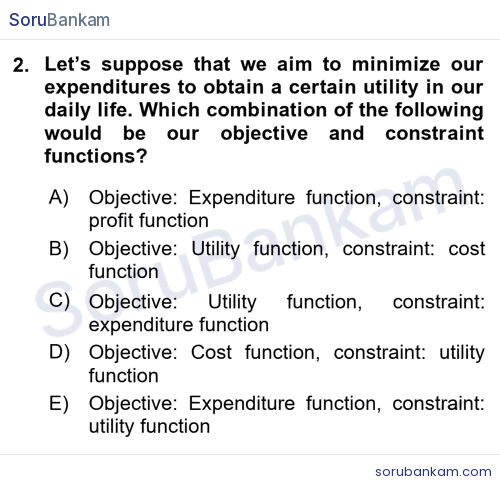
2. Let's suppose that we aim to minimize our expenditures to obtain a certain utility in our daily life. Which combination of the following would be our objective and constraint functions? A) Objective; Expenditure function, constraint: profit function Objective: Utility function, constraint: cost function C) Objective: Utility function, constraint: expenditure function D) Objective: Cost function, constraint: utility function E) Objective: Expenditure function, constraint: utility function
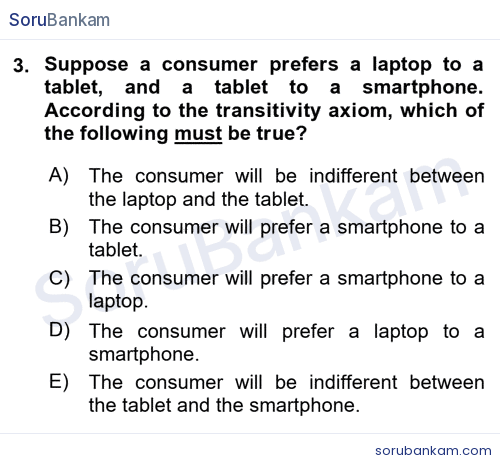
Suppose a consumer prefers a laptop to. a tablet, and a tablet to a smartphone. According to the transitivity axiom, which of the following must be true? A) The consumer will be indifferent between the laptop and the tablet. B) The consumer will prefer a smartphone to a tablete C) The consumer will prefer a smartphone to a laptop. D) The consumer will prefer a faptop to a smartphone. E) The consumer will be indifferent between the tablet and the smartphone.
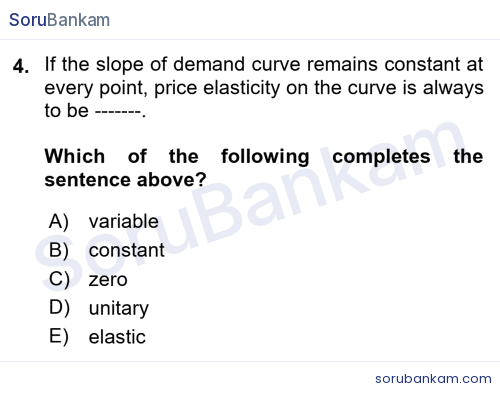
If the slope of demand curve remains constant at every point, price elasticity on the curve is always to be ----. Which of the following completes the sentence above? A) variable B) constant C) zero D) unitary E) elastic
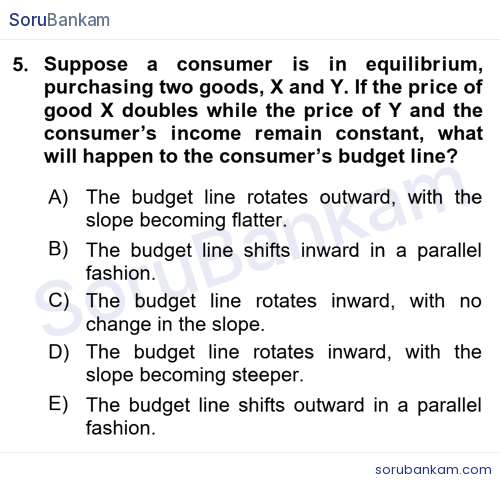
Suppose a consumer is in equilibrium, purchasing two goods, X and Y. If the price of good X doubles while the price of Y and the consumer's income remain constant, what will happen to the consumer's budget line? A) The budget line rotates outward, with fe slope becoming flatter. B) The budget line shifts inward in a parallel fashion. C) The budget line rotates inward, with no change in the slope. D) The budget line rotates inward, with the slope becoming stepper. E) The budget line shifts outward in a parallel fashion.
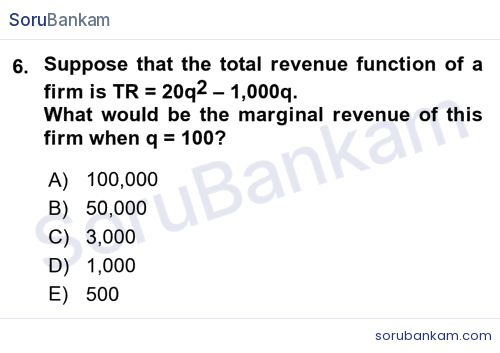
Suppose that the total revenue function of a firm is TR = 20q2-1,000q. What would beithe marginal revenue of this firm when q'= 100? A) 100,000 B) 50,000 C) 3,000 D) 1,000 * E) 500
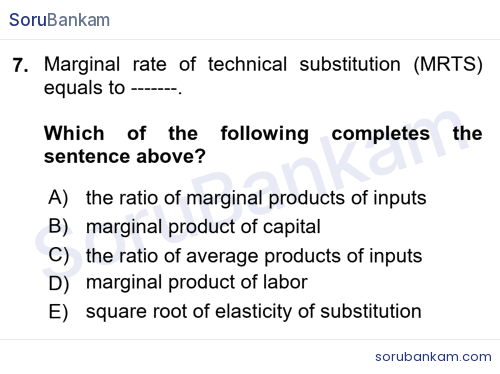
Marginal rate of technical substitution (MRTS) equalsto-. Which of the following completes the sentence above? A) the ratio of marginal products of inputs B) marginal product of capital C) the ratio of average products of inputs D) marginal product of labor E) square root of elasticity of substitution
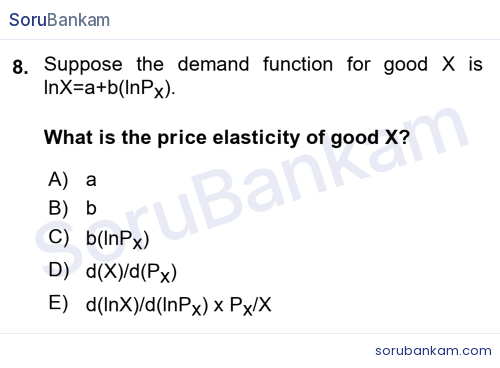
8. Suppose the demand function for good X is InX=a+b(InP×). What is the price elasticity of good X7 A) B) C) b(InPx) D) d(x)/d(Px) E) d(InX)/d(InPx) x Px/X
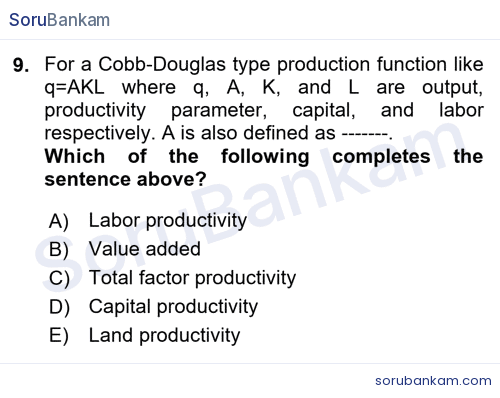
For a Cobb-Douglas type production function like q=AKL where q, A, K, and L are output, productivity parameter, capital, and labor respectively. A is also defined as —-. Which of the following completes the sentence above? A) Labor productivity B) Value added C) Total factor productivity D) Capital productivity E) Land productivity
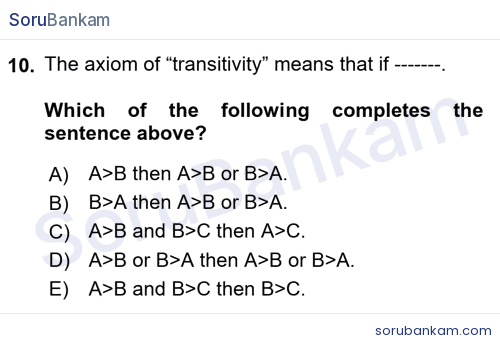
The axiom of transitivity" means that if.... Which of the following completes the sentence above? A) A>B then A=B or B>A. B) B>A then A>B or B>A. C) A>B and B>C then AsC. D) A>B or B>A then A>B or B>A. E) A>B and B>C then B»C.
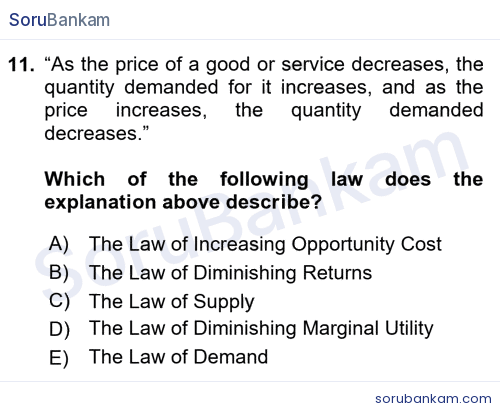
"As the price of a good or service decreases, the quantity demanded for it increases, and as the price increases, • the quantity demanded decreases." Which of the following law does the explanation above describe? A) The Law of Increasing Opportunity Cost B) The Law of Diminishing Retums C) nO! The Law of Supply D) The Law of Diminishing Marginal Utility E) The Law of Demand
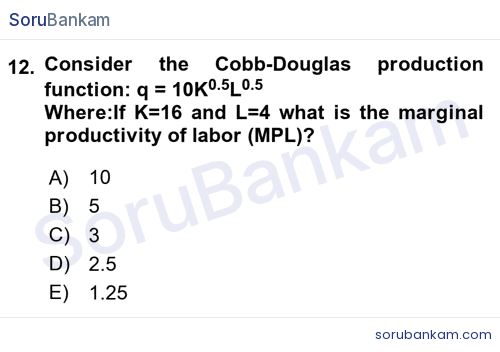
Consider the Cobb-Douglas production function: q = 10K°5L0.5 Where:If K=16 and L=4 what Is the marginal productivity of labor (MPL)? A) 10 B) 5 C) 3 D) 2.5 E) 1.25
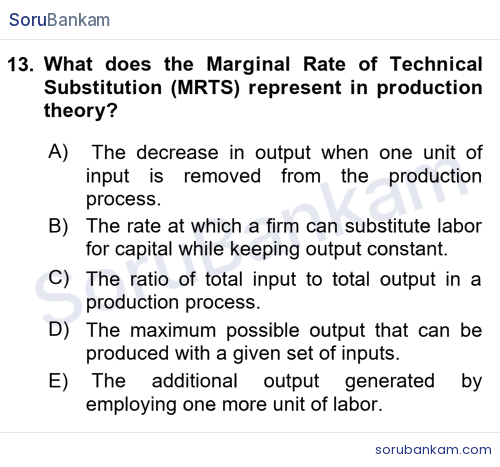
What does the Marginal Rate of Technical. Substitutlon (MRTS) represent in production theory? A) The decrease in output when one unit of input is removed from the production process. B) The rate at which a firm can substitute labor for capital while keeping output constant. C) The ratio of total input to total output in a production process. D) The maximum possible output that can be produced with a given satof inputs. E) The additional output generated by employing one more unit of labor.
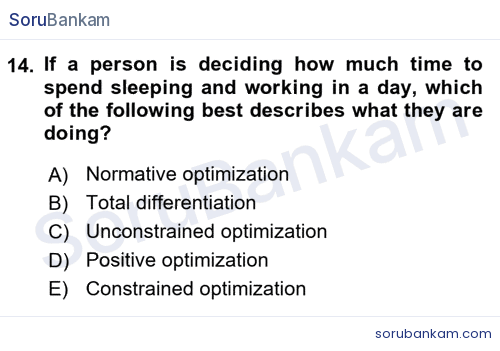
14. If a person is deciding how much time to spend sleeping and working In a day, which of the following, best describes what they are doing? A) Normative optimization Total differentiation C) Unconstrained optimization D) Positive optimization Ex Constrained optimization
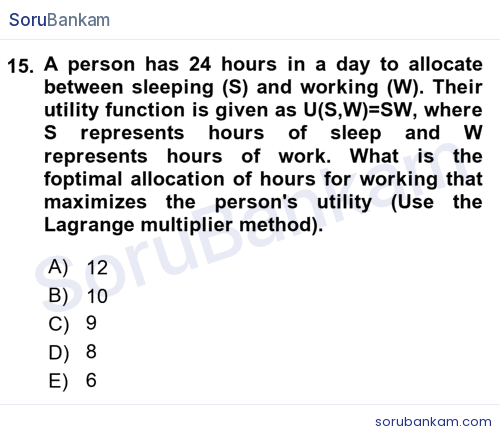
A person has 24 hours in a day to allocate between sleeping (S) and working (W). Their utility function is given as U(S,W)=SW, where S represents hours sleep and w represents hours of work. What is the iNfoptimal allocation of hours for working that maximizes the person's utility (Use the Lagrange multipiler method). A) 12 B) 10 C) 9 D) 8 E) 6 •
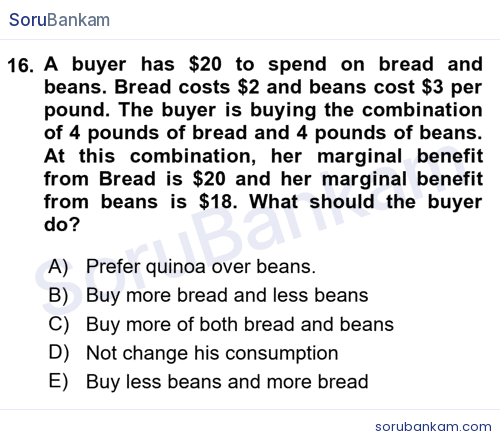
A buyer has $20 to spend on bread and beans. Bread costs $2 and beans cost $3 per pound. The buyer is buying the combination of 4 pounds of bread and 4 pounds of beans. At this combination, her marginal benefit from Bread is $20 and her marginal benefit from beans is $18. What should the buyer do? A) Prefer quinoa over beans. B) Buy more bread and less beans C) Buy more of both bread and beans D) Not change his consumption E) Buy less beans and more bread
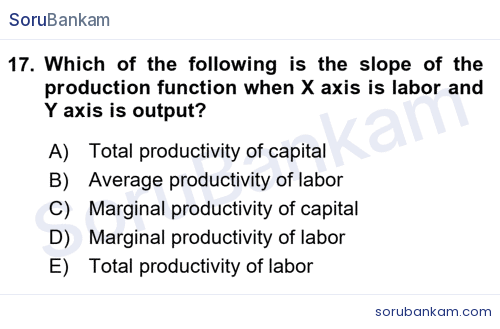
Which of the following is the slope of the production functlon when X axis Is labor and Y axis is output? A) Total productivity of capital B) Average productivity of labor C) Marginal productivity of capital D) Marginal productivity of labor E) Total productivity of labor
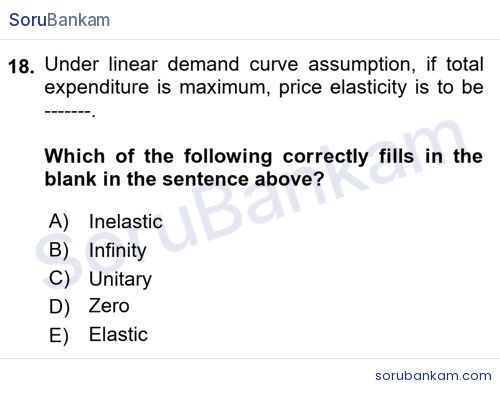
Under linear demand curve assumption, if total expenditure is maximum, price elasticity is to be Which of the following correctly fills in the blank in the sentence above? A) Inelastic B) Infinity C) Unitary D) Zero E) Elastic
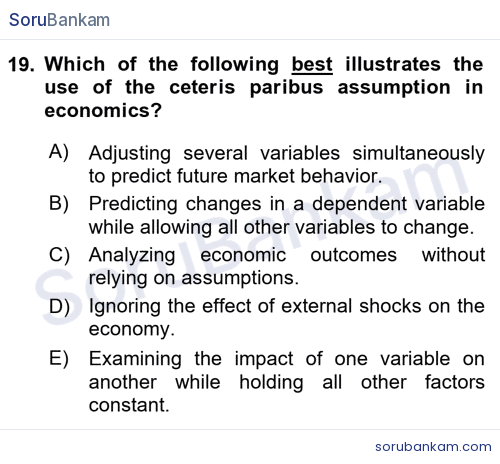
Which of the following best illustrates the use of the cateris paribus assumption in economics? A) Adjusting several variables simultaneously to predict future market behavior. B) Predicting changes in a dependent variable while allowing all other variables to change. C) Analyzing economic outcomes without relying on assumptions. D) Ignoring the effect of external shocks on the economy. E) Examining the impact of one variable on another while holding all other factors constant.
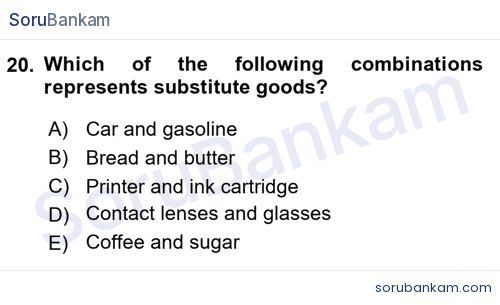
Which of the following combinations represents substitute goods? A) Car and gasoline B) Bread and butter C) Printer and ink cartridge D) Contact lenses and glasses E) Coffee and sugar