TAR227U Principles Of Ataturk And The History Of Turkish Revolution 1 2023-2024 Yaz Okulu Soruları
20 soru · Yaz okulu · 2023-2024
TAR227U Principles Of Ataturk And The History Of Turkish Revolution 1 dersinin 2023-2024 yaz okulu sınavı 20 sorudan oluşur; ders AÖF İktisat (İngilizce) bölümünde okutulur. Sorular aşağıda sırasıyla yer alır. Doğru cevaplar ve sonucun, testi çözdüğünde görünür.
Önizleme · 20 soru. Cevaplamak ve sonucunu görmek için sınavı başlat.
Sorular
20 soru
Soru 1
Soru 2
Soru 3
Soru 4
Soru 5
Soru 6
Soru 7
Soru 8
Soru 9
Soru 10
Soru 11
Soru 12
Soru 13
Soru 14
Soru 15
Soru 16
Soru 17
Soru 18
Soru 19
Soru 20
Sınav modunda süre tutulur, doğru cevaplar ve sonucun sınav bitince görünür.
Dersin üniteleri
Soruların metni (otomatik okuma)
Görsellerden otomatik okunmuştur; hata içerebilir. Sorular, görsellerdeki hâliyle geçerlidir.
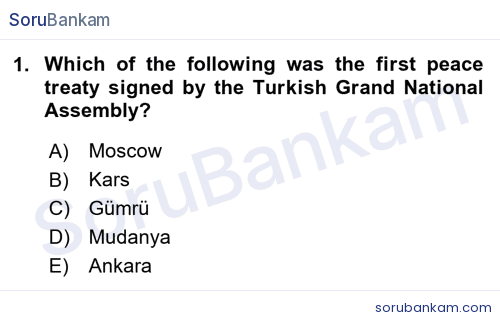
Which of the following was the first peace treaty signed by the Turkish Grand National Assembly? A) Moscow B) Kars C) Gümrü D) Mudanya E) Ankara
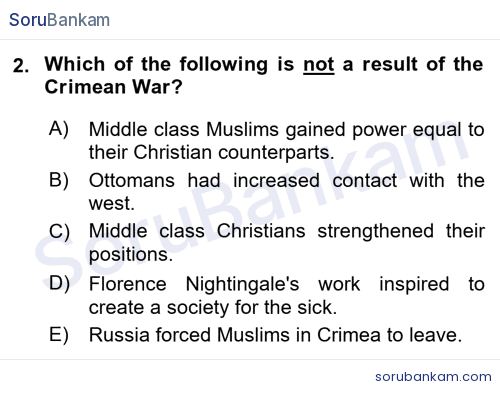
Which of the following is not a result of the Crimean War? A) Middle class Muslims gained power equal to their Christian counterparts. B) Ottomans had increased contact with the west. C) Middle class Christians strengthened their positions. D) Florence Nightingale's work inspired to create a society for the sick. E) Russia forced Muslims in Crimea to leave.
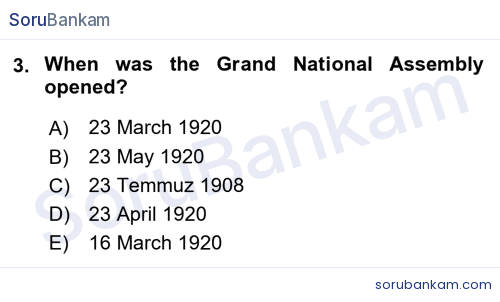
When was the Grand National Assembly opened? A) 23 March 1920 B) 23 May 1920 C) 23 Temmuz 1908 is' D) 23 April 1920 E) 16 March.1920
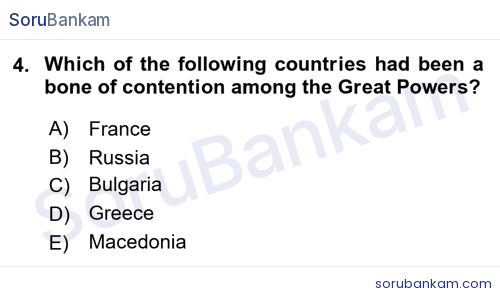
Which of the following countries had been a bone of contention among the Great Powers? A) France B) Russia C) Bulgaria D) Greece E) Macedonia
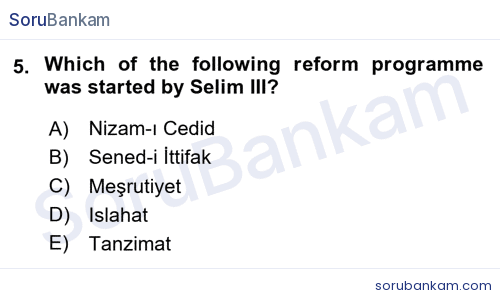
5. Which of the following reform programme was started by Selim IlI? Nizam-i Cedid Sened-i Ittifak C) Meşrutiyet D) Islahat E) Tanzimat
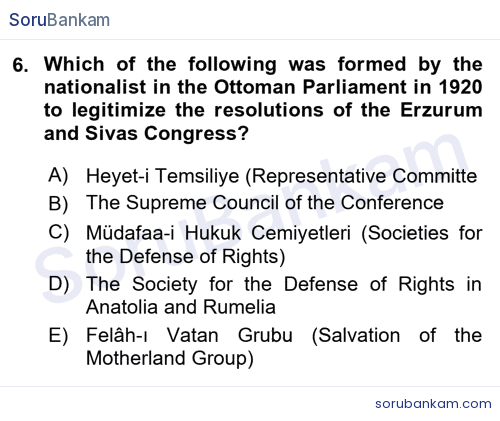
Which of the following was formed by the nationalist in the Ottoman Parliament in 1920 to legitimize the resolutions of the Erzurum and Sivas Congress? A) Heyet-i Temsiliye (Representative Committe, B) The Supreme Council of the Conference C) Müdafaa-i Hukuk Cemiyetleri (Societies for the Defense of Rights) D) The Society for the Defense of Rights in Anatolia and Rumelia E) Felâh-i Vatan Grubu (Salvation of the Motherland Group)
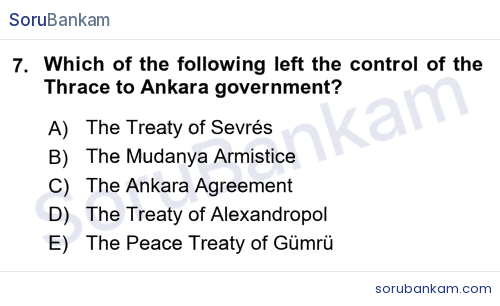
Which of the following left the control of the Thrace to Ankara government? A) The Treaty of Sevrés B) Ihe Mudanya Armistice C) The Ankara Agreement D) The Treaty of Alexandropol E) The Peace Treaty of Gümrü
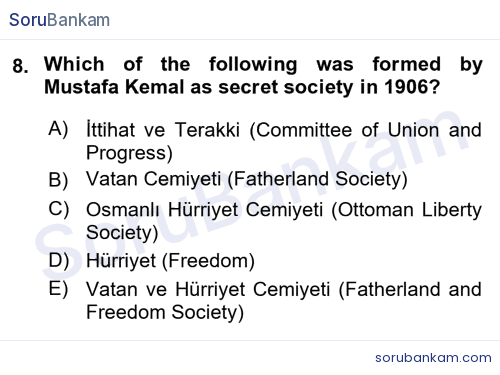
8. Which of the following was formed by Mustafa Kemal as scret society in 1906? A) Ittihat ve Terakki (Committee of Union and Progress) в)' Vatan Cemiyeti (Fatherland Society) C) Osmaniı Hürriyet Cemiyeti (Ottoman Liberty Society) D) Hürriyet (Freedom) « yEy-Vatan ve Hürriyet Cemiyeti (Fatherland and Freedom Society)
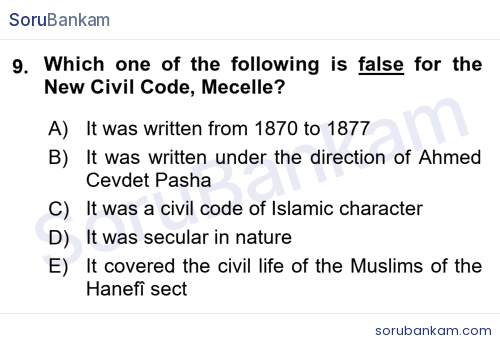
9. Which one of the following is false for the New Civil Code, Mecelle? A) It was written from 1870 to 1877 It was written under the direction of Ahmed Cevdet Pasha It was a civil code of Islamic character D) It was secular in nature E) It covered the civil life of the Muslims of the Hanefi sect
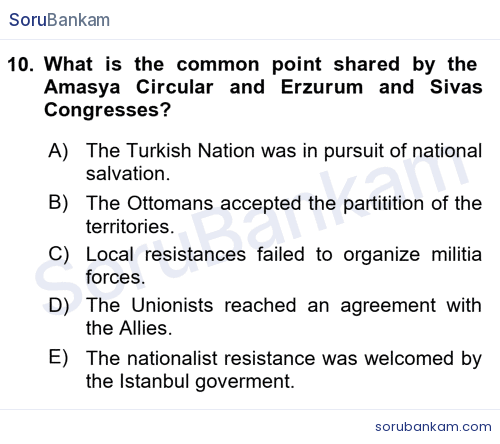
What is the common point shared by the Amasya Circular and Erzurum and Sivas Congresses? A) The Turkish Nation was in pursuit of national salvation. B) The Ottomans accepted the partitition of the territories. C) Local resistances failed to organize militia forces. D) The Unionists reached an agreement with the Allies. E) The nationalist resistance was welcomed by the Istanbul goverment.
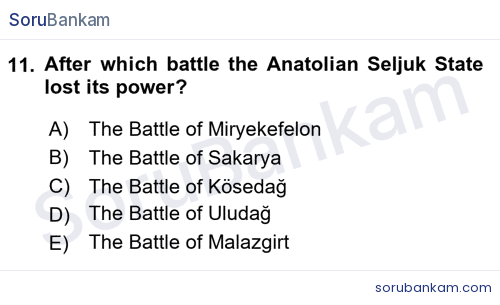
After which battle the Anatolian Seljuk State lost its power? A) The Battle of Miryekefelon B) The Battle of Sakarya C) The Battle of Kösedağ D) The Battle of Uludağ E) The Battle of Malazgirt
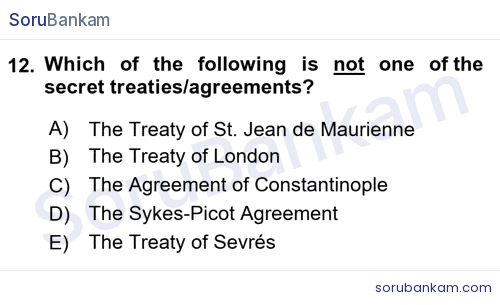
Which of the following is not one of the secret treaties/agreements? A) The Treaty of St. Jean de Maurienne B) The Treaty of London C) The Agreement of Constantinople D) The Sykes-Picot Agreement E) The Treaty of Sevrés
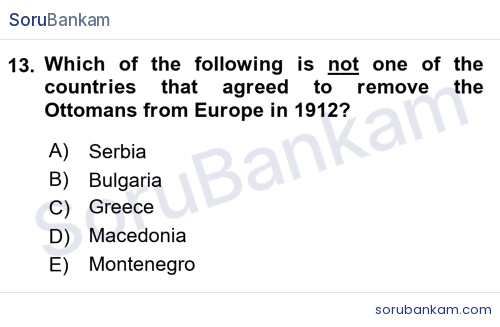
Which of the following is not one of the countries that agreed to remove the Ottomans from Europe in 1912? A) Serbia B) Bulgaria C) Greece D) Macedonia E) Montenegro
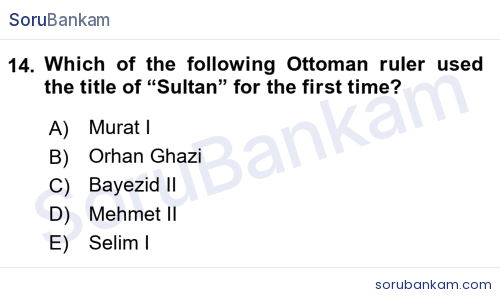
14. Which of the following Ottoman ruler used. the title of "Sultan" for the first time?, ant. A) Murat l B) Ortian Ghazi C) Bayezid I D) Mehmet I
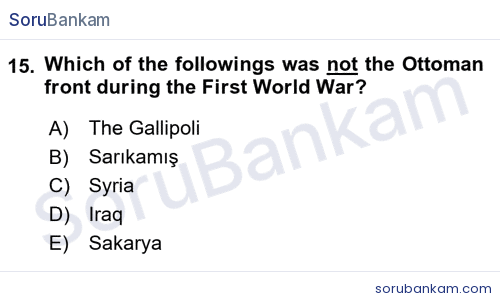
Which of the followings was not the ottoman' front during the First World War? A) Thę Gallipoli B) Sanıkamış C) Syria D) Iraq E) Sakarya
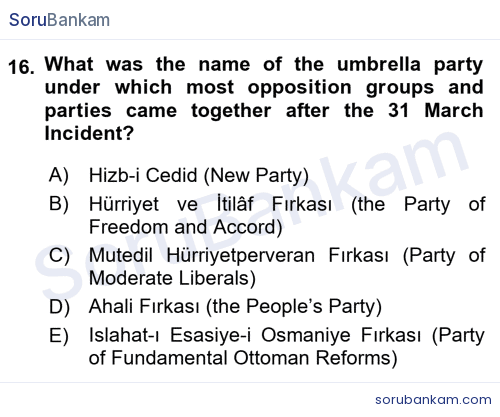
16. What was the name of the umbrella party under which most opposition groups and parties came together after the 31 March Incident? A) Hizb-i Cedid (New Party) B) Hürriyet ve ltilâf Firkasi (the Party of Freedom and Accord) C) Mutedil Hürriyetperveran Firkasi (Party of Moderate Liberals) D) Ahali Fırkası (the People's Party) Islahat-i Esasiye-i Osmaniye Firkası (Party of Fundamental Ottoman Reforms)
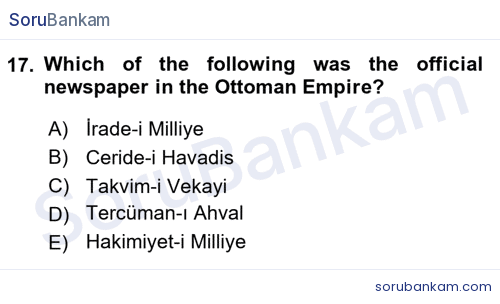
Which of the following was the official newspaper in the Ottoman Empire? A) İrade-i Milliye B) Ceride-i Havadis C) Takvim-i Vekayi D) Tercüman-i Ahval E) Hakimiyet-i Milliye
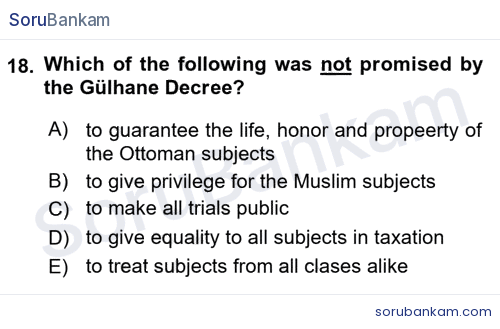
18. Which of the following was not promised by the Güthane Decree? A) to guarantee the life, honor and property of the Ottoman subjects to give privilege for the Muslim subjects C) to make ail trials public D) to give equality to all subjects in taxation E) to tréał subjects fromall clases alike
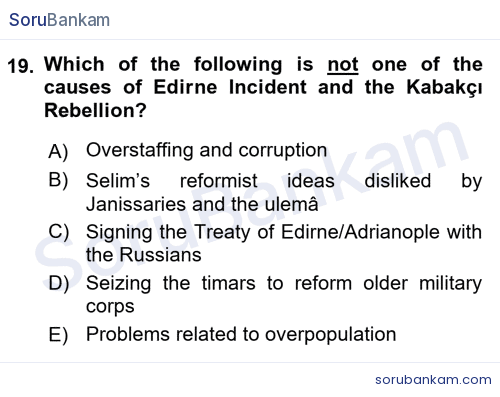
Which of the following is not one of the causes of Edirne Incident and the Kabakçı Rebellion? A) Overstaffing and corruption B) Selim's reformist ideas disliked by Janissaries and the ulemå C) Signing the Treaty of Edirne/Adrianople with the Russians D) Seizing the timars to reform older military corps E) Problems related to overpopulation
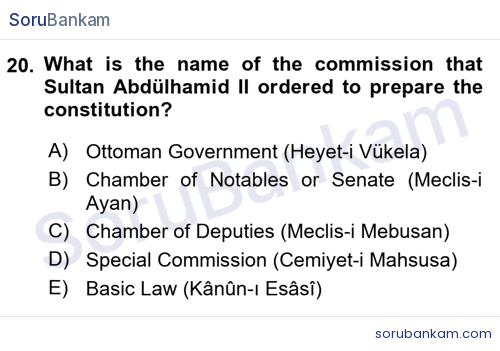
What is the name of the commission thạt Sultan Abdülhamid Il ordered to prepare the constitution? A) Ottoman Govemment (Heyet-i Vükela) B) Chamber of Notables or Senate (Meclis-i Ayan) C) Chamber of Deputies (Meclis-i Mebusan) D) Special Commission (Cemiyet-i Mahsusa) E) Basic Law (Kânûn-ı Esâsî)