TAR227U Principles Of Ataturk And The History Of Turkish Revolution 1 2021-2022 Vize Soruları
20 soru · Vize · 2021-2022
TAR227U Principles Of Ataturk And The History Of Turkish Revolution 1 dersinin 2021-2022 vize sınavı 20 sorudan oluşur; ders AÖF İktisat (İngilizce) bölümünde okutulur. Sorular aşağıda sırasıyla yer alır. Doğru cevaplar ve sonucun, testi çözdüğünde görünür.
Önizleme · 20 soru. Cevaplamak ve sonucunu görmek için sınavı başlat.
Sorular
20 soru
Soru 1
Soru 2
Soru 3
Soru 4
Soru 5
Soru 6
Soru 7
Soru 8
Soru 9
Soru 10
Soru 11
Soru 12
Soru 13
Soru 14
Soru 15
Soru 16
Soru 17
Soru 18
Soru 19
Soru 20
Sınav modunda süre tutulur, doğru cevaplar ve sonucun sınav bitince görünür.
Dersin üniteleri
Soruların metni (otomatik okuma)
Görsellerden otomatik okunmuştur; hata içerebilir. Sorular, görsellerdeki hâliyle geçerlidir.
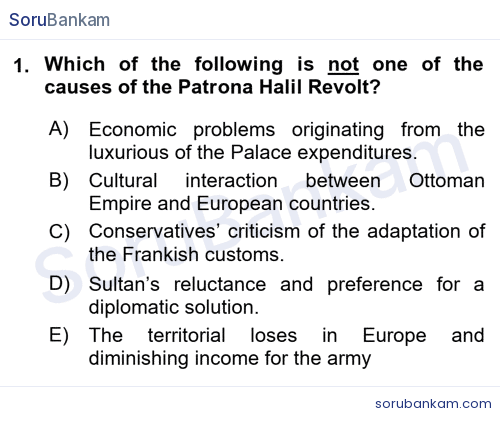
Which of the following is not one of the causes of the Patrona Halil Revolt? A) Economic problems originating from the luxurious of the Palace expenditures. B) Cultural interaction between Ottoman Empire and European countries. C) Conservatives' criticism of the adaptation of the Frankish customs. D) Sultan's reluctance and preference for a diplomatic solution. E) The territorial loses in Europe and diminishing income for the army
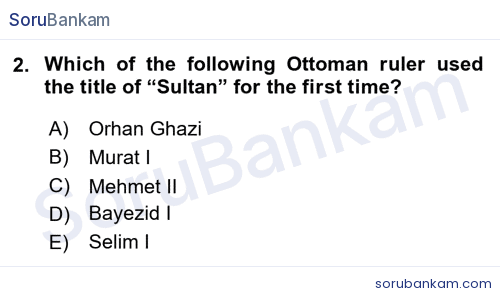
Which of the following Ottoman ruler used the title of "Sultan" for the first time? A) Orhan Ghazi B) Murat C) Mehmet D) Bayezid E) Selim
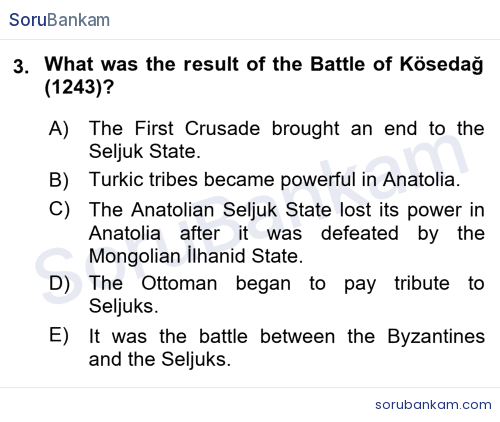
What was the result of the Battle of Kosedag (1243)? A) The First Crusade brought an end to the Seljuk State. B) Turkic tribes became powerful in Anatolia. C) The Anatolian Seljuk State lost its power in Anatolia after it was defeated by the Mongolian Ilhanid State. D) The Ottoman began to pay tribute to Seljuks. E) It was the battle between the Byzantines and the Seljuks.
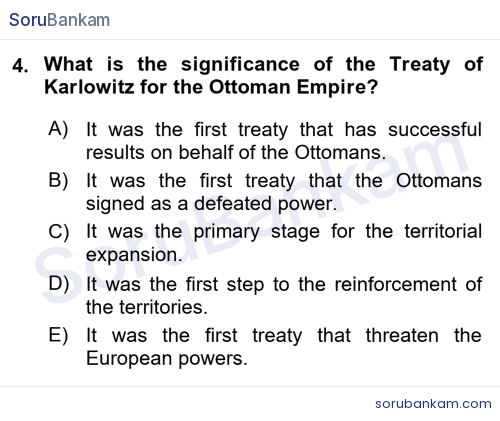
What is the significance of the Treaty of Karlowitz for the Ottoman Empire? A) It was the first treaty that has successful results on behalf of the Ottomans. B) It was the first treaty that the Ottomans" signed as a defeated power. C) It was the primary stage for the territorial expansion. D) It was the first step to the reinforcement of the territories. E) It was the first treaty that threaten the European powers.
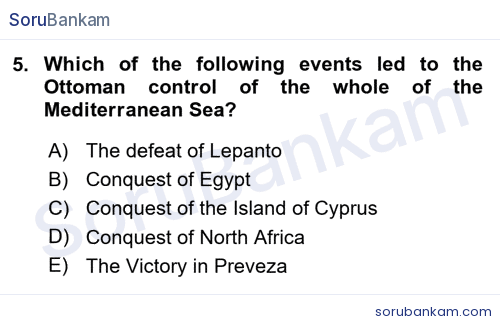
Which of the following events led to the Ottoman control Mediterranean Soap Of the whole of the A) The defeat of Lepanto B) Conquest of Egypt C) Conquest of the Island of Cyprus D) Conquest of North Africa E) The Victory in Preveza
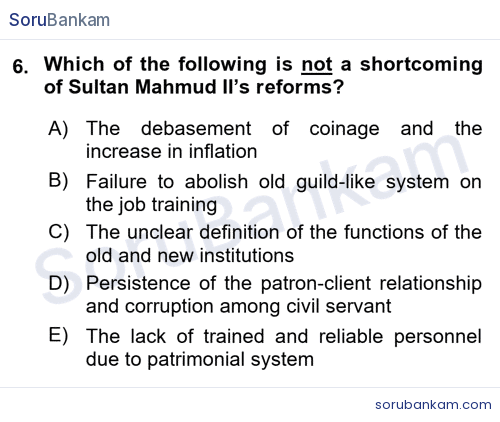
Which of the following is not a shortcoming of Sultan Mahmud Il's reforms? A) The debasement of coinage and the increase in inflation B) Failure to abolish old guild-like system on the job training C) The unclear definition of the functions of the old and new institutions D) Persistence of the patron-client relationship and corruption among civil servant E) The lack of trained and reliable personnel due to patrimonial system
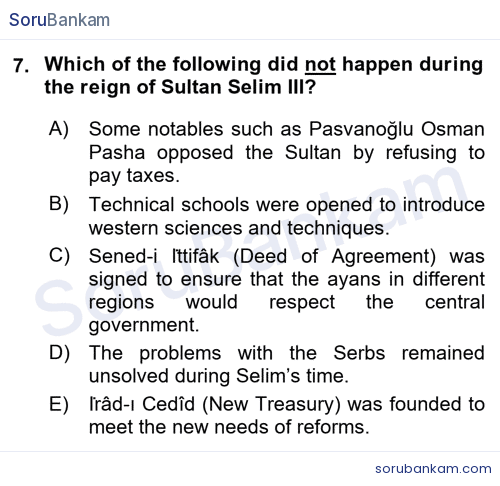
7. Which of the following did not happen during the reign of Sultan Selim Ill? A) Some notables such as Pasvanoğlu Osman Pasha opposed the Sultan by refusing to pay taxes. Technical schools were opened to introduce western sciences and techniques. C) Sened-i ltifak (Deed of Agreement) was signed to ensure that the ayans in different regions would respect the central government. D) The problems with the Serbs remained unsolved during Selim's time. E) Irad-i Cedid (New Treasury) was founded to meet the new needs of reforms.
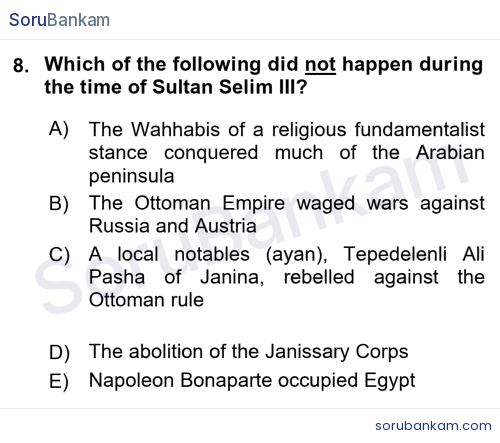
Which of the following did not happen during! the time of Sultan Selim Ill? A) The Wahhabis of a religious fundamentalist stance conquered much of the Arabian peninsula B) The Ottoman Empire waged wars against Russia and Austria C) A local notables (aram); Tepedelenli Ali Pasha of Janina, rebelled against the Ottoman rule D) The abolitioni-of the Janissaty Corps E) Napoleon Bonaparte occupied Egypt
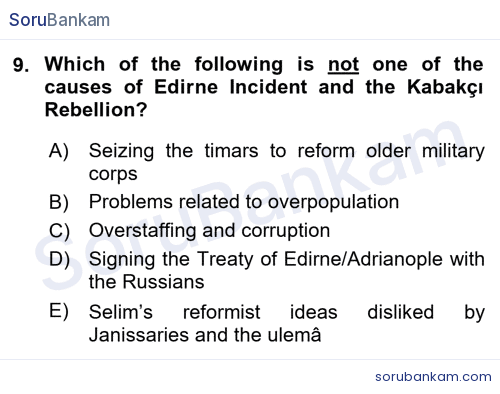
Which of the following is not one of the causes of Edirne Incident and the Kabakçı Rebellion? A) Seizing the timars to reform older military corps B) Problems related to overpopulation C) Overstaffing and corruption D) Signing the Treaty of Edime/Adrianople with the Russians E) Selim's reformist ideas dişliked by Janissaries and the ulemâ
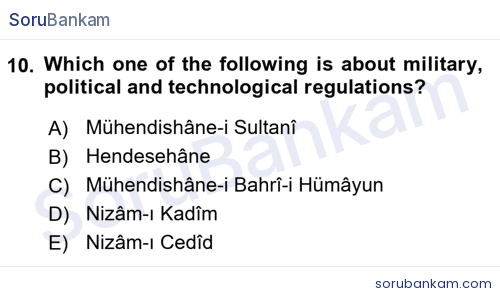
Which one of the following is about military, A) political and technological regulations? Mühendishâne-i Sultanî B) Hendesehåne C) Mühendishâne-i Bahrî-i Hümâyun D) Nizâm- Kadim E) Nizâm- Cedid
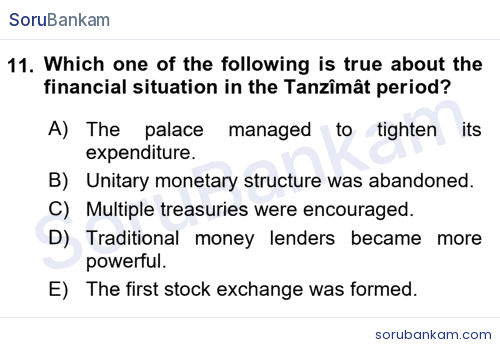
Which one of the following is true about the financial situation in the Tanzimât periad? A) The _ palace managed to tighten its expenditure. B) Unitary monetary structure was abandoned. C) Multiple treasures were encouraged. D) Traditional .foney lenders became more powerful. E) The first stock exchange was formed.
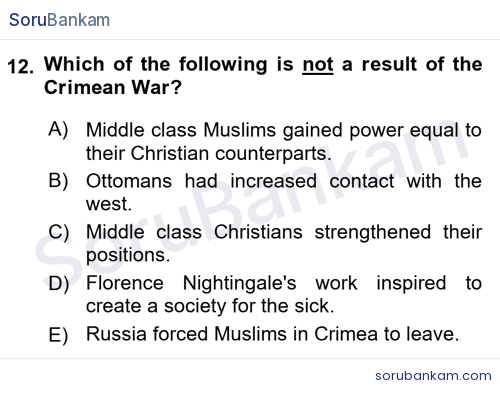
Which of the following is not a result of the Crimean War? A) Middle class Muslims gained power equal to their Christian counterparts. B) w' B) Ottomans had increased contact with the west. C) Middle class Christians strengthened their positions. D) Florence Nightingale's work inspired to create a society for the sick. E) Russia forced Muslims in Crimea to leave.
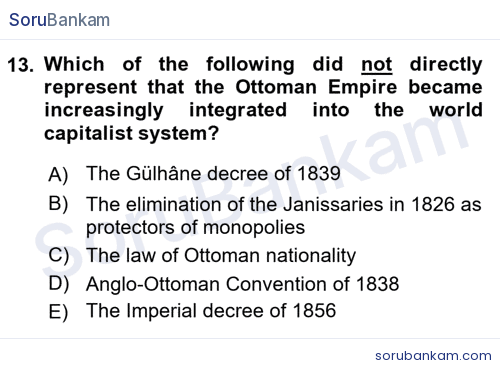
Which of the following did not directly represent that the Ottoman Empire became increasingly integrated into the world capitalist system? A) The Gülhâne decree of 1839 B) The elimination of the Janissaries in 1826 as protectors of monopolies C) The law of Ottoman nationality D) Anglo-Ottoman Convention of 1838 E) The Imperial decree of 1856
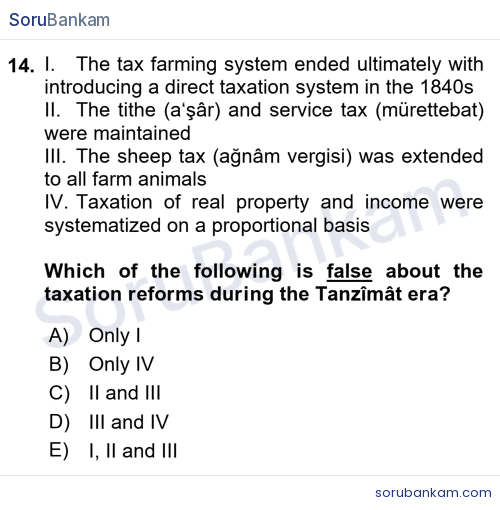
1. The tax farming system ended ultimately with introducing a direct taxation system in the 1840s II. The tithe (a'şâr) and service tax (mürettebat) were maintained III. The sheep tax (ağnâm vergisi) was extended to all farm animals IV. Taxation of real property and income were systematized on a proportional basis Which of the following is false about the taxation reforms during the Tanzîmât era? A) Only ! B) Only C) I and Iil D) IlI and E) I, Il and !!i
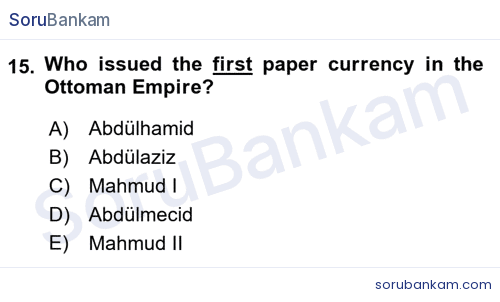
Who issued the first paper currency in the Ottoman Empire? A) Abdülhamid B) Abdülaziz C) Mahmud D) Abdülmecid E) Mahmud
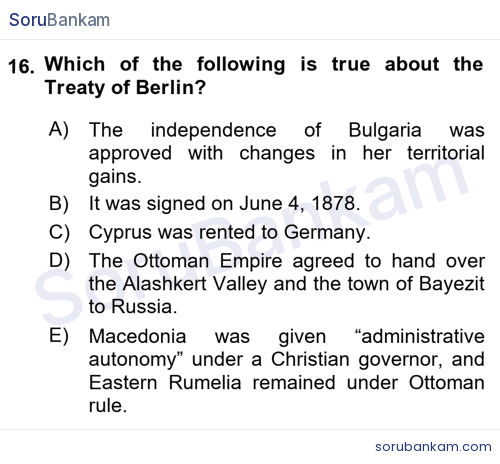
Which of the following is true about the Treaty of Berlin? A) The independence Bulgaria was approved with changes in her territorial gains. B) It was signed on June 4, 1878. C) Cyprus was rented to Germany. D) The Ottoman Empire agreed to hand over the Alashkert Valley and the town of Bayezit to Russia. E) Macedonia was given "administrative autonomy" under a Christian governor, and Eastern Rumelia remained under Ottoman rule.
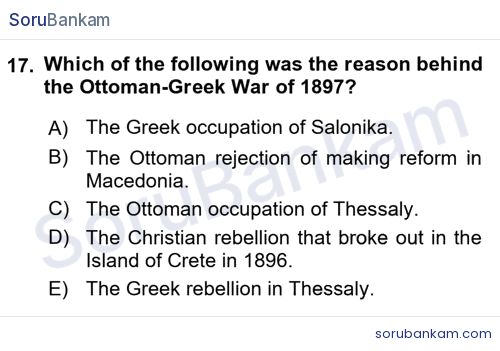
Which of the following was the reason behind the Ottoman-Greek War of 1897? A) The Greek occupation of Salonika. B) The Ottoman rejection of making reform in Macedonia. C) The Ottoman occupation of Thessaly: D) The Christian rebellion that broke out in the Island of Crete in 1896. E) The Greek rebellion in Thessaly.
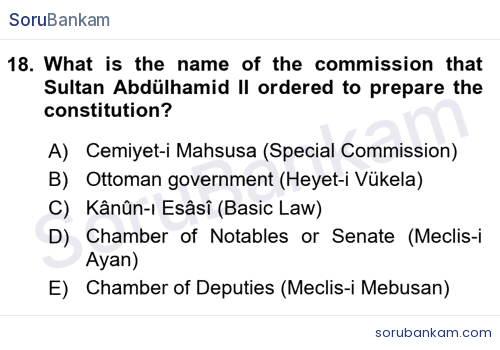
18. What is the name of the commission that Sultan Abdülhamid Il ordered to prepare the constitution? A) femiyet-i Mahsusa (Special Commission) By Öttoman government (Heyet-i Vükela) C) Kânûn-i Esâsi (Basic Law) D) Chamber at Notables or Senate (Meclis-i Ayan) Eh Chamber of Deputies (Meclis-i Mebusan)
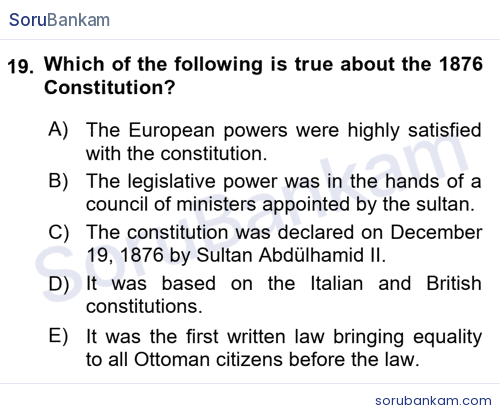
Which of the following is true about the 1876 Constitution? A) The European powers were highly satisfied with the constitution. B) w'B) The legislative power was in the hands of a council of ministers appointed by the sultan. C) The constitution was declared on December 19, 1876 by Sultan Abdülhamid II. D) It was based on the Italian and British constitutions. E) It was the first written law bringing equality to all Ottoman citizens before the law.
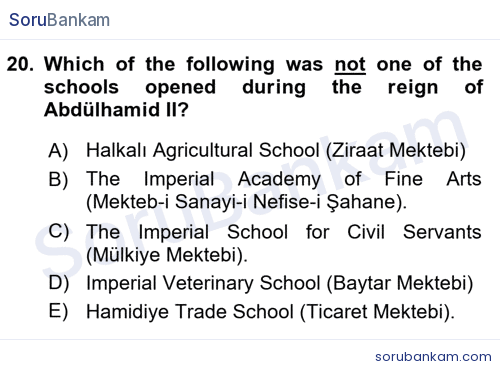
Which of the following was not one of the schools opened during the reign of Abdülhamid I|? A) Halkalı Agricultural School (Ziraat Mektebi) B) The Impenal Academy of Fine Arts (Mekteb-i Sanayi-i Nefise-i Şahane). C) The Imperial School for Civil Servants (Mülkiye Mektebi). D) Imperial Veterinary School (Baytar Mektebi) E) Hamidiye Trade School (Ticaret Mektebi).