ARY204U Research Methods 2021-2022 Final Soruları
20 soru · Final · 2021-2022
ARY204U Research Methods dersinin 2021-2022 final sınavı 20 sorudan oluşur; ders AÖF İktisat (İngilizce) bölümünde okutulur. Sorular aşağıda sırasıyla yer alır. Doğru cevaplar ve sonucun, testi çözdüğünde görünür.
Önizleme · 20 soru. Cevaplamak ve sonucunu görmek için sınavı başlat.
Sorular
20 soru
Soru 1
Soru 2
Soru 3
Soru 4
Soru 5
Soru 6
Soru 7
Soru 8
Soru 9
Soru 10
Soru 11
Soru 12
Soru 13
Soru 14
Soru 15
Soru 16
Soru 17
Soru 18
Soru 19
Soru 20
Sınav modunda süre tutulur, doğru cevaplar ve sonucun sınav bitince görünür.
Dersin üniteleri
Ünite özetleri ve konu anlatımları
- 1. Ünite: Philosophical Foundations Of Research
- 2. Ünite: Planning Research
- 3. Ünite: Writing A Literature Review
- 4. Ünite: Qualitative Research Methods
- 5. Ünite: Quantitative Methods
- 6. Ünite: Mixed Methods Research
- 7. Ünite: Research Ethics
- 8. Ünite: Writing Research Report
ARY204U Research Methods ders sayfası: bütün sınavlar ve üniteler
Soruların metni (otomatik okuma)
Görsellerden otomatik okunmuştur; hata içerebilir. Sorular, görsellerdeki hâliyle geçerlidir.
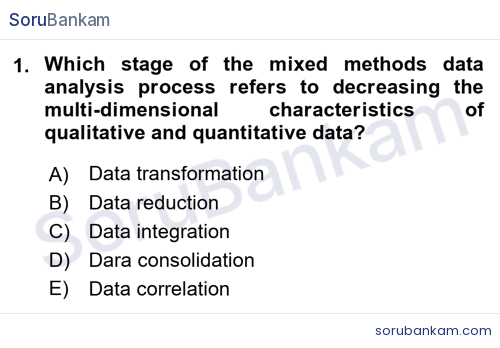
Which stage of the mixed methods data analysis process refers to decreasing the multi-dimensional characteristics qualitative and quantitative data? A) Data transformation B) Data reduction C) Data integration D) Dara consolidation E) Data correlation
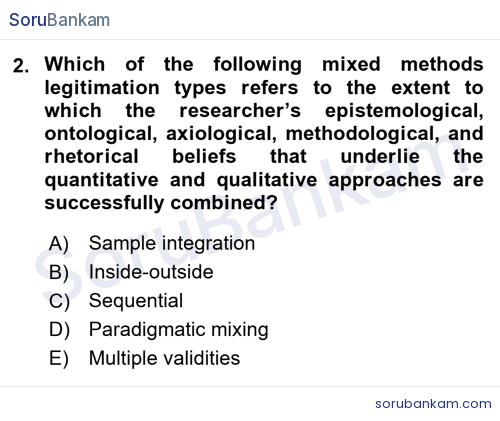
Which of the following mixed methods legitimation types refers to the extent to which the researcher's epistemological, ontological, axlological, methodological, and rhetorical beliefs that underlie the quantitative and qualitative approaches are successfully combined? A) Sample integration B) Inside-outside C) Sequential D) Paradigmatic mixing E) Multiple validities
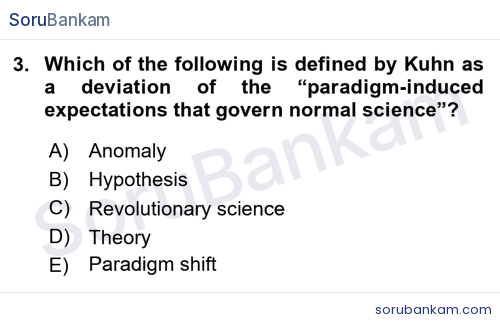
Which of the following is defined by Kuhn as a deviation of the "paradigm-induced expectations that govern normal science"? A) Anomaly B) Hypothesis C) Revolutionary science D) Theory E) Paradigm shift
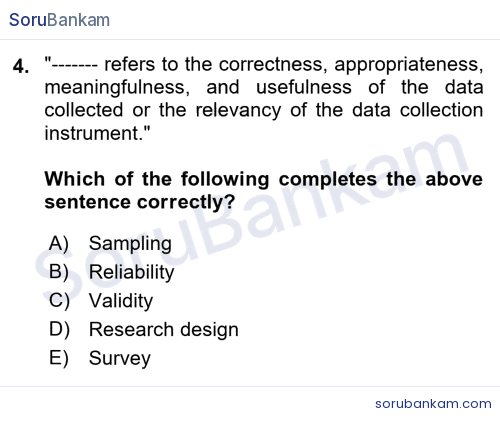
"- refers to the correctness, appropriateness, meaningfulness, and usefulness of the data collected or the relevancy of the data collection instrument, r Which of the following completes the above sentence correctly? A) Sampling B) Reliability C) Validity D) Research design E) Survey
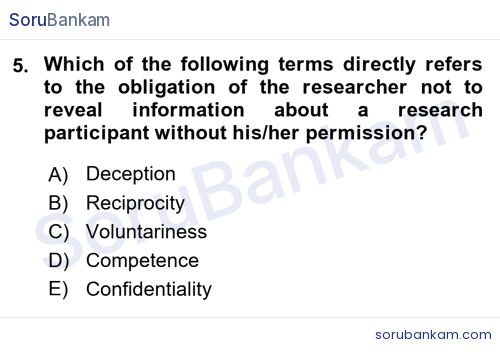
Which of the following terms directly refers to the obligation of the researcher not to reveal information about research participant without his/her permission? A) Deception 1. B) Reciprocity 21. C) Voluntariness D) Competence E) Confidentiality
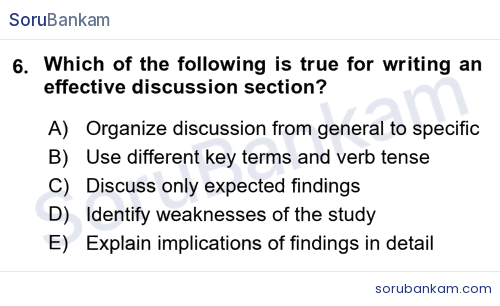
Which of the following is true for writing, an effective discussion section? A) Organize diséussion from general to specific B) Use different key terms and verb tense C) . vC) Discuss only expected findings D) Identify weaknesses of the study E) Explain implications of findings in detail
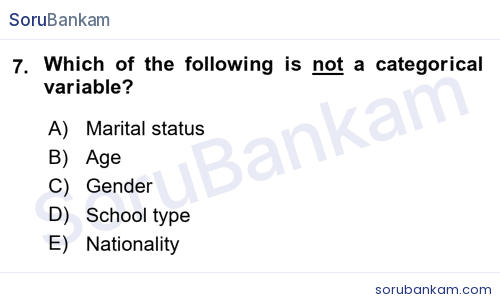
Which of the following is not a categorical variable? A) Marital status B) Age C) Gender D) School type E) Nationality
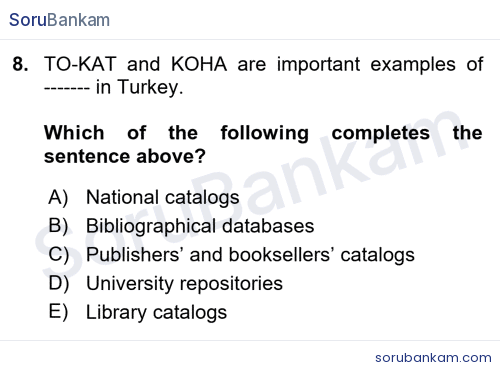
TO-KAT and KOHA are important examples of -- in Turkey. Which of the following completes the sentence above? A) National catalogs B) Bibliographical databases C) Publishers' and booksellers' catalogs D) University repositories E) Library catalogs
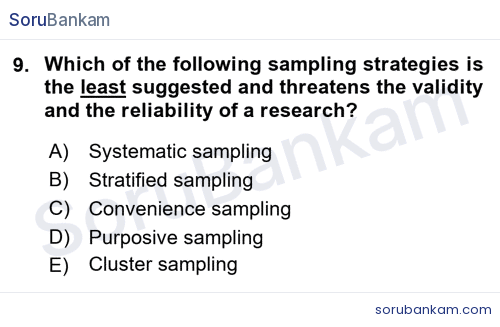
Which of the following sampling strategies is the least suggested and threatens the validity and the reliability of a research? A) Systematic sampling B) Stratified sampling C) Convenience sampling D) Purposive sampling E) Cluster sampling
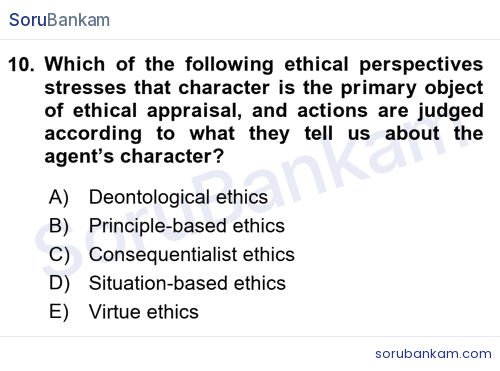
Which of the following ethical perspectives stresses that character is the primary object of ethical appraisal, and actions are judged according to what they tell us about the agent's character? A) Deontological ethics B) Principle-based ethics C) Consequentialist ethics D) Situation-based ethics E) Virtue ethics
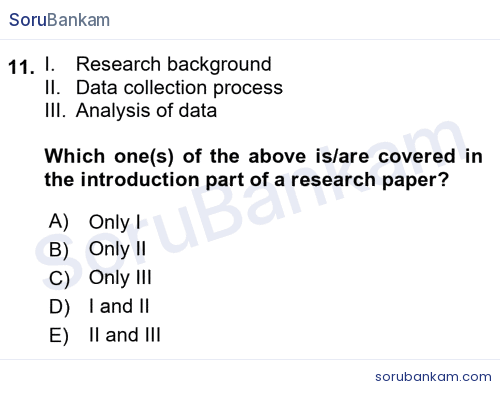
11. 1. Research background II. Data collection process III. Analysis of data Which one(s) of the above is/are covered in the introduction part of a research paper? A) Only ! B) Only 11y c) Only 'II + D) I and Il E) Il and Ill
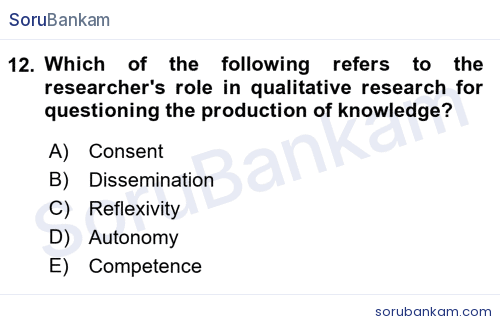
Which of the following refers to the researcher's role in qualitative research for questioning the production of knowledge? A) Consent B) Dissemination C) Reflexivity D) Autonomy E) Competence
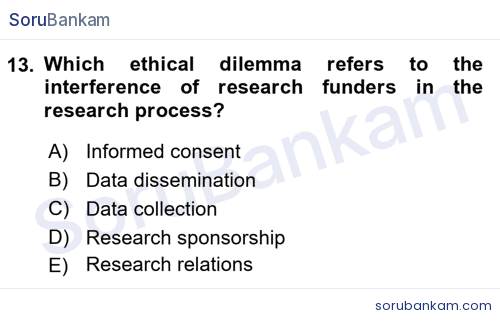
Which ethical dilemma refers the interference of research funders the research process? A) Informed consent B) Data dissemination C) Data collection D) Research sponsorship E) Research relations
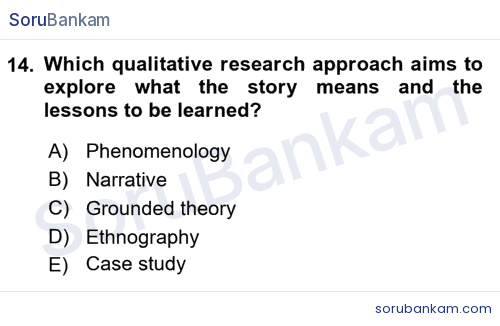
14. Which qualitative research approach aims ton explore what the story means and the lessons to be learned? Al Phenomenology • 1 By Narrative C) Grounded theory D) Ethnographys E) Caserstudy
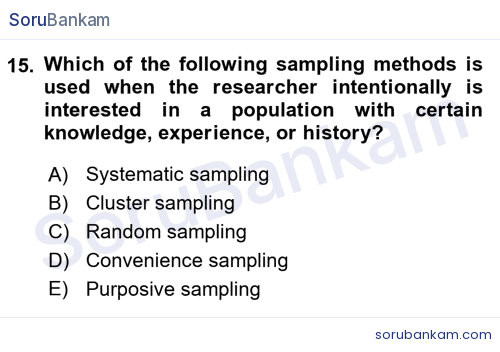
Which of the following sampling methods is used when the researcher intentionally is interested in a population • with certain knowledge, experience, or history? A) ("M) Systematic sampling B) Cluster sampling C) Random sampling D) Convenience sampling E) Purposive sampling
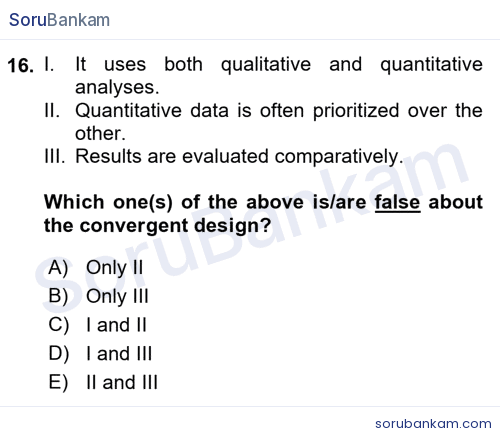
I. It uses both qualitative and quantitative analyses. II. Quantitative data is often prioritized over the other. Ili. Resuits are evaluated comparatively. Which one(s) of the above is/are false about the convergent design? A) Only B) Only III C) I and D) I and !!! E) Il and I1l
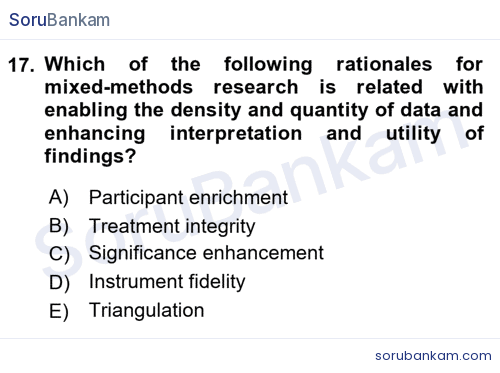
Which of the following rationales for mixed-methods research is related with enabling the density and quantity of data and enhancing interpretation and utility of findings? A) Participant enrichment B) Treatment intégrity C) Significance enhancement D) Instrument fidelity E) Triangulation
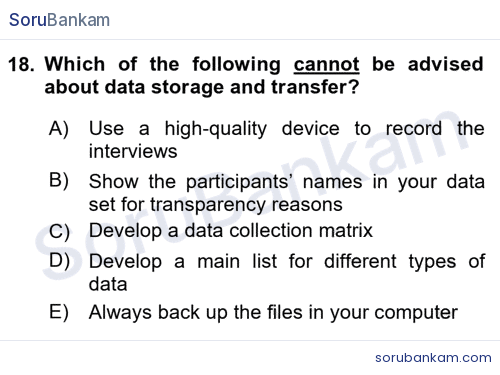
18. Which of the following cannot be advised about data storage and transfer? A) Use a high-quality device to record the interviews Show the participants' names in your data set for transparency reasons C) Develop a data collection metix 3,' D) Develop a main list for'i different types of data E) Always back up the files in your computer™
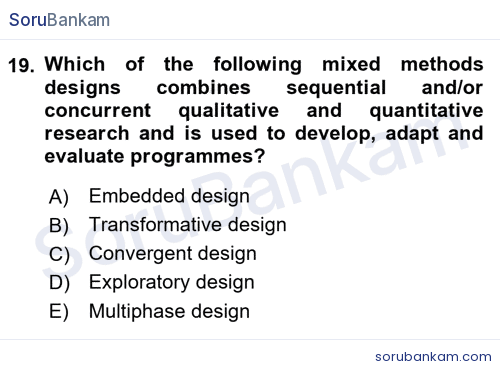
Which of the following mixed methods designs combines sequential and/or concurrent rosearch and is used to develope aapt and evaluate programmes? A) Embedded design B) Transformative design C) Convergent design D) Exploratory design E) Multiphase design
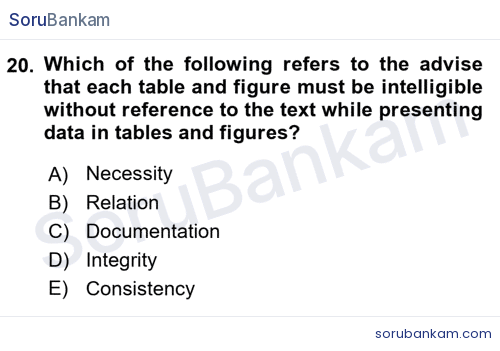
Which of the following refers to the advise that each table and figure must be intelligible without reference to the text while presenting data in tables and figures? A) Necessity B) Relation ... C) Documentation D) Integrity E) Consistency