ARY204U Research Methods 2023-2024 Vize Soruları
20 soru · Vize · 2023-2024
ARY204U Research Methods dersinin 2023-2024 vize sınavı 20 sorudan oluşur; ders AÖF İktisat (İngilizce) bölümünde okutulur. Sorular aşağıda sırasıyla yer alır. Doğru cevaplar ve sonucun, testi çözdüğünde görünür.
Önizleme · 20 soru. Cevaplamak ve sonucunu görmek için sınavı başlat.
Sorular
20 soru
Soru 1
Soru 2
Soru 3
Soru 4
Soru 5
Soru 6
Soru 7
Soru 8
Soru 9
Soru 10
Soru 11
Soru 12
Soru 13
Soru 14
Soru 15
Soru 16
Soru 17
Soru 18
Soru 19
Soru 20
Sınav modunda süre tutulur, doğru cevaplar ve sonucun sınav bitince görünür.
Dersin üniteleri
Ünite özetleri ve konu anlatımları
- 1. Ünite: Philosophical Foundations Of Research
- 2. Ünite: Planning Research
- 3. Ünite: Writing A Literature Review
- 4. Ünite: Qualitative Research Methods
- 5. Ünite: Quantitative Methods
- 6. Ünite: Mixed Methods Research
- 7. Ünite: Research Ethics
- 8. Ünite: Writing Research Report
ARY204U Research Methods ders sayfası: bütün sınavlar ve üniteler
Soruların metni (otomatik okuma)
Görsellerden otomatik okunmuştur; hata içerebilir. Sorular, görsellerdeki hâliyle geçerlidir.
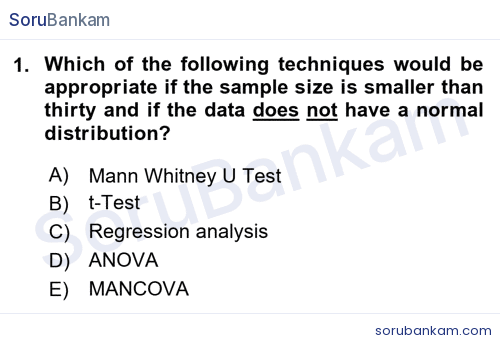
Which of the following techniques would be appropriate if the sample size is smaller than thirty and if the data does not have a normal distribution? A) Mann Whitney U Test B) t-Test C) Regression analysis D) ANOVA E) MANCOVA
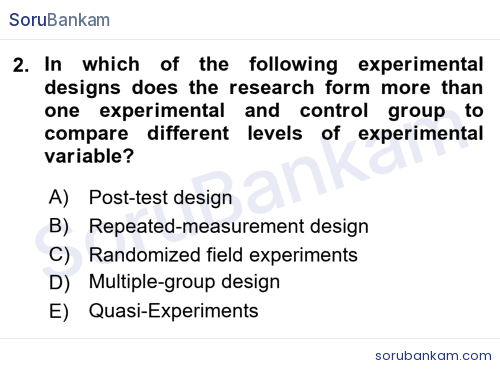
In which of the following experimental designs does the research form more than one experimental and control group to compare different levels of experimental variable? A) Post-test design B) Repeated-measurement design C) Randomized field experiments D) Multiple-group design E) Quasi-Experiments
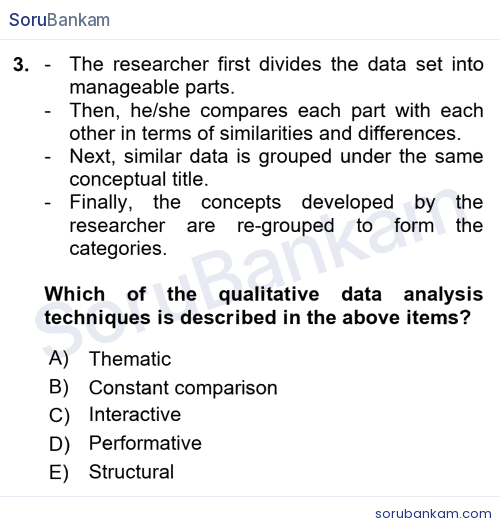
- The researcher first divides the data set int manageable parts. - Then, he/she compares each part with each other in terms of similarities and differences. - Next, similar data is grouped under the same conceptual title. - Finally, the concepts developed by the researcher are re-grouped to form the categories. Which of the qualitative data analysis^ techniques is described in the above items? A) Thematics. - B) Constant comparison C) Interactive D) Performative E) Structural
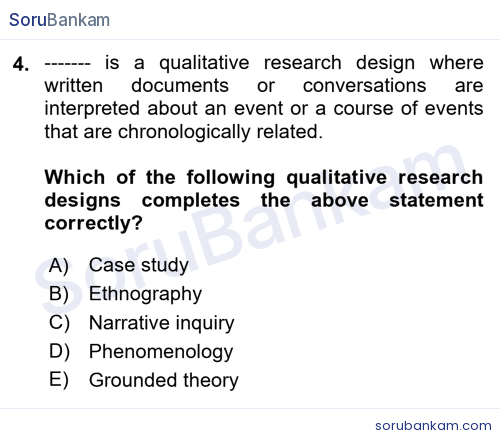
-- is a qualitative research design where written documents or conversations are interpreted about an event or a course of events that are chronologically related. Which of the following qualitative research designs completes the above statement correctly? A) Case study B) Ethnography C) Narrative inquiry D) S Phenomenology E) Grounded theory
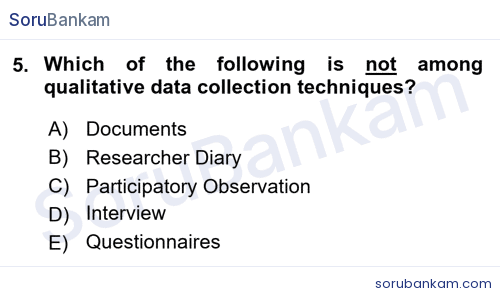
Which of the following is not among qualitative data collection techniques? A) Documents B) Researcher Diary C) Participatory Observation D) Interview E) Questionnaires
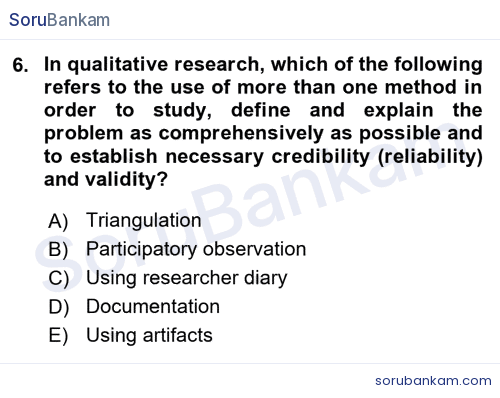
In qualitative research, which of the following refers to the use of more than one method in order to studyf define and explain the problem as torprehensively. as possible and to establish necessary credibility (reliability) and validity? A) Triangulation B) Participatory observationt' C) Using researcher diary D) • D) Documentation E) Using artifacts
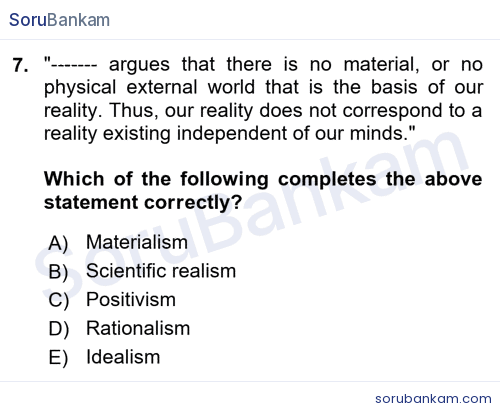
". argues that there is no material, or no physical external world that is the basis of our reality. Thus, our reality does not correspond to a reality existing independent of our minds." Which of the following completes the above statement correctly? A) Materialism B) Scientific realism C) Positivism D) Rationalism E) Idealism
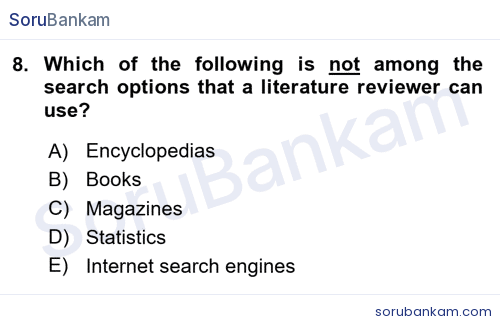
Which of the following is not among the search options that a literature reviewer can use? A) Encyclopedias B) Books C) Magazines D) Statistics E) Internet search engines
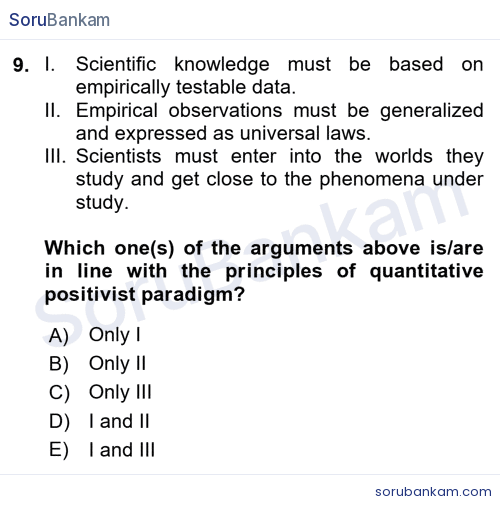
I. Scientific knowledge must be based on empirically testable data. I1. Empirical observations must be generalized and expressed as universal laws. III. Scientists must enter into the worlds they study and get close to the phenomena under study. Which one(s) of the arguments above is/are in line with the principles of quantitative positivist paradigm? A) Only ! B) Only C) Only !!! D) I and E) land i|l
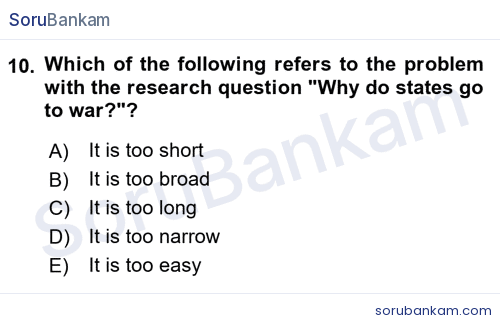
Which of the following refers to the problem with the research questlon "Why do states go to war?"? A) It is too short B) It is too broad C) It is too long D) It is too narrow E) It is too easy
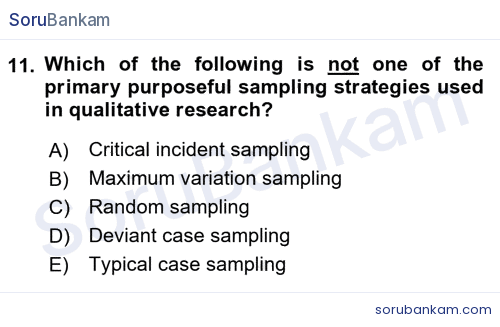
Which of the following is not one of fhe primary purposeful sampling strategies used in qualitative research? A) Critical incident sampling B) Maximum variation sampling C) Random sampling D) Deviant case sampling E) Typical case sampling
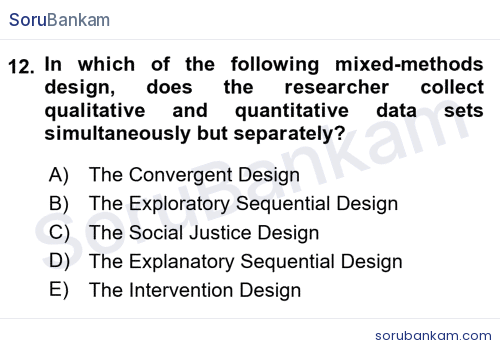
In which of the following mixed-methods design, does the researcher collect qualitative and quantitative data sets simultaneously but separately? A) The Convergent Design B) The Exploratory Sequential Design C) The Social Justice Design D) The Explanatory Sequential Design E) The Intervention Design
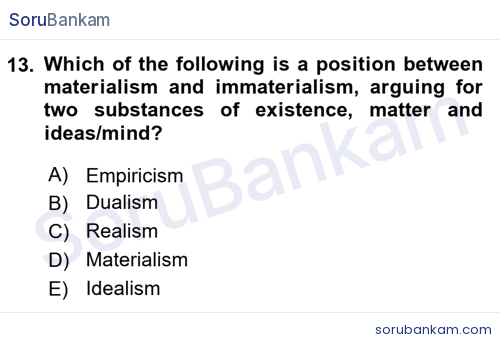
Which of the following is a position between materialism and immaterialism, arguing for two substances of existence, matter and ideas/mind? A) Empiricism B) Dualism C) Realism D) Materialism E) Idealism
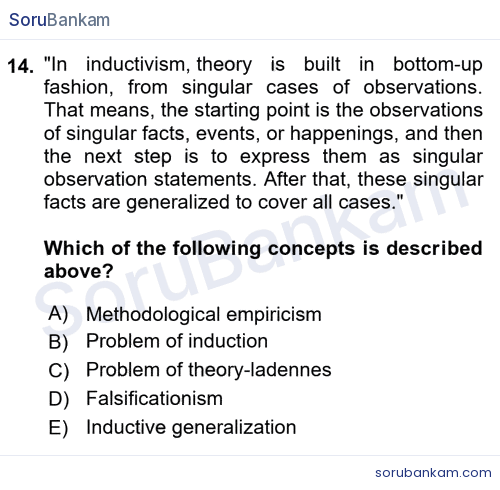
"In inductivism, theory is built in bottom-up fashion, from singular cases of observations. That means, the starting point is the observations of singular facts, events, or happenings, and then the next step is to express them as singular observation statements. After that, these singular facts are generalized to cover all cases," • Which of the following concepts is described above? A) Methodological empiricism B) Problem of induction C) Problem of theory-ladennes D) . Falsificationism E) *E) Inductive generalization
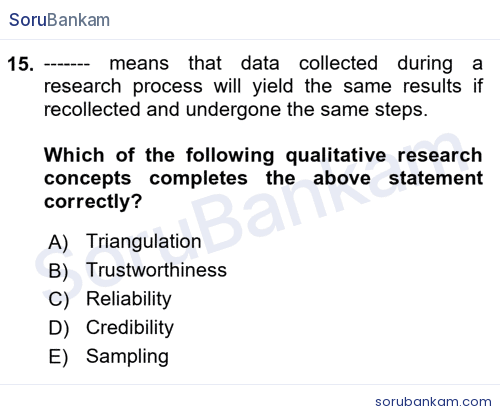
-- means that data collected during research process will yield the same results if recollected and undergone the same steps. Which of the following qualitative research concepts completes the above statement correctly? A) Triangulation B) Trustworthiness C) Reliability D) Credibility E) Sampling
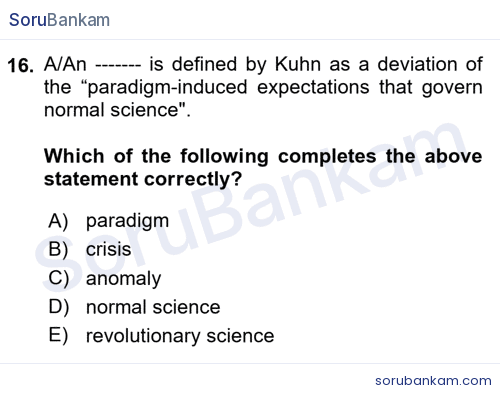
A/An is defined by Kuhn as a deviation of the "paradigm-induced expectations that govern normal science". Which of the following completes the above statement correctly? A) paradigm B) crisis C) anomaly D) normal science E) revolutionary science
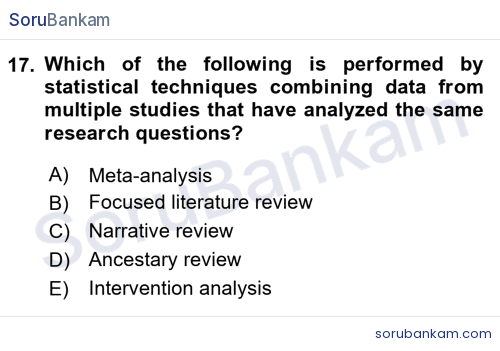
Which of the following is performed by statistical techniques combining data from multiple studies that have analyzed the same research questions? A) Meta-analysis B) Focused literature review C) Narrative review D) Ancestary review E) Intervention analysis
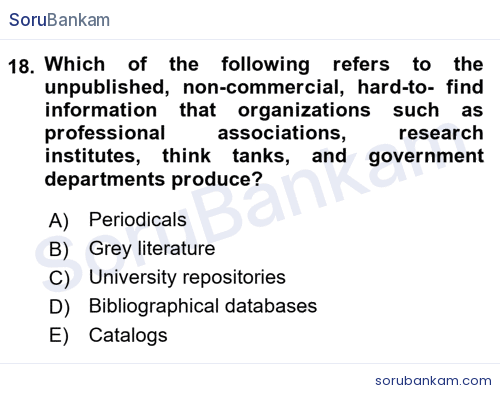
Which of the following refers to the unpublished, non-commercial, hard-to- find information that organizations such as professional associations, research institutes, think tanks, and government departments produce? A) Periodicals B) Grey literature C) University repositories D) Bibliographical databases E) Catalogs
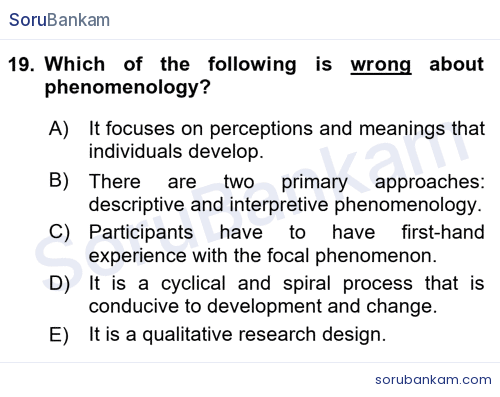
Which of the following is wrong about phenomenology? A) It focuses on perceptions and meanings that individuals develop. B) There are two primary approaches: descriptive and interpretive phenomenology. C) Participants have to have first-hand experience with the focal phenomenon. D) It is a cyclical and spiral process that is conducive to development and change. E) It is a qualitative research design.
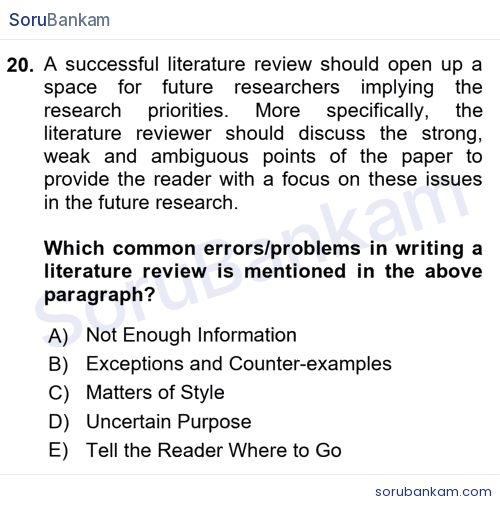
A successful literature review should open up a space for future researchers implying the research priorities. More specifically, the literature reviewer should discuss the strong, weak and ambiguous points of the paper to provide the reader with a focus on these issues. in the future research. Which common errors/problems in writing a literature review is mentioned in the above paragraph? A) Not Enough Information B) Exceptions and Counter examples C) Matters of Style D) Uncertain Purpose E) Tell the Reader Where to Goe