ULI106U Contemporary World Civilizations 2017-2018 Vize Soruları
20 soru · Vize · 2017-2018
ULI106U Contemporary World Civilizations dersinin 2017-2018 vize sınavı 20 sorudan oluşur; ders AÖF İktisat (İngilizce) bölümünde okutulur. Sorular aşağıda sırasıyla yer alır. Doğru cevaplar ve sonucun, testi çözdüğünde görünür.
Önizleme · 20 soru. Cevaplamak ve sonucunu görmek için sınavı başlat.
Sorular
20 soru
Soru 1
Soru 2
Soru 3
Soru 4
Soru 5
Soru 6
Soru 7
Soru 8
Soru 9
Soru 10
Soru 11
Soru 12
Soru 13
Soru 14
Soru 15
Soru 16
Soru 17
Soru 18
Soru 19
Soru 20
Sınav modunda süre tutulur, doğru cevaplar ve sonucun sınav bitince görünür.
Dersin üniteleri
Ünite özetleri ve konu anlatımları
- 1. Ünite: African Civilization
- 2. Ünite: The Chinese And Japanese Civilizations
- 3. Ünite: Hindu And Buddhist Civilizations
- 4. Ünite: The Western Civilization
- 5. Ünite: The Eastern Civilization
- 6. Ünite: The Islamic Civilization
- 7. Ünite: The Turkish Civilization
- 8. Ünite: Civilization İn The 21St. Century
ULI106U Contemporary World Civilizations ders sayfası: bütün sınavlar ve üniteler
Soruların metni (otomatik okuma)
Görsellerden otomatik okunmuştur; hata içerebilir. Sorular, görsellerdeki hâliyle geçerlidir.
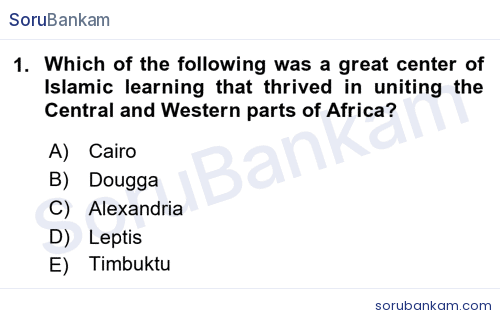
Which of the following was a great center of Islamic learning that thrived in uniting the Central and Western parts of Africa? A) Cairo B) Dougga C) Alexandria D) Leptis E) Timbuktu
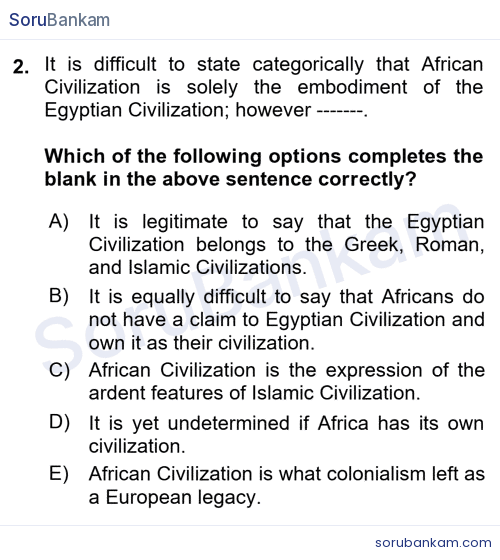
It is difficult to state categorically that African Civilization is solely the embodiment of the Egyptian Civilization; however .... Which of the following options completes the blank in the above sentence correctly? A) It is legitimate to say that the Egyptian Civilization belongs to the Greek, Roman, and Islamic Civilizations. B) It is equally difficult to say that Africans do not have a claim to Egyptian Civilization and own it as their civilization. ¿''' C) African Civilization is the expression of the ardent features of Islamic Civilization. D) It is yet undetermined if Africa has its own civilization. E) African Civilizátion is what colonialism left as a European legacy.
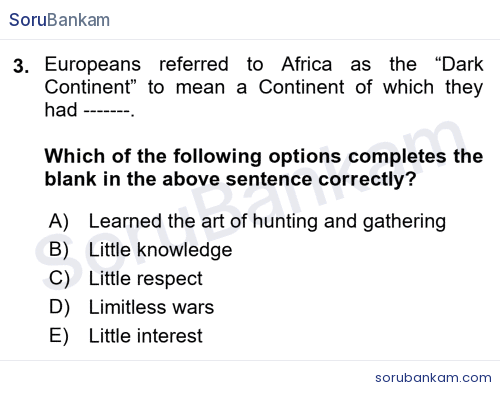
Europeans referred to Africa as the "Dark Continent" to mean a Continent of which they had ---. Which of the following options completes the blank in the above sentence correctly? A) Learned the art of hunting and gathering B) S Litte knowledge C) Little respect D) Limitless wars E) Little interest
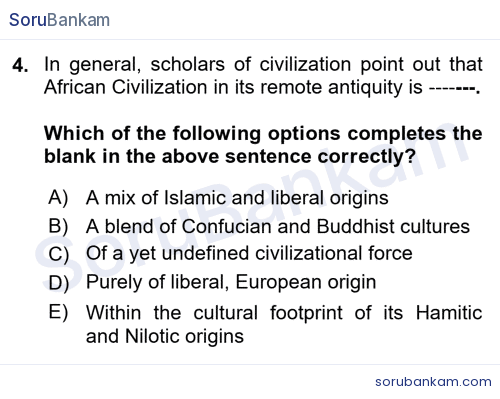
In general, scholars of civilization point out that African Civilization in its remote antiquity is ------. Which of the following options completes the blank in the above sentence correctly? A) A mix of Islamic and liberal origins B) A blend of Confucian and Buddhist cultures C) Of a yet undefined civilizational force D) Pürely of liberal, European origin E) Within the cultural footprint of its Hamitic and Nilotic origins
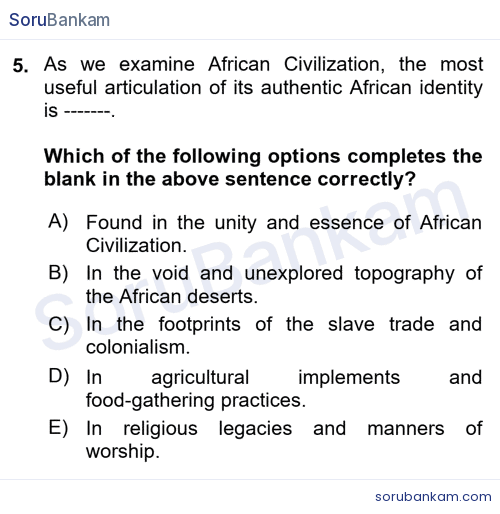
As we examine African Civilization, the most useful articulation of its authentic African identity Which of the following options completes the • i blank in the above sentence correctly? A) Found in the unity and essence of African Civilization. B) 2. In the void and unexplored topography of the African deserts. C) In the footprints of the slave trade and colonialism. D) In. agricultural implements and food-gathering practices. E) In religious legacies and manners of worship.
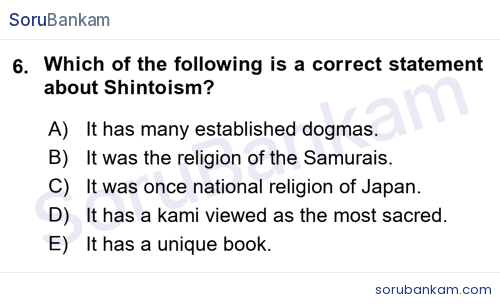
Which of the following is a correct statement A) about Shintoism? It has many established dogmas. B) It was the religion of the Samurais. C) It was once national religion of Japan. D) It has a kami viewed as the most sacred. E) It has a unique book.
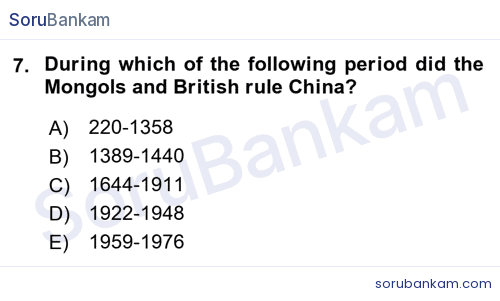
During which of the following period did the Mongols and British rule China? A) 220-1358 B) 1389-1440 C) 1644-1911 D) 1922-1948 E) 1959-1976
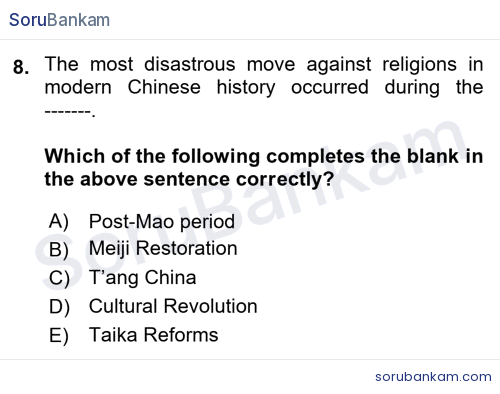
The most disastrous move against religions in modern Chinese history occurred during the ---- Which of the following completes the blank in the above sentence correctly? A) Post-Mao period B) Meiji Restoration C) Tang China D) Cultural Revolution E) Taika Reforms
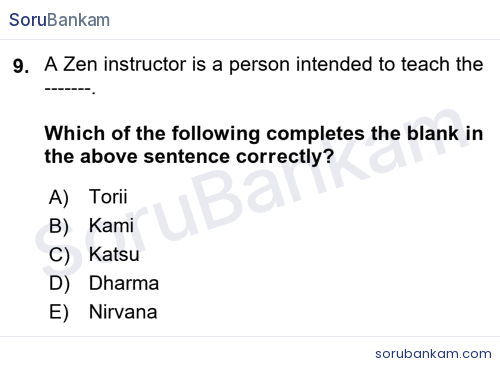
A Zen instructor is a person intended to teach the Which of the following completes the blank in the above sentence correctly? A) Tori ..!. B) Kami C) Katsu: D) Dharma E) Nirvana
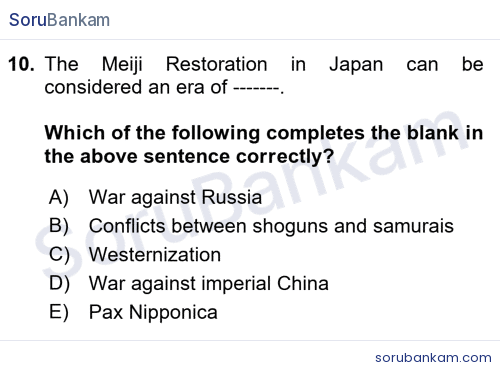
The Meiji Restoration in Japan can be considered an era of -.... Which of the following completes the blank in the above sentence correctly? A) War against Russia B) Conflicts between shoguns and samurais C) Westernization D) War against imperial China E) Pax Nipponica
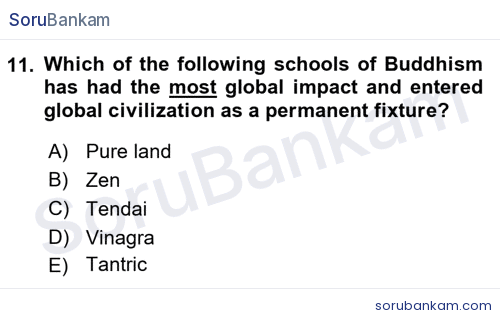
Which of the following schools of Buddhism has had the most global impact and entered global civilization as a permanent fixture? A) Pure land B) Zen C) Tendai ""'. D) Vinagra E) Tantric
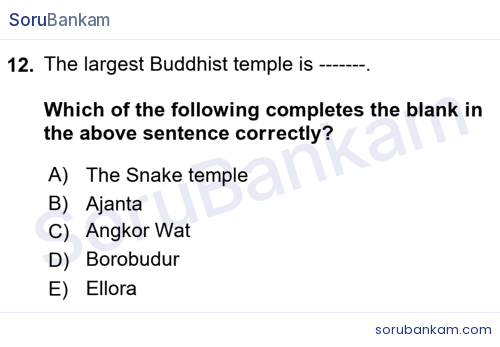
The largest Bust temples... Which of the following completes the blank in the abovę sentence correctly? A) The Snake temple B) Ajanta C) Angkor Wat i • D) Borobudur E) Ellora
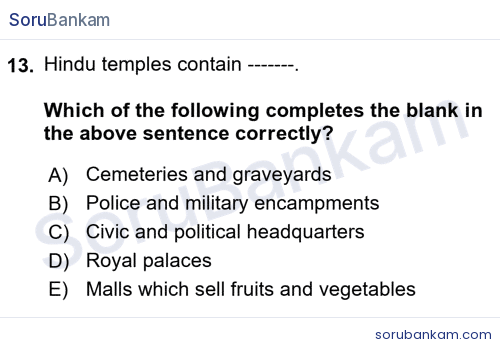
Hindu temples contain ----. Which of the following completes the blank in the above sentence correctly? A) Cemeteries and graveyards B) Police and military encampments C) Civic and political headquarters D) Royal palaces E) Malls which sell fruits and vegetables
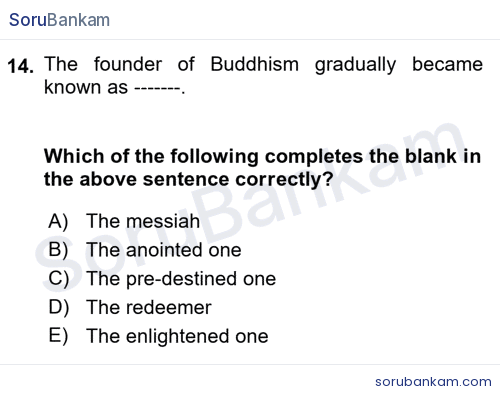
The founder of Buddhism gradually became known as ----.. Which of the following completes the blank in the above sentence correctly? A) The messiah B) The anointed one C) The pre-destined one D) The redeemer E) The enlightened one
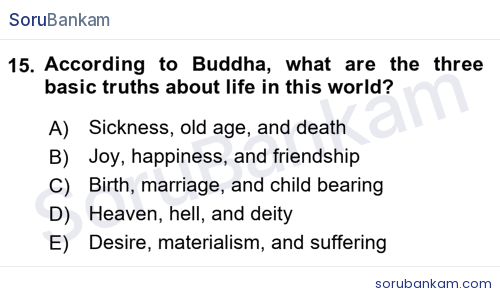
According to Buddha, what are the three basic truths about life in this world? A) Sickness, old age, and death B) Joy, happiness, and friendship C) Birth, marriage, and child bearing D) Heaven, hell, and deity E) Desire, materialism, and suffering
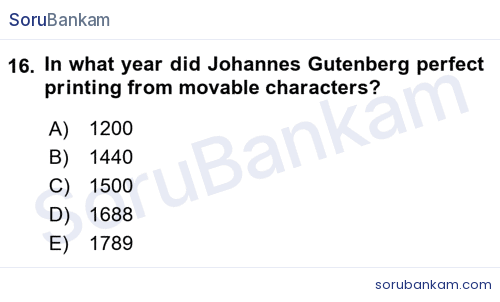
In what year did Johannes Gutenberg perfect printing from movable characters? A) 1200 B) 1440 C) 1500 D) 1688 E) 1789
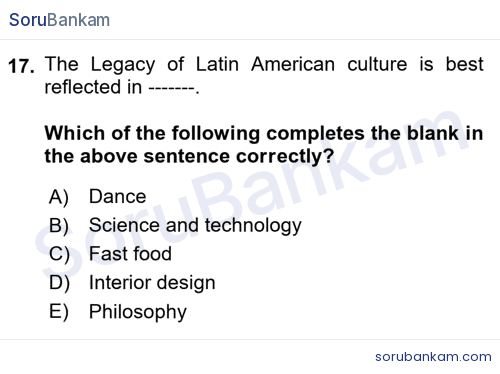
The Legacy of Latin American culture is best reflected in -- Which of the following completes the blank in the above sentence correctly? A) Dance B) Science and technology C) Fast food D) Interior design E) 'E) Philosophy
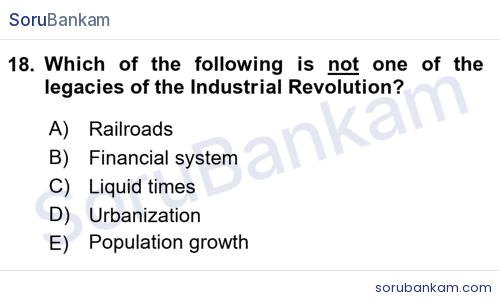
Which of the following is not one of the legacies of the Industrial Revolution? A) Railroads B) Financial system C) Liquid times D) Urbanization E) Population growth
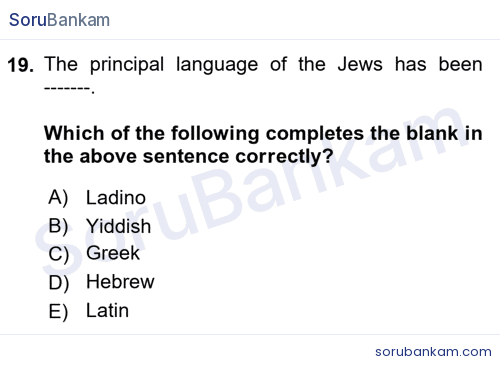
The principal language of the Jews has been -----. Which of the following completes the blank in the above sentence correctly? A) Ladino B) Yiddish "''' C) Greek D) Hebrew E) Latin
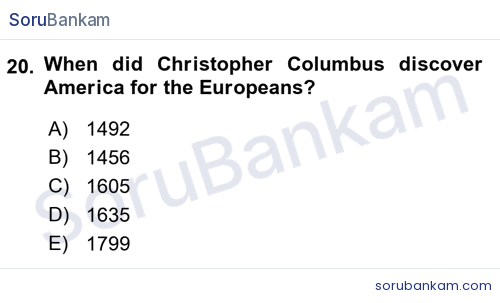
When did Christopher Columbus discover America for the Europeans? A) 1492 B) 1456 C) 1605 D) 1635 E) 1799