ULI106U Contemporary World Civilizations 2024-2025 Vize Soruları
20 soru · Vize · 2024-2025
ULI106U Contemporary World Civilizations dersinin 2024-2025 vize sınavı 20 sorudan oluşur; ders AÖF İktisat (İngilizce) bölümünde okutulur. Sorular aşağıda sırasıyla yer alır. Doğru cevaplar ve sonucun, testi çözdüğünde görünür.
Önizleme · 20 soru. Cevaplamak ve sonucunu görmek için sınavı başlat.
Sorular
20 soru
Soru 1
Soru 2
Soru 3
Soru 4
Soru 5
Soru 6
Soru 7
Soru 8
Soru 9
Soru 10
Soru 11
Soru 12
Soru 13
Soru 14
Soru 15
Soru 16
Soru 17
Soru 18
Soru 19
Soru 20
Sınav modunda süre tutulur, doğru cevaplar ve sonucun sınav bitince görünür.
Dersin üniteleri
Ünite özetleri ve konu anlatımları
- 1. Ünite: African Civilization
- 2. Ünite: The Chinese And Japanese Civilizations
- 3. Ünite: Hindu And Buddhist Civilizations
- 4. Ünite: The Western Civilization
- 5. Ünite: The Eastern Civilization
- 6. Ünite: The Islamic Civilization
- 7. Ünite: The Turkish Civilization
- 8. Ünite: Civilization İn The 21St. Century
ULI106U Contemporary World Civilizations ders sayfası: bütün sınavlar ve üniteler
Soruların metni (otomatik okuma)
Görsellerden otomatik okunmuştur; hata içerebilir. Sorular, görsellerdeki hâliyle geçerlidir.
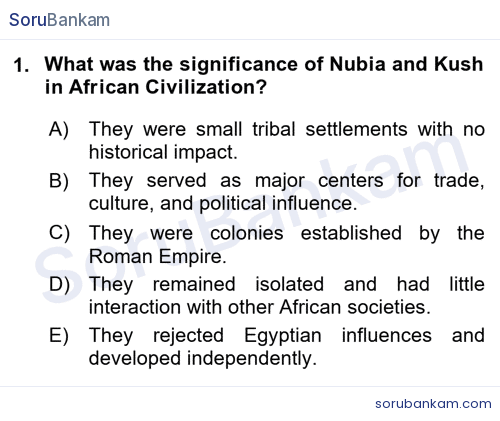
What was the significance of Nubia and Kush in African Civilization? A) They were small tribal settlements with no historical impact. B) They served as major centers for trade, culture, and political influence. C) They were colonies established by the Roman Empire. D) They remained isolated and had little interaction with other African societies. E) They rejected Egyptian influences and developed independently.
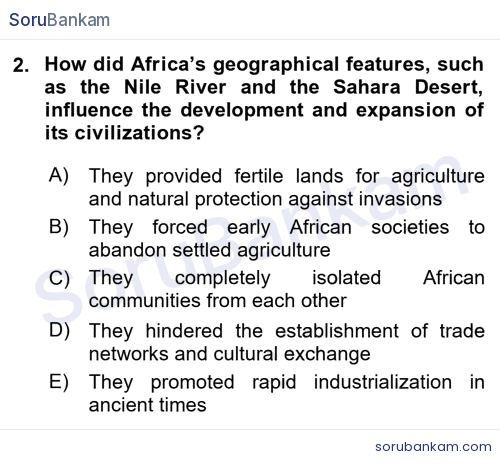
How did Africa's geographical features, such as the Nile River and the Sahara Desert, influence the development and expansion of its civilizations? A) They provided fertile lands for agriculture and natural protection against invasions'* B) They forced early African ‹societies to abandon settled agriculture C) They completely isolated African communities from each other D) They hindered the establishment of trade networks and cultural exchange E) They promoted rapid industrialization in. ancient times
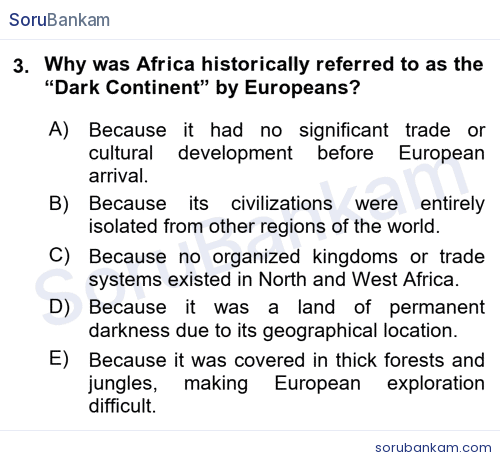
Why was Africa historically referred to as the "Dark Continent" by Europeans? A) Because it had no significant trade or cultural development before European arnval. B) Because its civilizations were entirely isolated from other regions of the world. C) Because no organized kingdoms or trade systems existed in North and West Africa. D) Because it was a land of permanent darkness due to its geographical location. E) Because it was covered in thick forests and jungles, making European exploration difficult.
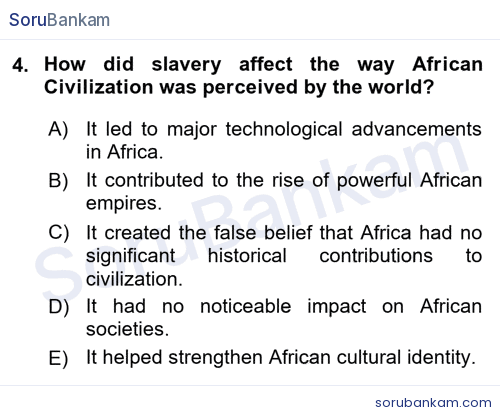
How did slavery affect the way African Civilization was perceived by the world? A) It led to major technological advancements in Africa. B) It contributed to the rise of powerful Africal empires. C) It created the false belief that Africa had no significant historical contributions to civilization. D) It had no noticeable impact on African societies. E) It helped strengthen African cultural identity.
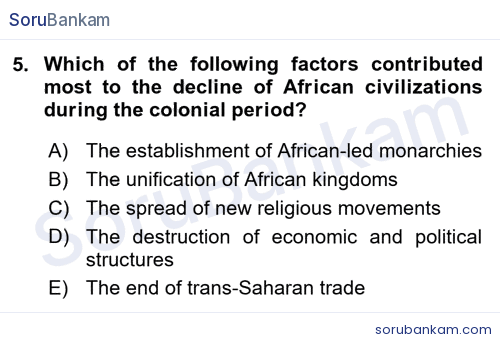
Which of the following factors contributed most to the decline of African civilizations during the colonial period? A) The establishment of African-led monarchies B) • The unification of African kingdoms C) The spread of new religious movements D) The destruction of economic and political structures E) The end of trans-Saharan trade
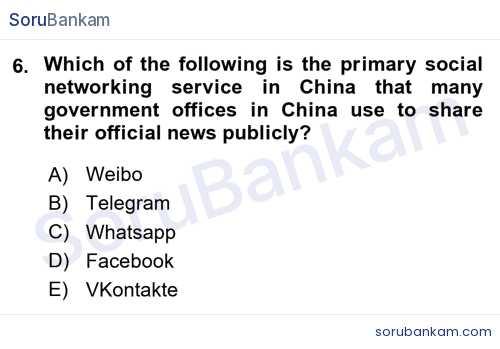
Which of the following is the primary social. networking service in China that many government offices in China use to share their official news publicly? A) Weibo B) Telegram C) Whatsapp D) Facebook E) VKontakte
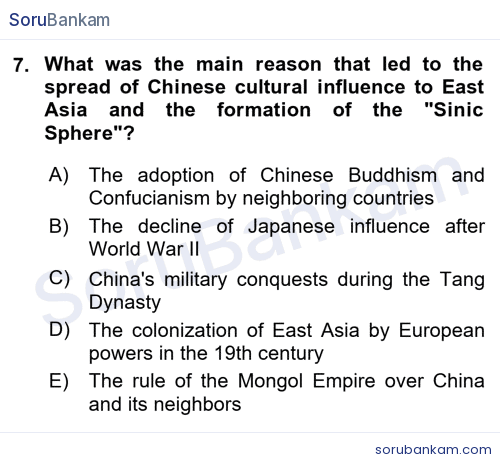
What was the main reason that led to the spread of Chinese cultural influence to East Asia and the formation of the "Sinic Sphere"? A) The adoption of Chinese Buddhism and Confucianism by neighboring countries B) The decline of Japanese influence after World War C) China's military conquests during the Tang Dynasty D) The colonization of East Asia by European powers in the 19th century E) The rule of the Mongol Empire over China and its neighbors
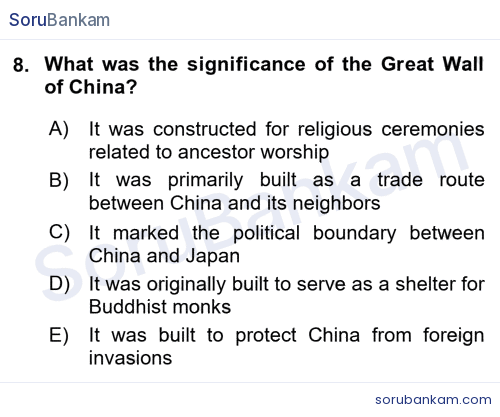
8. What was the significance of the Great wail of China? A) It was constructed for religious ceremonies related to ancestor worship B) It was primanly built as a trade route between China and its neighbors It marked the political boundary between China and Japan D) It was originally built to serve as a shelter, for . Buddhist monks It was built, to protect China from foreign invasions
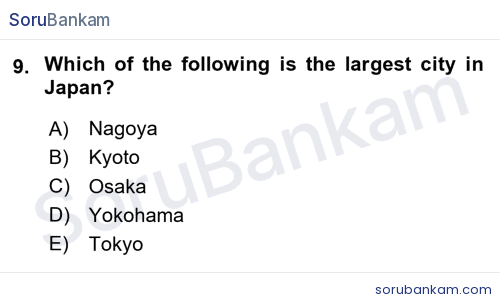
Which of the following is the largest city in Japan? A) Nagoya B) Kyoto C) Osaka D) Yokohama E) Tokyo
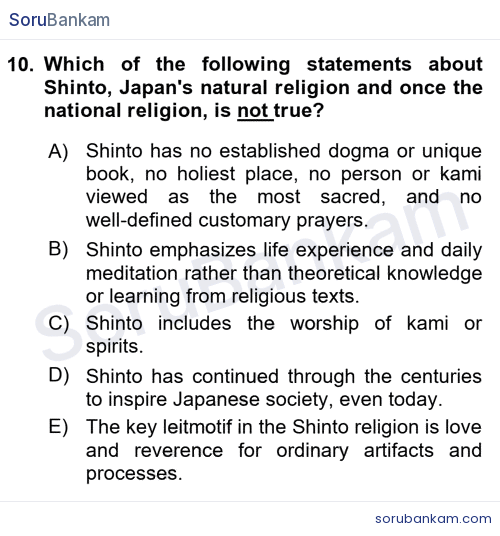
Which of the following statements about Shinto, Japan's natural rellgion and once the national religion, is not true? A) Shinto has no established dogma or unique book, no holiest place, no person or kami. viewed as the most sacred, and ho well-defined customary prayers: B) Shinto emphasizes life experience and daily meditation rather than theoretical knowledge or learning from religious texts. C) Shinto includes the worship of kami or spirits. D) Shinto has continued through the centuries to inspire Japanese society, even today. E) The key leitmotif in the Shinto religion is love and reverence for ordinary, artifacts and processes.
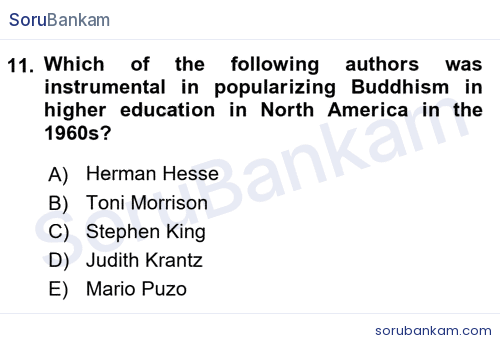
Which of the following authors was instrumental in popularizing Buddhism in higher education in North America in the 1960s? A) • Herman Hesse B) Toni Mornson C) Stephen King D) Judith Krantz E) Mario Puzo
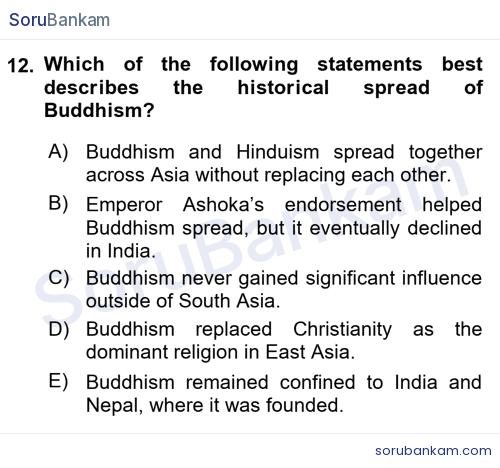
Which of the following statements best describes the historical spread of Buddhism? A) Buddhism and Hinduism spread together across Asia without replacing each other. B) Emperor Ashoka's endorsement helped Buddhism spread, but it eventually declined in India. C) Buddhism never gained significant influence outside of South Asia. D) Buddhism replaced Christianity as the dominant religion in East Asia. E) Buddhism remained confined to India and Nepal, where it was founded.
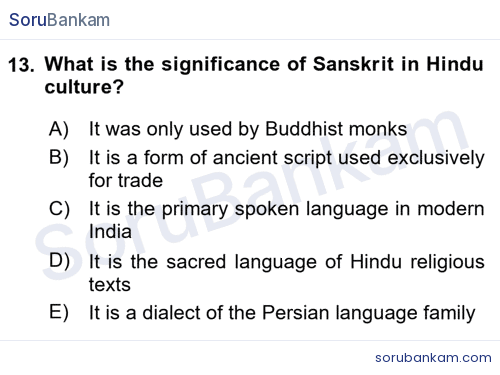
13. What is the significance of Sanskrit in Hindu culture? A) It was only used by Buddhist monks It is a form of ancient script used exclusively for trade C) It is the primary spoken language in modern India D) It is the sacred language of Hindu religious texts E) It is a dialect of the Persian language family
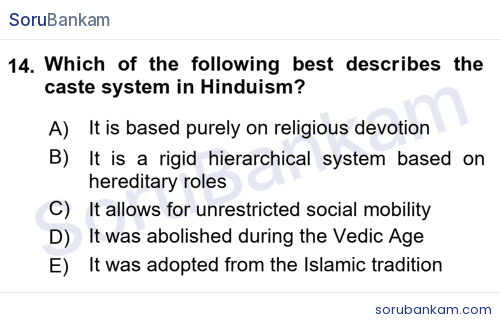
14. Which of the following best describes the caste system in Hinduism? A) It is based purely on religious devotion It is a rigid hierarchical system based on hereditary roles C) It allows for unrestricted social mobility D) It was abolished during the Vedic Age It was adopted from the Islamic tradition
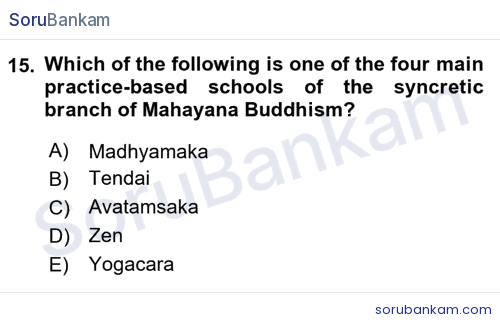
Which of the following is one of the four main practice-based schools of the syncretic branch of Mahayana Buddhism? * A) Madhyamaka B) Tendai C) Avatamsaka D) Zen E) Yogacara
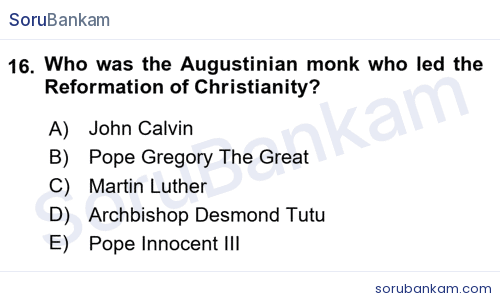
Who was the Augustinian monk who led the Reformation of Christianity? A) John Calvin B) Pope Gregory The Great C) Martin Luther D) Archbishop Desmond Tutu E) Pope innocent III
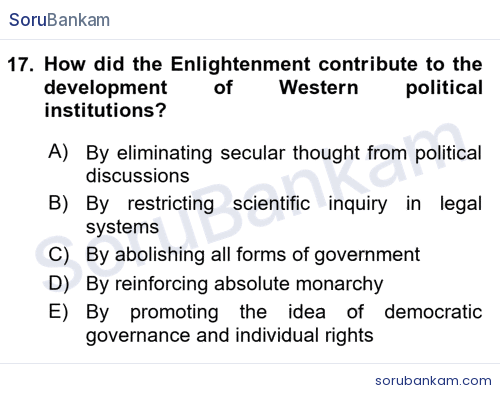
How did the Enlightenment contribute to the development Western political institutions? A) By eflminating secular thought from political discussions B) By restricting scientific inquiry in' legal systems C) By abolishing all forms of govemment D) By reinforcing absolute monarchy E) By promoting the idea of democratic governance and individual rights
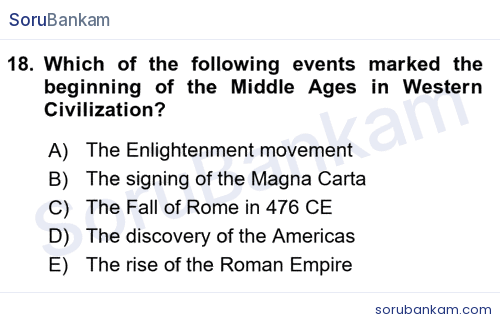
Which of the following events marked the beginning of the Middle Ages in Western Civilization? r!. i c. A) The Enlightenment movement B) - B) The signing of the Magna Carta C) The Fall of Rome in 476 D) The discovery of the Americas E) Thé rise of the Roman Empire
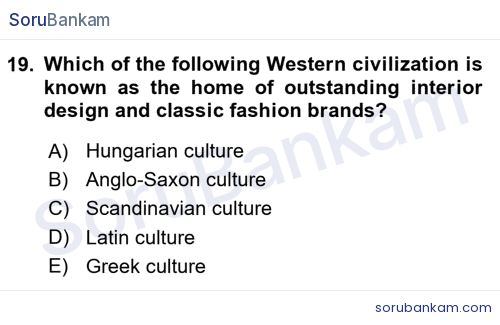
Which of the following Western civilization is known as the home of outstanding Interior design and classic fashion brands? A) Hungarian culture B) Anglo-Saxon culture C) Scandinavian culture D) Latin culture E) Greek culture
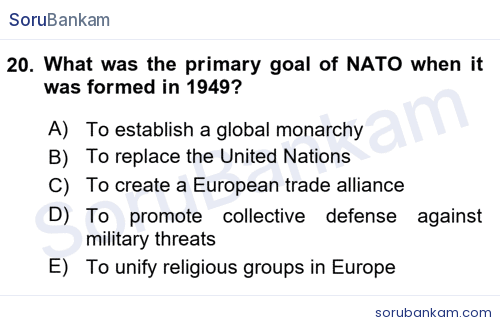
What was the primary goal of NATO when it was formed in 1949? A) To establish a global monarchy B) To replace the United Nations C) To create a European trade alliance D) To promote collective defense against military threats E) To unity religious groups in Europe