ISL113U Introduction to Business 2018-2019 Vize Soruları
20 soru · Vize · 2018-2019
ISL113U Introduction to Business dersinin 2018-2019 vize sınavı 20 sorudan oluşur; ders AÖF İktisat (İngilizce) bölümünde okutulur. Sorular aşağıda sırasıyla yer alır. Doğru cevaplar ve sonucun, testi çözdüğünde görünür.
Önizleme · 20 soru. Cevaplamak ve sonucunu görmek için sınavı başlat.
Sorular
20 soru
Soru 1
Soru 2
Soru 3
Soru 4
Soru 5
Soru 6
Soru 7
Soru 8
Soru 9
Soru 10
Soru 11
Soru 12
Soru 13
Soru 14
Soru 15
Soru 16
Soru 17
Soru 18
Soru 19
Soru 20
Sınav modunda süre tutulur, doğru cevaplar ve sonucun sınav bitince görünür.
Dersin üniteleri
Ünite özetleri ve konu anlatımları
- 1. Ünite: Foundations Of Business
- 2. Ünite: Business İn The Global Context
- 3. Ünite: Management
- 4. Ünite: Managing Human Resources
- 5. Ünite: Marketing Management
- 6. Ünite: Production Management And Managing Information Systems
- 7. Ünite: Accounting And Financial Analysis
- 8. Ünite: Managing Financial Resources
ISL113U Introduction to Business ders sayfası: bütün sınavlar ve üniteler
Soruların metni (otomatik okuma)
Görsellerden otomatik okunmuştur; hata içerebilir. Sorular, görsellerdeki hâliyle geçerlidir.
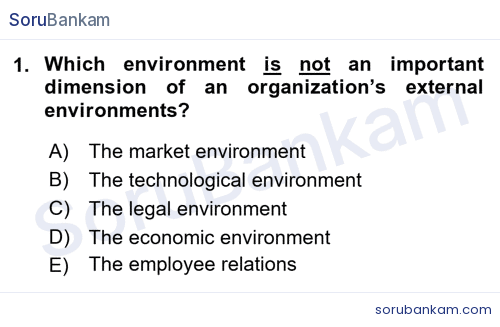
Which environment is not an important dimension of an organization's external environments? A) The market environment B) The technological environment C) The legal environment D) The economic environment E) The employee relations
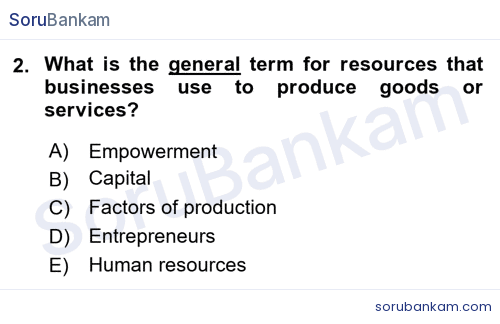
What is the general term for resources that businesses use to produce goods or services? A) Empowerment B) Capital C) Factors of production D) Entrepreneurs E) Human resources
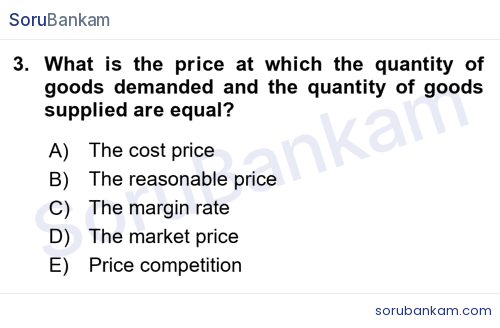
What is the price at which the quantity of goods demanded and the quantity of goods supplied are equal? 1 - A) The cost price B) The reasonable price C) The margin rate , D) The market price E) Price competition 1'
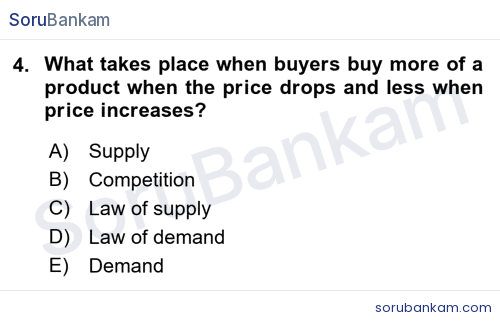
What takes place when buyers buy more of a product when the price drops and less when price increases? A) Supply B) Competition C) Law of supply D) E Law of demand E) Demand
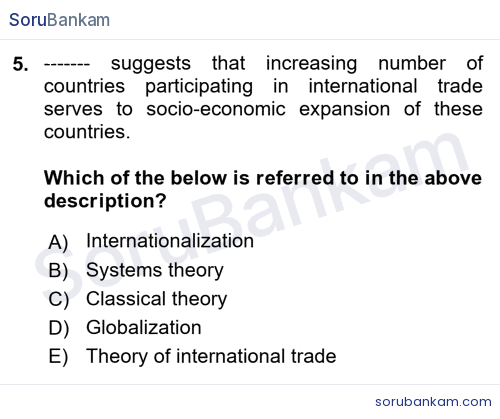
suggests that increasing number of countries participating in international trade serves to socio-economic expansion of these countries. Which of the below is referred to in the above description? A) Internationalization B) Systems theory C) Classical theory D) Globalization E) Theory of international trade
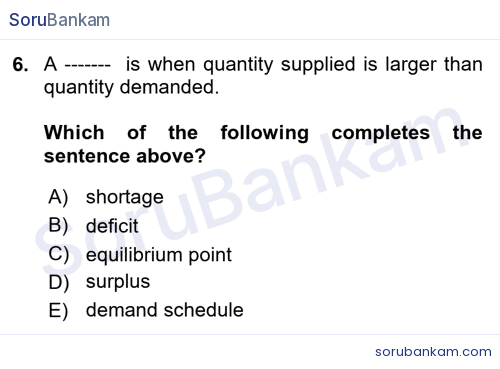
A - is when quantity supplied is larger than quantity demanded Which of the following completes the sentence above? A) shortage B) deficit C) equilibrium point D) . surplus E) "E) demand schedule
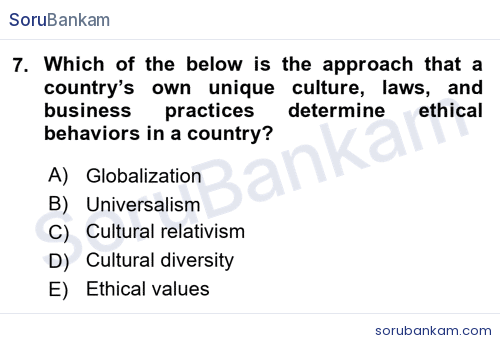
Which of the below is the approach that a country's own unique culture, laws, and business practices determine ethical behaviors in a country? A) Globalization B) Universalism C) Cultural relativism D) Cultural diversity E) Ethical values
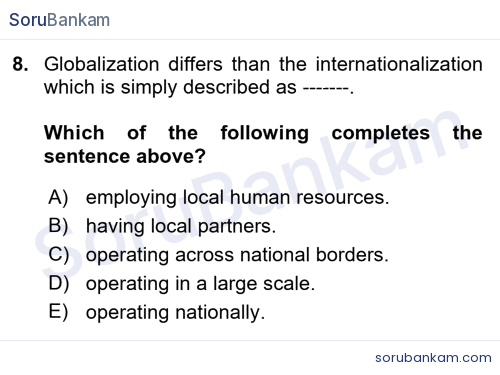
Globalization differs than the internationalization which is simply described as-....-. Which of the following completes the senterice above? A) employing local human resources. B) having local partners. C) operating across national borders. D) operating in a large scale. E) operating nationally.
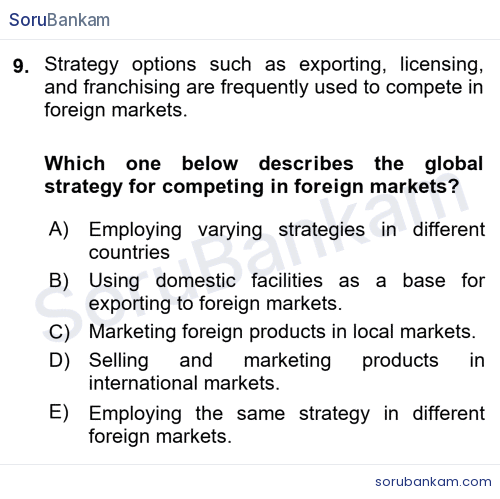
9. Strategy options such as exporting, licensing, and franchising are frequently used to compete in foreign markets. Which one below describes the global strategy for competing in foreign markets? A) Employing varying strategies in different countries B) Using domestic facilities as a base for exporting to foreign markets. C) Marketing foreign products in local markets. D) Selling and marketing products in international markets. Employing the same strategy in different foreign markets.
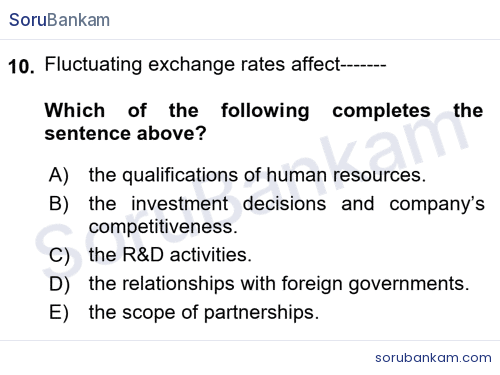
Fluctuating exchange rates affect--- Which of the following completes the sentence above? A) the qualifications of human resources. B) the investment decisions and company's competitiveness. C) the R&D activities. D) the relationships with foreign governments. E) the scope of partnerships.
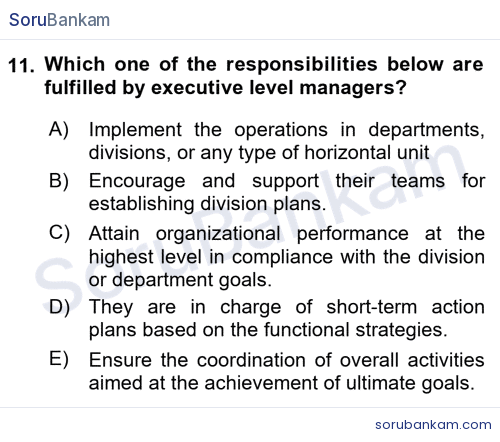
Which one of the responsibilities below are fulfilled by executive level managers? A) Implement the operations in departments, divisions, or any type of horizontal unit B) Encourage and support their teams. for establishing division plans. C) Attain organizational performance at the highest level in compliance with the division or department goals. D) They are in charge of short-term action plans based on the functional strategies. E) Ensure the coordination of overall activities aimed at the achievement of ultimate goals.
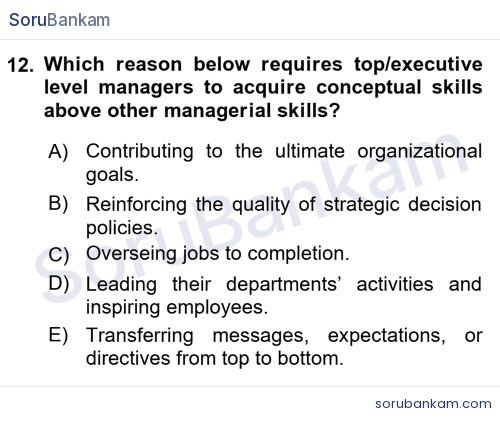
Which reason below requires top/executive level managers to acquire conceptual skills above other managerial skills? A) Contributing to the ultimate organizational goals. B) Reinforcing the quality of strategic decision policies. C) Overseing jobs to complation. D) Leading their departments' activities and inspiring employees. E) Transferring messages, expectations, or directives from top to bottom.
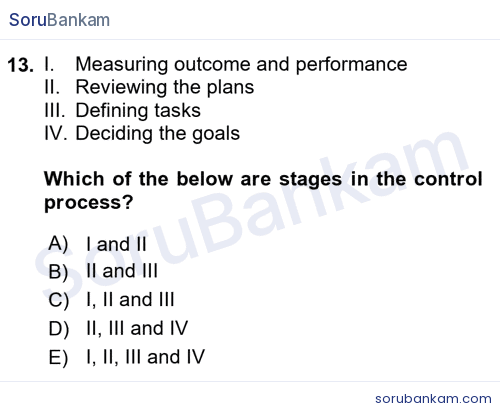
I. Measuring outcome and performance II. Reviewing the plans III. Defining tasks IV. Deciding the goals , Which of the below are stages in the control process? A) I and II. B) Iland III C) vc" i, ll and Ill D) II, Ill and E) I, Il, Ill and
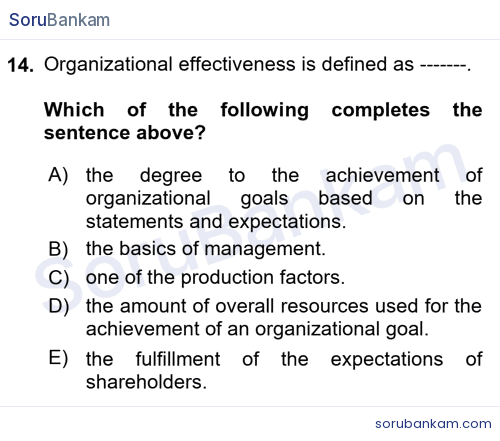
Organizational effectiveness is defined as... Which of the following completes the sentence above? A) the degree to the achievement of organizational goals based statements and expectations. B) the basics of management. C) one of the production factors. D) the amount of overall resources used for the achievement of an organizational goal. E) the fulfillment of the expectations of shareholders.
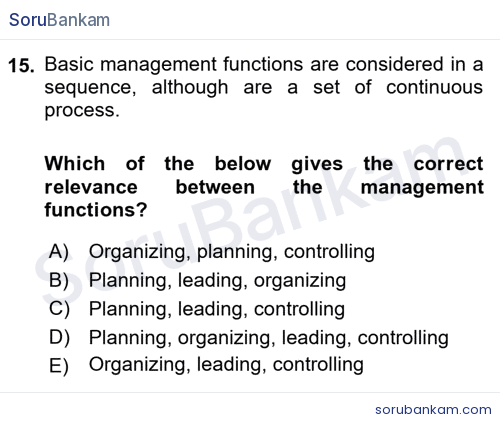
Basic management functions are considered in a sequence, although are a set of continuous process. Which of the below gives the correct relevance between the management functions? A) Organizing, planning, controlling B) Planning, leading, organizing C) Planning, leading, controlling D) Planning, organizing, leading, controlling E) Organizing, leading, controlling
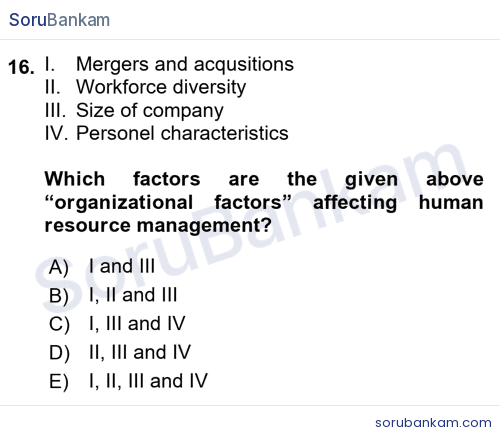
I. Mergers and acqusitions II. Workforce diversity III. Size of company IV. Personel characteristics Which factors are the given above' "organizational factors" affecting human resource management? A) I and Ill B) 1, Il and I|l C) 1, Ill and D) II, Ill and IV. ' E) I, li, Ill and
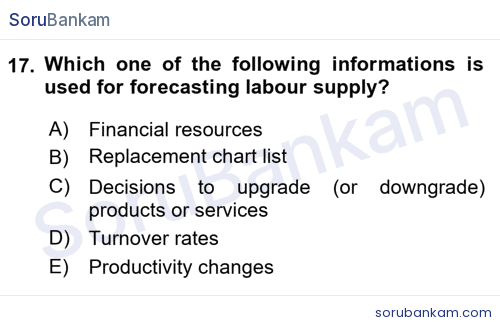
Which one of the following informations is used for forecasting labour supply? A) Financial resources B) Replacement chart list C) Decisions to upgrade (or downgrade) products or services D) Turnover rates E) Productivity changes
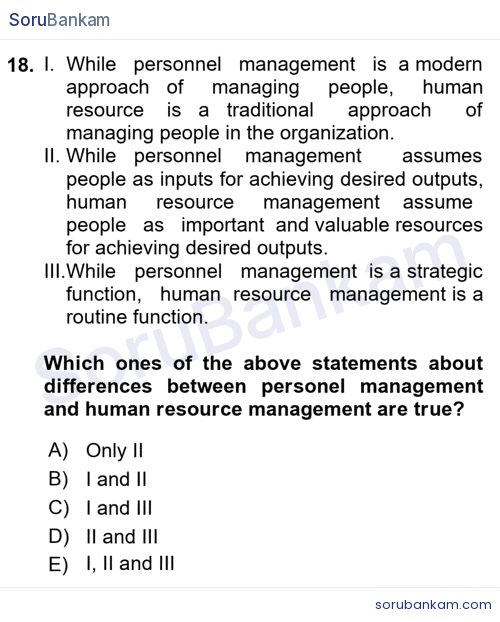
I. While personnel management is a modem approach of managing people, human resource is a traditional approach of managing people in the organization. II. While personnel management assumes people as inputs for achieving desired outputs, human resource management assume people as important and valuable resources for achieving desired outputs. III. While personnel management is a strategic function, human resource management is a routine function. Which ones of the above statements about differences between personel management and human resource management are true? A) Only B) land!! " C) I and Ill D) Il and Ill E) I, Il and ill
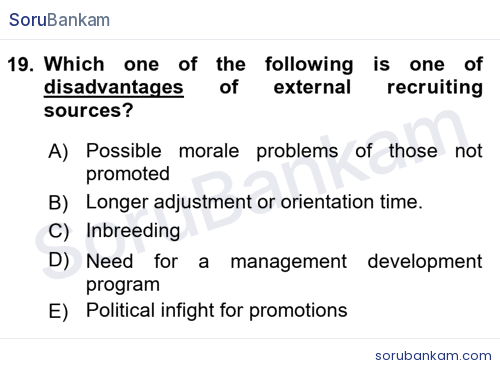
Which one of the following is one • of disadvantages external recruiting sources? A) Possible morale problems of those not promoted B) Longer adjustment or onentation time. C) Inbreeding D) Need for a management development program E) Political infight for promotions
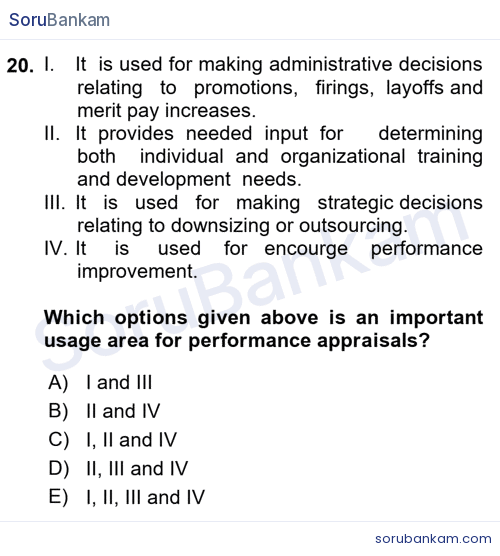
I. It is used for making administrative decisions relating to promotions, firings, layoffs and merit pay increases. II. It provides needed input for determining both individual and organizational training and development needs. III. It is used for making strategic decisions relating to downsizing or outsourcing. IV. It is used for encourge performance improvement. Which options given above Is an Important usage area for performance appraisals? A) I and IIT B) II and C) 1, Il and D) II, Ill and E) I, Il, Ill and