ULI458U Global South And Emerging Powers 2024-2025 Vize Soruları
20 soru · Vize · 2024-2025
ULI458U Global South And Emerging Powers dersinin 2024-2025 vize sınavı 20 sorudan oluşur; ders AÖF Uluslararası İlişkiler (İngilizce) bölümünde okutulur. Sorular aşağıda sırasıyla yer alır. Doğru cevaplar ve sonucun, testi çözdüğünde görünür.
Önizleme · 20 soru. Cevaplamak ve sonucunu görmek için sınavı başlat.
Sorular
20 soru
Soru 1
Soru 2
Soru 3
Soru 4
Soru 5
Soru 6
Soru 7
Soru 8
Soru 9
Soru 10
Soru 11
Soru 12
Soru 13
Soru 14
Soru 15
Soru 16
Soru 17
Soru 18
Soru 19
Soru 20
Sınav modunda süre tutulur, doğru cevaplar ve sonucun sınav bitince görünür.
Dersin üniteleri
ULI458U Global South And Emerging Powers ders sayfası: bütün sınavlar ve üniteler
Soruların metni (otomatik okuma)
Görsellerden otomatik okunmuştur; hata içerebilir. Sorular, görsellerdeki hâliyle geçerlidir.
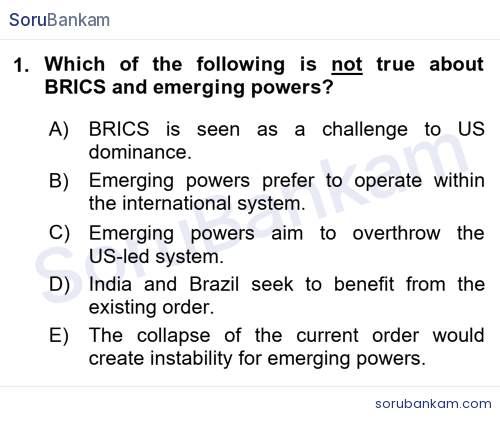
1. Which of the following is not true about BRICS and emerging powers? A) BRICS is seen as a challenge to US dominance. Emerging powers prefer to operate within the international system. C) Emerging powers aim to overthrow the US-led system. D) India and Brazil seek to benefit from the existing order. E) The collapse of the current order would create instability for emerging powers.
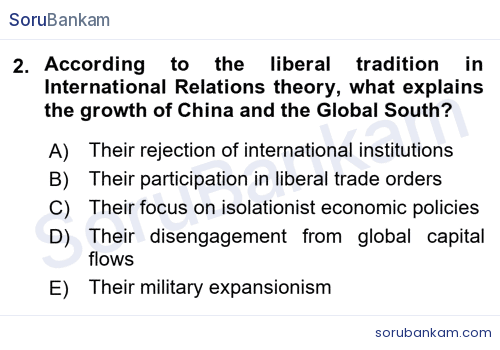
According to the liberai tradition International Relations theory, what explains the growth of China and the Globai South? A) Their rejection of international institutions B) Their participation in liberal trade orders. C) Their focus on isolationist economic policies D) Their disengagement from global capital flows E) Their military expansionism
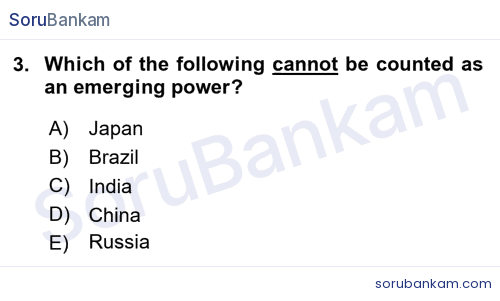
Which of the following cannot be counted as an emerging power? A) Japan. B) Brazil C) India D) China 15%, E) Russia
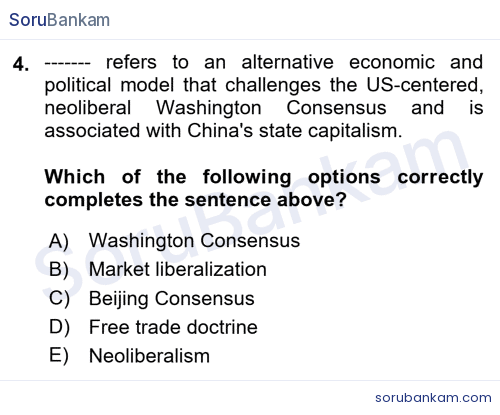
- refers to an alternative economic and political model that challenges the US-centered, neoliberal Washington Consensus and is associated with China's state capitalism. Which of the following options correctly completes the sentence above? A) Washington Consensus B) Market liberalization C) Beijing Consensus D) Free trade doctrine E) Neoliberalism
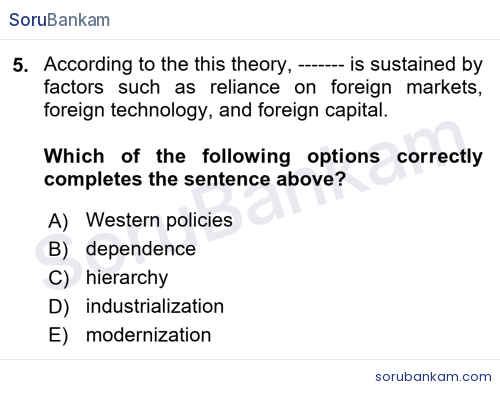
According to the this theory, +- is sustained by factors such as reliance on foreign markets, foreign technology, and foreign capital. Which of the following options correctly completes the sentence above? A) Westem policies B) dependence C) hierarchy D) industrialization E) modernization
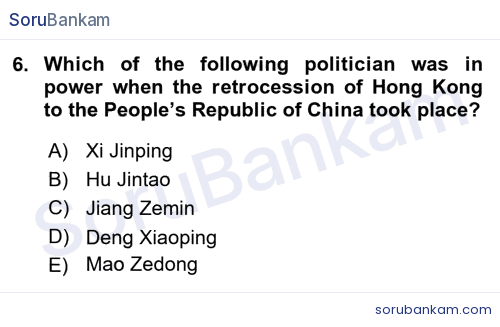
Which of the following politician was in power when the retrocession of Hong Kong to the People's Republic of Chinatook place? A) Xi Jinping B) "B) Hu Jintao C) Jiang Zemin D) Deng Xiaoping E) MabZedong
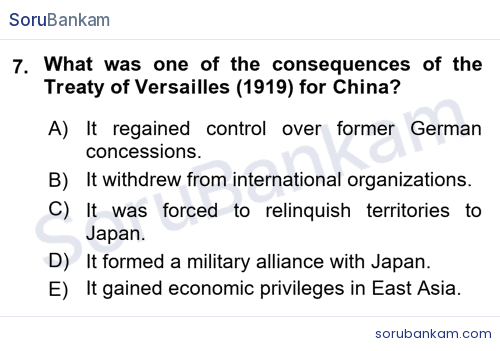
7. What was one of the consequences of the Treaty of Versailles (1919) for China? A) It regained control over former German concessions. B) It withdrew from international organizations. It was forced to relinquish territories to Japan. D) It formed a military alliance with Japan. E) It gained economic privileges in East Asia.
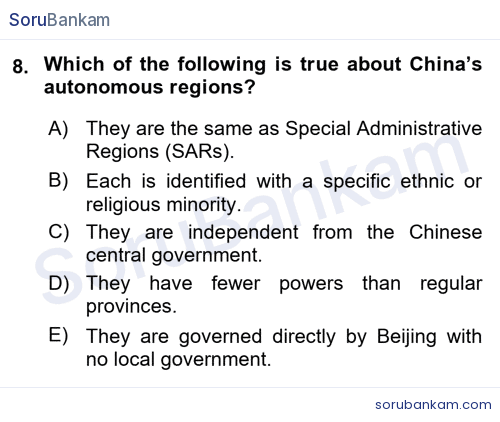
Which of the following is true about China's autonomous regions? A) They are the same as Special Administrative Regions (SARs). B) Each is identified with a specific ethnic or religious minority. C) They are independent from the Chinese central government. D) They have fewer powers than regular provinces. E) They are governed directly by Beijing with no local government.
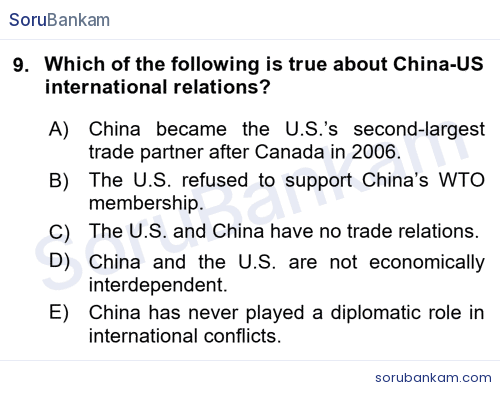
9. Which of the following is true about China-US international relations? A) China became the U.S.'s second-largest trade partner after Canada in 2006. B) The U.S. refused to support China's WTO membership. C) The U.S. and China have no trade relations. D) China and the U.S. are not economically interdependent. China has never played a diplomatic rote in international conflicts.
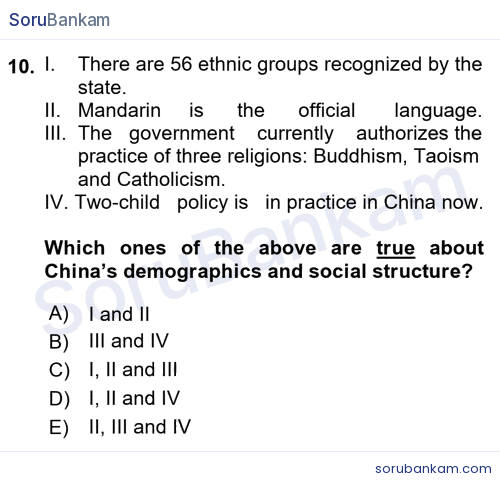
I. There are 56 ethnic groups recognized by ther state. II. Mandarin is the official language. III. The government currently authorizes the practice of three religions: Buddhism, Taoism and Catholicism. IV. Two-child policy is in practice in Chirta row. Which ones of the abova-aré true about China's demographics and social structure? A) I and B) I and C) 1, Il andyit D) I, Il and E) II, Ill and
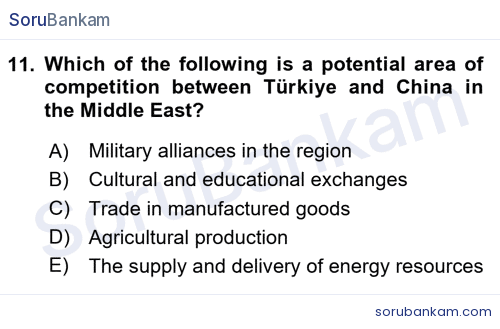
Which of the following is a potential area of competition between Türkiye and China in the Middle East? A) Military alliances in the region B) Cultural and educational exchanges C) Trade in manufactured goods D) Agricultural production E) The supply and delivery of energy resources
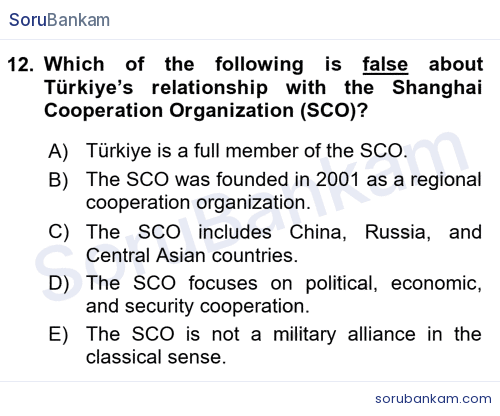
Which of the following is false about Türkiye's relationship with the Shanghai Cooperation Organization (SCO)? A) Türkiye is a full member of the SCO. B) The SCO was founded in 2001 as a regionah cooperation organization. C) The SCO includes China, Russia, and Central Asian countries. D) The SCO focuses on political, economic, and security cooperation. E) The SCO is not a military alliance in the classical sense. •
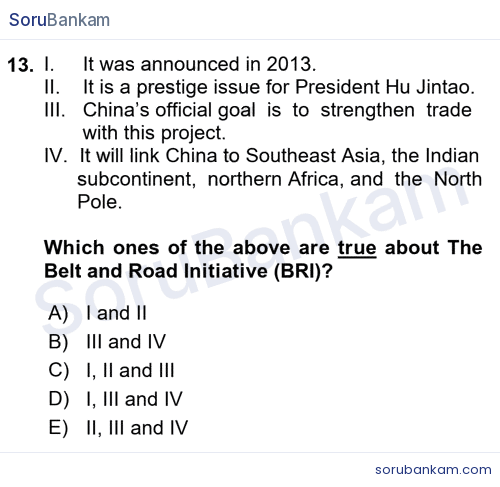
1. It was announced in 2013. II. It is a prestige issue for President Hu Jintao. Ili. China's official goal is to strengthen trade with us project. IV. It wil link China to Southeast Asia, the Indian subcontinent, northern Africa, and the North Pole. Which ones of the above are true about The Belt aud Road Initiative (BRI)? A) I and B) Ili and C) I, !l and D) I, Ill and E) II, Ill and
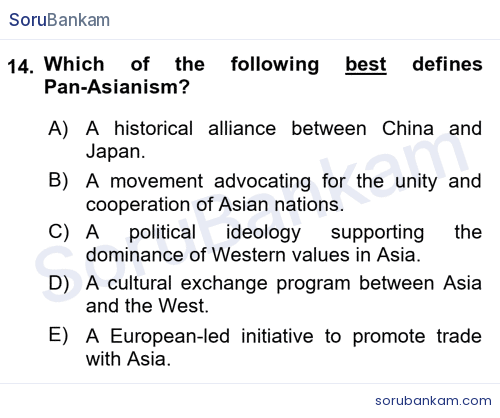
Which of the following best defines Pan-Asianism? A) A historical alliance between China and Japan. B) A movement advocating for the unity and cooperation of Asian nations. C) A political denly supporting the dominance of Western values in Asia. D) A cultural exchange program between Asia and the West. E) A European-led initiative to promote trade with Asia.
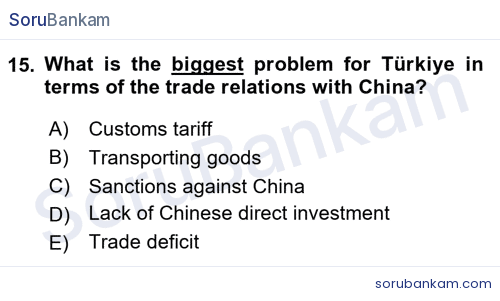
What is the biggest problem for Türkiye in terms of the trade relations with China? A) Customs tariff B) Transporting goods C) Sanctions against China D) Lack of Chinese direct investment E) Trade deficit
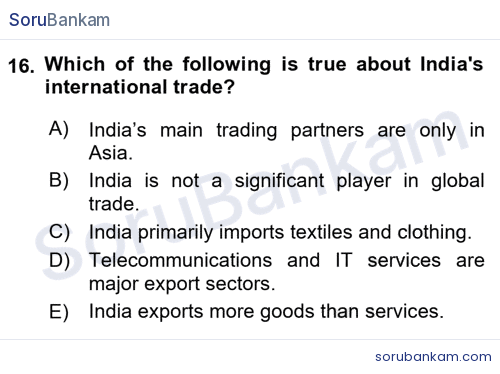
Which of the following is true about India's international trade? A) India's main trading partners are only in Asia. B) India is not a significant player global trade. C) India primarily imports textiles and clothing. D) Telecommunications and IT services are major export sectors. E) India exports more goods than services.**
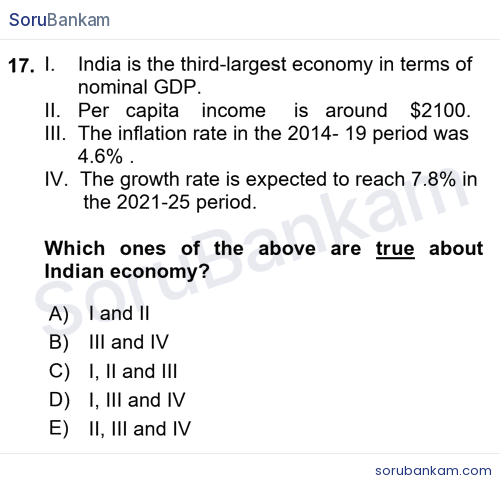
I. India is the third-largest economy in terms of nominal GDP. II. Per capita income is around $2100. III. The inflation rate in the 2014- 19 period was 4.6% . IV. The growth rate is expected to reach 7.8% in the 2021-25 period. Which ones of the above are true about Indian economy? A) I and B) III and C) I, li and ill D) 1, Ill and E) II, Ill and
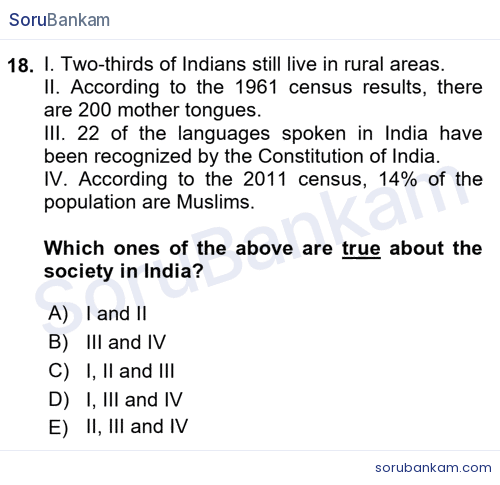
I. Two-thirds of Indians still live in rural areas. II. According to the 1961 census results, there are 200 mother tongues. Illi. 22 of the languages spoken in India have been recognized by the Constitution of India. IV. According to the 2011 census, 14% , of the population are Muslims. Which ones of the above are true about the society in India? A) I and B) Ili and IV • C) I, ! and fil D) I, Ill and E) II, Ill and
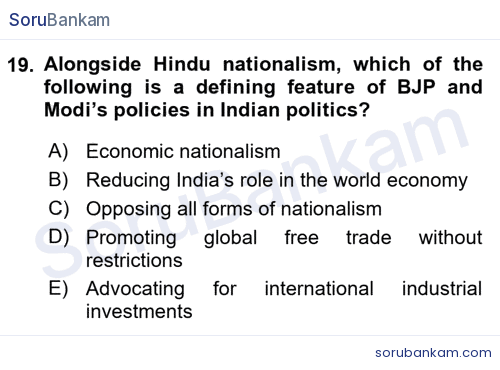
Alongside Hindu nationalism, which of the following is a defining feature of BJP and modi's policies in Indian politicst A) Eçanaric nationalism B) Reducing India's role in the world economy C) Opposing all forms of nationalism D) Promoting global free trade without restrictions E) Advocating for international industrial investments
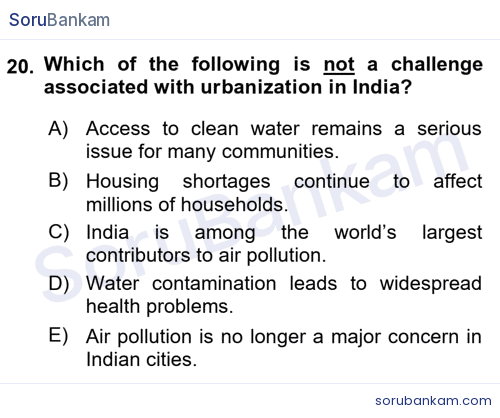
Which of the following is not a challenge associated with urbanization in india?. A) Access to clean water remains a serious issue for many communities. B) Housing shortages continue to affect millions of households. C) India is among the world's largest contributors to air pollution. D) Water contamination leads to widespread health problems. E) Air pollution is no longer a major concern in Indian cities.