ULI205U Theories Of International Relations 2 2021-2022 Vize Soruları
20 soru · Vize · 2021-2022
ULI205U Theories Of International Relations 2 dersinin 2021-2022 vize sınavı 20 sorudan oluşur; ders AÖF Uluslararası İlişkiler (İngilizce) bölümünde okutulur. Sorular aşağıda sırasıyla yer alır. Doğru cevaplar ve sonucun, testi çözdüğünde görünür.
Önizleme · 20 soru. Cevaplamak ve sonucunu görmek için sınavı başlat.
Sorular
20 soru
Soru 1
Soru 2
Soru 3
Soru 4
Soru 5
Soru 6
Soru 7
Soru 8
Soru 9
Soru 10
Soru 11
Soru 12
Soru 13
Soru 14
Soru 15
Soru 16
Soru 17
Soru 18
Soru 19
Soru 20
Sınav modunda süre tutulur, doğru cevaplar ve sonucun sınav bitince görünür.
Dersin üniteleri
Ünite özetleri ve konu anlatımları
- 1. Ünite: Contending Issues And Major Theories İn Ir
- 2. Ünite: Realist Theory Of International Relations
- 3. Ünite: Liberalism
- 4. Ünite: Marxist Theory
- 5. Ünite: International Political Economy
- 6. Ünite: International Regime Theories
- 7. Ünite: Normativism
- 8. Ünite: English School Of International Relations
ULI205U Theories Of International Relations 2 ders sayfası: bütün sınavlar ve üniteler
Soruların metni (otomatik okuma)
Görsellerden otomatik okunmuştur; hata içerebilir. Sorular, görsellerdeki hâliyle geçerlidir.
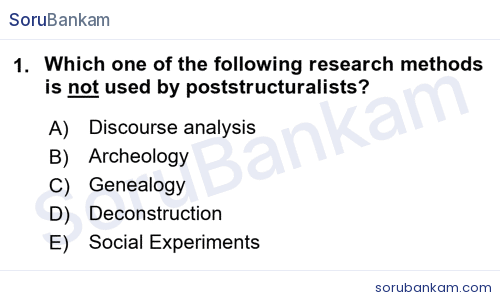
1. Which one of the following research methods is not used by poststructuralists? A) Discourse analysis Archeology C) Genealogy D) Deconstruction Social Experiments
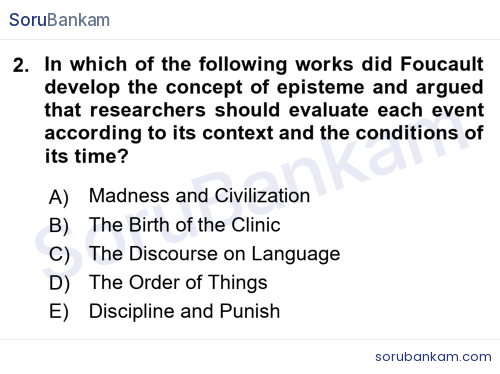
In which of the following works did Foucault develop the concept of episteme and argued that researchers should evaluate each event according to its context and the conditions of its time? A) Madness and Civilization B) The Birth of the Clinic C) The Discourse on Language D) The Order of Things E) Discipline and Punish
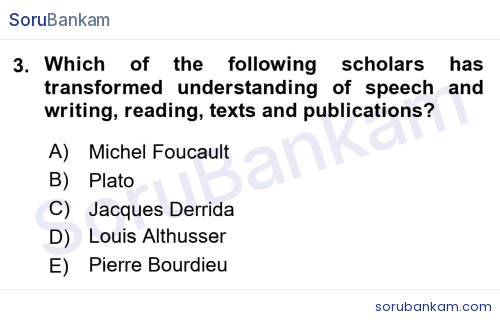
Which of the following scholars transformed understanding of speech and writing, reading, texts and publications? "" › A) Michel Foucault B) Plato т„"' C) Jacques Derrida D) Louis Althusser E) Pierre Bourdieu «
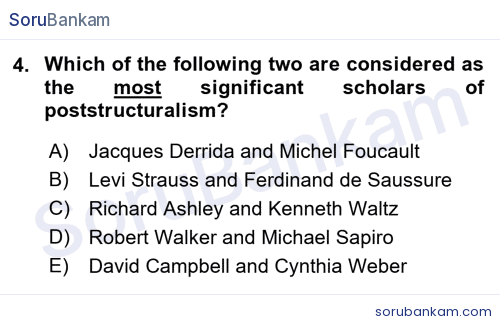
Which of the following two are considered as the most significant scholars poststructuralism? A) Jacques Derrida and Michel Foucault B) Levi Strauss and Ferdinand de Saussure C) Richard Ashley and Kenneth Waltz D) Robert Walker and Michael Sapiro E) David Campbell and Cynthia Weber
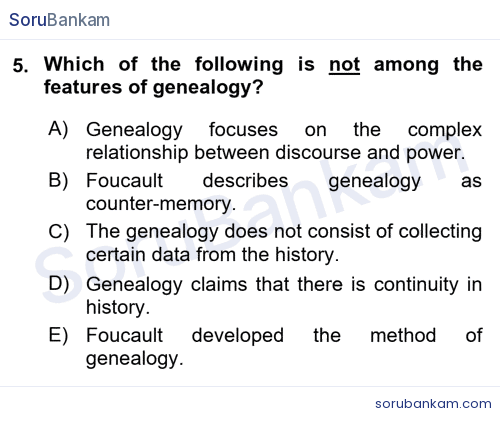
Which of the following is not among the features of genealogy? A) Genealogy focuses on the complex relationship between discourse and power. B) Foucault describes genealogy counter-memory. C) The genealogy does not consist of collecting certain data from the history. D) Genealogy claims that there is continuity in history. E) Foucault developed the method of genealogy.
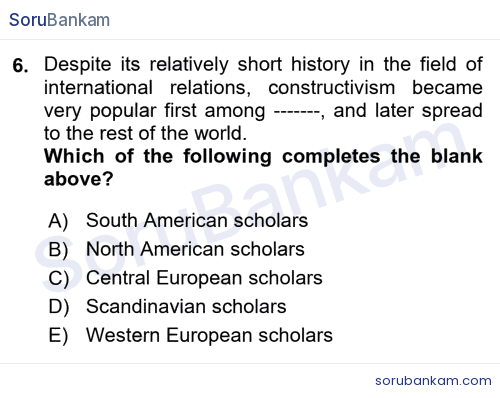
6. Despite its relatively short history in the field of international relations, constructivism + became very popular first among --, and later spread to the rest of the world. Which of the following complates the blank "', above? A) South American scholars B) Noth American scholars §. Cêntral European scholars Scandinavian scholars E) Wester European scholars
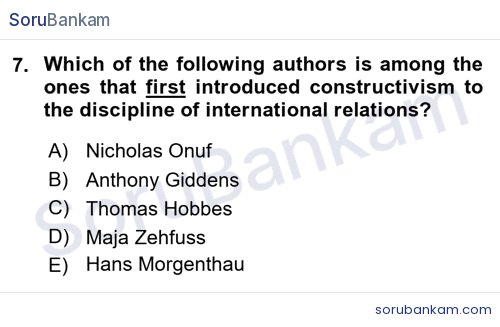
Which of the following authors is among the ones that first introduced constructivism to the discipline of international relations? A) Nicholas Onuf B) Anthony Giddens C) Thomas Hobbes D) Maja Zehfuss E) Hans Morgenthau
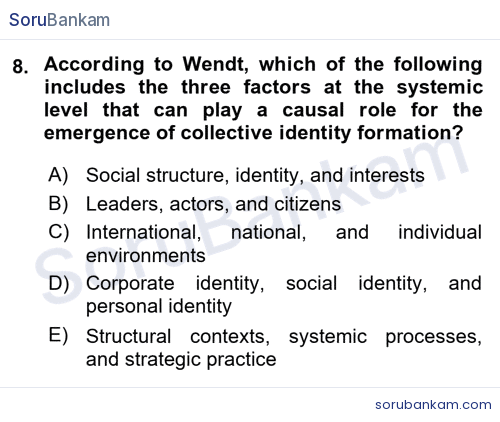
có According to Wendt, which of the following includes the three factors at the systemic level that can play a causal role for the emergence of collective identity formation? A) Social structure, identity, and interests B) Leaders, actors, and citizens C) International, national, and individual environments D) Corporate identity, social identity, and personal identity E) Structural contexts, systemic processes, and strategic practice
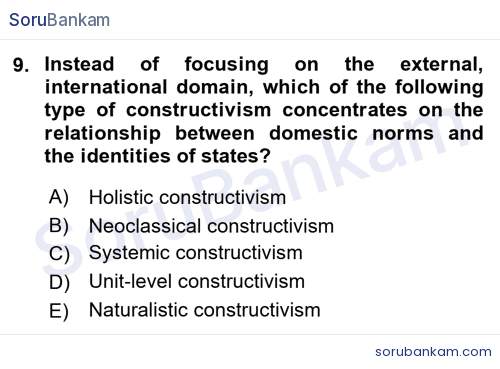
Instead of focusing on the external, international domain, which of the following type of constructivism concentrates on the relationship between domestic norms and the identities of states? A) Holistic constructivism B) Neoclassicar constructivism C) Systemic constructivism D) Unit-level constructivism E) Naturalistic constructivism
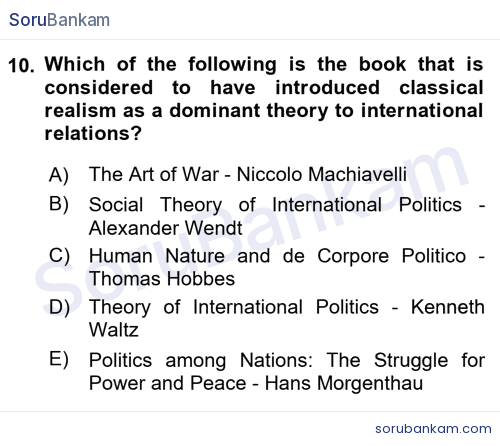
Which of the following is the book that is considered to have introduced classical realism as a dominant theory to international relations? A) The Art of War - Niccolo Machiavelli B) Social Theory of International Politics - Alexander Wendt C) Human Nature and de Corpore Politico - Thomas Hobbes D) Theory of International Politics - Kenneth Waltz E) Politics among Nations: The Struggle for Power and Peace - Hans Morgentha
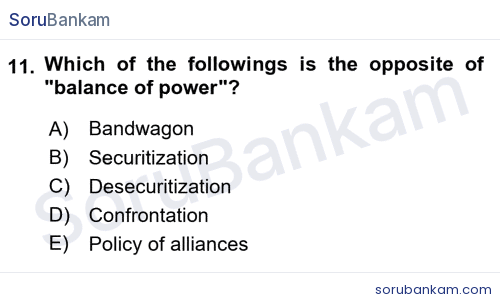
11. Which of the followings is the opposite of "balance of power"? A) Bandwagon Desecuritization D) Confrontation E) Policy of alliances
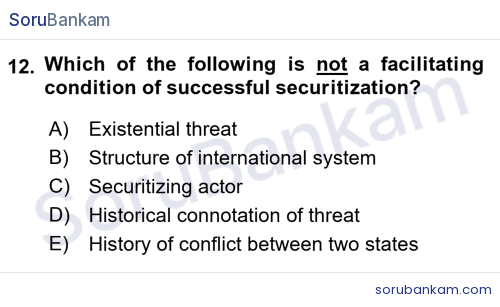
Which of the following is not a facilitating condition of successful securitization? A) Existential threat B) Structure of international system C) Securitizing actor D) Historical connotation of threat. E) History of conflict between two states
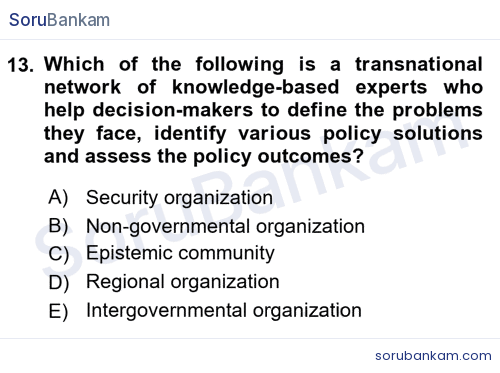
Which of the following is a transnational. network of knowledge-based experts who help decision-makers to define the problems they face, Identify various policy solutions and assess the policy outcomes? A) Security organization B) Non-govermental organization C) Epistemic community D) Regional organization E) Intergovernmental organization
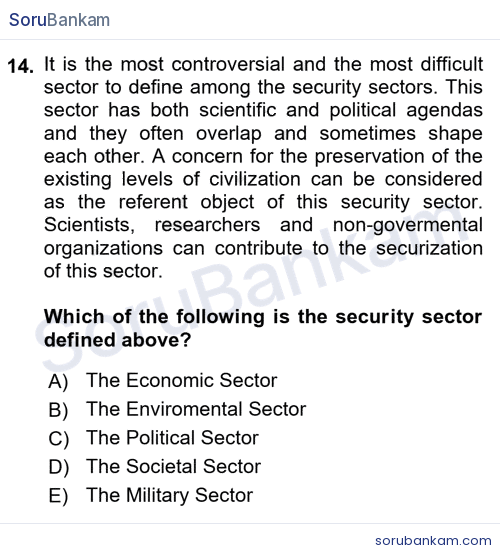
It is the most controversial and the most difficult sector to define among the security sectors. This sector has both sciehtific and political agendas and they often overtap and sometimes shape each other. A concern for the preservation of the existing levels of civilization can be considered as the referent object of this security sector. Scientists, researchers and non-govermental organizations can contribute to the securization of this sector. Which of the following is the security sector defined above? A) The Economic Sector B) The Enviromental Sector C) The Political Sector D) The Societal Sector E) The Military Sector
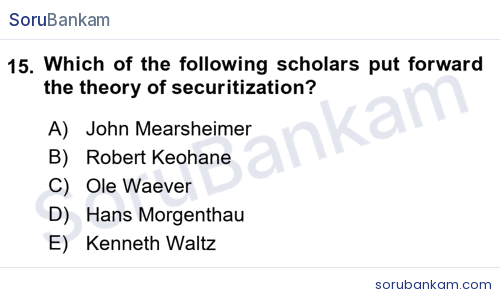
Which of the following scholars put forward the theory of securitization? A) John Mearsheimer B) Robert Keohane C) Ole Waever D) Hans Morgenthau E) Kenneth Waltz
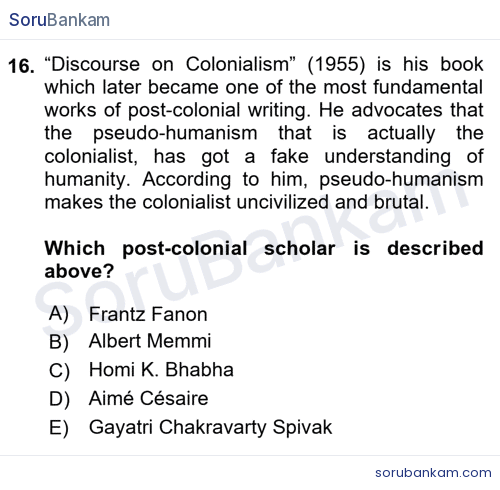
"Discourse on Colonialism" (1955) is his book which later became one of the most fundamental works of post-colonial writing. He advocates that the pseudo-humanism that is actually the colonialist, has got a fake understanding of humanity. According to him, pseudo-humanism makes the colonialist uncivilized and brutal. Which post-colonial scholar is described above? A) Frantz Fanon B) Albert Memmi C) Homi K. Bhabha D) Aimé Césaire E) Gayatri Chakravarty Spivak
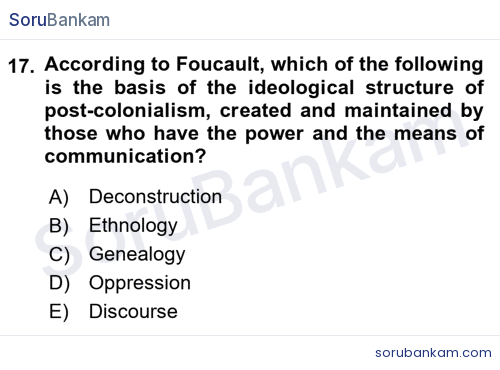
According to Foucault, which of the following Is the basls of the ideological structure of post-colonialism, created and maintained by those who have the power and the means of communication? A) Deconstruction • B) Ethnology C) Genealogy D) Oppression E) Discourse
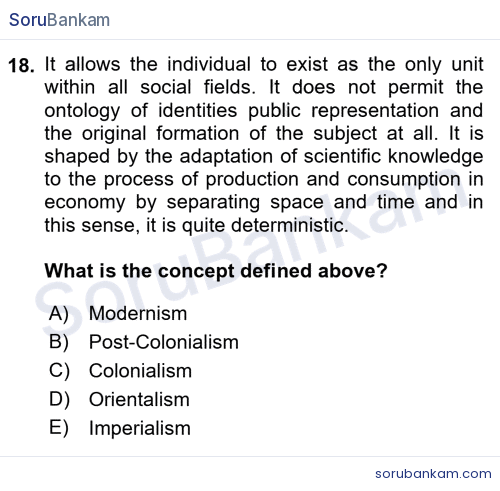
It allows the individual to exist as the only unit within all social fields. It does not permit the ontology of identities public representation and the original formation of the subject at all. It is shaped by the adaptation of scientific knowledge to the process of production and consumption in economy by separating space and time and in this sense, it is quite deterministic. What is the concept defined above? A) Modernism B) Post-Colonialism C) Colonlalism D) Orientalism E) Imperialism
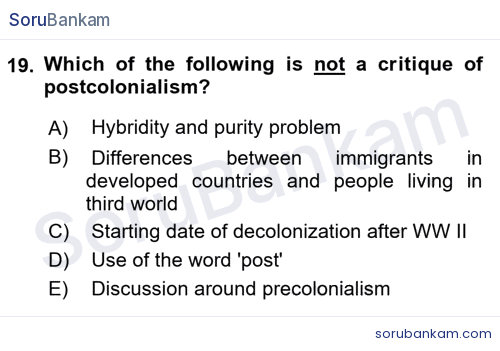
Which of the following is not a critique of postcolonialism? A) Hybridity and purity problem B) Differences between immigrants in developed countries and people living vin third world C) Starting date of decolonization after 11 D) Use of the word post' E) Discussion around precolonialism
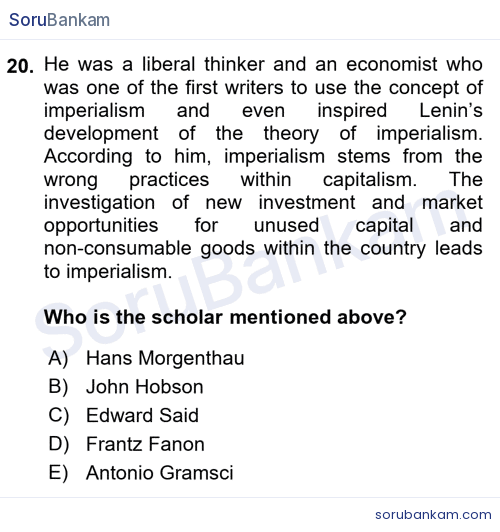
He was a liberal thinker and an economist who was one of the first writers to use the concept of imperialism and even inspired Lenin's development of the theory of imperialism. According to him, imperialism stems from the wrong practices within capitalism. The investigation of new investment and market opportunities for unused capital and non-consumable goods within the country leads to impertalism. Who is the scholar mentioned above? A) Hans Morgenthau B) John Hobson C) Edward Said D) Frantz Fanon E) Antonio Gramsci