ULI110U Diplomacy 2024-2025 Vize Soruları
20 soru · Vize · 2024-2025
ULI110U Diplomacy dersinin 2024-2025 vize sınavı 20 sorudan oluşur; ders AÖF Siyaset Bilimi ve Kamu Yönetimi (İngilizce) bölümünde okutulur. Sorular aşağıda sırasıyla yer alır. Doğru cevaplar ve sonucun, testi çözdüğünde görünür.
Önizleme · 20 soru. Cevaplamak ve sonucunu görmek için sınavı başlat.
Sorular
20 soru
Soru 1
Soru 2
Soru 3
Soru 4
Soru 5
Soru 6
Soru 7
Soru 8
Soru 9
Soru 10
Soru 11
Soru 12
Soru 13
Soru 14
Soru 15
Soru 16
Soru 17
Soru 18
Soru 19
Soru 20
Sınav modunda süre tutulur, doğru cevaplar ve sonucun sınav bitince görünür.
Dersin üniteleri
Ünite özetleri ve konu anlatımları
- 1. Ünite: Definition And Importance Of Diplomacy
- 2. Ünite: The Historical Evolution Of Diplomacy: First Practices
- 3. Ünite: Historical Evolution Of Diplomacy:Transition To Permanent Diplomacy
- 4. Ünite: Ottoman Diplomacy And Diplomatic Letters
- 5. Ünite: Instruments And Institutions Of Modern Diplomacy
- 6. Ünite: Diplomacy Of The Republic Of Turkey
- 7. Ünite: Diplomacy Practices Of Global Powers
- 8. Ünite: Practice Of Diplomacy: Negotiation, Mediation And Diplomatic Agreement
Soruların metni (otomatik okuma)
Görsellerden otomatik okunmuştur; hata içerebilir. Sorular, görsellerdeki hâliyle geçerlidir.
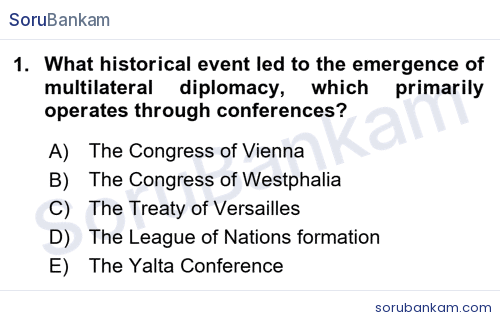
What historical event led to the emergence of multilateral diplomacy, which primarily operates through conferences? A) The Congress of Vienna B) The Congress of Westphalia C) The Treaty of Versailles D) The League of Nations formation E) The Yalta Conference
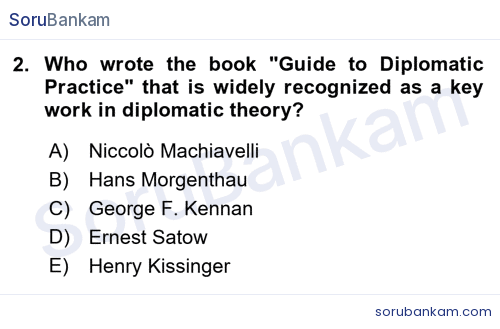
Who wrote the book "Guide to Diplomatic Practice" that is widely recognized as a key work in diplomatic theory? A) Niccolò Machiavelli B) Hans Morgenthau C) George F. Kennan D) Ernest Satow E) Henry Kissinger
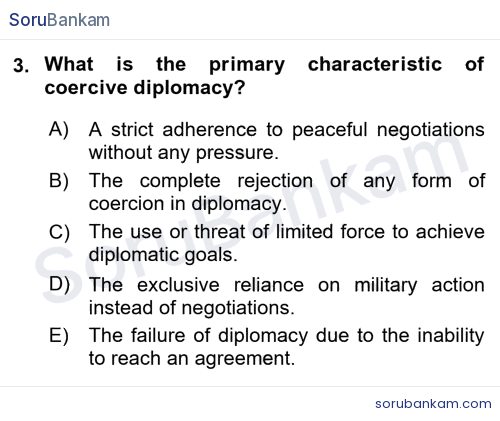
What is the primary characteristic of coercive diplomacy? A) A strict adherence to peaceful negotiations without any pressure. B) The complete rejection of any forg of coercion in diplomacy. C) The use or threat of limited force to achieve diplomatic goals., ' D) The exclusive reliance on military action instead of negotiations. E) The failure of diplomacy duento the inability to reach an agreement, i~
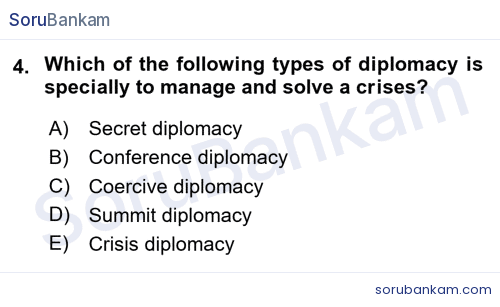
Which of the following types of diplomacy is specially to manage and solve a crises? A) Secret diplomacy B) Conference diplomacy C) Coercive diplomacy D) Summit diplomacy E) e) Crisis diplomacy
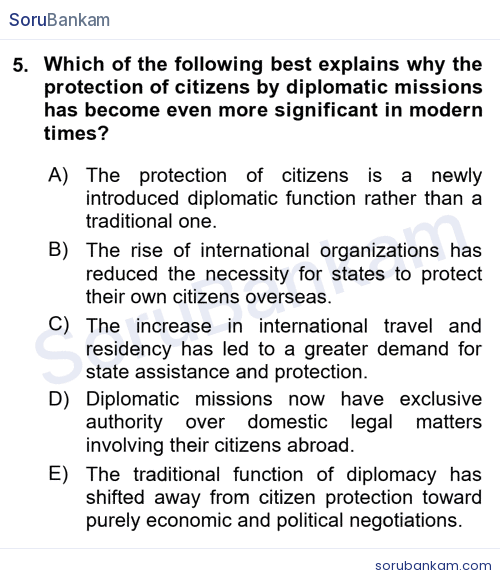
Which of the following best explains why the protection of citizens by diplomatic missions has become even more significant in modern times? A) The protection of citizens is a newly introduced diplomatic function rather than a traditional one. B) The rise of international organizations has reduced the necessity for states to protect their own citizens overseas. C) The increase in international travel and residency has led to a greater demand for state assistance and protection. D) Diplomatic missions now have exclusive authority over domestic legal matters involving their citizens abroad E) The traditional function of diplomacy has shifted away from citizen protection toward • purely economic and political negotiations.
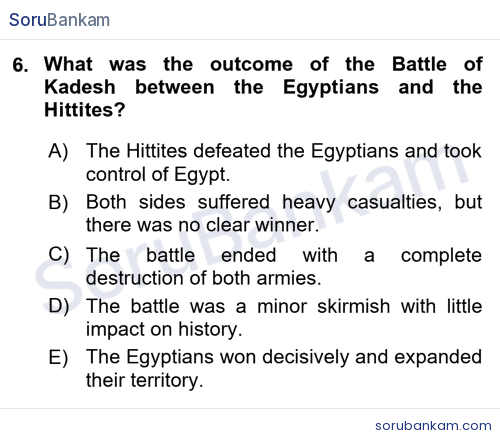
What was the outcome of the Battle of Kadesh between the Egyptians and the Hittites? A) Thé Hittites defeated the Egyptians and took control of Egypt. B) Both sides suffered heavy casualties, but there was no clear winner. C) The battle ended with a complete •destruction of both armies. D) 1 *D) The battle was a minor skirmish with tittle impact on history. E) The Egyptians won decisively and expanded their territory.
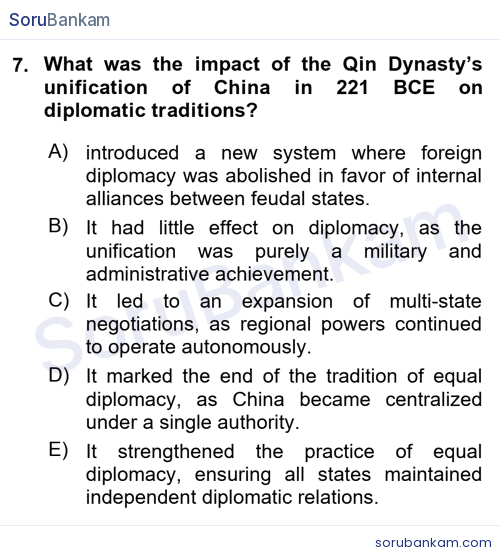
What was the impact of the Qin Dynasty's unification of China in 221 BCE on diplomatic tradițions? A) introduced a new system where foreign diplomacy was abolished in favor of internal alliances between feudal states. B) It had little effect on diplomacy, as the unification was purely a military and administrative achievement. C) It led to an expansion of multi-state negotiations, as regional powers continued to operate autonomously. D) It marked the end of the tradition of equal diplomacy, as China became centralized under a single authority. E) It strengthened the practice of equal diplomacy, ensuring all states maintained independent diplomatic relations.
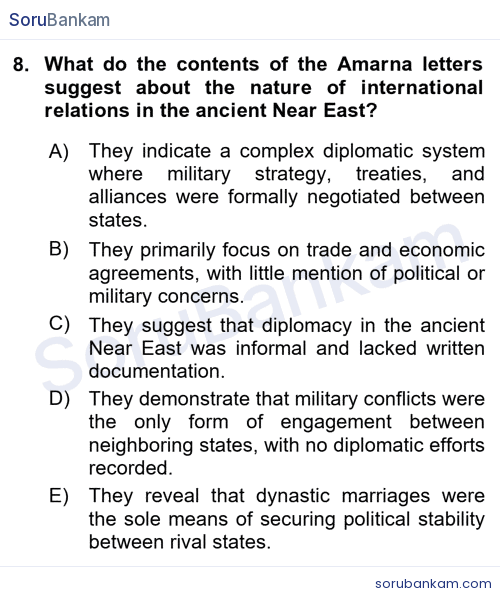
What do the contents of the Amarna letters suggest about the nature of International relations in the ancient Near East? A) They indicate a complex diplomatic system where military strategy, treaties, and alliances were formally negotiated between states. B) They primarily focus on trade and economic agreements, with little mention of political or military concerns. C) They suggest that diplomacy in the ancient Near East was informal and lacked written documentation. D) They demonstrate that military conflicts were the only form of engagement between neighboring states, with no diplomatic efforts recorded.. E) They reveal that dynastic marriages were the sole means of securing political stability between rival states.
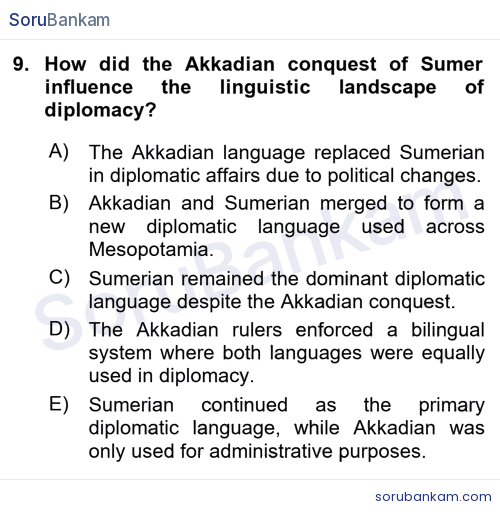
How did the Akkadian conquest of Sumer influence the linguistic landscape of diplomacy? A) The Akkadian language replaced Sumerian in diplomatic affairs due to political changes! B) 5) Akkadian and Sumeran merged to worm a new diplomatic language: used across Mesopotamia. C) Sumerian remained the dominant diplomatiq language despite the Akkadian conquest. D) The Akkadian rulers enforced a 'bilingual system where both languages were equally used in diplomacy. E) Sumenan continued as the primary diplomatic language, while Akkadian was only used for administrative purposes.
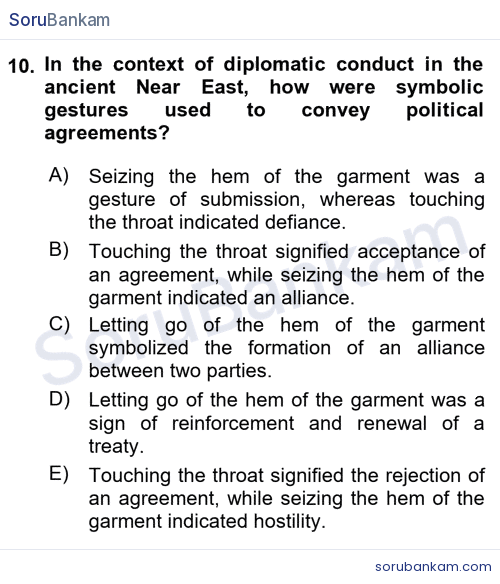
In the context of diplomatic conduct in the ancient Near East, how were symbolic gestures used to convey political agreements? 1:d. A) Seizing the hem of the garment was a gesture of submission, whereas touching the throat indicated defiance. B) Touching the throat signified acceptance of an agreement, while seizing the hem of the garment indicated an alliance. C) Letting go of the hem of the garment symbolized the formation of an alliance between two parties. D) Letting go of the hem of the garment was a sign of reinforcement and renewal of a treaty. E) Touching the throat signified the rejection of an agreement, while seizing the hem of the garment indicated hostility.
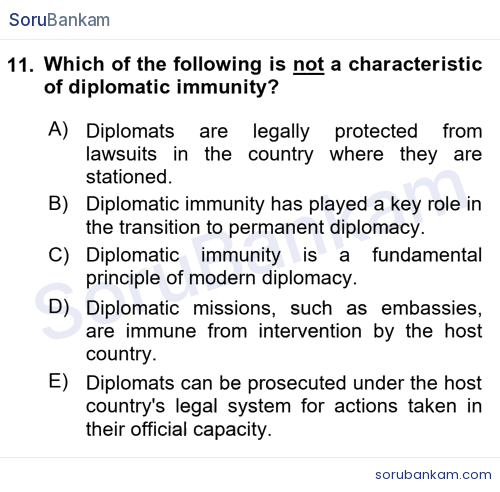
Which of the following is not a characteristic of diplomatic immunity? A) Diplomats are legally protected from lawsuits in the country where they are stationed. B) Diplomatic immunity has played a key' role in the transition to permanent diplomacy. C) Diplomatic immunity is a fundamental principle of modern diplomacy. D) Diplomatic missions, such as embassies, are immune from intervention by the host country. E) Diplomats can be prosecuted under the host country's legal system for actions taken in their official capacity.
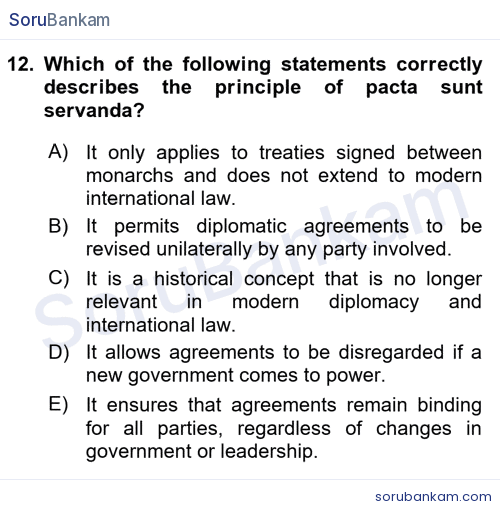
12. Which of the following statements correctly describes the principle of pacta sunt servanda? A) It only applies to treaties signed between monarchs and does not extend to modern international law. B) It permits diplomatic agreements to be revised unilaterally by any party involved. It is a historical concept that is no longer relevant modern diplomacy and international law. D) It allows agreements to be disregarded if a new govemment comes to power. E) It ensures that agreements remain binding for all parties, regardless of changes in government or leadership.
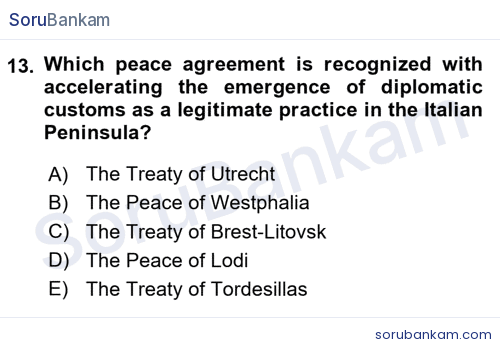
Which peace agreement is recognized with accelerating the emergence of diplomatic customs as a legitimate practice in the Italian Peninsula? A) The Treaty of Utrecht B) The Peace of Westphalia C) The Treaty of Brest-Litovsk D) The Peace of Lodi E) The Treaty of Tordesillas
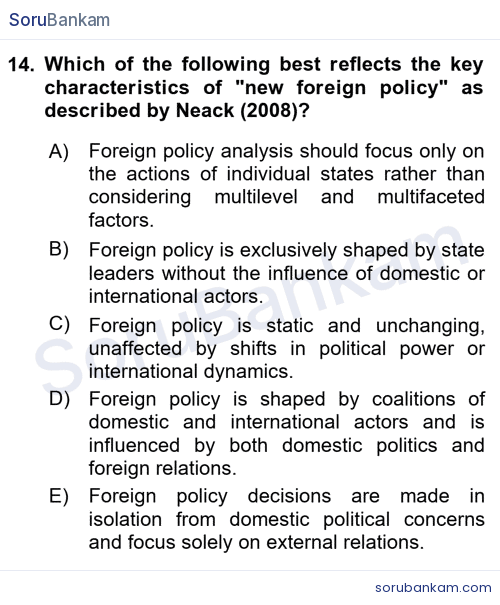
14. Which of the following best reflects the key characteristics of "new foreign policy" as described by Neack (2008)? A) Foreign policy analysis should focus only on the actions of individual states rather than considering multilevel and multifaceted factors. Foreign policy is exclusively shaped by state leaders without the influence of domestic or international actors. C) Foreign policy is static and unchanging, unaffected by shifts in political power or international dynamics. D) Foreign policy is shaped by coalitions of domestic and intemational actors and is influenced by both domestic politics and foreign relations. Foreign policy decisions are made in isolation from domestic political concerns and focus solely on external relations:
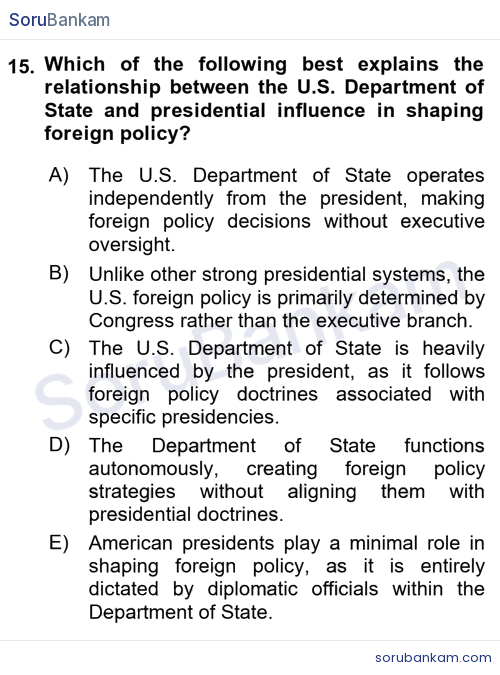
15. Which of the following best explains the relationship between the U.S. Department of State and presidential influence in shaping foreign policy? A) The U.S. Department of State operates independently from the president, making foreign policy decisions withoft executive oversight. Unlike other strong presidential systems, the J.S. foreign policy is primarily determined-by Congress rather than the executive branch. C) The U.S. Department of State is heavily influenced by the president, as it follows foreign policy doctrines associated with specific presidencies. D) The Department of State functions autonomously, creating foreign policy strategles without aligning them with • presidential doctrines. American presidents play a minimal role in shaping foreign policy, pow it is entirely dictated by diplomatic officials within the Department of State.
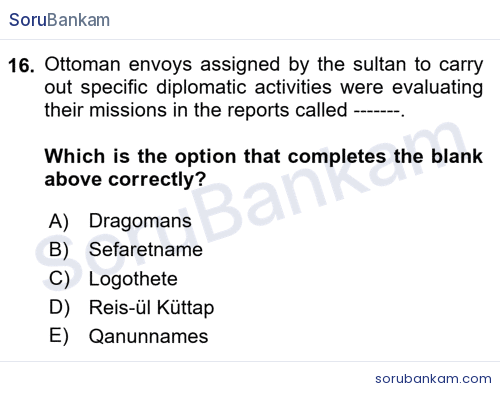
Ottoman envoys assigned by the sultan to carry out specilic diplomatic activities were evaluating their missions in the reports called.- Which is the option that completes the blank above correctly? A) Dragomans B) Sefaretname C) Logothete D) Reis-ül Küttap E) Qanunnames
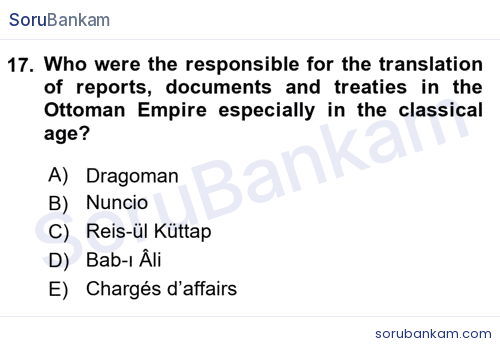
Who were the responsible for the translation of reports, documents and treaties in the Ottoman Empire especially in the classical age? A) Dragoman B) Nuncio C) Reis-ül Küttap D) Bab-t Ali E) Chargés d'affairs
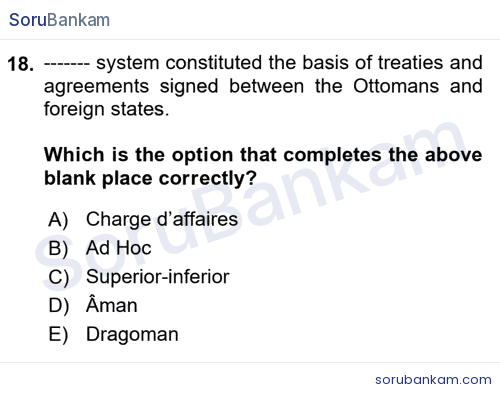
-- system constituted the basis of treaties and agreements signed between the Ottomans and foreign states. Whick isthe option that dompletes the above blank place correctly? A) Charge d'affaires 77,° B) Ad Haa, C) Superior-inferior D) • D) Aman E) Dragoman ,
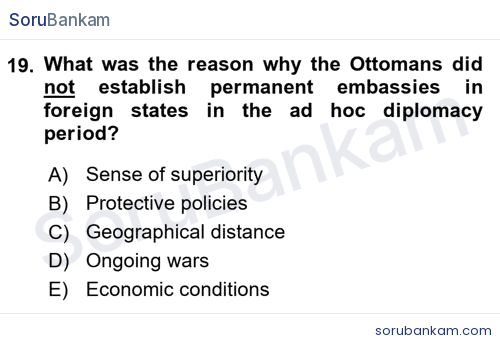
What was the reason why the Ottomans did not establish permanent embassies in foreign states In the ad hoc diplomacy period? A) Sense of superiority B) Protective policies C) Geographical distance D) Ongoing wars E) Economic conditions
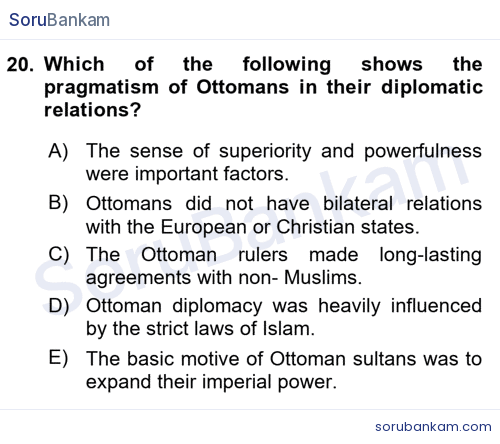
Which of the following shows the pragmatism of Ottomans in their diplomatic relations? A) The sense of superiority and powerfulness were important factors. B) Ottomans did not have bilateral relations with the European or Christian states. C) The Ottoman rulers made long-lasting agreements with non- Muslims. D) Ottoman diplomacy was heavily influenced by the strict laws of Islam. E) The basic motive of Ottoman sultans was to expand their imperial power.