TAR219U Political Thought 2023-2024 Vize Soruları
20 soru · Vize · 2023-2024
TAR219U Political Thought dersinin 2023-2024 vize sınavı 20 sorudan oluşur; ders AÖF Siyaset Bilimi ve Kamu Yönetimi (İngilizce) bölümünde okutulur. Sorular aşağıda sırasıyla yer alır. Doğru cevaplar ve sonucun, testi çözdüğünde görünür.
Önizleme · 20 soru. Cevaplamak ve sonucunu görmek için sınavı başlat.
Sorular
20 soru
Soru 1
Soru 2
Soru 3
Soru 4
Soru 5
Soru 6
Soru 7
Soru 8
Soru 9
Soru 10
Soru 11
Soru 12
Soru 13
Soru 14
Soru 15
Soru 16
Soru 17
Soru 18
Soru 19
Soru 20
Sınav modunda süre tutulur, doğru cevaplar ve sonucun sınav bitince görünür.
Dersin üniteleri
Ünite özetleri ve konu anlatımları
- 1. Ünite: Fundementals Of Political Thought
- 2. Ünite: Political Thought İn Ancient Greece And Rome
- 3. Ünite: Medieval Political Thought İn The Islamic World
- 4. Ünite: Political Thought İn The Medieval Europe
- 5. Ünite: Political Thought Of The New Age
- 6. Ünite: A Great Leap İn Political Thought: The Age Of Enlightenment
- 7. Ünite: Radicals Of Political Thought İn The 19Th Century
- 8. Ünite: A Battleground İn Political Thought: The Idea Of Justice
TAR219U Political Thought ders sayfası: bütün sınavlar ve üniteler
Soruların metni (otomatik okuma)
Görsellerden otomatik okunmuştur; hata içerebilir. Sorular, görsellerdeki hâliyle geçerlidir.
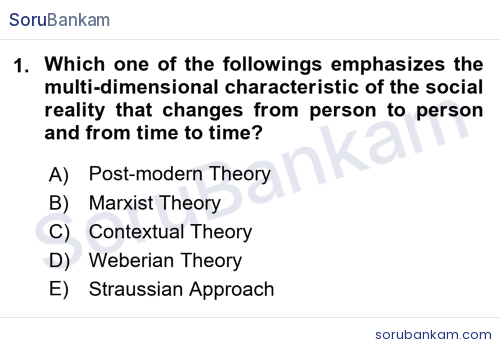
Which one of the followings emphasizes the multi-dimensional characteristic of the social reality that changes from person to person and from time to time? A) Post-modern Theory B) Marxist Theory C) Contextual Theory D) Weberian Theory E) Straussian Approach
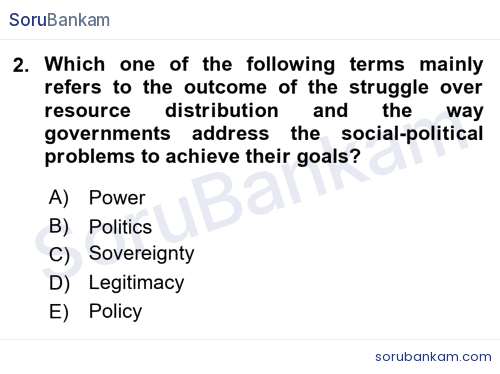
Which one of the following terms mainly refers to the outcome of the struggle over resource distribution and the way governments address the social-political problems to achieve their goals? A) Power B) Politics C) Sovereignty D) Legitimacy E) Policy
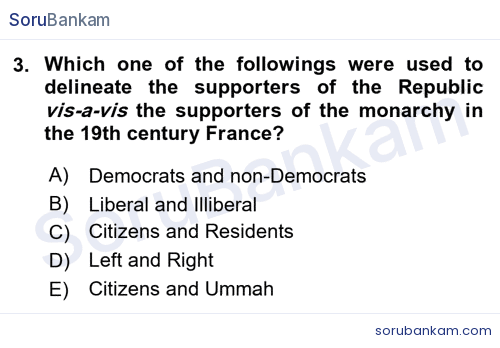
Which one of the followings were used fo delineate the supporters of the Republic vis-a-vis the supporters of the monarchy in the 19th century France? A) Democrats and non-Democrats B) Liberal and liliberal C) Citizens and Residents D) Left and Right E) Citizens and Ummah
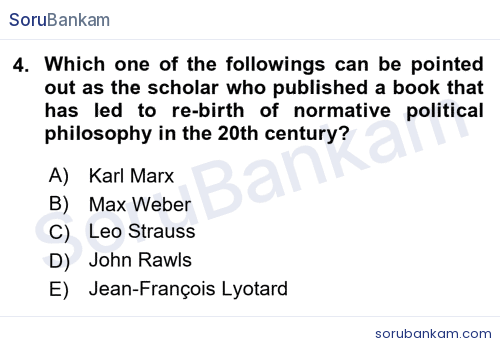
4. Which one of the followings can be pointed out as the scholar who published a book that has led to re-birth of normative political philosophy in the 20th century? Karl Marx Max Weber C) Leo Strauss D) John Rawis E) Jean-François Lyotard
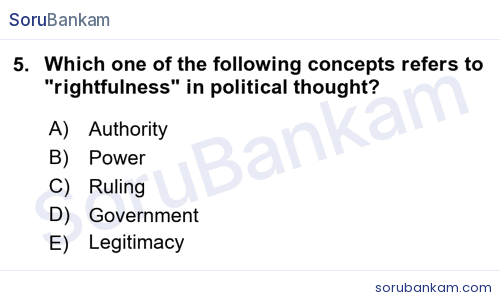
Which one of the following concepts refers to "rightfulness" in political thought? A) Authority B) Power C) Ruling D) Government E) Legitimacy
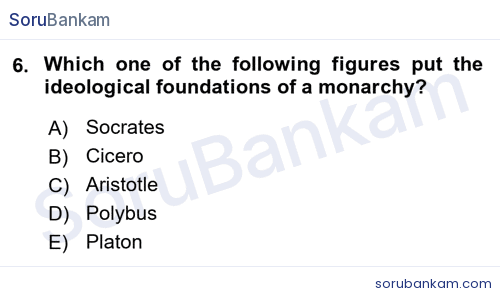
Which one of the following figures put the ideological foundations of a monarchy? A) Socrates B) Cicero C) Aristotle D) Polybus ... E) Platon
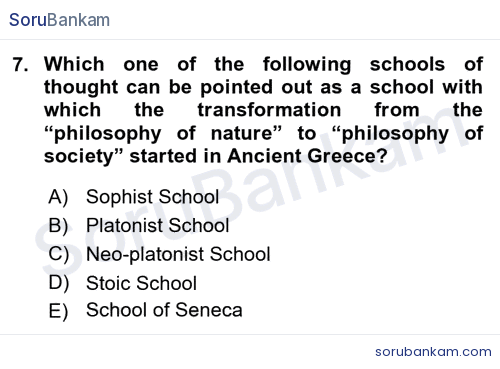
Which one of the following schools of thought can be pointed out as a school with which the transformation from the "philosophy of nature" to "philosophy of society" started in Ancient Greece? A) Sophist School B) Platonist School C) Nea platonist Schogly: " D) Stoic School E) School of Seneca
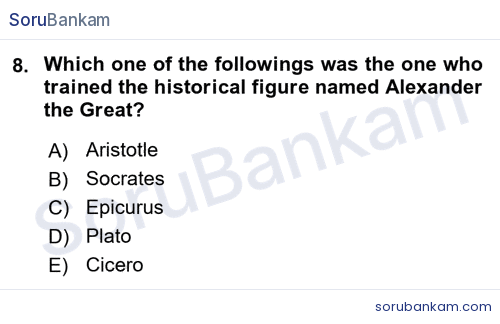
Which one of the followings was the one who trained the historical figure named Alexander the Great? A) Aristotte B) wBy Socrates C) Epicurus D) Plato E) ciçero'""
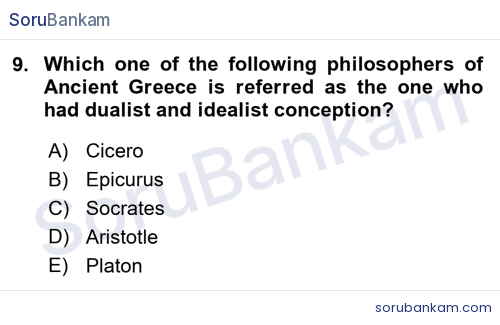
Which one of the following philosophers of Ancient Greece is referred as the one who had dualist and idealist conception? A) Cicero B) Epicurus C) Socrates D) Aristotle E) Platon
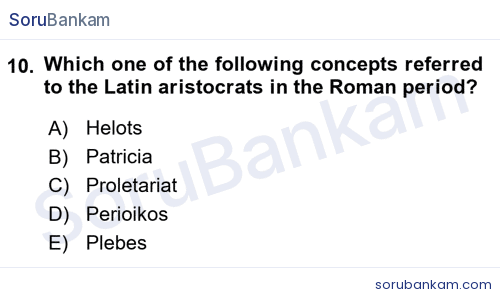
Which one of the following concepts referred to the Latin aristocrats in the Roman period? A) Helots B) Patricia C) Proletariat D) Perioikos E) Plebes
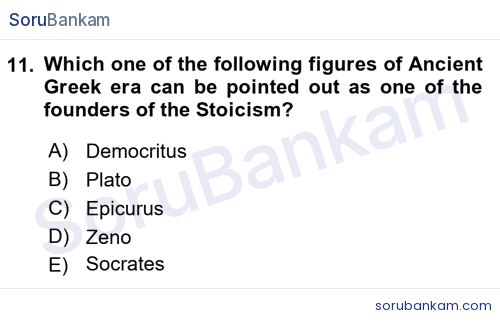
Which one of the following figures of Ancient Greek era can be pointed out as one of the founders of the Stoicism? A) Democritus B) Plato C) Epicurus D) Zeno E) Socrates
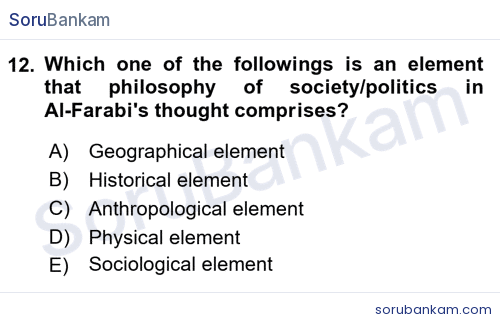
Which one of the followings is an element that philosophy of society/politics in Al-Farabi's thought comprises? A) Geographical element B) Historical element C) Anthropological element D) Physical element E) Sociological element
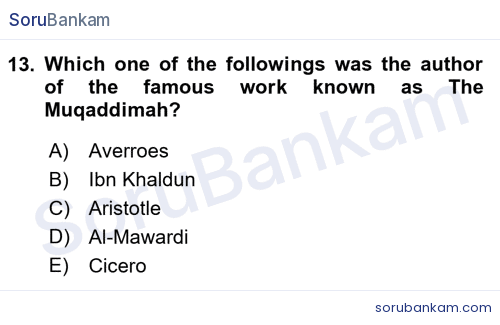
Which one of the followings was the author of the famous work known as The Muqaddimah? A) Averroes B) Ibn Khaldun C) Aristotle D) Al-Mawardi E) Cicero
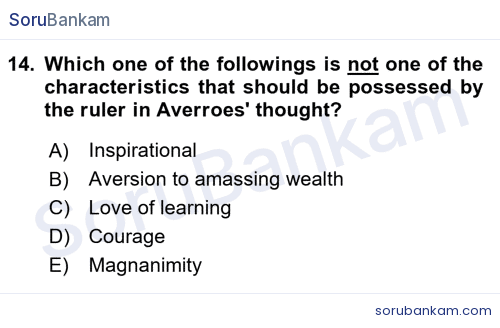
Which one of the followings is not one of that characteristics that should be possessed by the ruler in Averroes' thought? A) Inspirational B) Aversion to amassing wealth C) Love of learning s3i" D) Courage ,.== E) Magnanimity
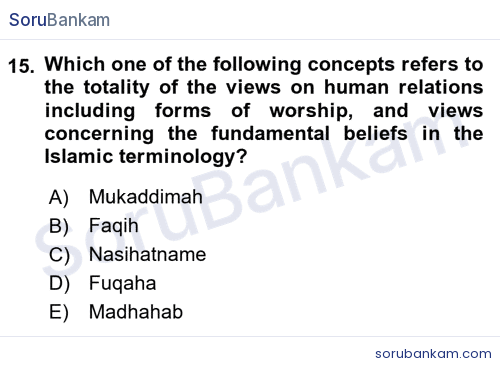
15. Which one of the following concepts refers to the totality of the views on human relations including formş bf worship, fand views concerning the fundamental beliefs in the Islamic terminology? " A) Mukaddimah B) Faqih C) Nasihatname E) Madnahab
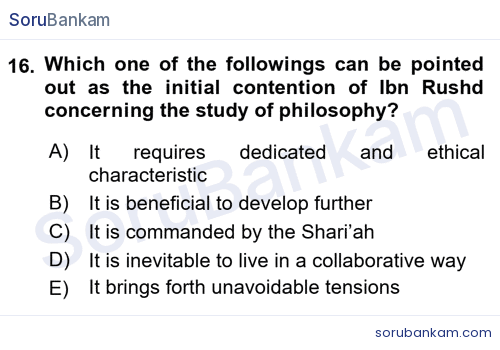
Which one of the followings can be pointed out as the initial contention of Ibn Rushd concerning the study of philosophy? A) It requires dedicated and ethical characteristic B) It is beneficial to develop further C) It is commanded by the Shar'ah D) It is inevitable to live in a collaborative way E) It brings forth unavoidable tensions
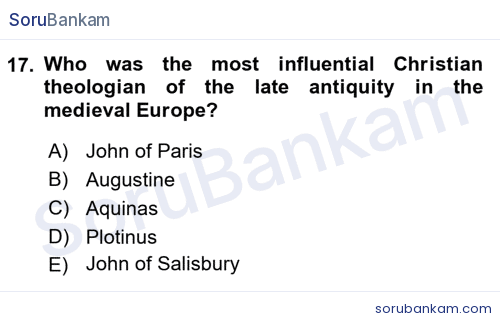
Who was the most infiuential Christian theologian of the late antiquity in the medieval Europe? A) John of Paris B) Augustine C) Aquinas D) Piotinus E) John of Salisbury
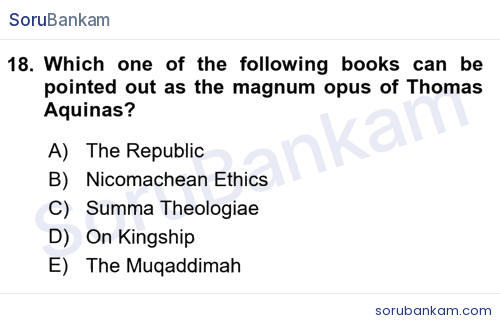
18. Which one of the following books can be pointed out as the magnum opus of Thomas Aquinas? A) The Republic B) Nicomachean Ethics 6) Suing the 49e E) The Muqaddimah
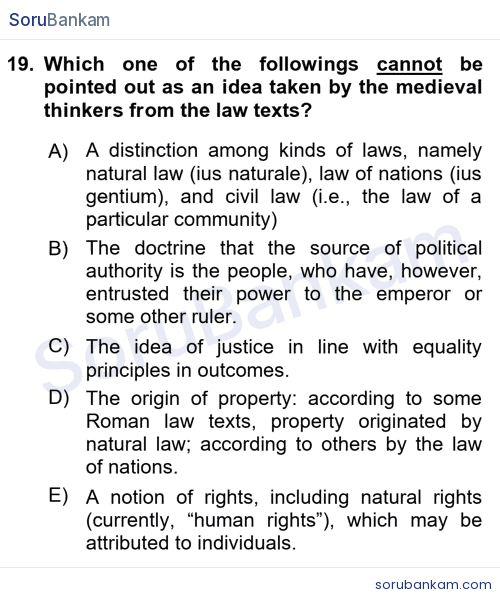
Which one of the followings cannot be pointed out as an idea taken by the medieval thinkers from the law texts? A) A distinction among kinds of laws, namely natural law (ius naturale), law of nations (ius gentium), and civil law (i.e., the law of a particular community) B) The doctrine that the source of political authority is the people, who have, however, entrusted their power to the emperor or some other ruler. C) The idea of justice in line with equality principles in outcomes. D) The origin of property: according to some Roman law texts, property originated by natural law; according to others by the law of nations. E) A notion of rights, including natural rights (currently, "human rights"), which may be attributed to individuals.
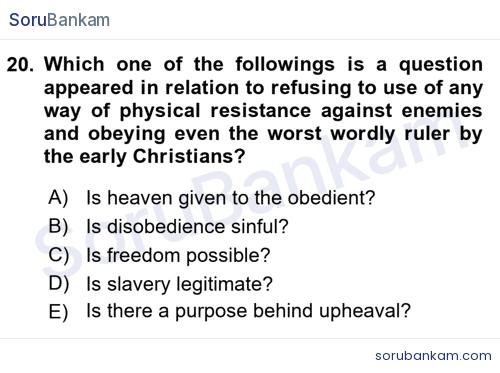
Which one of the followings is a question appeared in relation to refusing to use of any way of physical resistance against enemies and obeying even the worst wordly ruler by the early Christians? A) Is heaven given to the obedient? B) Is disobedience sinful? C) Is freedom possible? D) Is slavery legitimate? E) Is there a purpose behind upheaval?