KYT206U Urban and Enviromental Policy 2023-2024 Vize Soruları
20 soru · Vize · 2023-2024
KYT206U Urban and Enviromental Policy dersinin 2023-2024 vize sınavı 20 sorudan oluşur; ders AÖF Siyaset Bilimi ve Kamu Yönetimi (İngilizce) bölümünde okutulur. Sorular aşağıda sırasıyla yer alır. Doğru cevaplar ve sonucun, testi çözdüğünde görünür.
Önizleme · 20 soru. Cevaplamak ve sonucunu görmek için sınavı başlat.
Sorular
20 soru
Soru 1
Soru 2
Soru 3
Soru 4
Soru 5
Soru 6
Soru 7
Soru 8
Soru 9
Soru 10
Soru 11
Soru 12
Soru 13
Soru 14
Soru 15
Soru 16
Soru 17
Soru 18
Soru 19
Soru 20
Sınav modunda süre tutulur, doğru cevaplar ve sonucun sınav bitince görünür.
Dersin üniteleri
KYT206U Urban and Enviromental Policy ders sayfası: bütün sınavlar ve üniteler
Soruların metni (otomatik okuma)
Görsellerden otomatik okunmuştur; hata içerebilir. Sorular, görsellerdeki hâliyle geçerlidir.
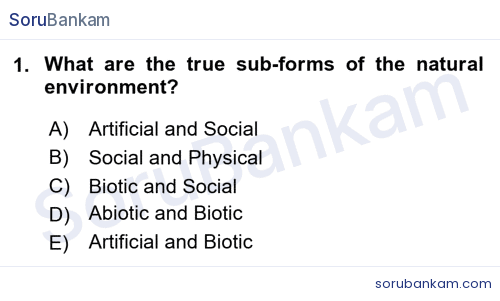
What are the true sub-forms of the natural environment? A) Artificial and Social B) Social and Physical C) Biotic and Social D) S Abiotic and Biotiç E) Artificial and Biotic
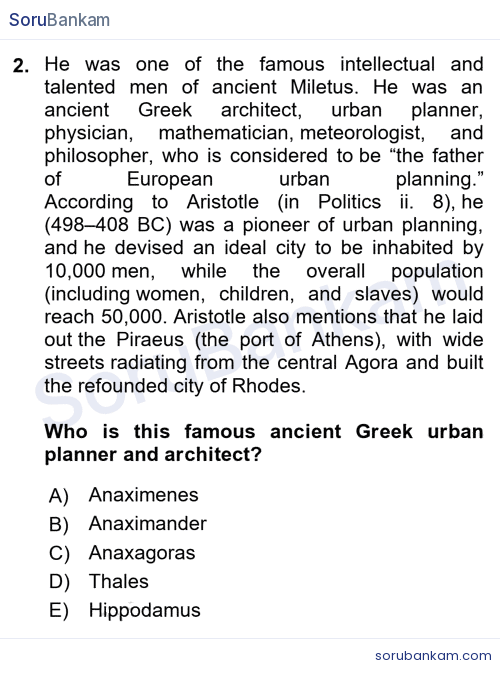
He was one of the famous intellectual and talented men of ancient Miletus. He was an ancient Greek architect, urban planner, physician, mathematician, meteorologist, and philosopher, who is considered to be "the father European urban planning." According to Aristotle (in Polítics ii. 8), he (498-408 BC) was a pioneer of urban planning, and he devised an ideal city to be inhabited by 10,000 men, while the overal population (including women, children, and slaves) would reach 50,000. Aristotle also mentions that he laid out the Piraeus (the port of Athens), with wide streets radiating from the central Agora and built the refounded city of Rhodes. Who is this famous ancient Greek urban planner and architect? A) Anaximenes B) Anaximander C) Anaxagoras D) Thales E) Hippodamus
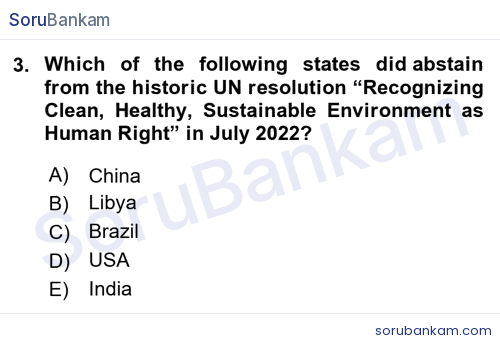
Which of the following states did abstain trom the historle UN resolution "Reçognizing Clean, Healthy, Sustainable Environment as A) Human Right"' in July 2022? - China B) Libya C) Brazil D) USA E) India
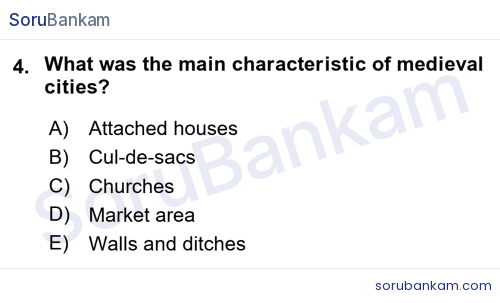
What was the main characteristic of medieval cities? A) Attached houses B) Cul-de-sacs C) Churches D) Market area E) Walls and ditches
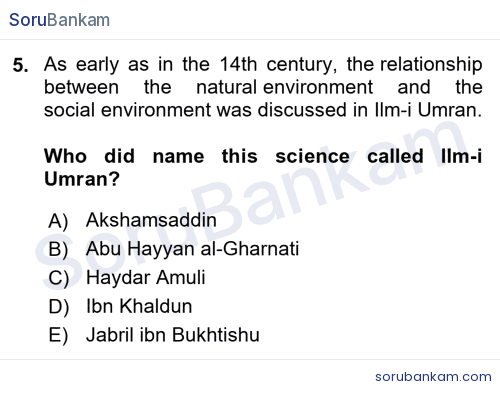
As early as in the 14th century, the relationship between the natural environment and the social environment was discussed in tim-i Umran. Who did name this science called Ilm-i Umran? A) Akshamsaddin B) Abu Hayyan al-Gharnati C) Haydar Amuli D) Ibn Khaldun E) Jabril ibn Bukhtishu
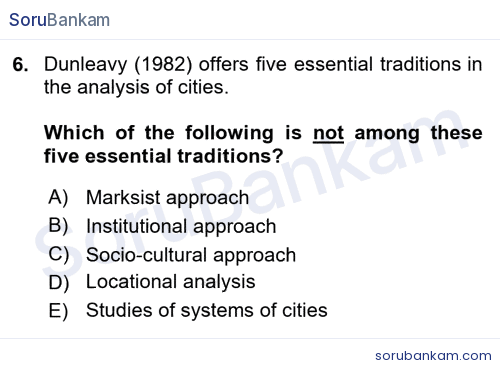
6. Dunleavy (1982) offers five essential traditions in the analysis of cities. Which of the following is not among these five assential traditions? A) Marksist approach B) Institutional approach c) Socio-cultural approach DI Locational analysis I E) Studies of systems of cities
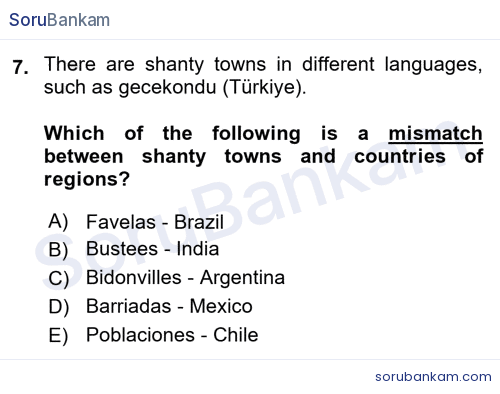
There are shanty towns in different languages, such as gecekondu (Türkiye). Which of the following is a mismatch between shanty towns and countries of regions? A) Favelas - Brazil B) Bustees - India C) Bidonvilles - Argentina D) Barriadas - Mexico E) Poblaciones - Chile
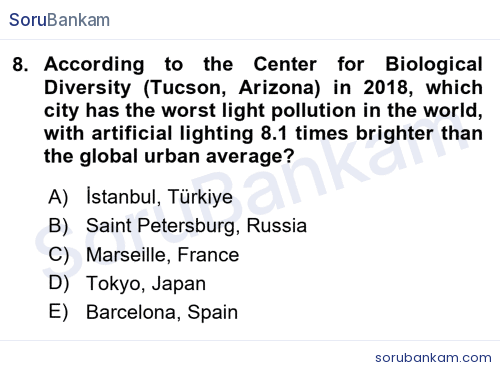
According to the Center for Biological. Diversity (Tucson, Arizona) in 2018, which city has the worst light pollution in the world, with artificial lighting 8.1 times brighter than the global urban average? A) Istanbul, Türkiye B) Saint Petersburg, Russia C) Marseille, France D) Tokyo, Japan E) Barcelona, Spain
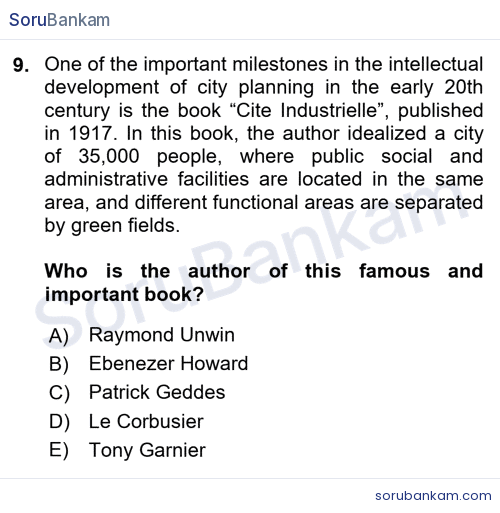
One of the important milestones in the intellectual development of city planning in the early 20th century is the book "Cite Industrielle" *, published in 1917. In this book, the author idealized a city of 35,000 people, where public social and administrative facilities are located in the same area, and different functional areas are separated by green fields. Who is the author of this famous and important book? A) Raymond Unwin B) Ebenezer Howard C) Patrick Geddes D) Le Corbusier E) Tony Garnier
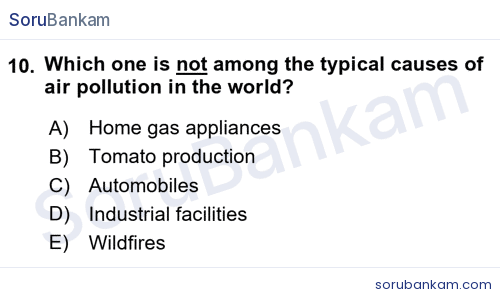
Which one is not among the typical causes of air pollution in the world? A) Home gas appliances B) Tomato production C) Automobiles D) Industrial facilities E) Wildfires
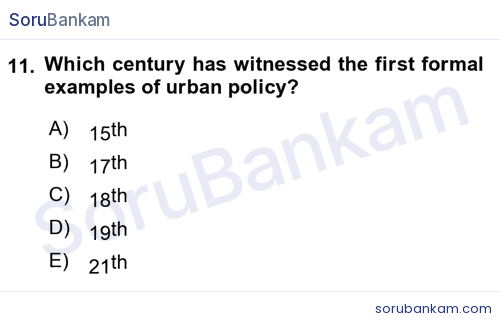
Which century has witnessed the first formal examples of urban policy? A) 15th B) 17th C) c) 18th D) 19th E) 2ath
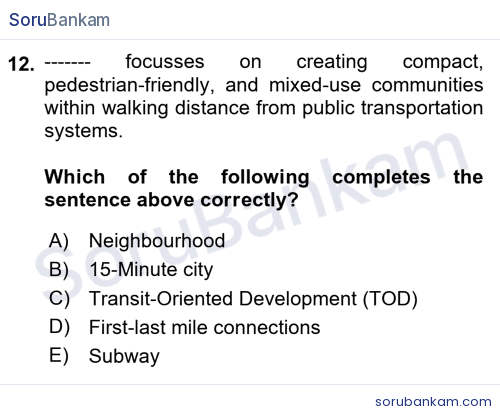
-- focusses creating compact, pedestrian-friendly, and mixed-use communitles within walking distance from public transportation systems. Which of the following completes the sentence above correctly? A) Neighbourhood B) 15-Minute city C) Transit-Oriented Development (TOD) D) E First-last mile connections E) Subway
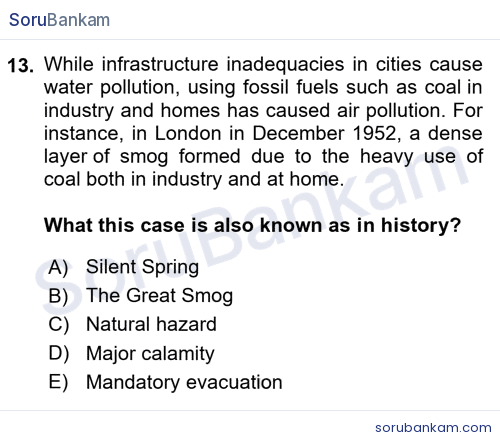
While infrastructure inadequacies in cities cause water pollution, using fossil fuels such as coal in industry and homes has caused air pollution. For instance, in London in December 1952, a dense layer of smog formed due to the heavy use of coal both in industry and at home. What this case is also known as in history? A) Silent Spring B) The Great Smog C) Natural hazard D) Major calamity E) Mandatory evacuation
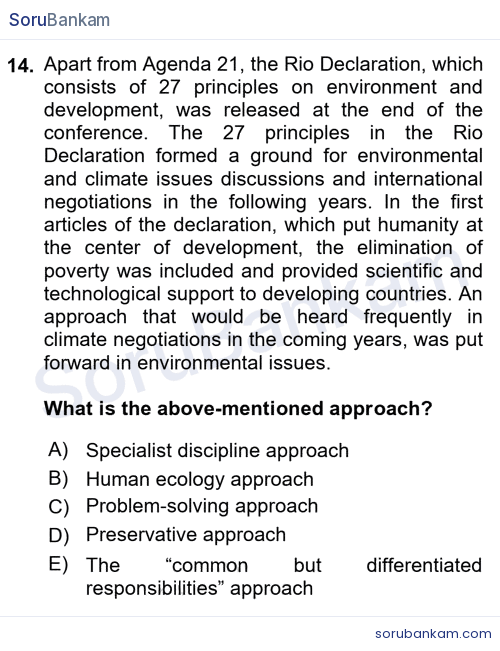
Apart from Agenda 21, the Rio Declaration, which consists of 27 principles on environment and development, was released at the end of the conference. The 27 principles in the Rio Declaration formed a ground for environmental and climate issues discussions and international negotiations in the following years. In the first articles of the declaration, which put humanity at the center of development, the elimination of poverty was included and provided scientific and technological support to developing countries. An approach that would be heard frequently in climate negotiations in the coming years, was put forward in environmental issues. What Is the above-mentloned approach? A) Specialist discipline approach B) Human ecology approach C) Problem-solving approach D) Preservative approach E) The "common but differentiated responsibilities" approach
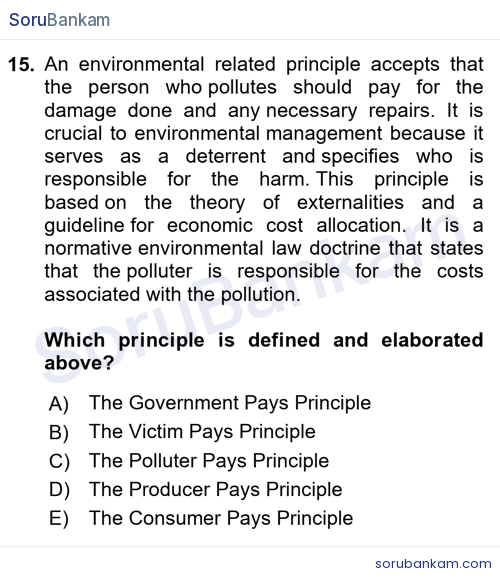
An environmental related principle accepts that the person who pollutes should pay for the damage done and any necessary repairs. It is crucial to environmental management because it serves as a deterrent and specifies who is responsible for the harm. This principle is based on the theory of externalities and a guideline for economic cost allocation. It is a normative environmental law doctrine that states that the polluter is responsible for the costs associated with the pollution. Which principle is defined and elaborated above? A) The Government Pays Principle B) The Victim Pays Principle C) The Polluter Pays Principle D) The Producer Pays Principle E) The Consumer Pays Principle
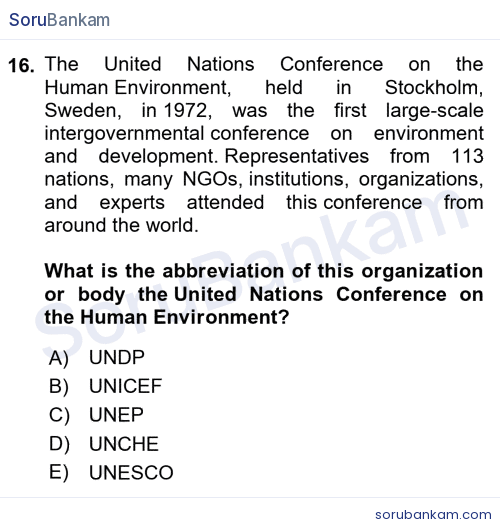
The United Nations Conference on the Human Environment, held in Stockholm, Sweden, in 1972, was the first large-scale intergovemmental conference on environment and development. Representatives from 113 nations, many NGOs, institutions, organizations; and experts attended this conference from around the world. What is the abbreviation of this organization or body the United Nations Conference on the Human Environment? 1. A) UNDP B) UNICEF C) UNEP D) UNCHE 138: E) UNESCOr
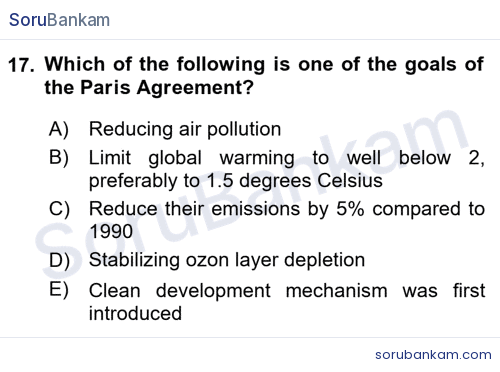
Which of the following is one of the goals of the Paris Agreement? A) Reducing air pollution B) Limit global warming to well below 2, preferably to 1.5 degrees Celsius C) Reduce their emissions by 5% compared to 1990 D) Stabilizing ozon layer depletion E) Clean development mechanism was first introduced
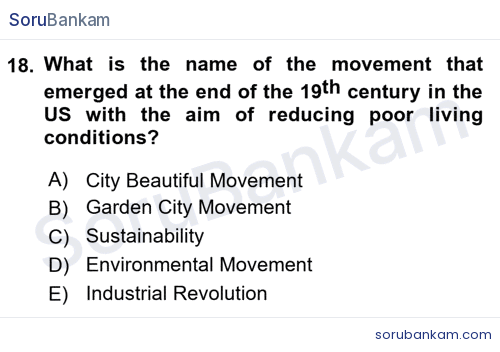
What is the name of the movement that emerged at the end of the 19th century in the US with the alm of reducing poor living conditions? A) City Beautiful Movement B) Garden City Movement C) Sustainability D) Environmental Movement E) Industrial Revolution
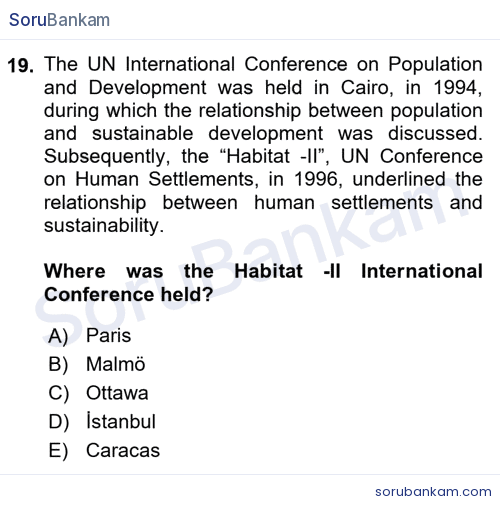
The UN Interational Conference on Population and Development was held in Cairo, in 1994, during which the relationship between population and sustainable development was discussed. Subsequently, the "Habitat -I", UN Conference , on Human Settlements, in 1996, underlined. the relationship between human settlements and sustainability. Where was the Habitat -|| International Conference held? A) Paris B) Malmo C) Ottawa D) Istanbul E) Caracas
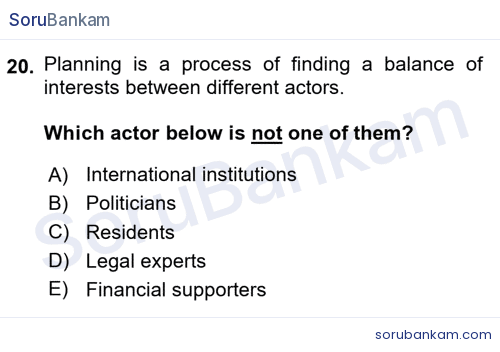
Planning is a process of finding a balance of interests between different actors. Which actor below is not one of them? A) International institutions B) Politicians C) Residents D) Legal experts E) Financial supporters