FIN208U Business Finance 2 2024-2025 Vize Soruları
20 soru · Vize · 2024-2025
FIN208U Business Finance 2 dersinin 2024-2025 vize sınavı 20 sorudan oluşur; ders AÖF İşletme (İngilizce) bölümünde okutulur. Sorular aşağıda sırasıyla yer alır. Doğru cevaplar ve sonucun, testi çözdüğünde görünür.
Önizleme · 20 soru. Cevaplamak ve sonucunu görmek için sınavı başlat.
Sorular
20 soru
Soru 1
Soru 2
Soru 3
Soru 4
Soru 5
Soru 6
Soru 7
Soru 8
Soru 9
Soru 10
Soru 11
Soru 12
Soru 13
Soru 14
Soru 15
Soru 16
Soru 17
Soru 18
Soru 19
Soru 20
Sınav modunda süre tutulur, doğru cevaplar ve sonucun sınav bitince görünür.
Dersin üniteleri
Ünite özetleri ve konu anlatımları
- 1. Ünite: Medium And Long Term Financing
- 2. Ünite: Cost Of Capital
- 3. Ünite: Capital Structure
- 4. Ünite: Capital Budgeting
- 5. Ünite: Payout (Dividend) Policy
- 6. Ünite: International Financial Management
- 7. Ünite: Risk Management
- 8. Ünite: Mergers And Acquisitions
FIN208U Business Finance 2 ders sayfası: bütün sınavlar ve üniteler
Soruların metni (otomatik okuma)
Görsellerden otomatik okunmuştur; hata içerebilir. Sorular, görsellerdeki hâliyle geçerlidir.
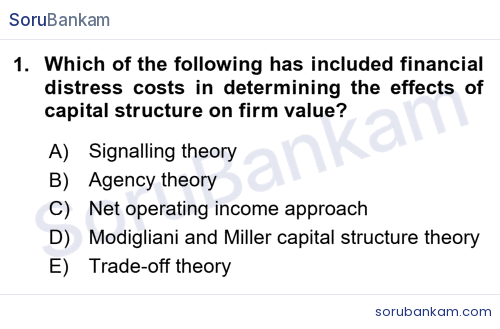
Which of the following has included financial distress costs in determining the effects of capital structure on firm value?. A) Signalling theory B) Agency theory C) Net operating income approach D) Modigliani and Miller capital structure theory E) Trade-off theory
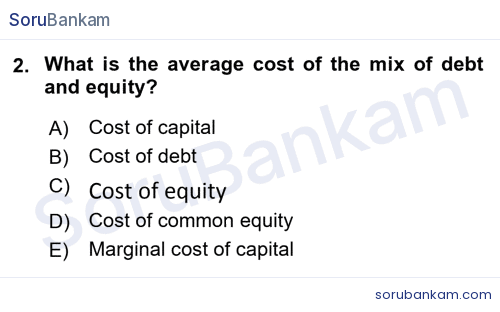
2. What is the average cost of the mix of debt and equity? A) Cost of capital 8) Cost of debt C) Cost of equity D) Cost of common equity Marginal cost of capital
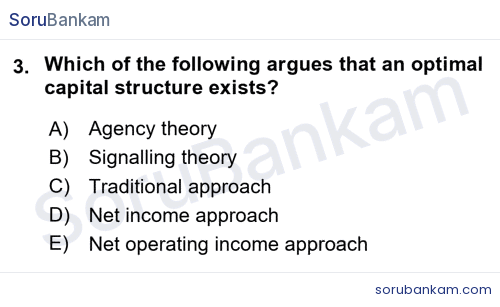
Which of the following argues that an optimal capital structure exists? A) Agency theory B) Signalling theory C) Traditional approach D) Net income approach E) Net operating income apprachi
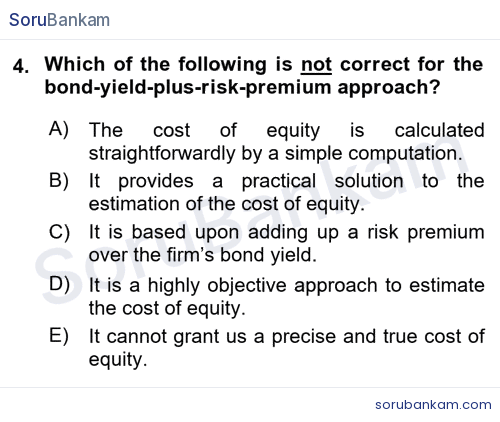
4. Which of the following is not correct for the bond-yield-plus-risk premium approach? A) The cost equity calculated straightforwardly by a simple computation. B) It provides a practical solution to. the estimation of the cost of equity, c C) It is based upon adding up a risk premium over the firm's bond yield: It is a highly objective approach to estimate the cost of equity. E) It cannot grant us a precise and true cost of equity.
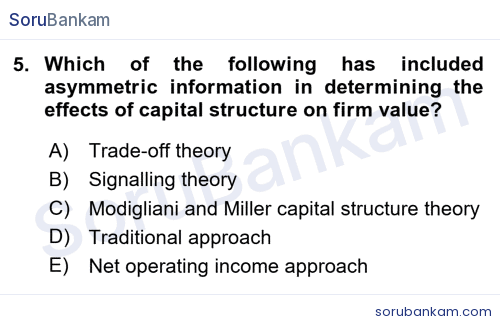
Which of the following has included asymmetric information in determining the effects of capital structure on firm value? A) Trade-off theory B) Signalling theory C) Modigliani and Miller capital structure theory D) Traditional approach E) Net operating income approach
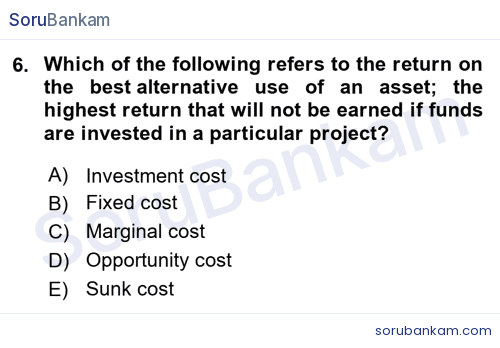
Which of the following refers to the return on the best alternative use of an asset; the highest return that will not be earned if funds are invested in a particular project? A) Investment cost B) Fixed cost. C) Marginal cost : D) Opportunity cost E) Sunk cost
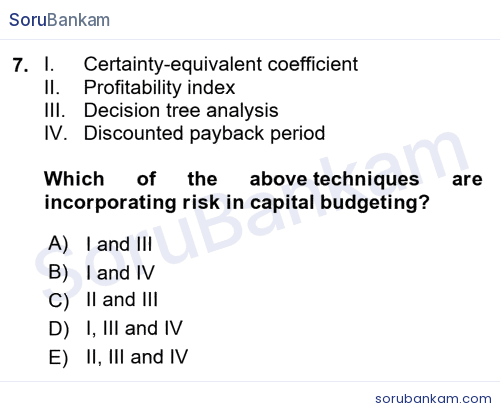
I. Certainty-equivalent coefficient !. Profitability index, III. Decision tree ahalysis IV. Discounted payback period Which of the above techniques are incorporating risk in capital budgetipg? A) I and B) kánd C) v VC) lI and I'l D) I, Ill and E) II, ill ano
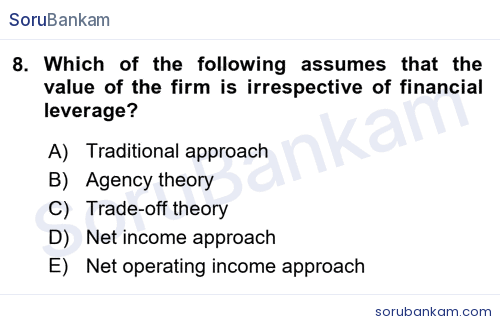
Which of the following assumes that the value of the firm is irrespective of financial leverage? A) Traditional approach B) 'Agency theory C) Trade-off theory D) Net income approach E) Net operating income approach
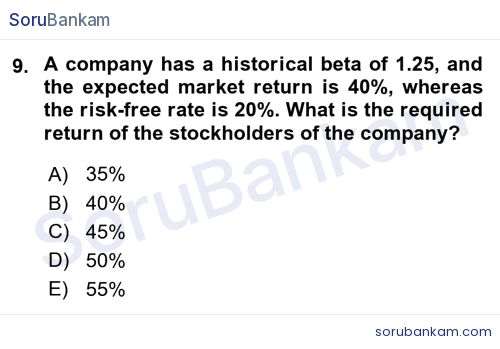
A company has a historical beta of 1.25, and the expected market return is 40%, whereas the risk-free rate is 20%. What is the required return of the stockholders of the company? A) 35% B) 40% C) 45% D) 50% E) 55%
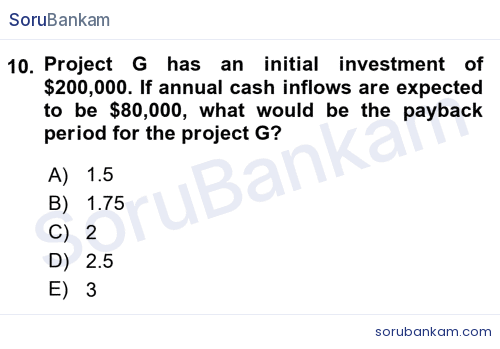
Project G has an initial investment of $200,000. If annual cash inflows are expected to be $80,000, what would be the payback period for the project G? A) 1.5 B) 1.75 C) 2 D) 2.5 E) 3
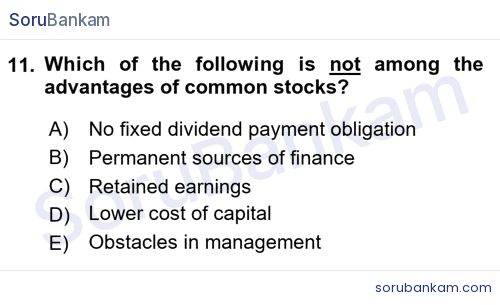
Which of the foliowing is not among the advantages of common stocks? A) No fixed dividend payment obligation B) Permanent sources of finance C) Retained eamings D) Lower cost of capital E) Obstacies in management
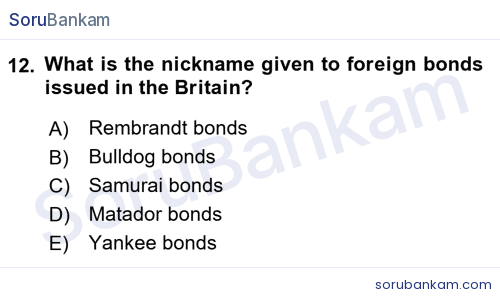
What is the nickname given to foreign bonds Issued in the Britain? A) Rembrandt bonds B) Bufldog bonds C) Samurai bonds D) Matador bonds E) Yankee bonds
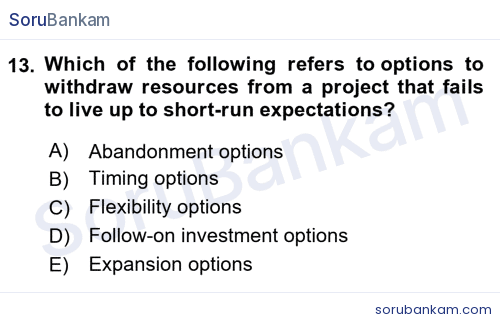
Which of the following refers to options to withdraw resources from a project that fails to live up to short-run expectations? A) Abandonment options B) Timing options C) Flexibility options D) Follow-on investment options E) Expansion options
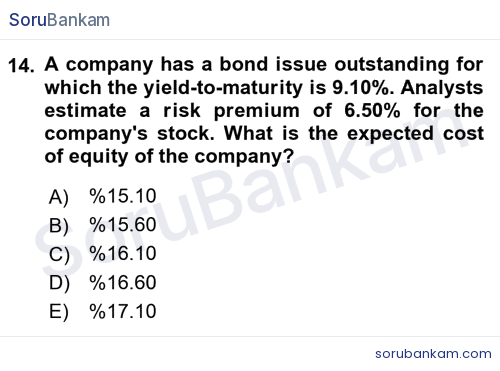
A company has a bond issue outstanding for estimate a risk premium of 6.58% for ste for the company's stock. What is the expected cost of equity of the company? A) %15.10 B) %15.60 C) %16.10% D) %16.60 E) %17.10
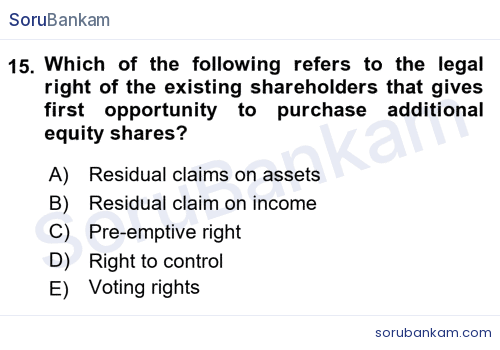
Which of the following refers to the legal right of the existing shareholders that gives first opportunity to purchaso, additional A) equity shares? ... A) Residual claims on assets B) Residual claim on income C) Pre-emptive right D) Right to control E) Voting rights
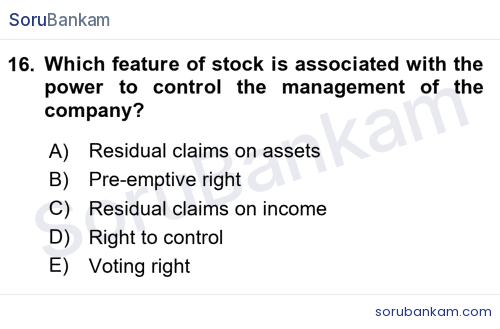
Which feature of stock is associated with the power to control the management of the company? A) Residual claims on assets B) Pre-emptive right C) Residual claims on income D) Right to control E) Voting right
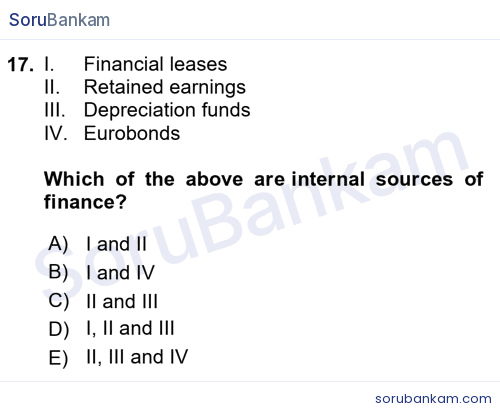
I Financial leases II. Retained eamings lil. Depreciation funds IV. Eurobonds Which of the above are internal sources of finance? A) I and B) 1 and C) Il and Ill D) 1, Il and Ill E) II, Ill and
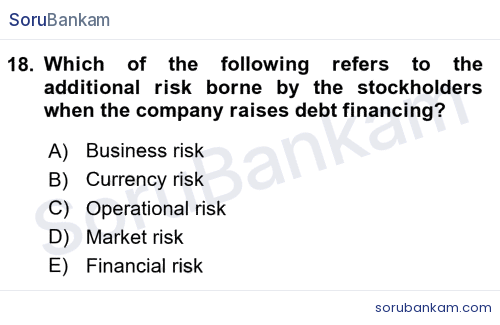
Which of the following refers to the additional risk borne by the stockholders when the company raises debt financing? A) Busirtèss risk B) Currency risk C) Operational risk, D) Market risk E) Financial risk
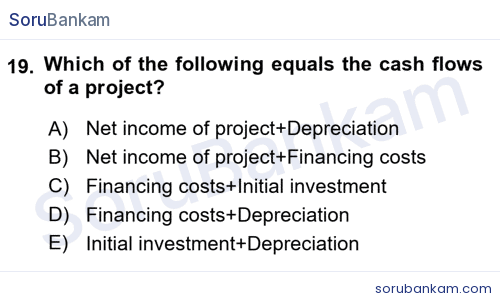
Which of the following equals the cash flows of a project? A) Net income of project+Depreciation B) Net income of project+Financing costs C) Financing costs+Initial investment D) Financing costs+Depreciation E) Initial investment+Depreciation
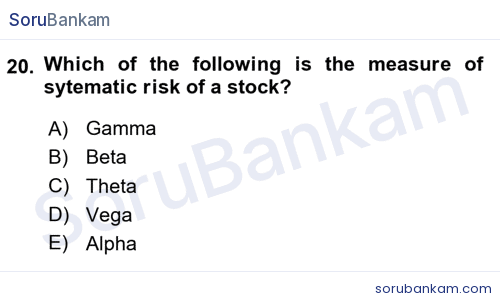
Which of the following is the measure of sytematic risk of a stock? A) Gamma B) Beta C) Theta D) Vega E) Alpha