ISL116U Business Information Systems 2018-2019 Vize Soruları
20 soru · Vize · 2018-2019
ISL116U Business Information Systems dersinin 2018-2019 vize sınavı 20 sorudan oluşur; ders AÖF İşletme (İngilizce) bölümünde okutulur. Sorular aşağıda sırasıyla yer alır. Doğru cevaplar ve sonucun, testi çözdüğünde görünür.
Önizleme · 20 soru. Cevaplamak ve sonucunu görmek için sınavı başlat.
Sorular
20 soru
Soru 1
Soru 2
Soru 3
Soru 4
Soru 5
Soru 6
Soru 7
Soru 8
Soru 9
Soru 10
Soru 11
Soru 12
Soru 13
Soru 14
Soru 15
Soru 16
Soru 17
Soru 18
Soru 19
Soru 20
Sınav modunda süre tutulur, doğru cevaplar ve sonucun sınav bitince görünür.
Dersin üniteleri
Ünite özetleri ve konu anlatımları
- 1. Ünite: Fundamentals Of Information Systems
- 2. Ünite: It Components Of Business Information Systems
- 3. Ünite: Information Systems Development And Management
- 4. Ünite: Human Resource Information System
- 5. Ünite: Marketing Information System
- 6. Ünite: Accounting/Finance Information Systems
- 7. Ünite: Production Information Systems
- 8. Ünite: Beyond Erp: From Data To Intelligence
ISL116U Business Information Systems ders sayfası: bütün sınavlar ve üniteler
Soruların metni (otomatik okuma)
Görsellerden otomatik okunmuştur; hata içerebilir. Sorular, görsellerdeki hâliyle geçerlidir.
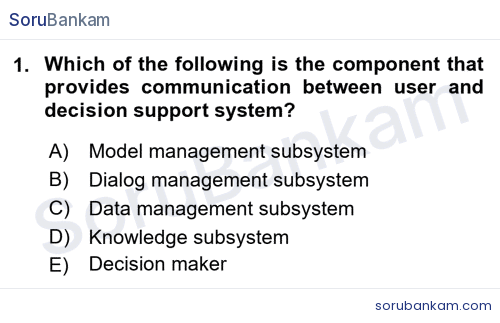
Which of the following is the component that provides communication between user and decision support system? A) Model management subsystem B) Dialog management subsystem C) Data management subsystem. D) Knowledge subsystem E) Decision maker
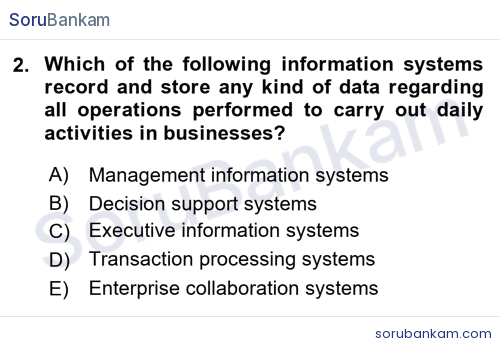
Which of the following information systems record and store any kind of data regarding all operations performed to carry out daily activities in businesses? A) Management information systems B) Decision support systems C) Executive information systems D) Transaction processing systems E) Enterprise collaboration systems
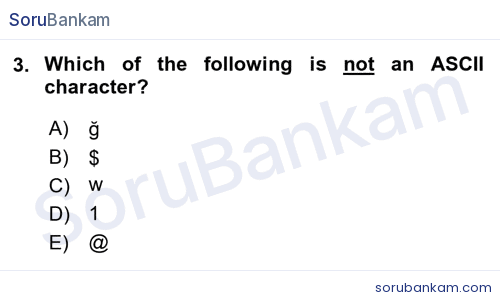
3. Which of the following is not an ASCIn character? A) B) I V C) D) E) '1.=
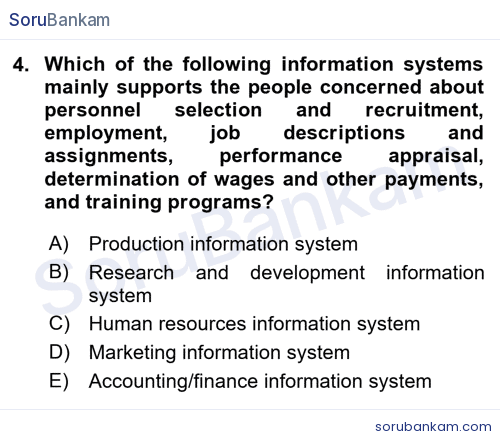
Which of the following information systems mainly supports the people concerned about personnel selaction and recruitment, employment, job descriptions and assignments, performance appraisal, determination of wages and other payments, and training programs? A) Production information system B) Research and development information system C) Human resources information system D) Marketing information system E) Accounting/finance information system
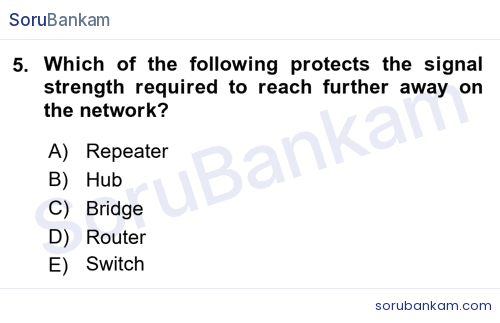
Which of the following protects the signal strength required to reach further away on the network? A) Repeater B) Hub C) Bridge "''' D) Router E) Switch
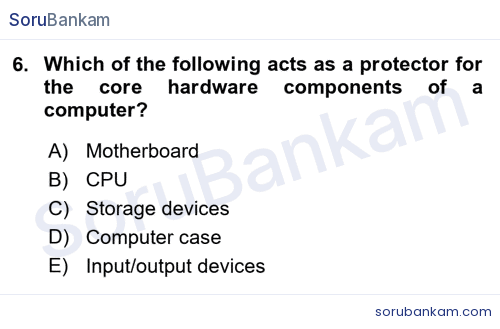
Which of the following acts as a protector for the core hardware components of computer? A) Motherboard B) " NB) ČPU C) Storage devices D) Computer case E) Inputoutput devices. *
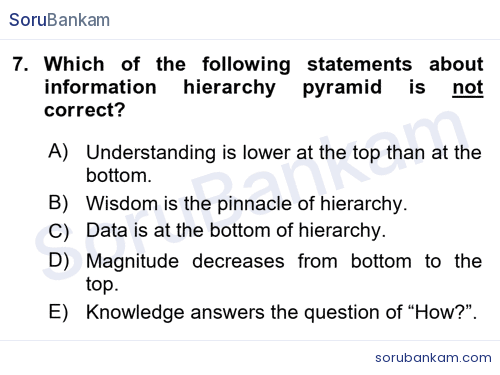
Which of the following statements about information hierarchy pyramid is not correct? A) Understanding is lower at the top than at the bottom. B) Wisdom is the pinnacle of hierarchy: C) Data is at the bottom of hierarchy. D) Magnitude decreases from bottom to the top. E) Knowledge answers the question of "How?"
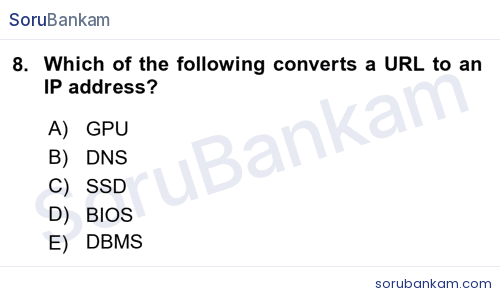
Which of the following converts a URL to an IP address? A) GPU B) DNS C) SSD D) BIOS E) DBMS
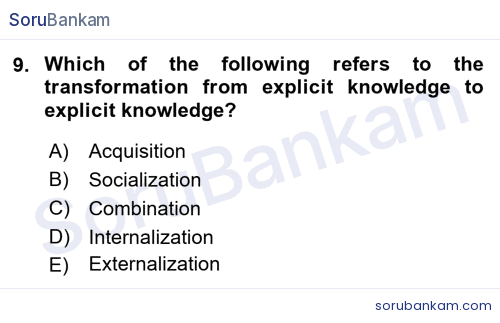
Which of the following refers to the transformation from explicit knowledge to explicit knowledge? A) Acquisition B) Socialization C) Combination D) Internalization E) Extemalization
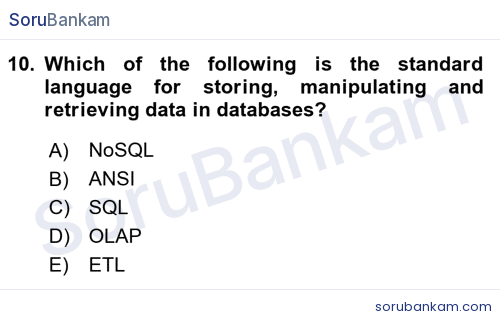
Which of the following is the standard language for storing, manipulating and retrieving data in databases? A) NoSQL B) ANSI C) SQL D) OLAP E) ETL
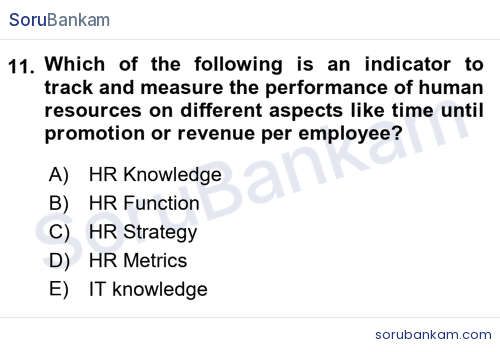
Which of the following is an indicator fo track and measure the performance of human resources on different aspects like time until promotion or revenue per employee? A) HR Knowledge B) HR Function C) HR Strategy D) HR Metrics E) IT knowledge
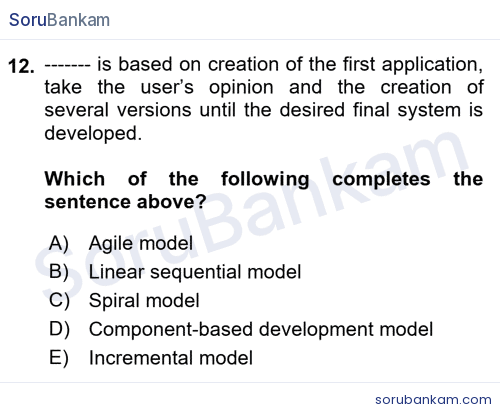
-- is based on creation of the first application, take the user's opinion and the creation of several versions until the desired final system is developed. Which of the following completes the sentence above? A) Agile model B) Linear sequential model C) Spiral model D) Component-based development model E) Incremental model
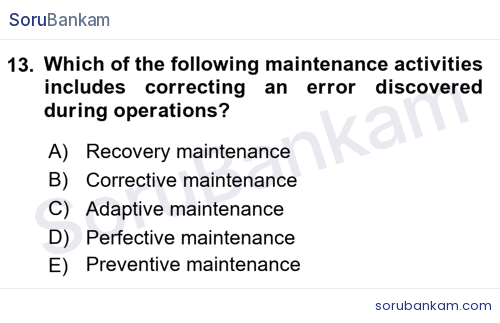
Which of the following maintenance activities includes correcting an error discovered during operations? A) Recovery maintenance B) Corrective maintenance C) Adaptive maintenance D) Perfective maintenance E) Preventive maintenance
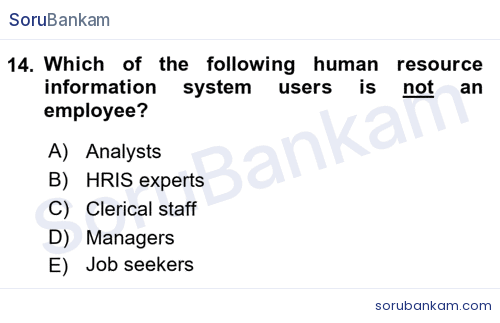
Which of the following human resource information system users not an employee? A) Apâlysts B) _HRIS experts C) Clerical staff D) Managers: • E) Job.seékers
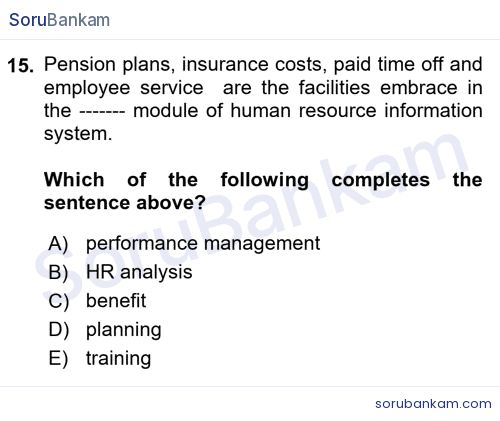
Pension plans, insurance costs, paid time off and employee service are the facilities embrace in the -_ module of human resource information system., 1 Which of the following completes the sentence above? A) performance management B) HR analysis C) benefit D) planning E) training
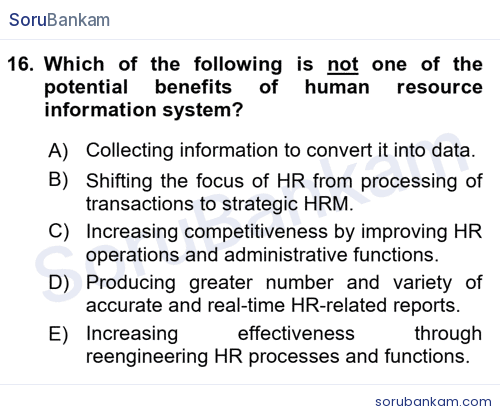
Which of the following is not one of the potential benefits of human resource information system? A) Collecting information to convert it into data. B) Shifting the focus of HR from processing of transactions to strategic HRM. C) Increasing competitiveness by improving HR operations and administrative functions. D) Producing greater number and variety of accurate and real-time HR-related reports. E) Increasing effectiveness through reengineering HR processes and functions.
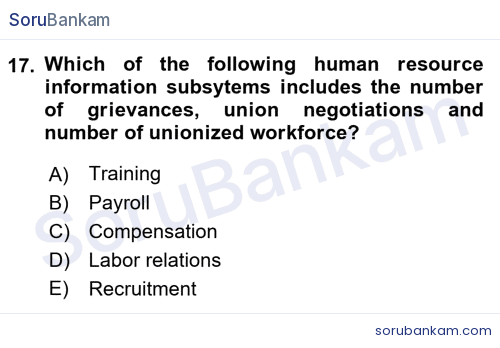
Which of the following human resource information subsytems includes the number of grievances, union negotlations and number of unionized workforce? A) Training B) Payroli C) Compensation D) Labor relations E) Recruitment
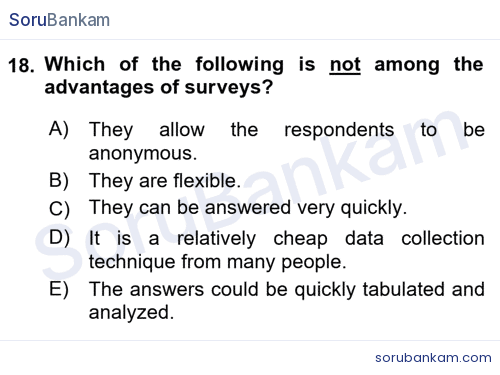
Which of the following is not among the advantages of surveys? A) They allow the respondents to be anonymous. B) They are flexible. C) They can be answered very quickly. D) It is a relatively cheap data collection technique from many people. E) The answers could be quickly tabulated and analyzed.
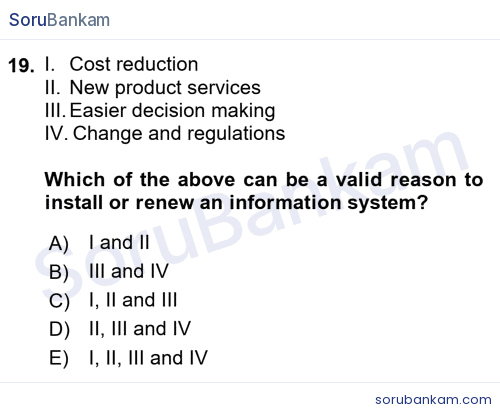
1. Cost reduction II. New product services lil. Easier decision making IV. Change and regulations Which of the above can be a valid reason to Install or renew an information system? A) I and B) lil and C) 1, li and Ill D) II, Ill and E) I, li, Ill and
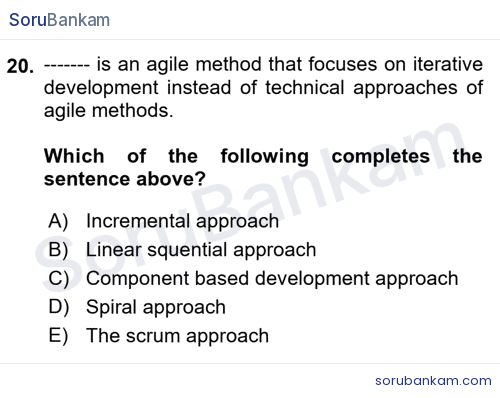
sunnu. is an agile method that focuses on iterative development instead of technical approaches of agile methods. Which of the following completes • the sentence above? A) Incremental approach B) Linear squential approach C) Component based development approach D) Spiral approach E) The scrum approach