INO304U Çocuklara Yabancı Dil Öğretimi 2 2012-2013 Vize Soruları
20 soru · Vize · 2012-2013
INO304U Çocuklara Yabancı Dil Öğretimi 2 dersinin 2012-2013 vize sınavı 20 sorudan oluşur; ders AÖF İngilizce Öğretmenliği bölümünde okutulur. Sorular aşağıda sırasıyla yer alır. Doğru cevaplar ve sonucun, testi çözdüğünde görünür.
Önizleme · 20 soru. Cevaplamak ve sonucunu görmek için sınavı başlat.
Sorular
20 soru
Soru 1
Soru 2
Soru 3
Soru 4
Soru 5
Soru 6
Soru 7
Soru 8
Soru 9
Soru 10
Soru 11
Soru 12
Soru 13
Soru 14
Soru 15
Soru 16
Soru 17
Soru 18
Soru 19
Soru 20
Sınav modunda süre tutulur, doğru cevaplar ve sonucun sınav bitince görünür.
Dersin üniteleri
INO304U Çocuklara Yabancı Dil Öğretimi 2 ders sayfası: bütün sınavlar ve üniteler
Soruların metni (otomatik okuma)
Görsellerden otomatik okunmuştur; hata içerebilir. Sorular, görsellerdeki hâliyle geçerlidir.
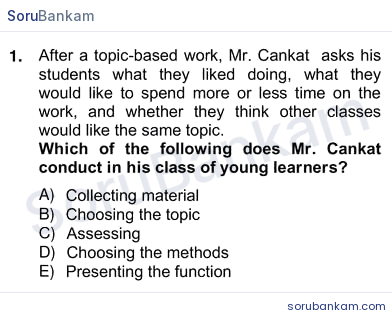
After a topic-based work, Mr. Cankat asks his students what they liked doing, what they would like to spend more or less time on the work, and whether they think other classes would like the same topic. • Which of the following does Mr. Cankat conduct in his glass of young leapers? A) Coleoting material ..... B) . Choosing the topic C) i* C) Assessing D) Choosing the methods E) Presenting the function
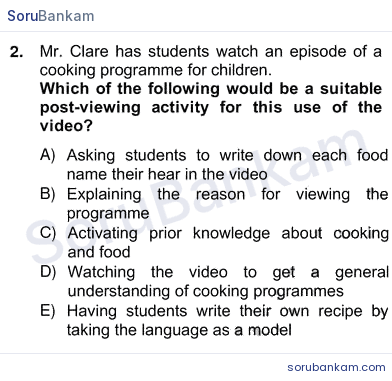
2. Mr. Clare has students watch an episode of a cooking programme for children. Which of the following would be a suitable post-viewing activity for this use of the video? A) Asking Students to write down each food name their hear in the video. B) Explaining the reason. for viewing programme Activating prior knowledge about. and food D) Watching the video to ge ageneral understanding of cooking programmes Having students write thei own racipe. taking the language as a model
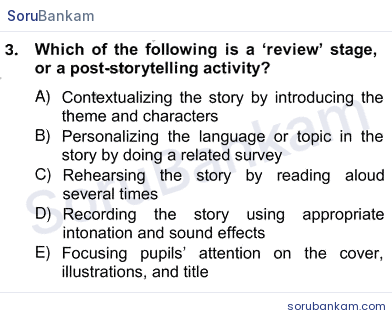
Which ofthe following is a 'review' stage; or @post gtorytelling activity? Contextualizing the story by introducing the fueme and characters. Personalizing the language or topic in the story by doing a related survey C) Rehearsing «tHe story by. reading aloud several times D) Recording the story using appropnate intonation and sound effects E) Focusing pupils' attention on the cover, illustrations, and title
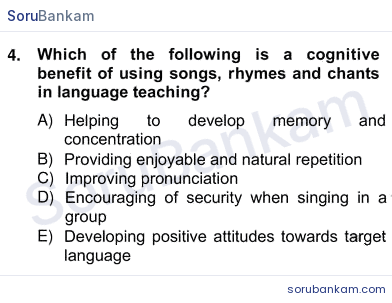
4. Which the following is a cognitive benefit of using songs, rhymes and shants in language teaching? A) Helping to develop memory and concentration B) Providing enjoyable and natural repetition C) Improving pinunciation D) Encauraging of security-when singing in group Developing positive attitudes towards language
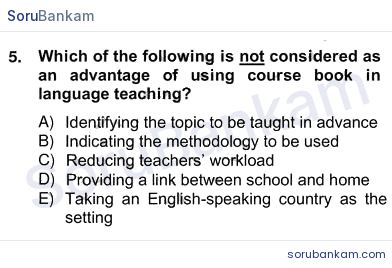
5. Which of the following, is not constered as an advantage colse. book in language teaching? A) Identiving the topic to betaught in advance B) Indiceting the methodology to be used C) Reducing deachers Bikoad reviling a thik between school and home Taking an Eaglish-speaking country as the Betting
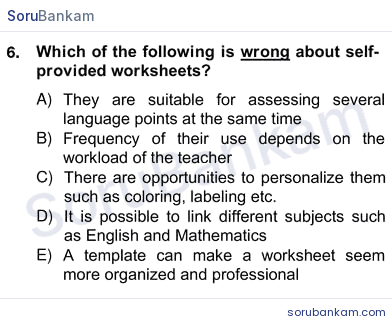
Which of the following Is wrong about self- provided worksheets? A) They are suitable for assessing several language points at the same time B) Frequency of their use depends on the. workload of the teacher C) There are opportunities to personalize them suchas coloring, labelingietc. #'is possible to link different subjects such as English and Mathematics E A template can make a worksheet seem more organized and professional
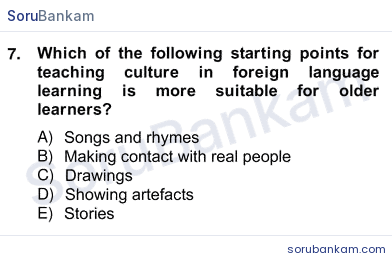
Which of the following starting points for teaching culture in foreign language learning is more suitable for older • learners? A) Ay Songs and rhymes B) Making contact with real people C) Drawings D) Showing artefacts E) Stories
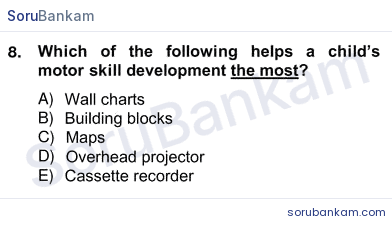
Which of the following helps a child's motor skill development the most? A) Wall charts B) Building blocks C) Maps D) Overhead projector E) Cassette recorder :...:
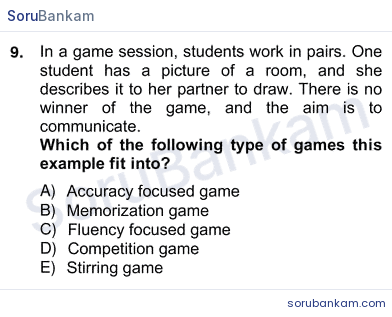
In a game session, students work in pairs. One student has a picture of a room, and she describes it to her partner to draw. There is no winner of thie game, and the aim is to communicate. Which of the following type of games, this example fit into? A) Accuracy focused game,, B) Memorization game- C) i* C) Fluency focused game D) Competition game E) Stirring game
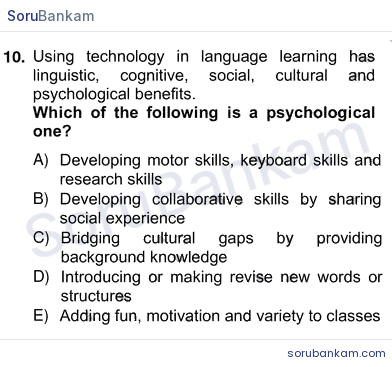
Using technology in language learning linguistic, cognitive, social, cultural psychological behefits. Which of the following Is a psychological ane? A) Developing motor skills, board skits and B) Deyeloping collaboral skills shating •gaps providing C) background knowledge D) Introduçing or making, ray now words. or structures E) Adding fug, motivation and variety to classes
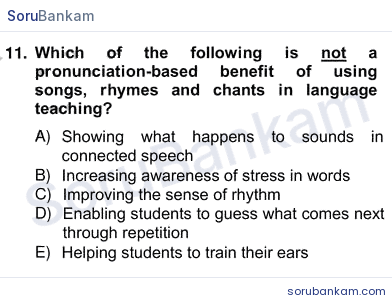
Whiph the following not nonuiçiation-based benefit using ongs, rhymes and chants in language A) teaching? Showing what happens to sounds in?. connected speech B) Increasing awareness of stress it words C) Improving the sense of rhythm D) Enabling students to guess what comes next through repetition E) Helping students to train their ears
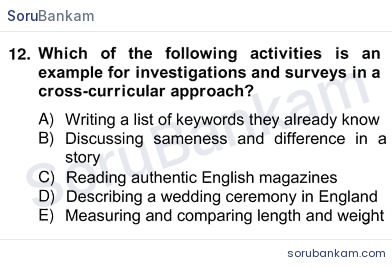
Which of the following activitias is an example for investigations and surveys in a cross-curricular approach? A) Writing a list of keywords they already know B) Discussing sameness and difference in e stary C) Reading authlintic English magazines D) Deserbing a wedding cereriony in England E) Weasuring and comparing length and weight
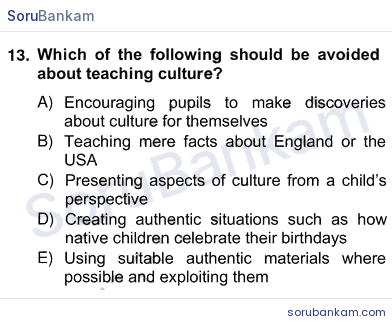
13. Which of the following should be ay about teaching culture A) Encouraging soupis to make Aseyeries about culture foraemselves B) Teaching: n ere facts about stand or the USA C) Presi aspects of dulture from a child's Creating authentic Situations such as how native children celebrate their birthdays Using suitable authentic matenals where possible an exploiting them
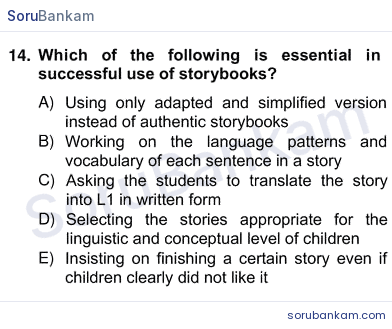
74. Which of the following is essential in successful use of storybooks? A) Using only adapted and simplified version instead of authentie storybooks . B) Working on the language patterns and vocabulary of each sentence in a story C) Asking the students to translate the story into Lit in written form." Selecting the stories appropriate for the linguistic and conceptual level of children E) Insisting on finishing a certain story even if children cleanly did not like it
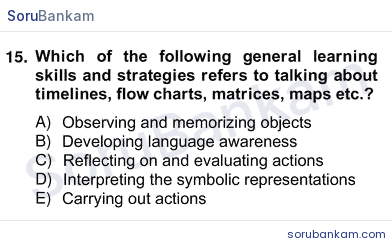
Which of the following general learning skills and strategias refers to talking about timelines, flow charts, matrices, maps etc.? A) Observing and memorizing objects B) Developing language awareness C) Reflecting on and evaluating actions -•* D) Interpreting the symbolic represehtations E) Carrung out actions.
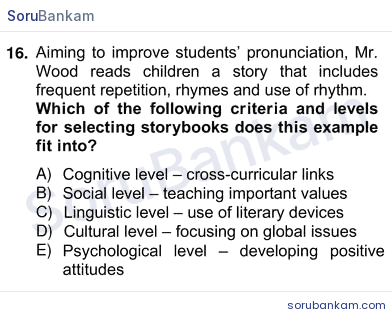
Aiming to improve students' pronunciation, Mr. Wood reads children a story that includes frequent repetition, rhymes and use of rhythm. • Which of the following, criterla and levels for selecting storybooks does this example fit into? A) Cognitive level - cross-curricular-inks B) Social level - teaching important values C) Linguistic level - use of literary devices D) Cultural level - focusing on globai issues- E) Psychological level - developing positive attitudes
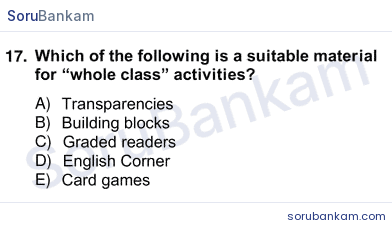
Which of the following is a suitable materlal for "whole class" activities? A) Transparencies B) Building blocks C) Graded readers D) English Comer E) Card gamest
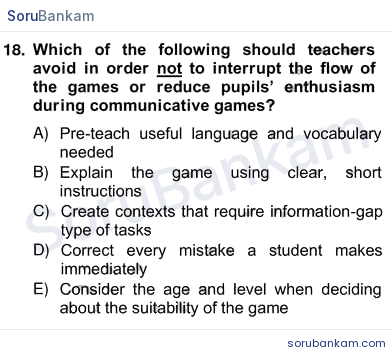
Which of the following shoulde. chats avoid in order not to interrupt the fiot of the games or reduce pupris. arthusiasm during communicative games A) Pre-teach useful language änd vocabel needed B) Explain the gan short instructiprtet C) Qréate contextsethat requi ofmation-gap "" type of taskss D) Correct every mistake student makes imfrediately E) Conder the age and revel when deciding angui the suitablty of the game
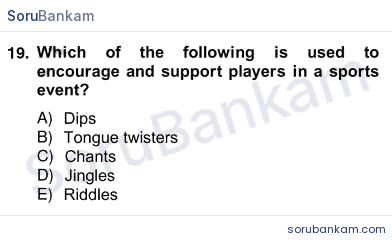
59 Which of the following used to concourage and support players in a sports event? A) Dips B) Tongue twisters C) Chants D) Jingles E) Riddleg. 1. 11
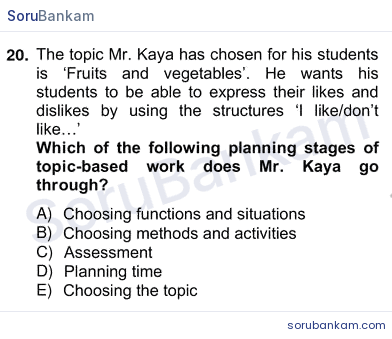
20. The topic Mr. Kaya has chosen for his students is 'Fruits and vegetables'. He wants his students to be abte to express their likes and dislikes by using the structures 'I like/don't like. •Which of the following planning stages of topic-based work does Mr. Kayà through?.,"'. A) Choosing functions and situations Choosing methods and activities C) Assessment Pianning time E) Chaosing the topic