INO309U İngiliz/Amerikan Edebiyatı 1 2015-2016 Final Soruları
20 soru · Final · 2015-2016
INO309U İngiliz/Amerikan Edebiyatı 1 dersinin 2015-2016 final sınavı 20 sorudan oluşur; ders AÖF İngilizce Öğretmenliği bölümünde okutulur. Sorular aşağıda sırasıyla yer alır. Doğru cevaplar ve sonucun, testi çözdüğünde görünür.
Önizleme · 20 soru. Cevaplamak ve sonucunu görmek için sınavı başlat.
Sorular
20 soru
Soru 1
Soru 2
Soru 3
Soru 4
Soru 5
Soru 6
Soru 7
Soru 8
Soru 9
Soru 10
Soru 11
Soru 12
Soru 13
Soru 14
Soru 15
Soru 16
Soru 17
Soru 18
Soru 19
Soru 20
Sınav modunda süre tutulur, doğru cevaplar ve sonucun sınav bitince görünür.
Dersin üniteleri
INO309U İngiliz/Amerikan Edebiyatı 1 ders sayfası: bütün sınavlar ve üniteler
Soruların metni (otomatik okuma)
Görsellerden otomatik okunmuştur; hata içerebilir. Sorular, görsellerdeki hâliyle geçerlidir.
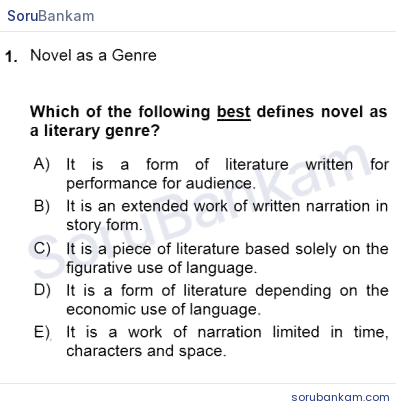
1. Novel as a Genre • Which of the following best defines novel as a literary genre? a to po. A) It is a form of literature written for performappe for audience.« B) It, is dif extended workto written narration in story form C) It is a piece of literature based solely on the figurative use of language. D) It is a form of literature depending on the economic use of language. It is a work of narration limited in time, characters and epace.
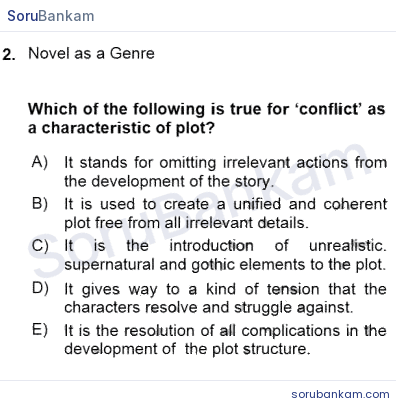
2. Novel as a Genre Which of the following is true for confecte a characteristic of plot? A) It stands for omitting irrelevam *is fram the developinènt of the store 4 is used to create a untied and coherent plot free from all irreleva details C) It is the D) characters resolve and Suggie, against. E) It is the tesgution opall complications development of the plot structure:
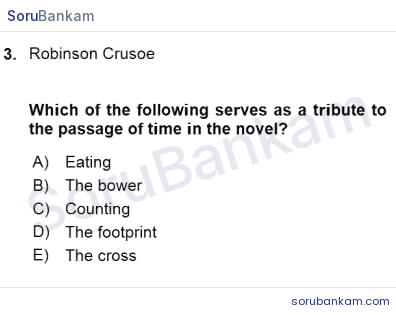
Robinson Crusoe • Which of the following serves as a tribute to the passage of time in the novel? A) Eating B) t' The bowen C) Forting ..** D) The footprint E) The cross
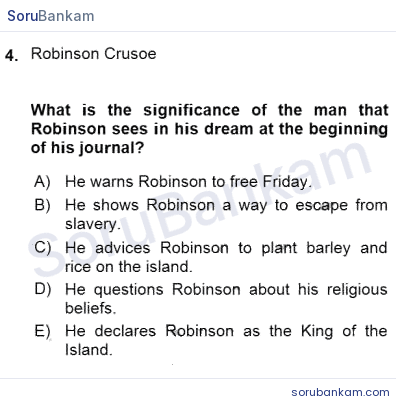
Robinson Crusoe • What is the significance of the man that Robinson sees in his dream at the beginning of his journal? A) He wams Robinson to free Fric B) He snows Robinson & way e from slavery. C) He advices Robinso to want barley and rice on the island. D) He questions Robinson about his religious belies. E) He declares. Robinsori as the King of the Island
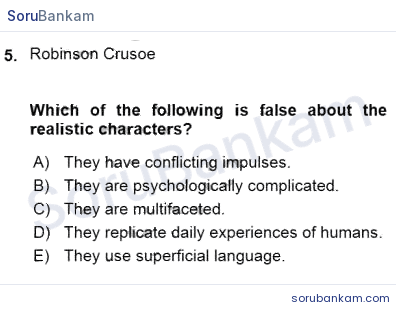
5. Robimse of the Towing is false about the realistic cters? d, A) They confictiny pulses. B) atley are psyen as camy campicated. dy are paultira They reptieafe daily experiences of humans. They use siperficial language.:
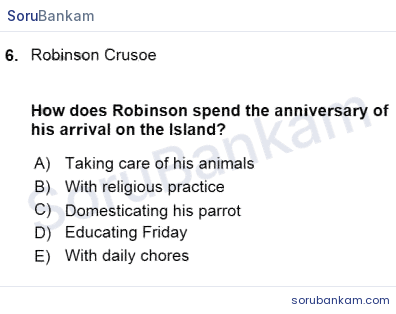
Robinson Crusoe How does Robinson spend the anniversary of his arrival on the Island? A) Taking care of his animals B) With religious practice C) Domesticating his paid'" D) .. *D) Educating Friday E) With daily chores
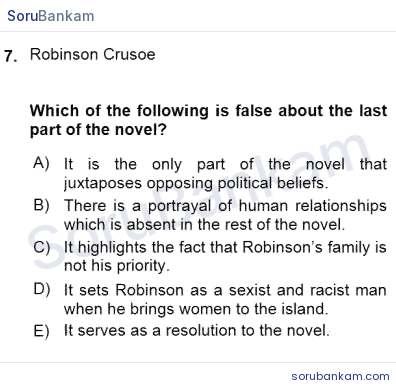
7. Robinson Crusoe • Which of the following is false about the last part of the novel? A) It is the only part of the navel that juxtaposes opposing political ballets. B) Thete is a portrayal of human relationships Which is absent in the rest of the novel. C) It highlights the fact that Robinson's family is not his priority; D) It sets Robinson as a sexist and racist man when he brings women to the island. It serves as a resolutionto the novel.
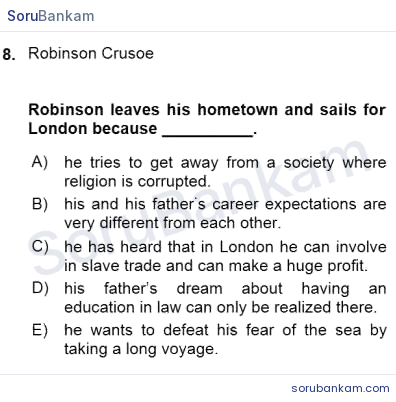
8. Robinson Crusce Robinson leaves his hometown and sails for London because .... A) he tries to get away from a society where religion is cotrupted. B) hip ond his father's caredi expectations are very different from each other. C) he has heard that in London he can involve in siave trade and can make a buge profit. D) his father's dream about having an ediacation in law can only be realized there. he wants to defeat his fear of the sea by taking a long voyage.
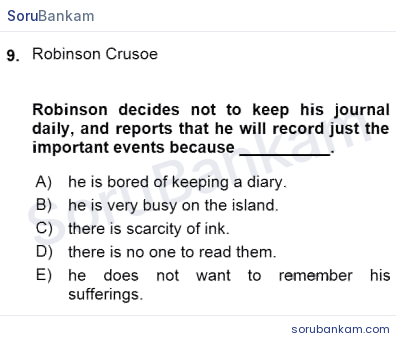
Robinson Crusoe Robinson decides not to keep his journal daily, and reports that he will record just the important events because A) he is bored of keeping a diary...* B) hats very busy on thevstand C) 4, G) there is scarcity of ink. D) there is no one to read them. E) he does not want to sneraber hist sufferings.
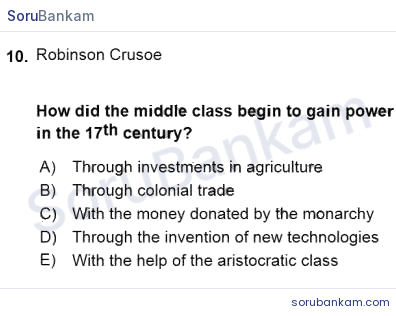
10. Robinson Crusoe How did the mate a class b Ito gain power in the 17th century? A) Through investrpers B). ough colonial trade. ith the money donated by te menarchy Through the invention of new technologies With the help of the aristocratic class
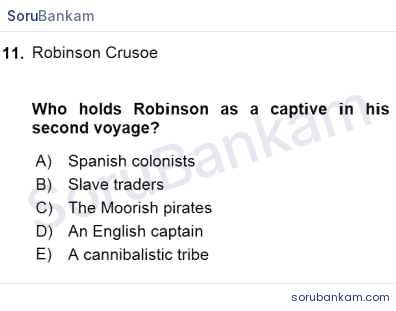
11. Robinson Crusoe • Who holds Robinson as a captive in his secord voyage? r.... A) Spanish colonists B) Slave traders' •N! The Moorish pirates An English captain A cannibalistic tribe
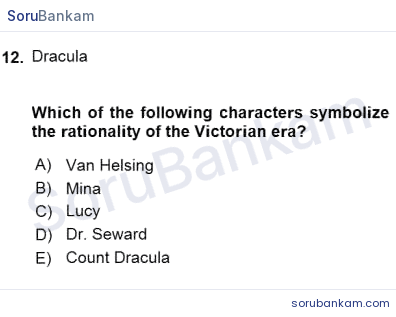
Dracula Which of the following characters symbalize the rationality of the Victorian era? A) Van Helsing B) Mina C) Librey cisteni D) ... D) Dr. Seward E) Count Dracula
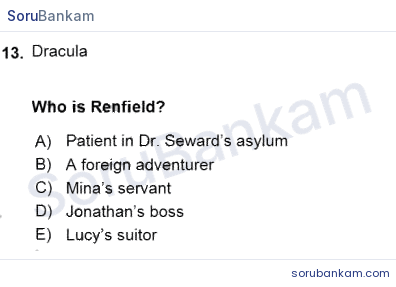
13. Dracula ire field? Patient in! award's asygum A foreigh denturer C) Minds servant 1,D) Jeriathan's boss ina he's suitor
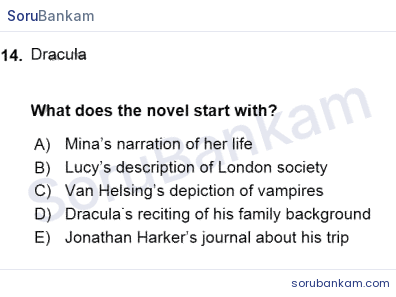
Dracina hat does the novel start with? A) Mina's narration of her life B) Lucy's description of London society* C) Van Helsing's depiction of sarpires D) . Dracula's reciting of his family background E) Jonathan Harkers journal about his trip.
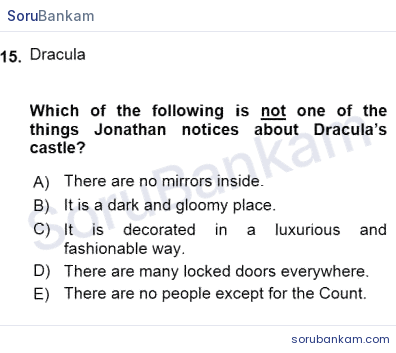
15. Dracula Which of the following, Is not one of the things Jonathan notices about Dracula's castle? 2t......ru.ta A) There are no mirors inside., B) lisat dark and gloomy place. it is decorated in a luxurious and fashionable way. D) There are many locked doors everywhere. E) There are no people except for the Count.
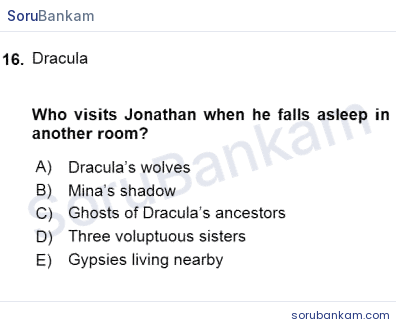
16. Dracula Who visits Jonathan wher he falls asleep in another room? A) Dracula's wolves C) Ghosts of Dracula's ancestors Mina's shadow .. "Ö) Three voluptuous sisters E) Gypsies living nearby
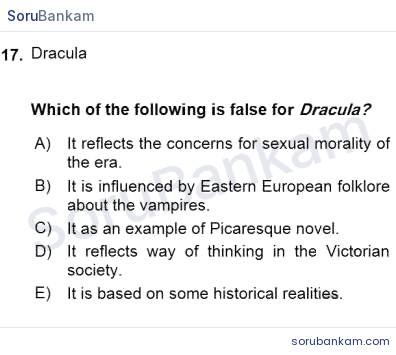
Dracula • Which of the following is false for Dracula? A) It reflects the concerns for sexual morality of the era. B) It is inflyended by Eastem European falklore about the vampires. C) ..C) It as an example of Picaresque novel. D) It reflects way of thinking in the Victorian society. E) It is based on some historical realities
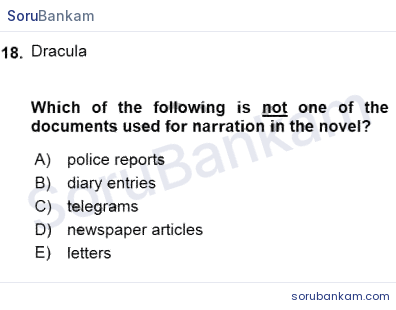
18. Dracula 4 Which of the foraying of the document use or narration Die novel? A) police reporte B) diary entries" C) gwspaper articles etters
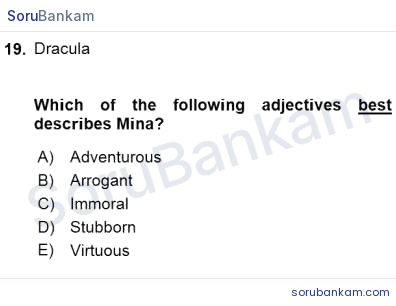
19. Dracula Which of the following adjectives best describes Mina? A) Adventurous 3•$...... rate. B) Arrogant, i* C) "Stubborn E) Virtuous
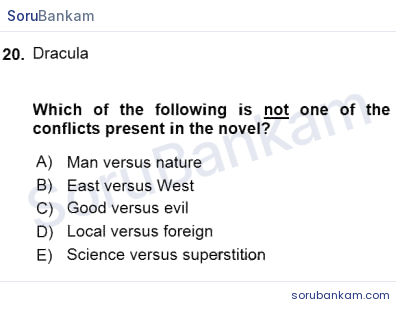
20. Dracula Which of the following is not one of othe conflicts present in the novel? A) Man versus nature B) East versus West C) Good versus evil .."'D) Local versus foreign E Science versus superstitia