IKT451U Economic Growth And Development 2024-2025 Final Soruları
20 soru · Final · 2024-2025
IKT451U Economic Growth And Development dersinin 2024-2025 final sınavı 20 sorudan oluşur; ders AÖF İktisat (İngilizce) bölümünde okutulur. Sorular aşağıda sırasıyla yer alır. Doğru cevaplar ve sonucun, testi çözdüğünde görünür.
Önizleme · 20 soru. Cevaplamak ve sonucunu görmek için sınavı başlat.
Sorular
20 soru
Soru 1
Soru 2
Soru 3
Soru 4
Soru 5
Soru 6
Soru 7
Soru 8
Soru 9
Soru 10
Soru 11
Soru 12
Soru 13
Soru 14
Soru 15
Soru 16
Soru 17
Soru 18
Soru 19
Soru 20
Sınav modunda süre tutulur, doğru cevaplar ve sonucun sınav bitince görünür.
Dersin üniteleri
IKT451U Economic Growth And Development ders sayfası: bütün sınavlar ve üniteler
Soruların metni (otomatik okuma)
Görsellerden otomatik okunmuştur; hata içerebilir. Sorular, görsellerdeki hâliyle geçerlidir.
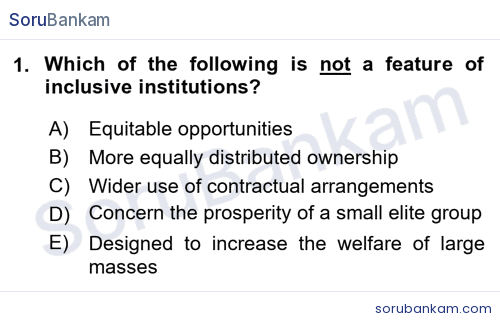
Which of the following is not a feature of inclusive institutions? A) Equitable opportunities B) More equally distributed ownership C) Wider use of contractual arrangements D) Concern the prospenty of a small elite group E) Designed to increase the welfare of large masses
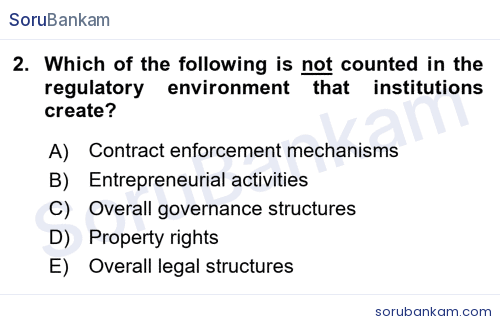
Which of the following is not counted in the regulatory environment that institutions create? A) Contract enforcement mechanisms B) S Entrepreneurial activities C) Overall governance structures D) Property rights E) Overall legal structures
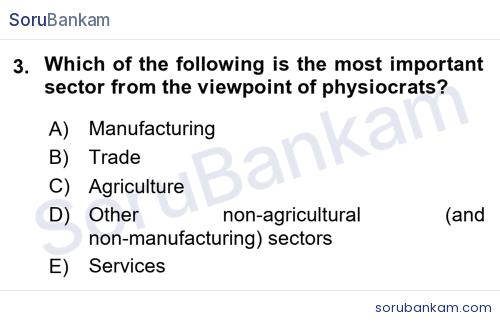
Which of the following is the most important sector from the viewpoint of physiocrats? A) Manufacturing B) Trade C) Agriculture D) Other non-agricultural (and non-manufacturing) sectors E) Services
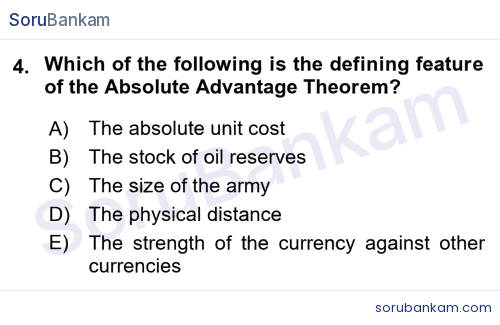
4. Which of the following is the defining feature of the Absolute Advantage Theorem? A) The absolute unit cost B) The stock of oil reserves C) The size of the army D) The physical distance The strength of the currency against other ctrtencies
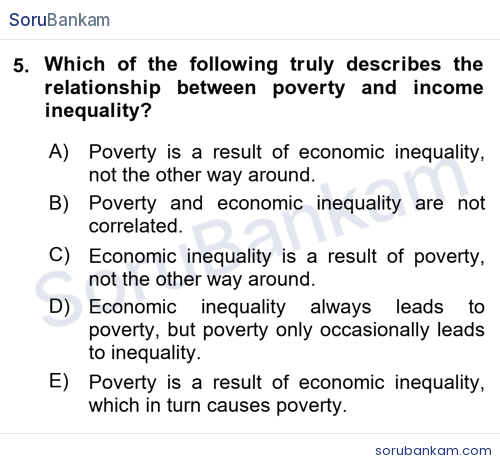
Which of the following truly describes the relationship between poverty and income inequality? A) Poverty is a result of economic inequality, not the other way around. B) Poverty and economic inequality are not correlated. C) Economic inequality is a result of poverty, not the other way around. D) Economic inequality always leads to poverty, but poverty only occasionally leads to inequality. E) Poverty is a result of economic inequality, which in turn causes poverty.
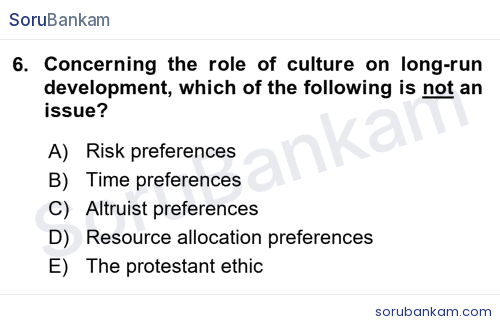
Concerning the role of culture on long-run development, which of the following Is not an issue? A) Risk preferences B) Time preferences C) Altruist preferences D) Resource allocation preferences E) The protestant ethic
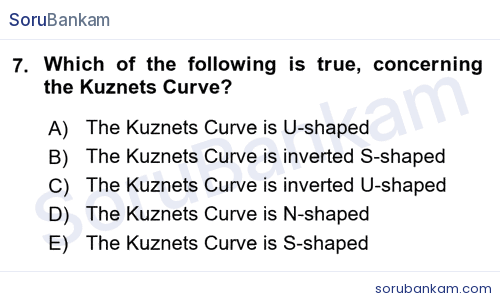
Which of the following is true, concerning the Kuznets Curve? jir A) The Kuznets Curve is U-shaped B) The Kuznets Curve is inverted S-shaped C) The Kuznets Curve is inverted U-shaped D) The Kuznets Curve is N-shaped E) The Kuznats Curve is S-shaped
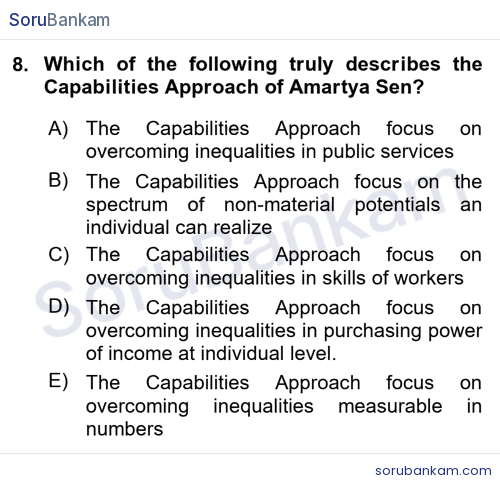
8. Which of the following truly describes the Capabilities Approach of Amartya Sen? A) The, Capabilities Approach focus on & vercoming inequalities in public services B) The Capabilities Approach focus on the spectrum of non-material potentials an individual can realize C) The. Capabilities Approach focus on * overcoming inequalities in skills of workers ~• D) The Capabilities Approach focus or overcoming inequalities in purchasing power of income at individual level. E) The Capabilities Approach focus on overcoming inequalities measurable in numbers
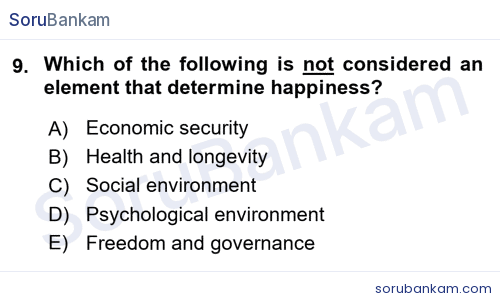
Which of the following is not considered an element that determine happiness? A) Economic security B) Health and longevity C) Social environment D) Psychological environment E) Freedom and governance
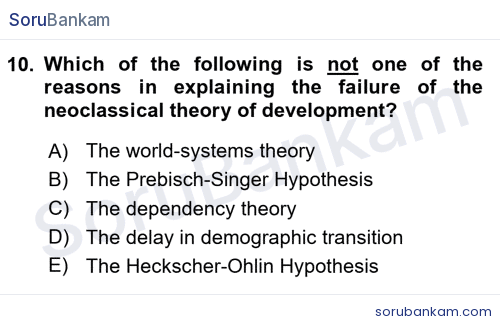
Which of the following is not one of the reasons in explaining the failure of the neoclassical theory of development? A) The world-systems theory B) The Prebisch-Singer Hypothesis C) The dependency theory D) The delay in demographic transition E) The Heckscher-Ohlin Hypothesis
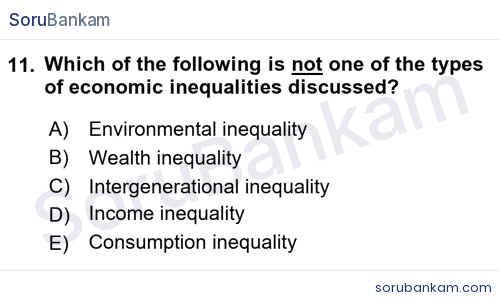
11. Which of the following is not one of the types of economic inequalities discussed? Environmental inequality Wealth inequality C) Intergenerational inequality D) Income inequality E) Consumption inequality
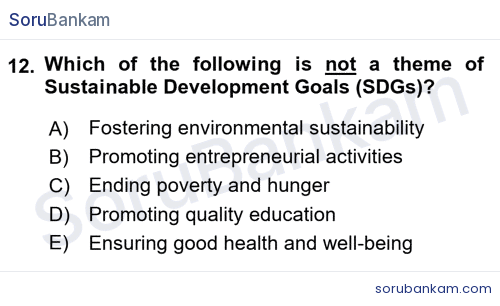
Which of the following is not a theme of Sustainable Development Goals (SDGs)? A) Fostering environmental sustainability B) Promoting entrepreneurial activities C) Ending poverty and hunger D) Promoting quality education E) Ensuring good health and well-being
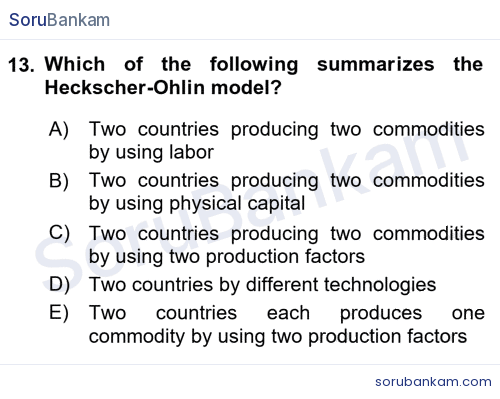
Which of the following summarizes the Heckscher-Ohiln model? A) Two countries producing two commodities by using labor B) Two countries producing two commodities! by using physical capital C) Two countries producing two commodities by using two production factors D) Two countries by different technologies E) 2) Two countries each produces one commodity by using two prodaction factors
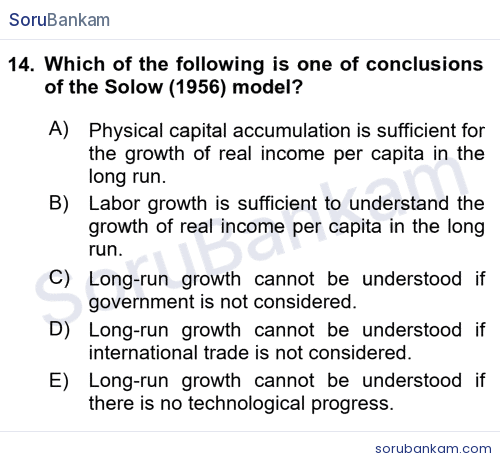
14. Which of the following is one of conclusions of the Solow (1956) model? A) Physical capital accumulation is sufficient for the growth of real income per capita in the long run. "''' B) Labor growth is sufficient to understand the growth of realincome per capita in the long run. C) tong-run growth cannot be understood if government is not considered. D) Long-run growth cannot be understood if international trade is not considered. Long-run growth cannot be understood if there is no technological progress.
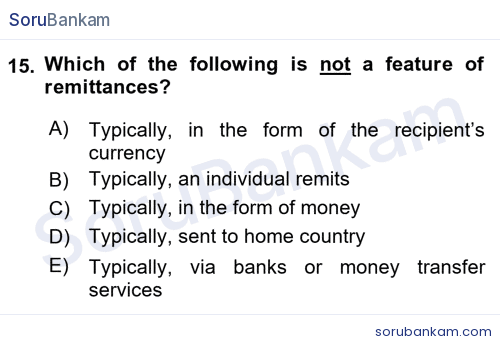
Which of the following is not a feature of remittances? A) Typically, in the form of the recipient's currency B) Typically, an individual remits C) Typically, in the form of money D) Typically, sent to home country E) Typically, via banks or money transfer services
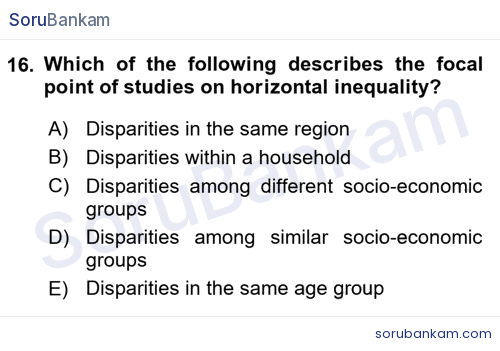
Which of the following describes the focal point of studies on horizontal inequality? A) Disparities in the same region B) Disparities within a household C) Disparities among different socio-economic groups D) Disparities among similar socio-economic groups E) Disparities in the same age group
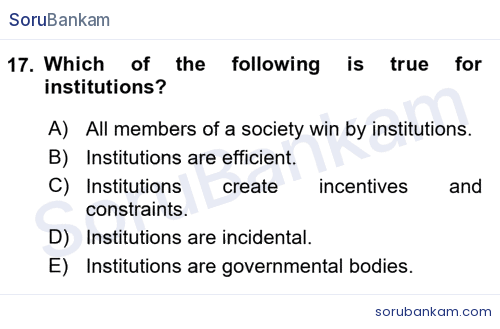
Which of the following is true for institutions? A) All members of a society wint by institutions. B) Institutions are efficient. C) Institutions create incentives and constraints. D) Institutions are incidental. E) Instifutions are governmental bodies.
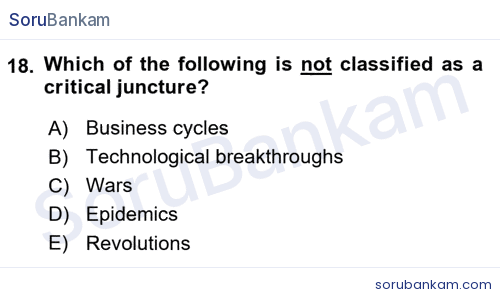
18. Which of the following is not classified as a critical juncture? A) Business aycles Technological breakthroughs INC Wars Epidemics E) Revolutions
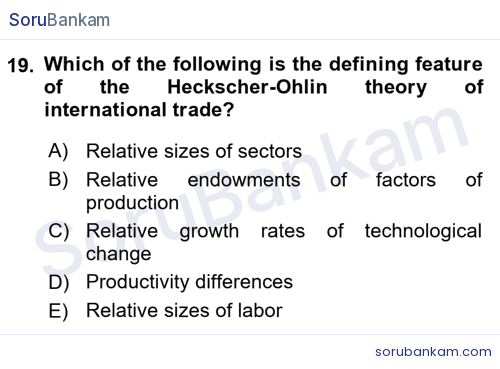
Which of the following is the defining feature of the Heckscher-Ohlin theory of international trade? A) Relative sizes of sectors B) Relative endowments factors of production C) Relative growth rates of technological change D) Productivity differences E) Relative sizes of labor
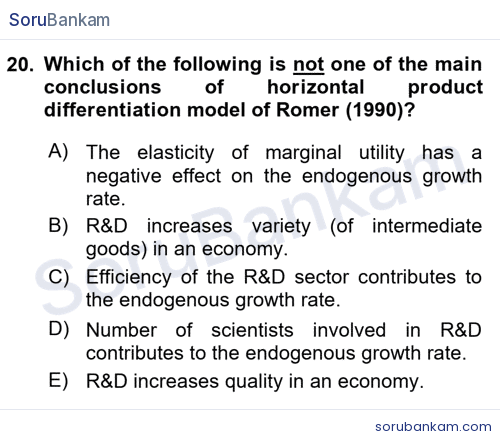
Which of the following is not one of the main conclusions of horizontal product differentiation model of Romer (1990)? A) The elasticity of marginal utility has a negative effect on the endogenous growth rate. B) R&D increases variety (of intermediate goods) in an economy. C) Efficiency of the R&D sector contributes to the endogenous growth rate. D) Number of scientists involved in R&D contributes to the endogenous growth rate. E) R&D increases quality in an economy.