ULI459U Global Political Economy 2020-2021 Yaz Okulu Soruları
20 soru · Yaz okulu · 2020-2021
ULI459U Global Political Economy dersinin 2020-2021 yaz okulu sınavı 20 sorudan oluşur; ders AÖF İktisat (İngilizce) bölümünde okutulur. Sorular aşağıda sırasıyla yer alır. Doğru cevaplar ve sonucun, testi çözdüğünde görünür.
Önizleme · 20 soru. Cevaplamak ve sonucunu görmek için sınavı başlat.
Sorular
20 soru
Soru 1
Soru 2
Soru 3
Soru 4
Soru 5
Soru 6
Soru 7
Soru 8
Soru 9
Soru 10
Soru 11
Soru 12
Soru 13
Soru 14
Soru 15
Soru 16
Soru 17
Soru 18
Soru 19
Soru 20
Sınav modunda süre tutulur, doğru cevaplar ve sonucun sınav bitince görünür.
Dersin üniteleri
ULI459U Global Political Economy ders sayfası: bütün sınavlar ve üniteler
Soruların metni (otomatik okuma)
Görsellerden otomatik okunmuştur; hata içerebilir. Sorular, görsellerdeki hâliyle geçerlidir.
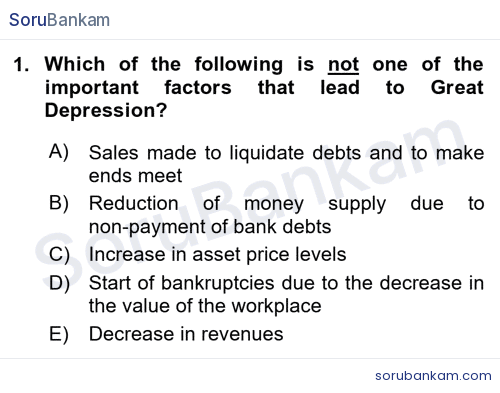
Which of the following is not one of the Important factors that lead to Great Depression? A) Sales made to liquidate debts and to make ends meet B) Reduction of money supply due to non-payment of bank debts C) Increase in asset price levels D) Start of bankruptcies due to the decrease in the value of the workplace E) Decrease in revenues
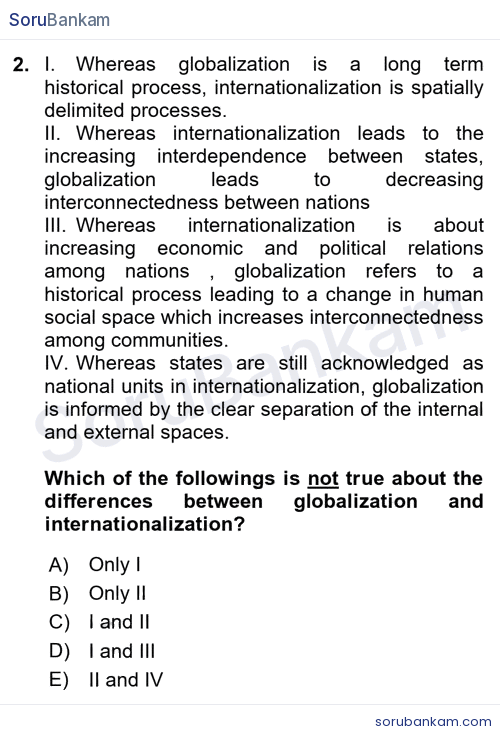
2. I. Whereas globalization is a long term historical process, internationalization is spatially delimited processes. II. Whereas internationalization leads to the increasing interdependence between states, globalization leads decreasing interconnectedness between nations III. Whereas internationalization is about increasing economic and political relations among nations, globalization refers to a historical process leading to a change in human social space which increases interconnectedness among communities. IV. Whereas states are still acknowledged as national units in internationalization, globalization is informed by the clear separation of the internal and external spaces. Which of the followings s'not true about the differences between globalization and internationalization? A) Only i B) Only.!! D) I and ill E) I and IV
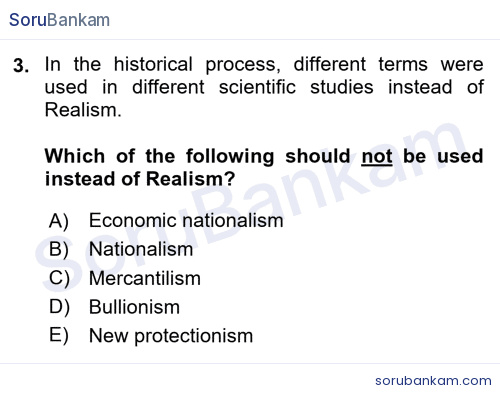
In the historical process, different terms were used in different scientific studies instead of Realism. Which of the following should not be used instead of Realism? A) Economic nationalism B) Nationalism C) Mercantilism D) Bullionism E) New protectionism
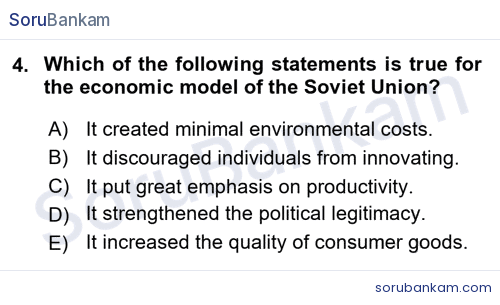
4. Which of the following statements is true for the economic model of the Soviet Union? A) It created minimal environmental costs. It discouraged individuals from innovating. It put great emphasis on productivity D) It strengthened the political legitimacy. E) It increased the quality of consumer goods.
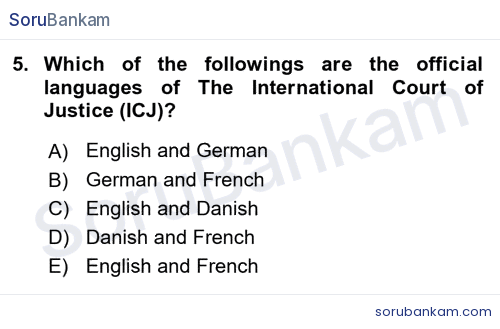
Which of the followings are the official. languages of The, Internatlonal Court of Justice (IC.J)? A) English and German B) German and French C) English and Danish D) Danish and French E) Enğlish and French
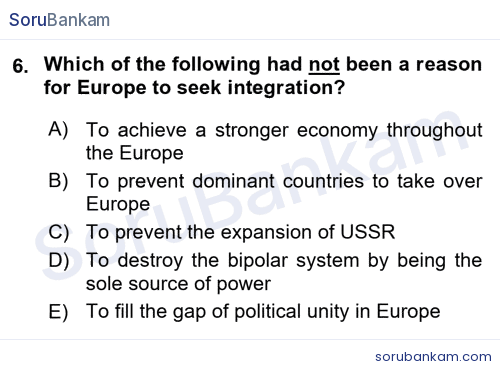
Which of the following had not been a reason for Europe to seek integration? A) To achieve à stronger economy throughout the Europe B) To prevent dominant countries to take over Europe C) To prevent the expansion of USSR D) To 'destroy the bipolar system by being the • .sole source of power E) To fill the gap of political unity in Europe
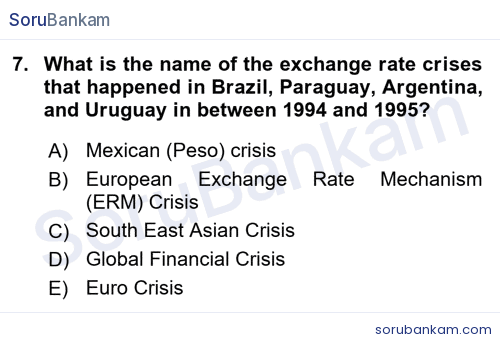
What is the name of the exchange rate crises that happened in Brazil, Paraguay, Argentina, and Uruguay in between 1994 and 1995? A) Mexican (Peso) crisis B) European Exchange Rate Mechanism (ERM) Crisis C) South East Asian Crisis D) Global Financial Crisis E) Euro Crisis
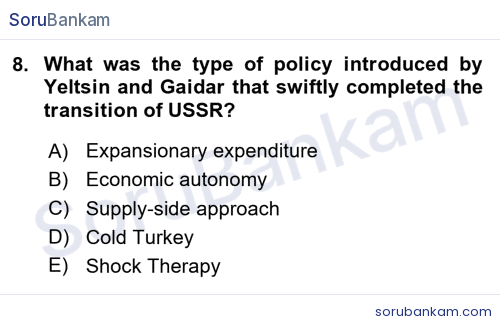
What was the type of policy introduced by Yeltsin and Gaidar that swiftly completed the transition of USSR? A) Expansionary expenditure B) Economic autonomy C) Supply-side approach D) Cold Turkey E) Shock Therapy
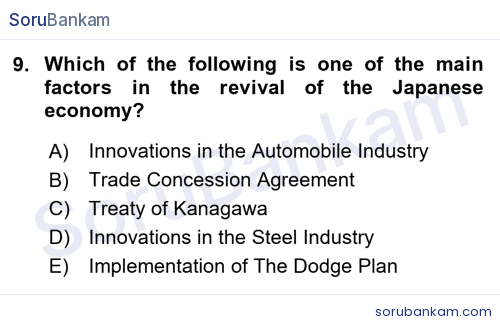
Which of the following is one of the main factors in the revival of the Japanese economy? A) Innovations in the Automobile industry B) Trade Concession Agreement C) Treaty of Kanagawa D) Innovations in the Steel Industry E) Implementation of The Dodge Plan
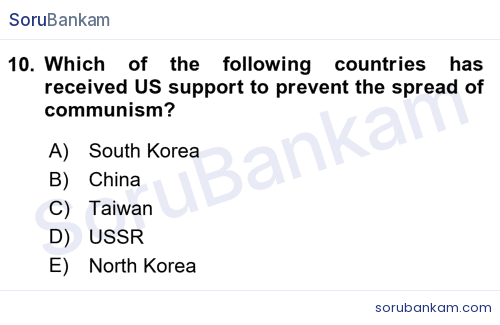
Which of the following countries has received US support to prevent the spread of communism? A) South Korea B) China C) Taiwan D) USSR E) North Korea
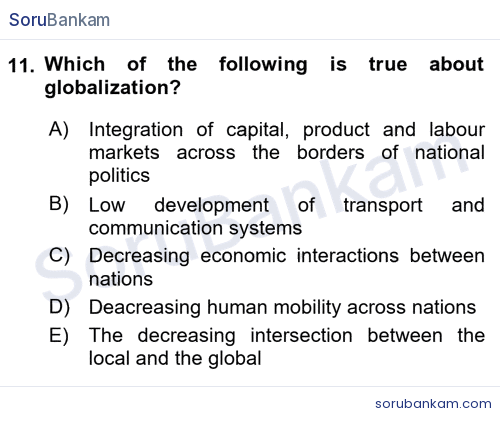
11. Which of the following is true about globallzation? A) Integration of capital, product and labour markets across the borders of national politics Low development of transport and communication systems C) Decreasing economio interactions between mations "D) Deacreasing human mobility across nations The decreasing intersection between the local and the global
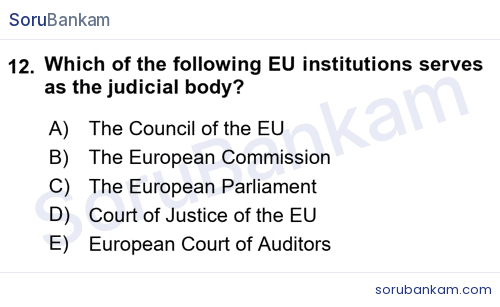
Which of the following EU institutions serves as the judicial body? A) The Council of the B) The European Commission C) The European Parliament D) Court of Justice of the E) European Court of Auditors
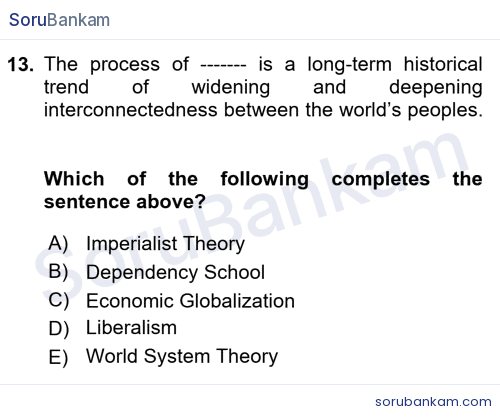
The process of - is a long-term historical trend widening and deepening interconnectedness between the word's peoples. Which of the following completes the sentence above? A) Imperialist Theory B) Dependency School C) Economic Globalization D) Liberalism E) World System Theory -
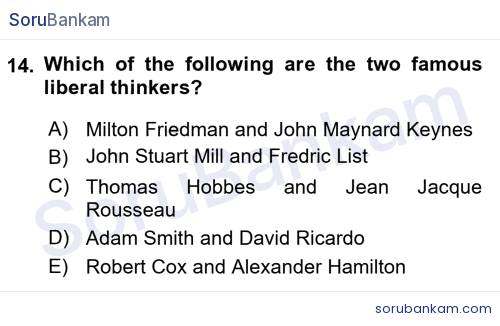
Which of the following are the two famous Ilberal thinkers? A) Milton Friedman and John Maynard Keynes B) John Stuart Mill and Fredric List C) c) Thomas Hobbes and Jean Jacque Rousseau D) Adam Smith and David Ricardo E) Robert Cox and Alexander Hamilton
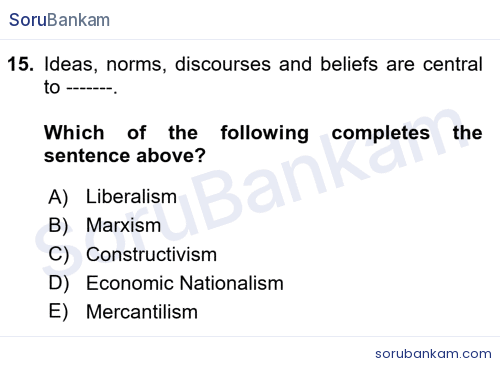
Ideas, norms, discourses and beliefs are central to----.. Which of the following completes the sentence above? A) Liberalism B) Marxism C) Constructivism D) Economic Nationalism E) Mercantilism
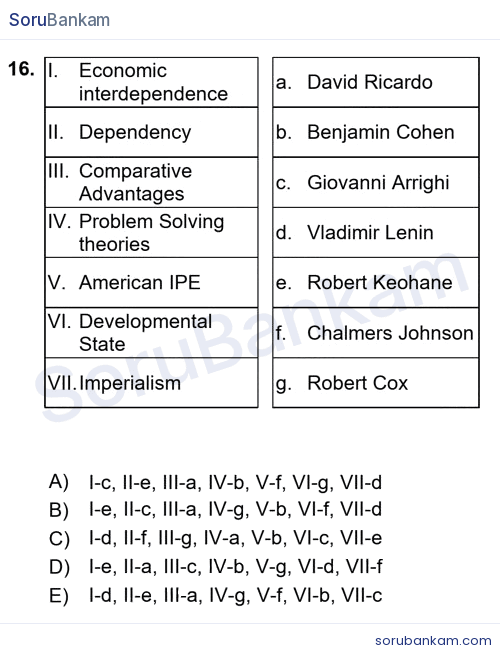
I. Economic interdependence a. David Ricardo li. Dependency b. Benjamin Cohen III. Comparative c. Giovanni Arrighi Advantages IV. Problem Solving d. Vladimir Lenin theories V. American IPE e. Robert Keohane VI. Developmental f. Chalmers Johnson State VIl. Imperialism g. Robert Cox A) I-c, II-e, Ill-a, IV-b, V-f, VI-g, Vil-d B) 1-e, II-c, Ill-a, IV-g, V-b, VI-f, VIl-d C) I-d, II-f, III-g, IV-a, V-b, VI-c, Vil-e D) I-e, II-a, lil-c, IV-b, V-g, VỊ-d, VII-f E) I-d, Il-e, Ill-a, IV-g, V-r, Vi-b, Vil-c
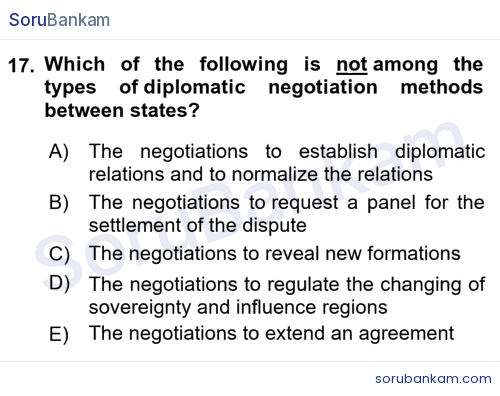
Which of the following is not among, the types of diplomatic negotiation matfods between states? A) The negotiations-«d establish diplomatic relations and to normalize the relations B) The negotiations to request a panel for the settlement of the dispute C) The negotiations to reveal new formations D) The negotiations to regulate the changing of sovereignty and influence regions E) The negotiations to extend an agreement
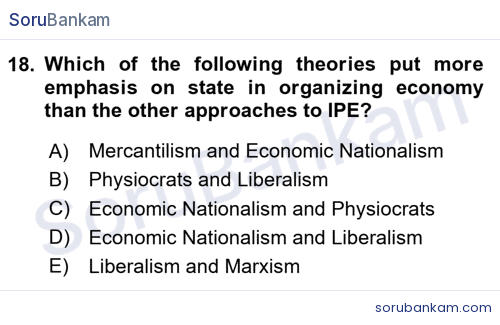
Which of the following theories put more emphasis on state In organizing economy than the other approaches to IPE? A) Mercantilism and Economic Nationalism B) Physiocrats and Liberalism C) Economic Nationalism and Physiocrats D) Economic Nationalism and Liberalism E) Liberalism and Marxism
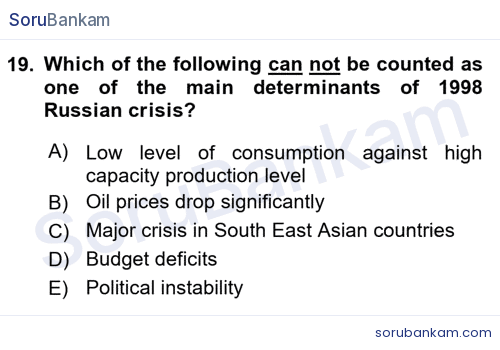
Which of the following can not be counted as one of the main determinants of 1998 Russian crisis? A) Low level of consumption against high capacity production level B) Oil prices drop significantly C) Major crisis in South East Asian countries D) Budget deficits E) Political instability
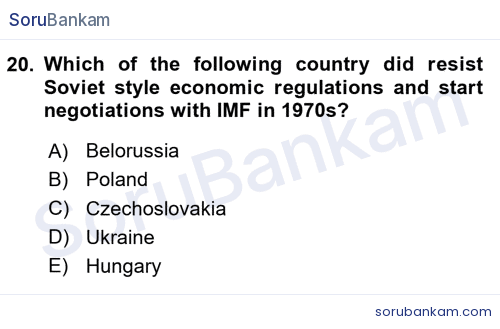
Which of the following country did resist Sovlet style economic regulations and start negotiations with IMF in 1970s? A) Belorussia B) Poland C) Czechoslovakia D) Ukraine E) Hungary