IKT323U Industrial Economics 2023-2024 Vize Soruları
20 soru · Vize · 2023-2024
IKT323U Industrial Economics dersinin 2023-2024 vize sınavı 20 sorudan oluşur; ders AÖF İktisat (İngilizce) bölümünde okutulur. Sorular aşağıda sırasıyla yer alır. Doğru cevaplar ve sonucun, testi çözdüğünde görünür.
Önizleme · 20 soru. Cevaplamak ve sonucunu görmek için sınavı başlat.
Sorular
20 soru
Soru 1
Soru 2
Soru 3
Soru 4
Soru 5
Soru 6
Soru 7
Soru 8
Soru 9
Soru 10
Soru 11
Soru 12
Soru 13
Soru 14
Soru 15
Soru 16
Soru 17
Soru 18
Soru 19
Soru 20
Sınav modunda süre tutulur, doğru cevaplar ve sonucun sınav bitince görünür.
Dersin üniteleri
IKT323U Industrial Economics ders sayfası: bütün sınavlar ve üniteler
Soruların metni (otomatik okuma)
Görsellerden otomatik okunmuştur; hata içerebilir. Sorular, görsellerdeki hâliyle geçerlidir.
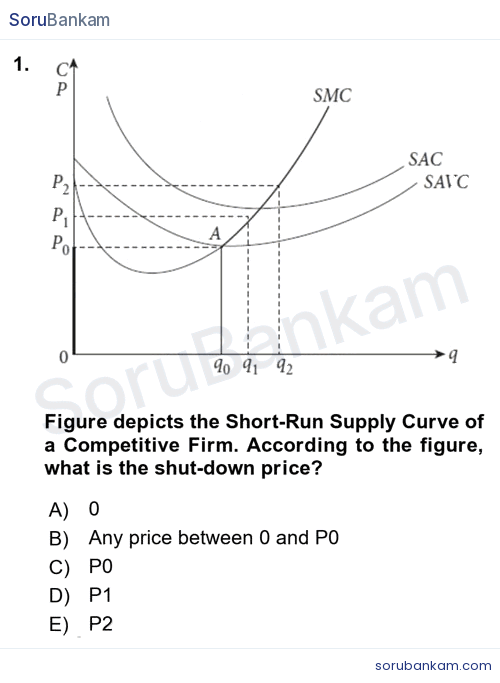
SMC SAC SAVG 9091 92 *4 Figure depicts the Short-Run Supply Curve of a Competitive Firm. According to the figure, what is the shut-down price? A) 0 B) Any price between 0 and C) PO D) P1 E) P2
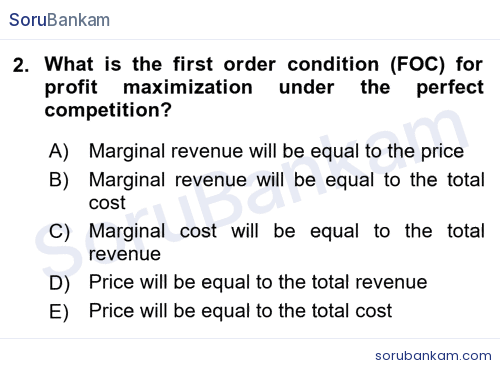
2. What is the first order condition (FOC) for profit maximization under the perfect competition? A) Marginal revenue will De'equal to the price Marginal revenue will be equal to the total c) Marginal cost Will be gawat the total revenue D) Price will be equal to the total revenue E) Price will be equal to the total cost
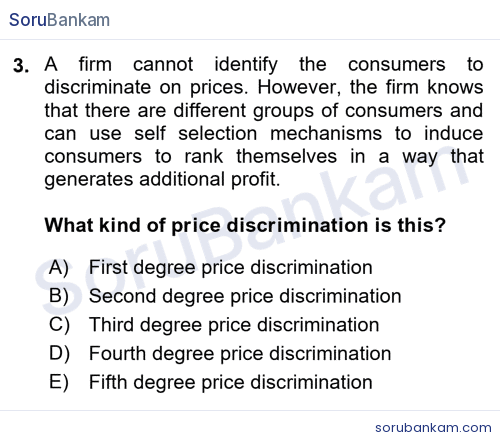
A firm cannot identify the consumers to discriminate on prices. However, the firm knows that there are different groups of consumers and can use self selection mechanisms to induce consumers to rank themselves in a way that generates additional profit. What kind of price discrimination is this? A) First degree price discrimination B) Second degree price discrimination C) Third degree price discriminațion D) Fourth degree price discrimination E) Fith degree price discrimination
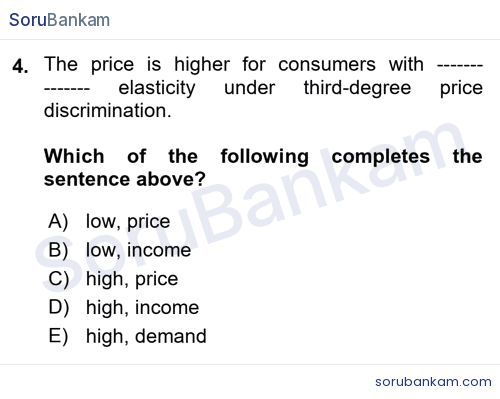
The price is higher for consumers with elasticity under third-degree price discrimination. Which of the following completes the sentence above? A) low, price B) low, income C) high, price D) high, income E) high, demand
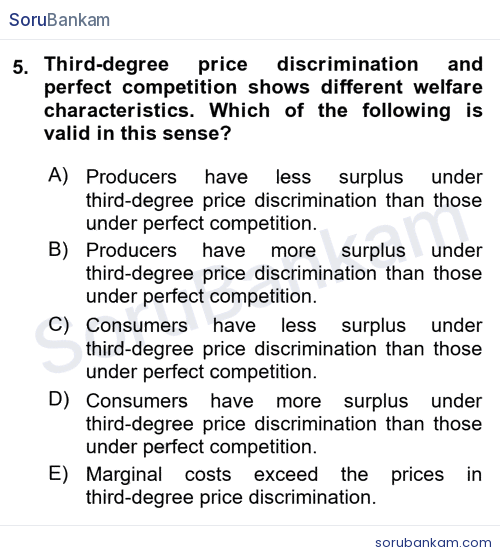
5. Third-degree price discrimination and perfect competition shows different welfare characteristles. Which of the following is valid in thistsense? e3'a' A) Producers have less surplus under third-degree pricę discrimination than those under perfect competition. B) Produçers' have more surplus under third-degree price discrimination than those "al. under perfect competition. C) Consumers have less surplus under third-degree price discrimination than those under perfect competition. Consumers have more surplus under third-degree price discrimination than those under perfect competition. E) Marginal costs exceed the prices in third-degree price discrimination.
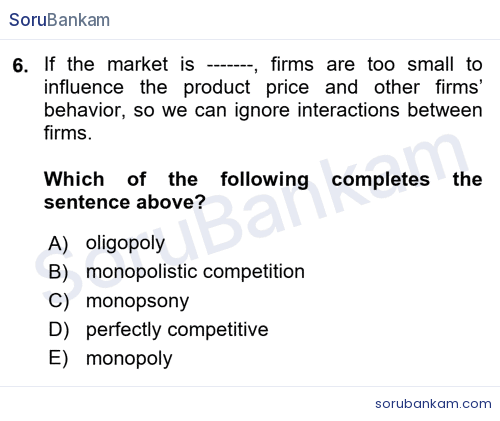
If the market is —_, firms are too small to influence the product price and other firms' behavior, so we can ignore interactions between firms. Which of the following completes the sentence above? A) oligopoly B) monopolistic competition C) monopsony D) perfectly competitive E) monopoly
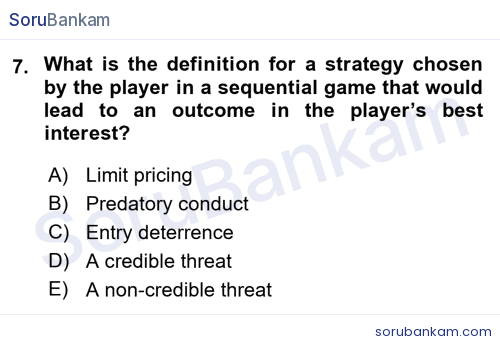
What is the definition for a strategy chosen by the player in a sequential game that would lead to an outcome in the player's best interest? A) Limit pricing B) Predatory conduct C) Entry deterrence D) A credible threat E) A non-credible threat
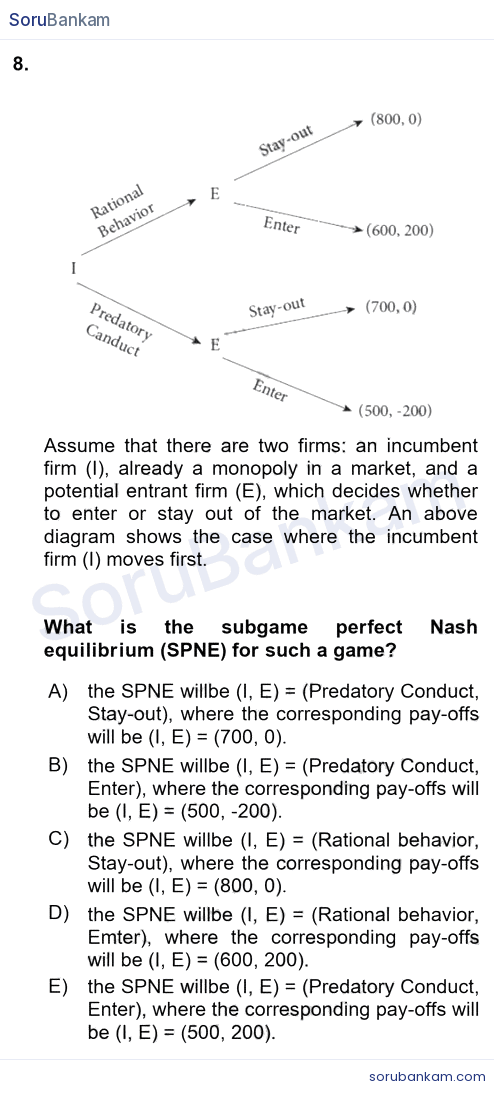
: (800, 0) Stay out Rational Behavior Enter *(600,200) Stay-02st (700, 0) Predatory Canduct • (500, -200) Assume that there are two firms: an incumbent firm (1), already a monopoly in a market, and a potential entrant firm (E), which decides whether to enter or stay out of the market. An above diagram shows the case where the incumbent firm (I) moves first. What is the subgame perfect Nash equilibrium (SPNE) for such a game? A) the SPNE wilbe (I, E) = (Predatory Conduct, Stay-out), where the corresponding pay-offs .. will be (I, E) = (700, 0). B) the SPNE willbe (I, E) = (Predatory Conduct, Enter), where the corresponding pay-offs will be (, E) = (500, - 200). C) the SPNE willbe (I, E) = (Rational behavior) Stay-out), where the corresponding pay-offs will be (1, E) = (800, 0). D) the SPNE willbe (I, E) = (Rational behavior, Emter) ' where the corresponding pay-offi. will be (I, E) = (600, 200). E) the SPNE willbe (l, E) = (Predatory Conduct, Enter), where the corresponding pay-offs will be (I, E) = (500, 200).
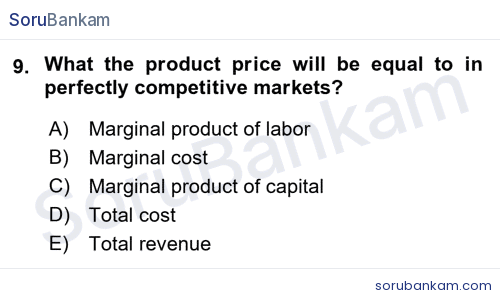
9. What the product price will be equal to in perfectly competitive markets? Marginal product of labor Marginal cost C) Marginal product of capital D) Total cost E) Total revenue
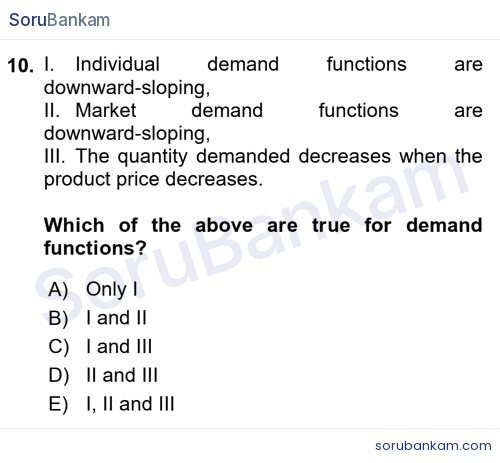
1. Individual demand functions ale downward-sloping, II. Market demand functions are downward-sloping, i. The quantity demanded decreases when the product price decreases. Which of the above are true for " demand functions? A) Only ! B) landil C) I and Ill D) II and E) I, Il and ill
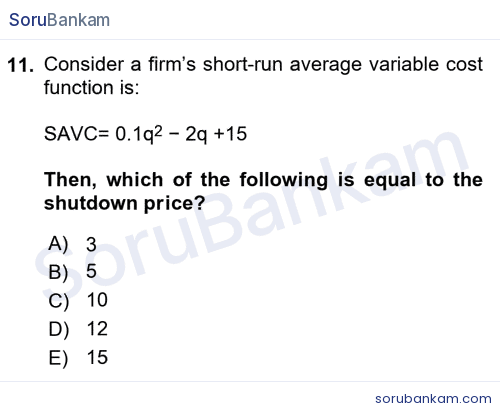
Consider a firm's short-run average variable cost function is: ..т. SAVC=0.1024 2q +15 • Then, which of the following Is equal to the shutdown price? A) 3 B) . C) val 10 D) 12 E) 15
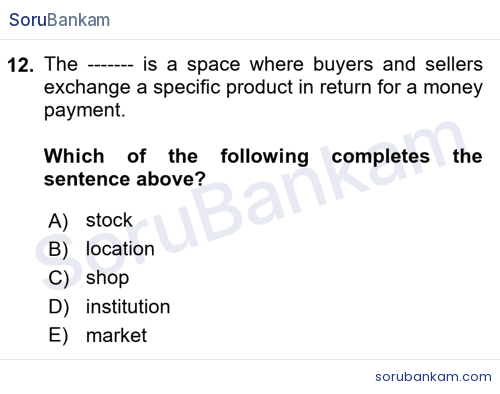
The - is a space where buyers and sellers exchange a specific product in return for a money payment. Which of the following completes the sentence above? A) stock B) location C) shop D) institution E) market
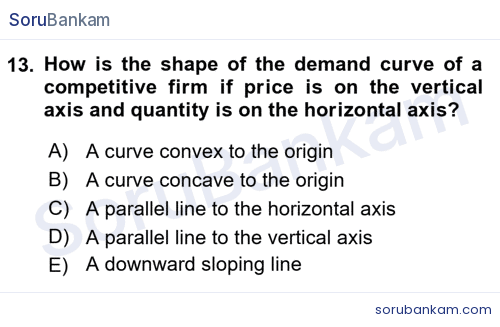
How is the shape of the demand curve of a competitive firm if price is on the vertical axis and quantity is on the horizontal axis? A) A curve convex to the origin B) A curve concave to the origin C) A parallel line to the horizontal axis D) A parallel line to the vertical axis E) A downward sloping line
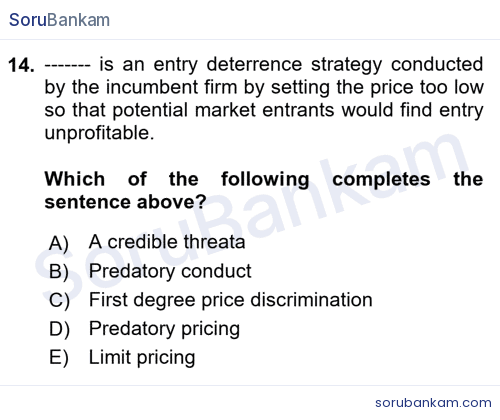
is an entry deterrence strategy conducted by the incumbent firm by setling the price too low so that potential market entrants would find entry unprofitable. Which of the following completes the sentence above? A) A credible threata B) Predatory conduct C) First degree price discrimination D) Predatory pricing E) Limit pricing
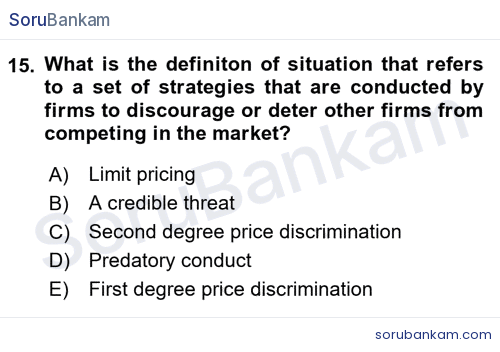
What is the definiton of situation that refers to a set of strategies that are conducted by firms to discourage or deter other firms from competing in the market? A) Limit pricing B) A credible threat C) Second degree price discrimifation D) Predatory conduct » * E) First degree price discrimination
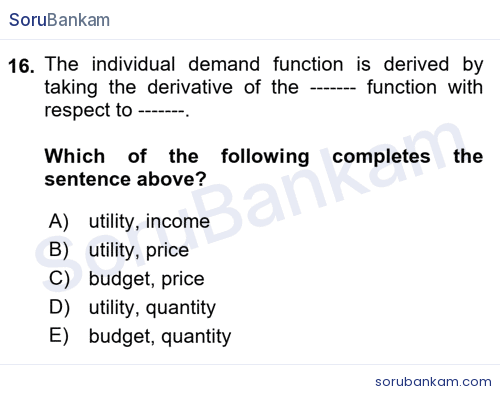
The individual demand function is derived by taking the derivative of the function with respect to --.._. Which of the following completes the sentence above? A) utility, income B) utility, price C) budget, price D) utility, quantity E) budget, quantity
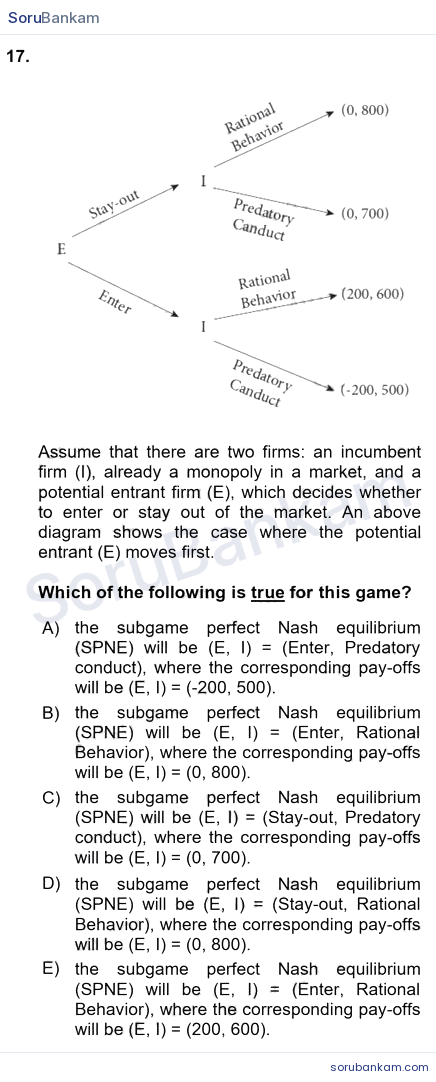
Rational - (0,800) Behavior Stay-out Predatory * (0,700) Canduct Rational Enkey Behavior - (200, 600) Predatory Canduct *(-200,500) Assume that there are two firms: an incumbent firm (I), already a monopoly in a market, and a potential entrant firm (E), which decides whether to enter or stay out of the market. An above diagram shows the case where the potential , entrant (E) moves first. Which of the following is true for this game? A) the subgame perfect Nash equilibrium (SPNE) will be (E, I) = (Enter, Predatory conduct), where the corresponding pay-offs will be (E, I) = (-200, 500). B) the subgame perfect Nash equilibrium (SPNE) will be (E, I) = (Enter, Rational w. Behavior), where the corresponding pay-offs will be (E, I) = (0, 800). C) the subgame perfect Nash equilibrium (SPNE) will be (E, 1) = (Stay-out, Predatory conduct), where the corresponding pay-offs will be (E, I) = (0,700). D) the subgame perfect Nash equilibrium (SPNE) will be (E, I) = (Stay-out, Rational Behavior), where the corresponding pay-offs will be (E, I) = (0, 800). E) the subgame perfect Nash equilibrium (SPNE) will be (E, 1) = (Enter, Rational Behavior), where the corresponding pay-offs will be. (E, 1) = (200, 600).
Within the context of third degree price discriminatlon, which of the following refers to the practice of setting different prices for distinct customer groups based on their varying levels of willingness to pay for a product? A) Group pricing. B) Single pricing C) Double pricing D) Perfect price discrimination E) Elevated pricing
What is the second-order condition for profit maximization under the perfect compețition? A) The second-order condition for profit maximization requires that the first derivative of the profit function be negative B) The second-order condition for profit maximization requires that the second derivative of the profit function be positive C) Marginal cost must be decreasing in equilibrium D) The second-order condition for profit maximization requires that the first derivative of the profit function be positive E) The second-order condition for profit maximization requires that the second derivative of the profit function be negative
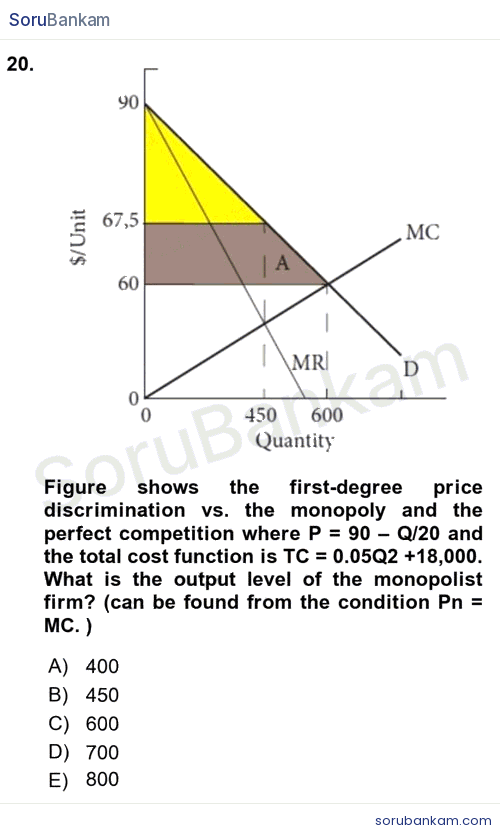
5 60 WRI 0 450 600 Quantity Figure + shows they first-degree price discrimination vs. the monopoly and the perfect competition where P = 90 - Q/20 and he total cost unction is TC = 0.05Q2 +18,000 What is the output level of the monopolis firm? (cambe found from the condition Pn = MC. ) A) 400 B) 450 C) 600 D) 700 E) 800