IKT317U Monetary Theory and Policy 2024-2025 Vize Soruları
20 soru · Vize · 2024-2025
IKT317U Monetary Theory and Policy dersinin 2024-2025 vize sınavı 20 sorudan oluşur; ders AÖF İktisat (İngilizce) bölümünde okutulur. Sorular aşağıda sırasıyla yer alır. Doğru cevaplar ve sonucun, testi çözdüğünde görünür.
Önizleme · 20 soru. Cevaplamak ve sonucunu görmek için sınavı başlat.
Sorular
20 soru
Soru 1
Soru 2
Soru 3
Soru 4
Soru 5
Soru 6
Soru 7
Soru 8
Soru 9
Soru 10
Soru 11
Soru 12
Soru 13
Soru 14
Soru 15
Soru 16
Soru 17
Soru 18
Soru 19
Soru 20
Sınav modunda süre tutulur, doğru cevaplar ve sonucun sınav bitince görünür.
Dersin üniteleri
IKT317U Monetary Theory and Policy ders sayfası: bütün sınavlar ve üniteler
Soruların metni (otomatik okuma)
Görsellerden otomatik okunmuştur; hata içerebilir. Sorular, görsellerdeki hâliyle geçerlidir.
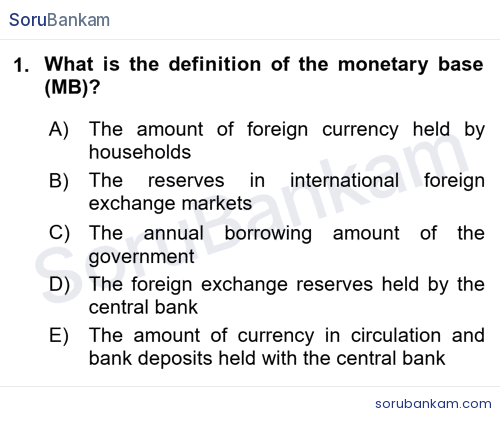
What is the definition of the monetary base (MB)? A) The amount of foreign currency held by households B) 3) The reserves in international foreign exchange markets C) The annual borrowing amount of the government D) The foreign exchange reserves held by the central bank E) The amount of currency in circulation and bank deposits held with the central bank
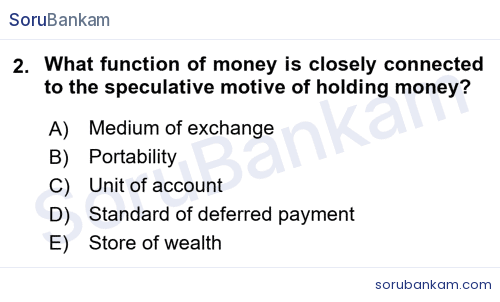
What function of money is closely connected to the speculative motive of holding money? A) Medium of exchange B) Portability C) Unit of account D) Standard of deferred payment. E) Store of wealth
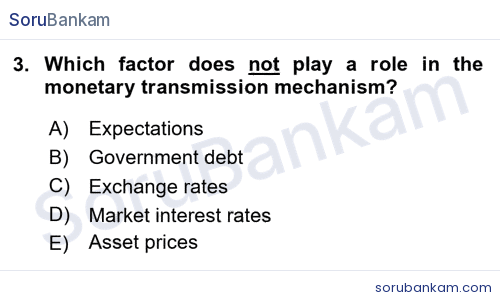
3. Which factor does not play a role in the monetary transmission mechanism? Expectations Government debt C) Exchange rates D) Market interest rates E) Asset prices
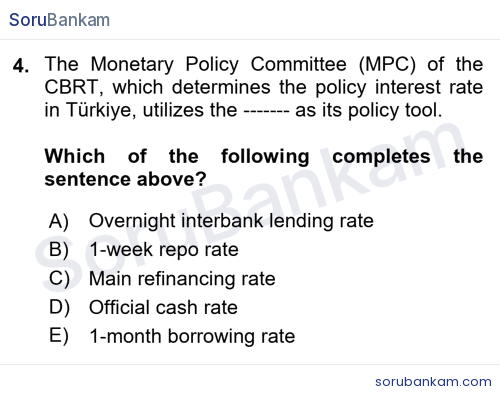
The Monetary Policy Committee (MPC) of the CBRT, which determines the policy interest rate in Türkiye, utilizes the ... as its policy tool. Which of the following completes the sentence above? A) Overnight interbank lending rate B) 1-week repo rate C) Main refinancing rate D) Official cash rate E) 1-month borrowing rate
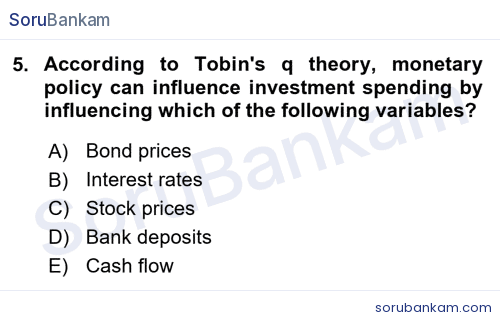
According to Tobin's q theory, monetary policy can influence Investment spending by influencing which of the following variables? A) Bond prices B) Interest rates C) Stock prices D) Bank deposits E) Cash flow
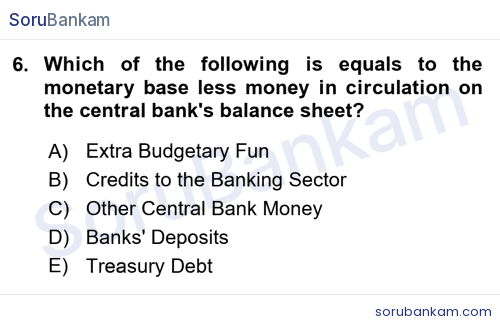
Which of the following is equals to the monetary base less money In circulation on the central bank's balance sheet? A) fatra Budgetary FuR "*'• B) Credits to the Banking Sector C) Other Central Bank Money D) Banks' Deposits E) Treasury Debt
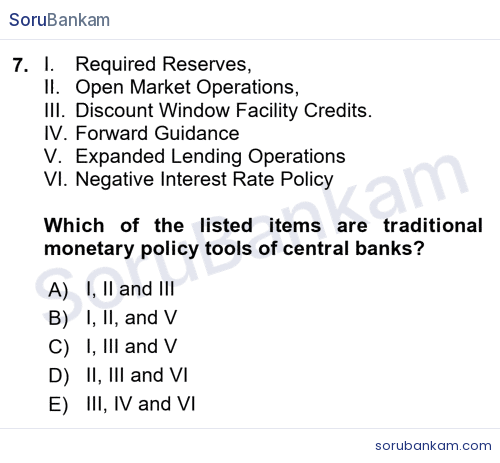
I. Required Reserves, I!. Open Market Operations, Ili. Discount Window Facility Credits. IV. Forward Guidance V. Expanded Lending Operations VI. Negative Interest Rate Policy Which of the listed Items are traditlonal monetary policy tools of central banks? A) I, Il and Ill B) I, Il, and C) I, Ill and D) II, Ill and E) ili, IV and
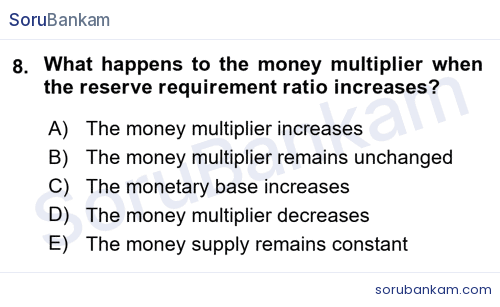
What happens to the money multiplier when the reserve requirement ratio increases? A) The money multiplier increases B) The money multiplier remains unchanged C) The monetary base increases D) The money multiplier decreases E) The money supply remains constant
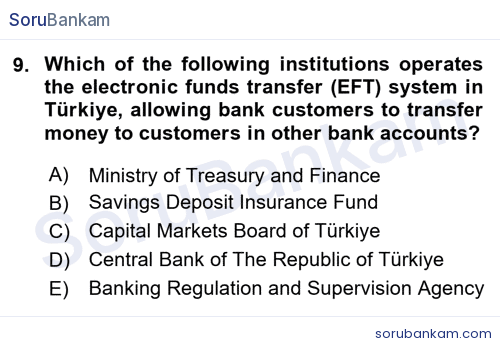
Which of the following institutions operates the electronic funds transfer (EFT) system in Türkiye, allowing bank customers to transfer money to customers in other bank accounts? A) Ministry of Treasury and Finance B) Savings Deposit Insurance Fund C) Capital Markets Board of Türkiye D) Central Bank of The Republic of Türkiye E) Banking Regulation and Supervision Agency
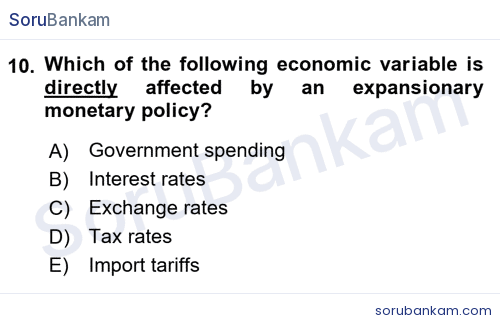
Which of the following economic variable is directly affected by an expansionary monetary policy? A) Government spending B) Interest rates C) Exchange rates D) Tax rates. E) Import tariffs
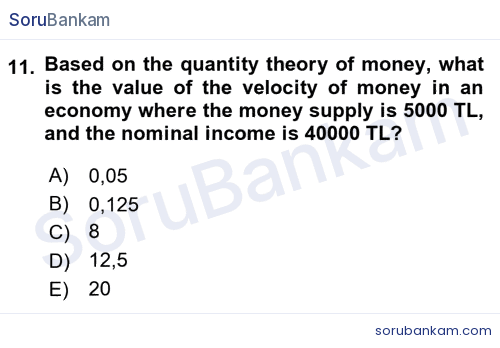
11. Based on the quantity theory of money, what Is the value of the velocity of money, hit an economy where the money supply is 5000 TL, and the nominal income is 40600 TL? A) 0,05 0,125 C) 8 D) 12,5
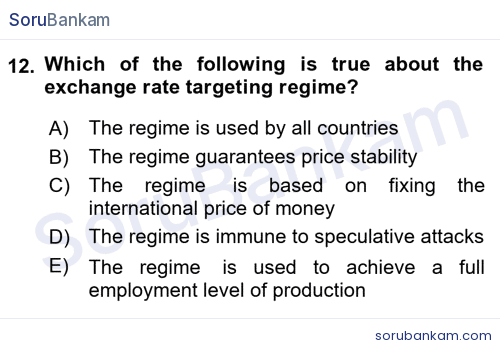
Which of the following is true about the exchange rate targeting regime? A) The regime is used by all countries B) The regime guarantees price stability C) The regime is based on fixing the international price of money D) The regime is immune to speculative attacks E) The regime is used to achieve a full employment level of production
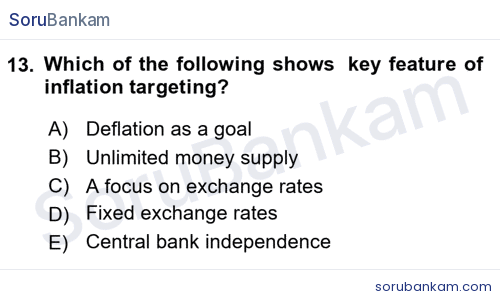
Which of the following shows key feature of inflation targeting? A) Deflation as a goal B) Unlimited money supply C) A focus on exchange rates D) Fixed exchange rates E) Central bank independence
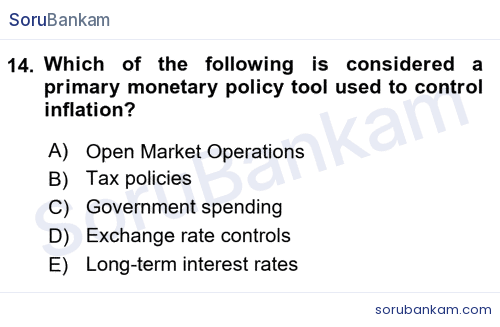
Which of the following is considered primary monetary policy tool used to control inflation? A) Oper Market Operations B) WB) Tax policies C) Goverment spending D) Exchange rate controls E) Long-term interest rates
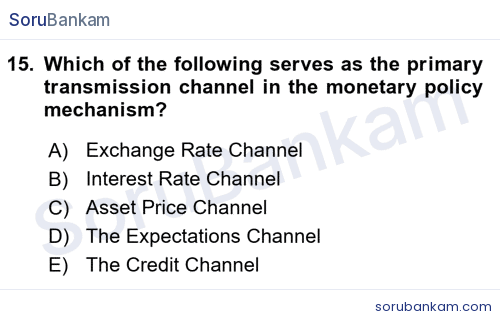
Which of the following serves as the primary transmission channel in the monetary policy mechanism? A) Exchange Rate Channel B) Interest Rate Channel C) Asset Price Channel D) The Expectations Channel E) The Credit Channel
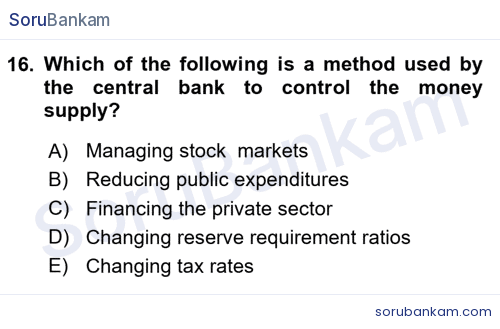
Which of the following is a method used by the central bank to control the money supply? A) Managing stock markets B) Reducing public expenditures C) Financing the private sector D) Changing reserve requirement ratios E) Chänging tax rates
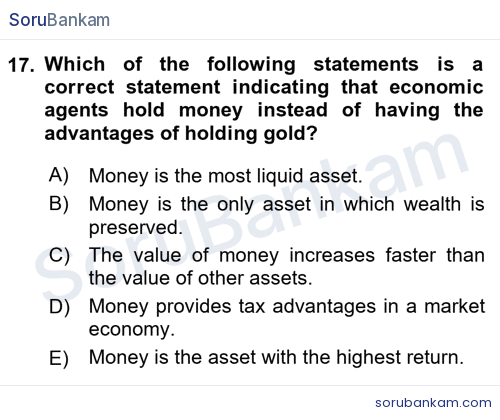
Which of the following statements is correct statement indicating that economic agents hold money instead of having the advantages of holding gold? A) Money is the most liquid asset. B) Money is the only asset in which wealth is preserved. C) The value of money increases faster than the value of other assets. D) Money provides tax advantages in a market economy. E) Money is the asset with the highest return.
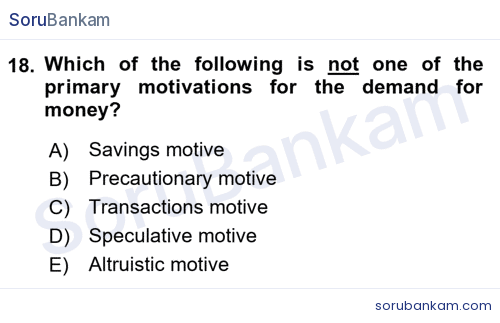
Which of the following is not one of the primary motivations for the demand for money? A) Savings motive B) Precautionary motive C) Transactions motive D) Speculative motive E) Altruistic motive
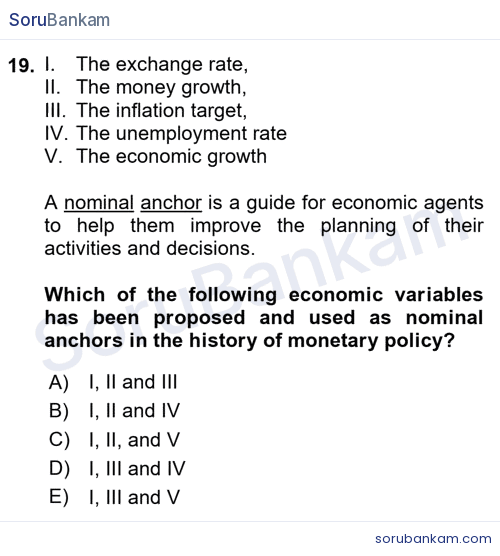
1. The exchange rate, II. The money growth, III. The inflation target, IV. The unemployment rate V. The economic growth A nominal anchor is a guide for economic agents to help them improve the planning of their activities and decisions. Which of the following economic variables has been proposed and used as nominal anchors in the history of monetary policy? A) I, ll and !!l B) I, and C) I, II, and D) I, Ill and E) I, Ill and
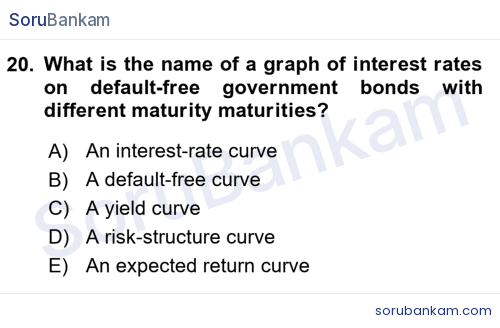
What is the name of a graph of interest rates on default-free government bonds with different maturity maturities? A) An interest-rate curve B) A default-free curve C) A yield curve D) A risk-structure curve E) An expected return curve