MUH213U Accounting 1 2021-2022 Yaz Okulu Soruları
20 soru · Yaz okulu · 2021-2022
MUH213U Accounting 1 dersinin 2021-2022 yaz okulu sınavı 20 sorudan oluşur; ders AÖF İktisat (İngilizce) bölümünde okutulur. Sorular aşağıda sırasıyla yer alır. Doğru cevaplar ve sonucun, testi çözdüğünde görünür.
Önizleme · 20 soru. Cevaplamak ve sonucunu görmek için sınavı başlat.
Sorular
20 soru
Soru 1
Soru 2
Soru 3
Soru 4
Soru 5
Soru 6
Soru 7
Soru 8
Soru 9
Soru 10
Soru 11
Soru 12
Soru 13
Soru 14
Soru 15
Soru 16
Soru 17
Soru 18
Soru 19
Soru 20
Sınav modunda süre tutulur, doğru cevaplar ve sonucun sınav bitince görünür.
Dersin üniteleri
Ünite özetleri ve konu anlatımları
- 1. Ünite: Accounting And Business Environment
- 2. Ünite: Recording Process
- 3. Ünite: Accrual Accounting And Adjusting Process
- 4. Ünite: Completing The Accounting Cycle
- 5. Ünite: Merchandising Operations
- 6. Ünite: Merchandise Inventory
- 7. Ünite: Internal Control And Cash
- 8. Ünite: Receivables
MUH213U Accounting 1 ders sayfası: bütün sınavlar ve üniteler
Soruların metni (otomatik okuma)
Görsellerden otomatik okunmuştur; hata içerebilir. Sorular, görsellerdeki hâliyle geçerlidir.
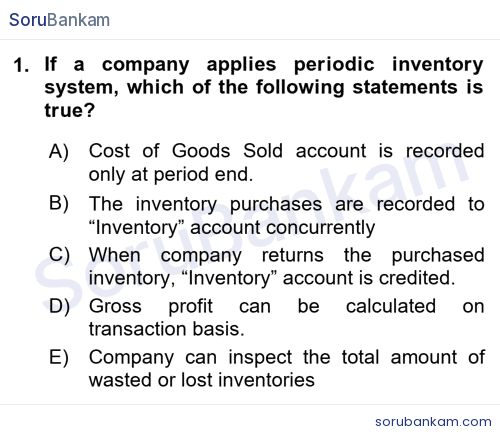
1. If a company applies periodic inventory system, which of the following statements is true? A) Cost of Goods Sold account is recorded only at period end. B) The inventory purchases are recorded to "Inventory" account concurrently C) When company retums the purchased inventory, "Inventory" account is credited. D) Gross profit Can be calculated on transaction basis. Company can inspect the total amount of wasted or lost inventories
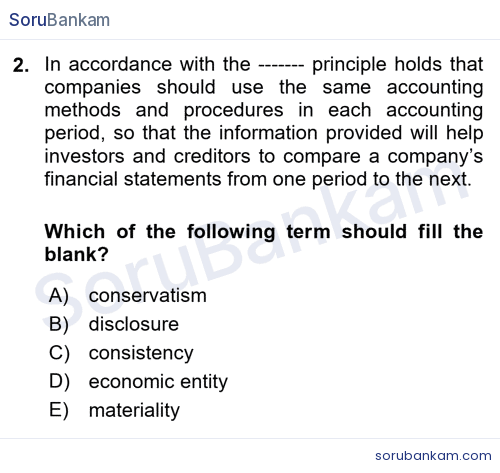
In accordance with the - principle holds that companies should use the same accounting methods and procedures in each accounting period, so that the information provided will help investors and creditors to compare a company's financial statements from one period to the next. Which of the following term should fill the blank? A) conservatism B) disclosure C) consistency D) economic entity E) materiality
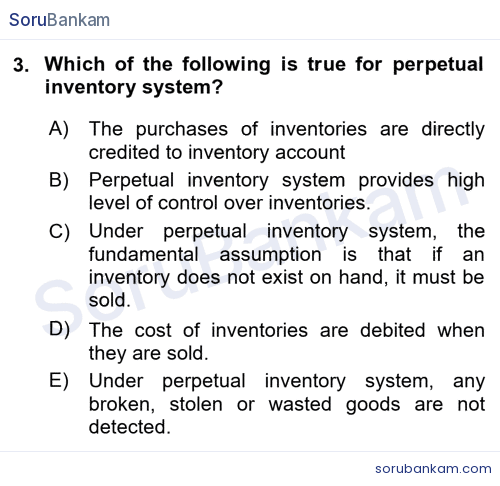
Which of the following is true for perpetual inventory system? A) The purchases of inventories are directly credited to inventory account B) Perpetual inventory system provides high level of control over inventories. C) Under perpetual inventory system, the fundamental assumptioh is that if an • inventory does not exist on hand, it must be sold. D) The cost of inventories are debited when they are sold. E) Under perpetual inventory system, any broken, stolen or wasted goods are not detected.
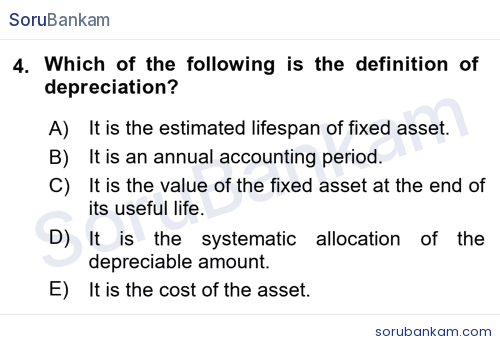
Which of the following is the definition of depreciation? A) It is the estimated lifespan of fixed asset. B) It is an annual accounting period. C) It is the value of the fixed asset at the end of its useful life. D) It is the systematic allocation of the depreciable amount. E) It is the cost of the asset.
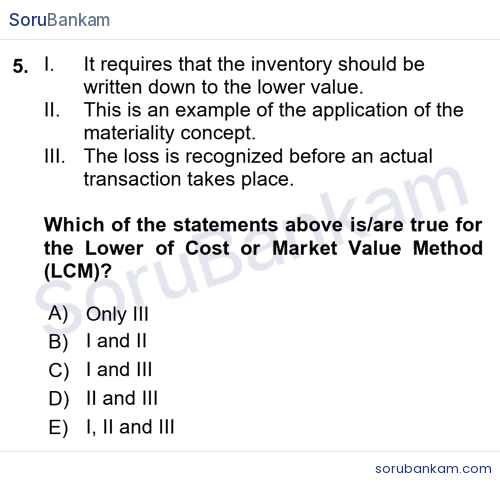
I. It requires that the inventory should be written down to the lower value. II. This is an example of the application of the materiality concept. Ili. The loss is recognized before an actual transaction takes place. 1. Which of the statements above is/are true for the Lower of Cost or Market Value Method (LCM)? A) Only Ill B) I and C) I and I!! D) Il and Ill E) I, Il and
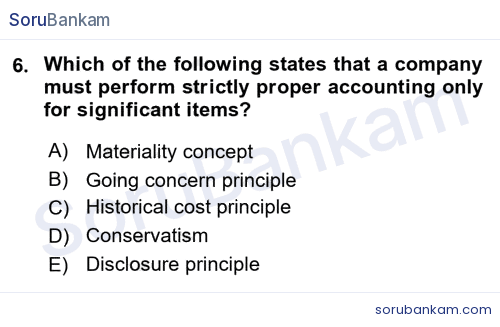
Which of the following states that a company must perform strictly proper accounting only for significant items? A) Materiality concept B) By Going concern principle C) Historical cost principle D) Conservatism' E) Disclosure principle.
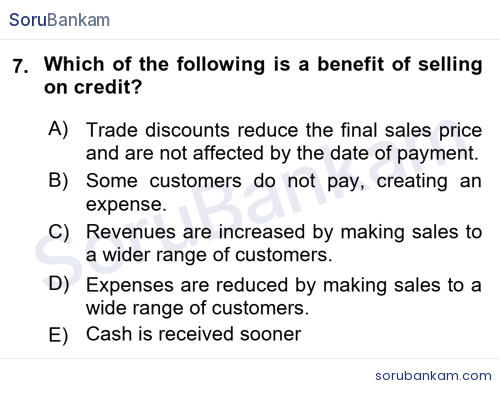
Which of the following is a benefit of selling on credit? A) Trade discounts reduce the final sales price and are not affected by the date of payment. B) Some customers do not pay, creating an expense. C) Revenues are increased by making sales to a wider range of customers. D) Expenses are reduced by making sales to a wide range of customers. E) Cash is received sooner
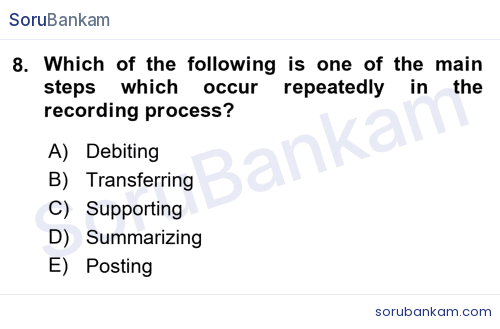
Which of the following is one of the main steps which occur repeatedly the recording process? A) Debiting B) Transferring C) Supporting D) Summarizing E) Posting
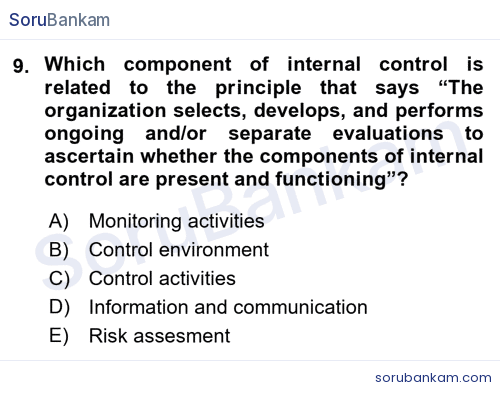
Which component of internal controi is related to the principle that says "The organization selects, develops, and performs ongoing and/or separate evaluations to ascertain whether the components of internal control are present and functioning"? A) Monitoring activities B) Control environment C) Control activities D) Information and communication E) Risk assesment
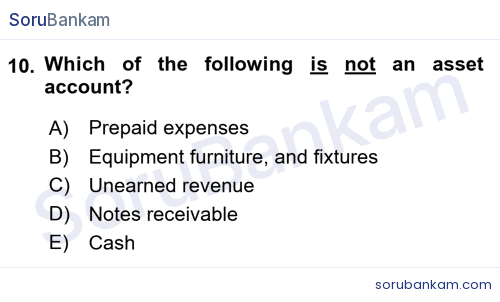
Which of the following is not an asset account? A) Prepaid expenses B) Equipment furniture, and fixtures C) Unearned revenue D) Notes receivable E) Cash
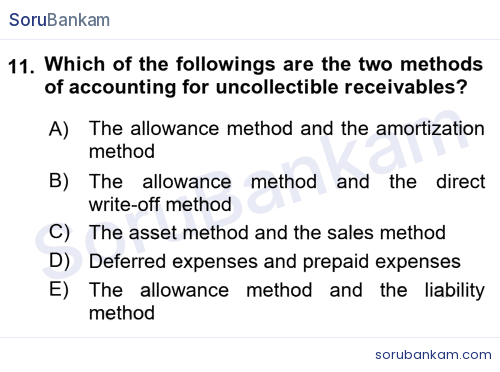
Which of the followings are the two methods of accounting for uncollectible receivables? A) The allowance method and the amortization method B) The allowance method and the direct write-off method C) c) The asset method and the sales method D) Deferred expenses and prepaid expenses E) The allowance method and the liability method
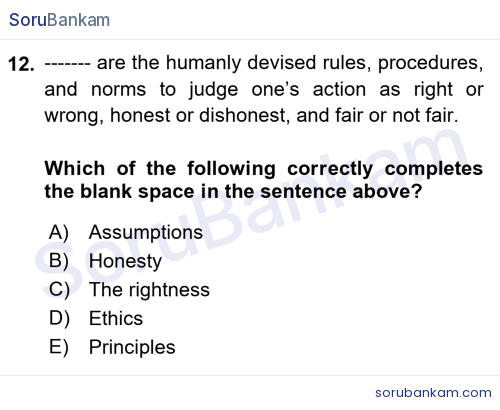
—— are the humanly devised rules, procedures, and norms to judge one's action as right or wrong, honest or dishonest, and fair or not fair. Which of the following correctly completes the blank space in the sentence above? A) Assumptions • B) Honesty C) The rightness D) Ethics E) Principles
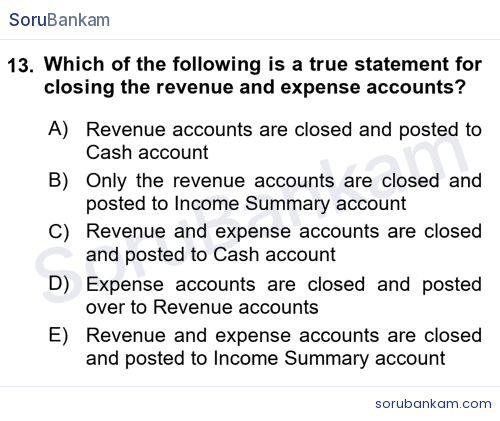
Which of the following is a true statement for closing the revenue and expense accounts? A) Revenue accounts are closed and posted to Cash account B) Only the revenue accounts are closed and posted to Income Summary account C) Revenue and expense accounts' are closed and posted to Cash account D) Expense accounts are closed and posted over to Revenue accounts E) Revenue and expense accounts are closed and posted to Income Summary account
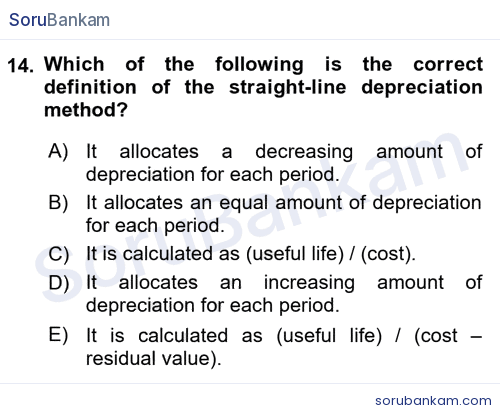
Which of the following is the correct definition of the straight-line depreciation method? A) It allocates a decreasing amount of • depreciation for each period. B) It allocates an equal amount of depreciation for each period. C) It is calculated as (yseful life) / (cost). D) Dy #'allocates an "increasing amount of depreciation for each period. E) It is calculated as (useful life) / (cost - residual-value).
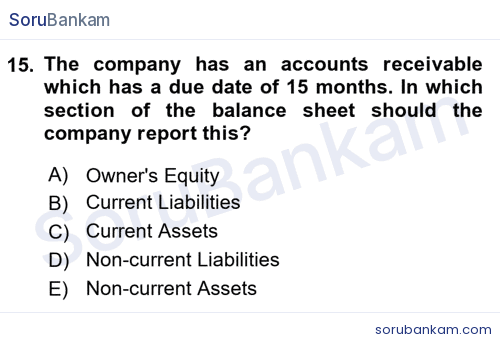
The company has an accounts receivable which has a due date of 15 months. In which section of the balance sheet should the company report this? A) Owner's Equity B) Current Liabilities C) Current Assets D) Non-current Liabilities E) Non-current Assets
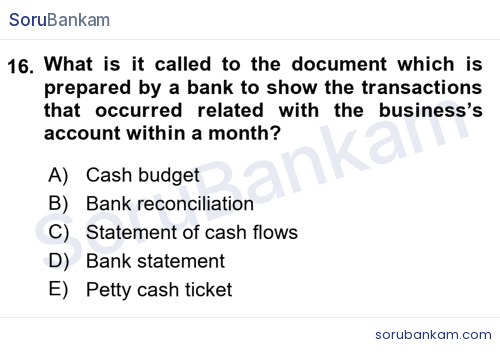
What is it called to the document which is prepared by a bank to show the transactions that occurred related with the business's account within a month? A) Cash budget B) Bank reconciliation C) Statement of cash flows D) Bank statement E) Petty cash ticket
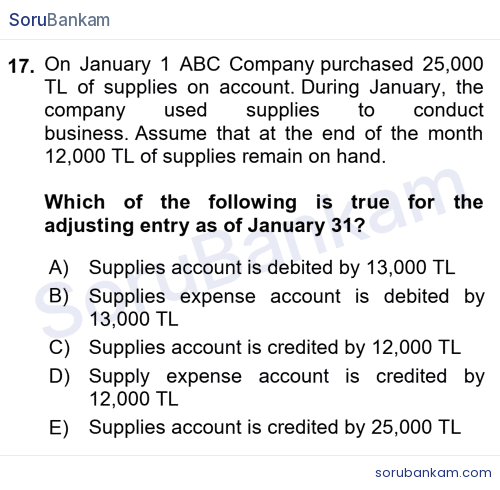
On January 1 ABC Company purchased 25,000 TL of supplies on account. During January, the company used supplies conduct business. Assume that at the end of the month 12,000 TL of supplies remain on hand. Which of the following is true for the adjusting entry as of January 317 A) Supplies account is debited by 13,000 B) Supplies expense account is debited by 13,000 C) Supplies account is credited by 12,000 D) Supply expense account is credited by 12,000 E) Supplies account is credited by 25,000
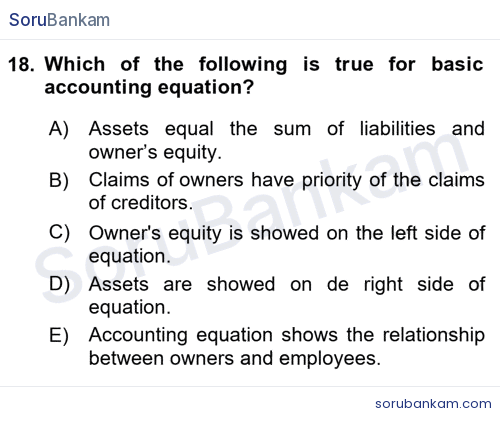
18. Which of the following is true for basic accounting equation? A) Assets equal the sum of liabilities and owner's equity. Claims of owners have priority of the claims of creditors. i r' C) Owner's equity is showed on the left side of equation. D) Assets are showed on de right side equation. E) Accounting equation shows the relationship between owners and employees.
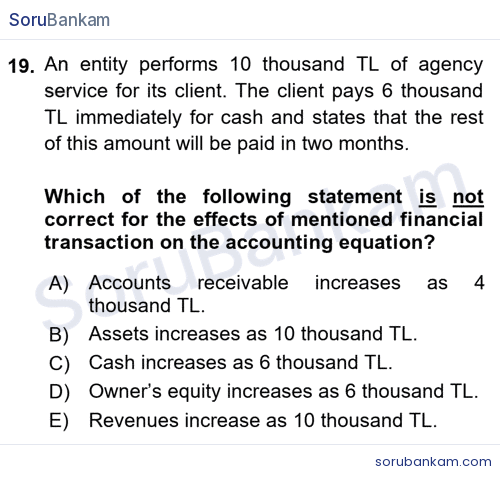
19. An entity performs 10 thousand TL of agency service for its client. The client pays 6 thousand TL immediately for cash and states that the rest of this amount will be paid in two months. Which of the following statement is not correct for the effects of mentioned financial transaction on the accounting equation? A) Accounts receivable increases as 4 thousand TL. Assets increases as 10 thousand TL. C) Cash increases as 6 thousand TL. D) Owner's equity increases as 6 thousand TL. E) Revenues increase as 10 thousand TL.
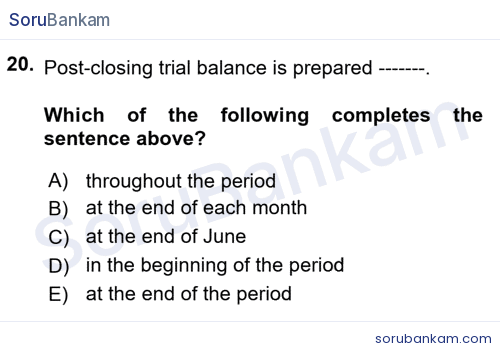
Post-closing trial balance is prepared - Which of the following completes the sentence above? A) throughout the period ('." B) at the end of each month C) at the end of June D) in the beginning of the period E) at the end of the period