IKT105U Introduction to Economics 1 2019-2020 Final Soruları
20 soru · Final · 2019-2020
IKT105U Introduction to Economics 1 dersinin 2019-2020 final sınavı 20 sorudan oluşur; ders AÖF İktisat (İngilizce) bölümünde okutulur. Sorular aşağıda sırasıyla yer alır. Doğru cevaplar ve sonucun, testi çözdüğünde görünür.
Önizleme · 20 soru. Cevaplamak ve sonucunu görmek için sınavı başlat.
Sorular
20 soru
Soru 1
Soru 2
Soru 3
Soru 4
Soru 5
Soru 6
Soru 7
Soru 8
Soru 9
Soru 10
Soru 11
Soru 12
Soru 13
Soru 14
Soru 15
Soru 16
Soru 17
Soru 18
Soru 19
Soru 20
Sınav modunda süre tutulur, doğru cevaplar ve sonucun sınav bitince görünür.
Dersin üniteleri
Ünite özetleri ve konu anlatımları
- 1. Ünite: Basic Concepts, Scope And Methodology Of Economics
- 2. Ünite: How Markets Work? Market Forces And Equilibrium
- 3. Ünite: The Theory Of Consumer Choice
- 4. Ünite: Elacticity, Goverment Policies And Market Efficiency
- 5. Ünite: The Firm And The Cost Of Production
- 6. Ünite: The Firm İn Perfectly Competitive Markets
- 7. Ünite: Monopoly And Imperfect Competition
- 8. Ünite: Factors Of Production And Factor Markets
IKT105U Introduction to Economics 1 ders sayfası: bütün sınavlar ve üniteler
Soruların metni (otomatik okuma)
Görsellerden otomatik okunmuştur; hata içerebilir. Sorular, görsellerdeki hâliyle geçerlidir.
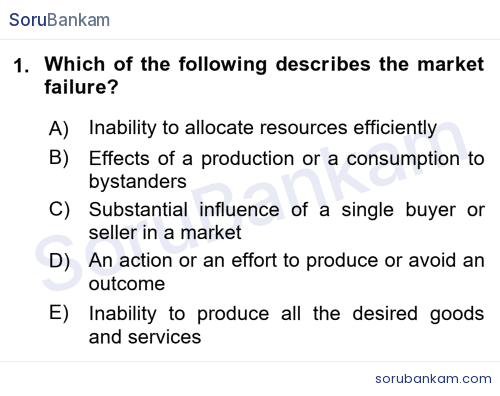
Which of the following describes the market failure? A) Inability to allocate resources efficiently B) Effects of a production or a consumption to bystanders C) Substantial influence of a single buyer or seller in a market D) An action or an effort to produce or avoid an outcome E) Inability to produce all the desired goods and services
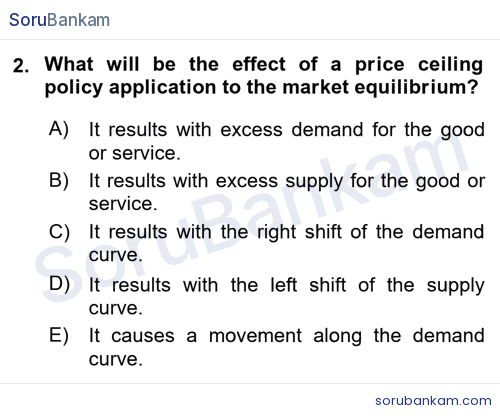
2. What will be the effect of a price ceiling! policy application to the market equilibrim? A) It results with excess demand for the good or service. B) It results with excess supply for the good or' service. C) It results with the right shift of the demand curve. D) it results with the left shift of the supply curve. It causes armovement algngt the demand curve.
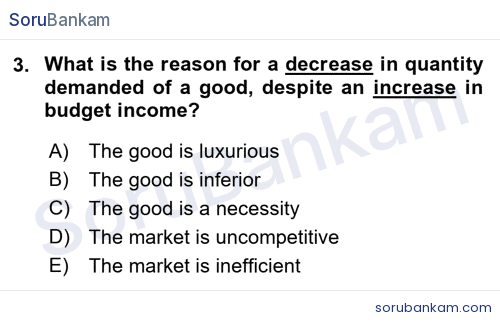
What is the reason for a decrease in quantity demanded of a good, despite an increase in budget income? A) The good is luxurious B) The good is inferior C) The good is a necessity D) The market is uncompetitive E) The market is inefficient
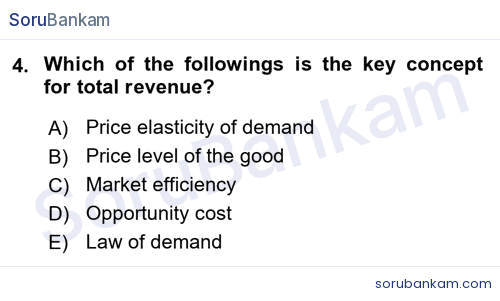
Which of the followings is the key concept for total revenue? A) Price elasticity of demand B) Price level of the good C) Market efficiency D) Opportunity cost 2. E) Law of demand
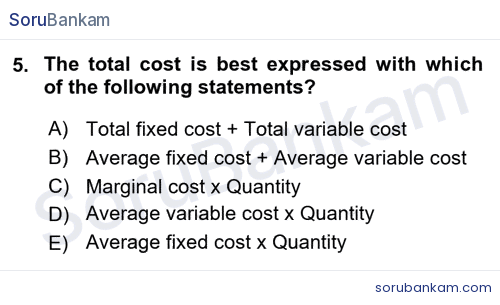
The total cost is best expressed with which of the following statements? A) Total fixed cost + Total variable cost B) Average fixed cost #'Àverage variable cost C) Marginal cost x Quantity D) Average variable cost x Quantity E) Average fixed cost x Quantity
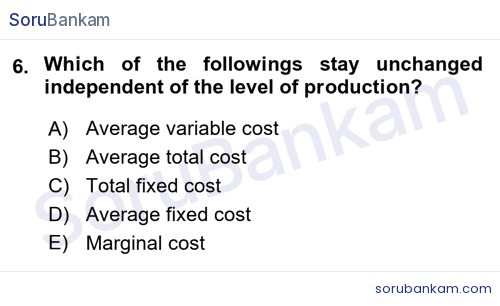
Which of the followings stay unchanged independent of the level of production? A) Average variable cost B) Average total cost C) Total fixed cost D) Average fixed cost E) Marginal cost
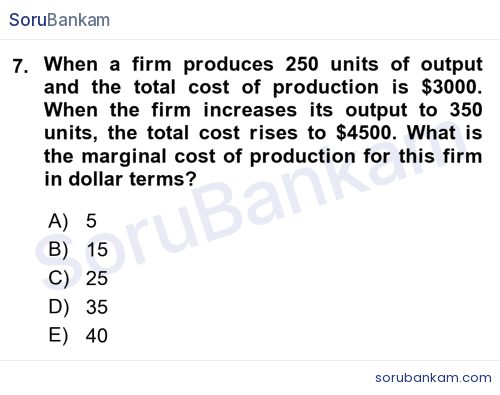
7. When a firm produces 250 units of output and the total cost of production is $3000. When the firm increases its output to 350 units, the total cost rises to $4500. What is the marginal cost of production for this firm in dollar terms? A) B) 15 C) 25 D) 35 E) 40
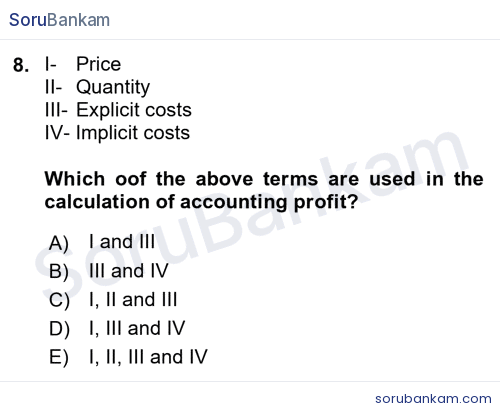
- Price I- Quantity Ill- Explicit costs IV- Implicit costs Which oof the above terms are used in the calculation of accounting profit? A) I and I! B) lil and C) 1, Il and Ill D) I, Ill and E) I, II, III and
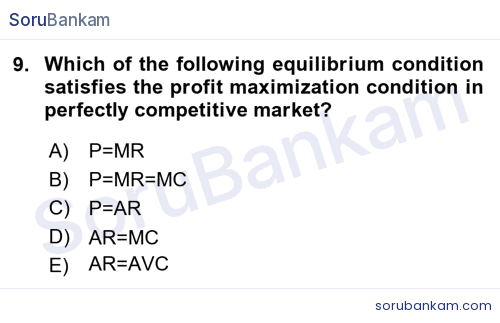
9. Which of the following equilibrium condition satisfies the profit maximization condition in perfectly competitive market? A) P=MR P=MR=MC P=AR D) AR=MC E) AREAVC
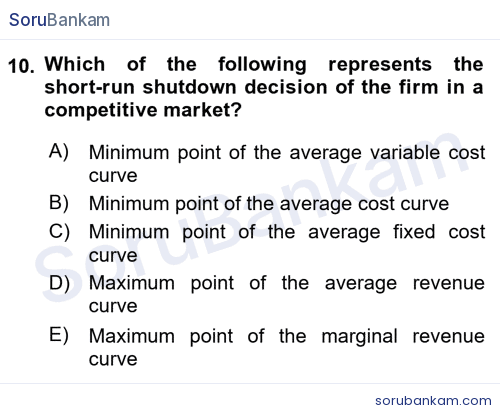
Which of the following represents the short-run shutdown decision of the firm in a competitive market? A) Minimum point of the average variable cost curve B) Minimum point of the average cost curve C) Minimum point of the average fixed cost curve D) Maximum point of the average revenue curve E) Maximum point of the marginal revenue curve
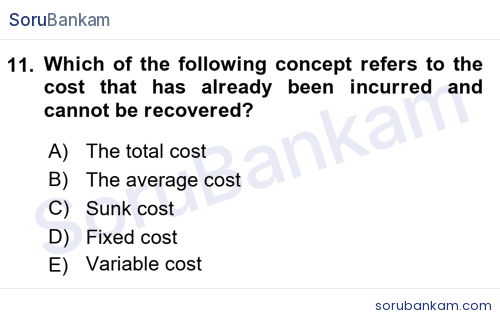
Which of the following concept refers to the cost that has already been incurred and cannot be recovered? A) The total cost B) The average cost C) Sunk cost D) Fixed cost E) Variable cost
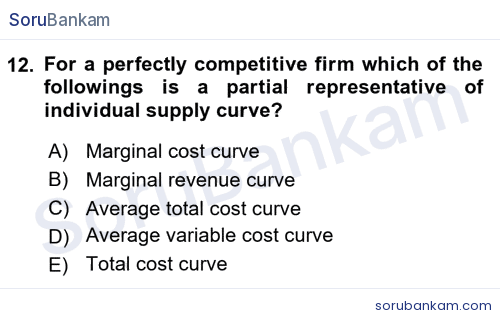
For a perfectly competitive firm which of the followings is a partial representative of individual supply curve? A) Mafginal cost curve B) *B) Marginal revenue curve C) Average total cost curve D) Average, variable cost curve E) Totalcost curve
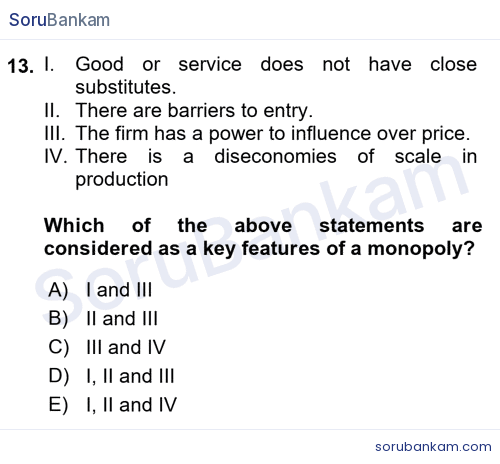
I. Good or service does not have close substitutes. II. There are barriers to entry. III. The firm has a power to influence over price. IV. There is a diseconomies of scale in production Which of the above statements are considered as a key features of a monopoly? A) I and !!I B) II and III C) Ill and D) 1, Il and ill E) I, Il and
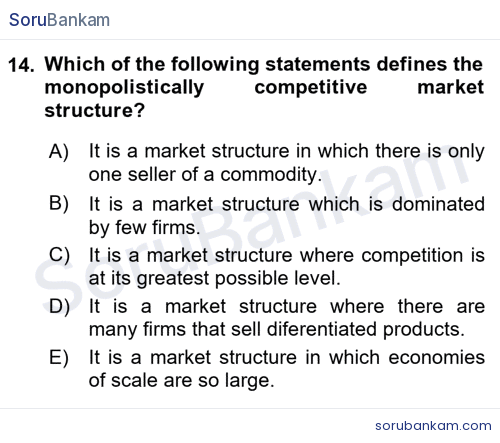
Which of the following statements defines the monopolistically competitive market structure? A) It is a market structure in which there is only one seller of a commodity. B) It is a market structure which is dominated by few firms. C) It iș a market structure where competition is at its greatest possible level. D) It is a market structure where there are many firms that sell diferentiated products. E) e) It is a market structure in which economies of scale are so large.
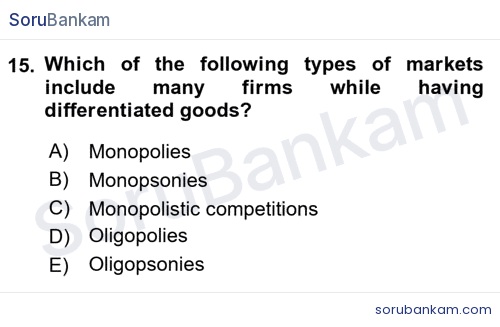
Which of the following types of markets include many firms while differentiated goods? mies. having A) Monopolies B) Monopsonies C) Monopolistic competitions D) Oligopolies E) Oligopsonies
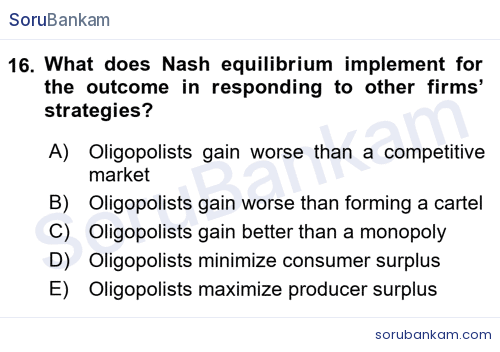
What does Nash equilibrium implement for the outcome in responding to other firms' strategies? A) Oligopolists gain worse than a competitive market B) Oligopolists gain worse than forming a cartel C) Oligopolists gain better than a monopoly D) Oligopolists minimize consumer surplus E) Oligopolists maximize producer surplus
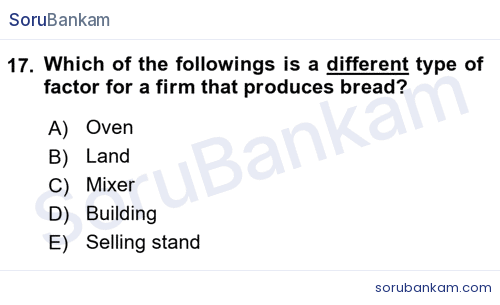
Which of the followings is a different type of factor for a firm that produces bread? A) Oven B) Land C) Mixer D) Building *. E) Selling stand
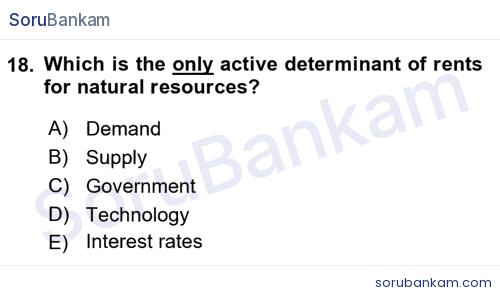
Which is the only active determinant of rents for natural resources? A) Demand B) . Stipply C) Govemment D) Technology E) E Interest rates
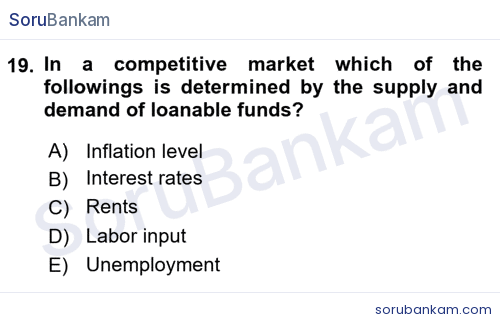
19. In a competitive market which of the followings is determined by the supply and demand of loanable funds? A) Inflation level B) Interest rates Rents Labor input E) Unemployment
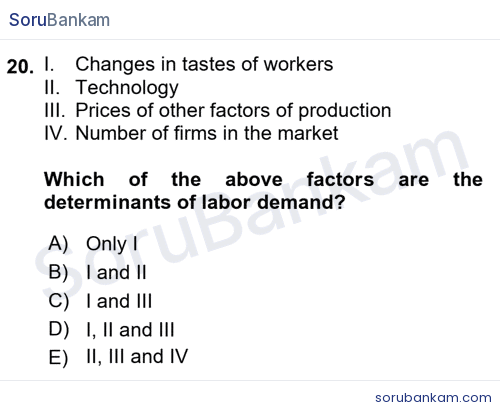
1. Changes in tastes of workers II. Technology III. Prices of other factors of production IV. Number of firms in the market Which of the above factors are the determinants of labor demand? A) Only B) land C) I and Ill D) I, Il and I|l E) II, Ill and